A group of students place a 0.045 kg water sample, initial temperature 21.5 degrees Celsius, on...
A group of students place a 0.045 kg water sample, initial temperature 21.5 degrees Celsius, on a heat source. The water is then warmed up to its boiling point then further heated until it is completely evaporated. Note: Both the heat source and the water are in a thermally isolated container.
i. Find the total heat absorbed by the water during this process.
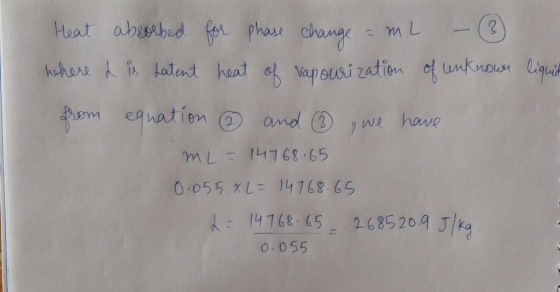
ii. A similar experiment is performed on an unknown liquid, mass=0.055kg with initial temperature 21.5 degrees Celsius. During the experiment, the unknown liquid absorbs a total of 2.03x10^4 J to completely evaporate the liquid. Note: The specific heat for the unknown liquid is 1130J/kg*K and its boiling point temperature is 110.5 degrees Celsius. Determine the latent heat of vaporization for this liquid.
Homework Answers
Solution :-
Solution to this problem is based on the concepts of calorimetry, part (i) and (ii) are based on same formula where total heat absorbed by water/unkown liquid = heat required to rasie temperature from initial temperature(21.5) to boiling point (1000C for water & 110.50C for unknown liquid) + heat required to change phase of liquid at constant temperature (constant temperature being boiling point for liquid). I solved part (i) in cgs units and finally converted answer into SI units where part (ii) is solved entirely in SI units as every data for part (ii) is provided in SI units. dT or deltaT is same in 0C or Kelvin.
Please read solution carefully and feel free to ask any doubt you face while understanding my solution. I would be happy to help.


Add Answer to:
A group of students place a 0.045 kg water sample, initial
temperature 21.5 degrees Celsius, on...
Suppose data for latent heat of vaporization is as follows: initial water temperature = 19.50 degrees...
Suppose data for latent heat of vaporization is as follows: initial water temperature = 19.50 degrees Celsius, final water temperature = 41.20 degrees Celsius, initial water mass = 65.10 g, final water mass = 67.30 g. Present an algebraic expression for the latent heat of vaporization (Lv).
155 grams of ice at -10.0 degrees celsius is added to 1.17 kg of water at...
155 grams of ice at -10.0 degrees celsius is added to 1.17 kg of water at 70.0 degrees celsius and mixed together in thermal isolation until they come to equilibrium. The specific heat of ice is 2010 J/kgC. The specific heat of water is 4186 J/kgC. The latent heat of fusion for water is 3.34x10^5 J/kg. The latent of vaporization for water is 2.26x10^6 J/kg. What is the final equilibrium. The answer is 51.9 celsius. I just need the steps...
4. A 0.500 kg piece of copper at an initial temperature of 20.0°C is placed in...
 4. A 0.500 kg piece of copper at an initial temperature of 20.0°C is placed in a water bath and the temperature of the metal is raised to 100.0°C. Note: The specific heat capacity of copper is 385J/kg K and the latent heat of fusion is 2.07x1057/kg. a. How much heat was required to raise the temperature of the copper? b. How much more heat would be required to raise the copper to its melting point? C. How much heat...
4. A 0.500 kg piece of copper at an initial temperature of 20.0°C is placed in...
 4. A 0.500 kg piece of copper at an initial temperature of 20.0°C is placed in a water bath and the temperature of the metal is raised to 100.0°C. Note: The specific heat capacity of copper is 385J/kg K and the latent heat of fusion is 2.07x10⁵J/kg. a. How much heat was required to raise the temperature of the copper? e. An identical piece of heated copper (at 100.0°C) is placed in a calorimeter containing 0.500 kg of an unknown...
A cup of water at Temperature of 21 degrees Celsius with .5 [kg] of water is...
A cup of water at Temperature of 21 degrees Celsius with .5 [kg] of water is sliding on a table. It starts sliding at 20 [m/s] and slows to a halt. Assuming that the cup itself is (almost) massless, and that all the energy has gone into heat, what is the final temperature of the water?
An isolated gas (nitrogen, N2), at initial temperature of 22.7 degrees Celsius, is expanded from as...
An isolated gas (nitrogen, N2), at initial temperature of 22.7 degrees Celsius, is expanded from as initial volume of 0.750L to 1.450L at constant pressure, P=132kPa. During this process the gas absorbs 318.5J of heat. i. Calculate the work output by the system during this expansion ii. Estimate the specific heat capacity of the gas for this process. Express your answer in J/kg*K.
A mass 2.4 kg of solid laurasium is initially at temperature 6∘C. It is put into...
A mass 2.4 kg of solid laurasium is initially at temperature 6∘C. It is put into contact with 3.8 kg of liquid tethium which is at temperature 97∘C, and the two chemicals are thermally insulated from the rest of the universe. The specific heat capacity of solid laurasium is 1165Jkg∘C, and the specific heat capacity of liquid laurasium is 3495Jkg∘C. The melting point of laurasium is 22∘C, and the latent heat for its solid liquid transition is 25149Jkg. The specific...
(9%) Problem 11: Suppose you place 0.285 kg of 21.5°C water in a 0.55 kg aluminum...
 (9%) Problem 11: Suppose you place 0.285 kg of 21.5°C water in a 0.55 kg aluminum pan with a temperature of 155°C, and 0.0075 kg of the water evaporates immediately, leaving the remainder to come to a common temperature with the pan. 0.20 Date: 131/2020 11:39:00 PM Substances Specific heat (c) Solids J/kg C kcal/kg. Aluminum 900 0.215 Concrete 840 Copper 387 0.0924 Granite 840 0.20 Ice (average) 2090 0.50 Liquids Water 4186 1.000 Gases Steam (100°C) 1520 (2020) 0.363(0.482)...
A mass M of solid metal at temperature T is put into 3.0kg of water which...
A mass M of solid metal at temperature T is put into 3.0kg of water which is initially at 90◦C. The metal and water are placed in an insulated container. The specific heat for water is 4186 J/ kg K . The metal has a melting point of 60◦C. The latent heat associated with the solid-liquid transition of the metal is 7.5 × 10^4 J/kg . The specific heat for the metal is 600 J/kg in the solid phase and...
Liquid nitrogen is often used as an effective coolant, as its boiling temperature is far below...
 Liquid nitrogen is often used as an effective coolant, as its boiling temperature is far below the freezing temperature of water. Specifically, the boiling point of liquid nitrogen is 77.0 K. A 0.650-kg block of iron at an initial temperature of 293.15 K is immersed in an insulated bath of liquid nitrogen with an initial temperature of 77.0 K. After the iron and the liquid nitrogen reach a state of thermal equilibrium, the iron block has cooled to a final...
 4. A 0.500 kg piece of copper at an initial temperature of 20.0°C is placed in a water bath and the temperature of the metal is raised to 100.0°C. Note: The specific heat capacity of copper is 385J/kg K and the latent heat of fusion is 2.07x1057/kg. a. How much heat was required to raise the temperature of the copper? b. How much more heat would be required to raise the copper to its melting point? C. How much heat...
 4. A 0.500 kg piece of copper at an initial temperature of 20.0°C is placed in a water bath and the temperature of the metal is raised to 100.0°C. Note: The specific heat capacity of copper is 385J/kg K and the latent heat of fusion is 2.07x10⁵J/kg. a. How much heat was required to raise the temperature of the copper? e. An identical piece of heated copper (at 100.0°C) is placed in a calorimeter containing 0.500 kg of an unknown...
 (9%) Problem 11: Suppose you place 0.285 kg of 21.5°C water in a 0.55 kg aluminum pan with a temperature of 155°C, and 0.0075 kg of the water evaporates immediately, leaving the remainder to come to a common temperature with the pan. 0.20 Date: 131/2020 11:39:00 PM Substances Specific heat (c) Solids J/kg C kcal/kg. Aluminum 900 0.215 Concrete 840 Copper 387 0.0924 Granite 840 0.20 Ice (average) 2090 0.50 Liquids Water 4186 1.000 Gases Steam (100°C) 1520 (2020) 0.363(0.482)...
 Liquid nitrogen is often used as an effective coolant, as its boiling temperature is far below the freezing temperature of water. Specifically, the boiling point of liquid nitrogen is 77.0 K. A 0.650-kg block of iron at an initial temperature of 293.15 K is immersed in an insulated bath of liquid nitrogen with an initial temperature of 77.0 K. After the iron and the liquid nitrogen reach a state of thermal equilibrium, the iron block has cooled to a final...
Most questions answered within 3 hours.
-
Where is the error in this code sequence?
String s1 = "Hello";
String s2 = "ello";...
asked 11 months ago -
Financial data for Joel de Paris, Inc., for last year
follow:
Joel de Paris, Inc.
Balance...
asked 11 months ago -
Consider this reaction:
Al2(SO4)3 (aq)+ BaCl3
(aq) Al2Cl6 (aq)- +
3BaSO4(s) . What is the...
asked 11 months ago -
Suppose that Savneet is considering increasing her
recent random sample from 20 car rentals to 40...
asked 11 months ago -
Trucks arrive at an unloading terminal at an average rate of 120
per hour.
Trucks arrive...
asked 11 months ago -
Why are methanol and ethanol completely soluble in water while
octanol is not very little soluble....
asked 11 months ago -
A facilities manager at a university reads in a research report
that the mean amount of...
asked 11 months ago -
When the CuSO4 is rehydrated by adding water to the anhydrous
compound, is this an endothermic...
asked 11 months ago -
A ray of sunlight is passing from diamond into crown glass; the
angle of incidence is...
asked 11 months ago -
A block of mass 0.249 kg is placed on top of a light, vertical
spring of...
asked 11 months ago -
how do the kidneys compensate in the presences of acidosis
a) trigger hyperventilate
b) reserve acid...
asked 11 months ago -
Question 501 pts
The rental rate of capital to the firm increases. Which of the
following...
asked 11 months ago