Consider the following jobs having I/0 wait of 70% with Arrival time and CPU minutes needed.
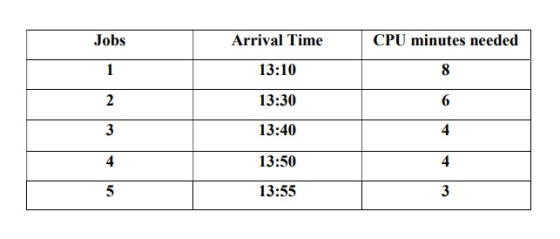
Calculate CPU idle, CPU busy and CPU busy/ process. Draw a graph showing no. of jobs and when it completes.
Homework Answers
Here, based on the given task set, we task are scheduled on the basis of their arrival i.e first come first server basis.
- Since all arrive at 13:XX , the 13 until of time is related, hence the arrival time is taken with respect to 13 i.e arrival time will be 10, 30, 40, 50, and 55 units of time.
- Based on this data , the Graph when the jobs are arrived and
completed is given below :
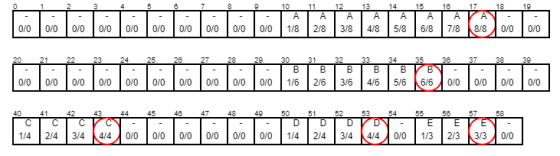
Based on this graph , the
CPU idle
= Number of empty slots in the graph / Total number of slots in the graph =
= 34 / 59 = 57.62 %
CPU busy
= Number of filled slots in the graph / Total number of slots in the graph
= 25 / 59 = 42.38 %
CPU busy/ process
= Number of filled slots in the graph / Number of process scheduled
= 25 / 5 = 5
Add Answer to:
Consider the following jobs having I/0 wait of 70% with Arrival
time and CPU minutes needed....
Q1. Consider the following jobs having I/O wait of 70% with Arrival time and CPU minutes...
 Q1. Consider the following jobs having I/O wait of 70% with Arrival time and CPU minutes needed. 40 Marks Jobs Arrival Time 13:10 CPU minutes needed 8 1 13:30 6 3 13:40 4 4 13:50 4 5 13:55 3 Calculate CPU idle, CPU busy and CPU busy/ process 10 Marks Draw a graph showing no. of jobs and when it completes. 30 Marks Note: You can consult with slide # 7 of uploaded Lecture # 7. Page 1 of 1
1. Consider the following jobs having I/0 wait of 70% with Arrival time and CPU minutes...
 1. Consider the following jobs having I/0 wait of 70% with
Arrival time and CPU minutes needed.
Draw a graph showing no. of jobs and when it completes.
Jobs Arrival Time CPU minutes needed 13:10 8 2 13:30 6 3 13:40 4 4 13:50 4 5 13:55 3
1. Consider the following jobs having I/0 wait of 70% with
Arrival time and CPU minutes needed.
Draw a graph showing no. of jobs and when it completes.
Jobs Arrival Time CPU minutes needed 13:10 8 2 13:30 6 3 13:40 4 4 13:50 4 5 13:55 3
Q2. Consider the following processes with arrival time and burst time. 20 Marks Process Arrival Time...
 Q2. Consider the following processes with arrival time and burst time. 20 Marks Process Arrival Time Burst Time P16 29 0.0 P21 19.0 12 P32 22.0 13 P41 30.0 25 Calculate waiting time and average waiting time Round Robin (R-R) scheduling algorithm by using the following Quantum/Time slice: a. Quantum/Time Slice = 8 b. Quantum/Time Slice = 16 Q3. Calculate the CPU Utilization and Idle time by considering 35% I/O wait and number of processes are from 1 to 5....
Consider the following 5 processes Process Arrival Time CPU Burst Time 0 3 2 6 P2...
 Consider the following 5 processes Process Arrival Time CPU Burst Time 0 3 2 6 P2 4 4 6 5 P4 2 Ps (a) Draw a timing diagram showing when each process executes under FIFO, SJF, and SRT (b) Determine the Average Turnaround Time (ATT) for each scheduling algorithm for the 5 processes
CPU scheduling Process Arrival Time Burst Time Priority P1 0 8 8 P2 0 4 10...
CPU scheduling Process Arrival Time Burst Time Priority P1 0 8 8 P2 0 4 10 P3 4 1 6 P4 6 6 8 For Shortest Remaining Time draw the Gantt chart to illustrate how these processes would be scheduled, and calculate turnaround time per process and the wait time per process.
Process Arrival Time CPU Burst Time P1 0 7 P2 3 8 P3 4 3 P4...
Process Arrival Time CPU Burst Time P1 0 7 P2 3 8 P3 4 3 P4 6 7 For the following algorithms, calculate the average wait time and turn around time. Round-robin with quantum of one time-unit
V. Round Robin and SJF comparison 6 Process Arrival Time CPU Burst Time P1 0 9...
 V. Round Robin and SJF comparison 6 Process Arrival Time CPU Burst Time P1 0 9 P2 4 4 P3 6 P4 For each of the following algorithms, draw a Gantt chart and calculate the average wait time and turn around time. 1. Round robin with quantum=1 time unit 2. Round-robin with quantum=3 time-units 3. SJF WI preemption (Shortest Remaining Time First), assume quantum=3 4. SJE Wlo preemption 5. ECES
consider the following processes: process: p1 p2 p3 p4 p5 Arrival time: 0 1 3 4 ...
consider the following processes: process: p1 p2 p3 p4 p5 Arrival time: 0 1 3 4 5 CPU time: 5 4 2 3 2 draw a timing graph that shows when each process executes under SJF(shortest job first) and another graph for SRT(shortest remaining time).
Assume that you have four different processes with the following attributes: Process Arrival time. CPU Burst....
Assume that you have four different processes with the following attributes: Process Arrival time. CPU Burst. I/O Burst Total CPU time A. 0 4 4 9 B 3 2 3 7 C 6 5 1 11 D 12 1 1 5 As we did in class, perform a scheduling simulation using these four processes according to the following algorithms: 1) First Come First Serve 2) Round Robin with time slice = 1 3) Round Robin with time slice = 3...
5. [27pts.] Given the following set of processes, with arrival times, priorities, and the length of...
 5. [27pts.] Given the following set of processes, with arrival times, priorities, and the length of the CPU burst in ms: Priority Burst time Arrival Time Process 3 P1 4 P2 2 10 P3 P4 (Note: a lower number means higher priority) Draw a Gantt chart showing a FCFS scheduling algorithm. a. b. Draw a Gantt chart showing a non-preemptive Priority scheduling algorithm. c. Draw a Gantt chart showing a Round Robin Scheduling algorithm with quantum of 4ms d. Compute...
 Q1. Consider the following jobs having I/O wait of 70% with Arrival time and CPU minutes needed. 40 Marks Jobs Arrival Time 13:10 CPU minutes needed 8 1 13:30 6 3 13:40 4 4 13:50 4 5 13:55 3 Calculate CPU idle, CPU busy and CPU busy/ process 10 Marks Draw a graph showing no. of jobs and when it completes. 30 Marks Note: You can consult with slide # 7 of uploaded Lecture # 7. Page 1 of 1
 1. Consider the following jobs having I/0 wait of 70% with
Arrival time and CPU minutes needed.
Draw a graph showing no. of jobs and when it completes.
Jobs Arrival Time CPU minutes needed 13:10 8 2 13:30 6 3 13:40 4 4 13:50 4 5 13:55 3
1. Consider the following jobs having I/0 wait of 70% with
Arrival time and CPU minutes needed.
Draw a graph showing no. of jobs and when it completes.
Jobs Arrival Time CPU minutes needed 13:10 8 2 13:30 6 3 13:40 4 4 13:50 4 5 13:55 3
 Q2. Consider the following processes with arrival time and burst time. 20 Marks Process Arrival Time Burst Time P16 29 0.0 P21 19.0 12 P32 22.0 13 P41 30.0 25 Calculate waiting time and average waiting time Round Robin (R-R) scheduling algorithm by using the following Quantum/Time slice: a. Quantum/Time Slice = 8 b. Quantum/Time Slice = 16 Q3. Calculate the CPU Utilization and Idle time by considering 35% I/O wait and number of processes are from 1 to 5....
 Consider the following 5 processes Process Arrival Time CPU Burst Time 0 3 2 6 P2 4 4 6 5 P4 2 Ps (a) Draw a timing diagram showing when each process executes under FIFO, SJF, and SRT (b) Determine the Average Turnaround Time (ATT) for each scheduling algorithm for the 5 processes
 V. Round Robin and SJF comparison 6 Process Arrival Time CPU Burst Time P1 0 9 P2 4 4 P3 6 P4 For each of the following algorithms, draw a Gantt chart and calculate the average wait time and turn around time. 1. Round robin with quantum=1 time unit 2. Round-robin with quantum=3 time-units 3. SJF WI preemption (Shortest Remaining Time First), assume quantum=3 4. SJE Wlo preemption 5. ECES
 5. [27pts.] Given the following set of processes, with arrival times, priorities, and the length of the CPU burst in ms: Priority Burst time Arrival Time Process 3 P1 4 P2 2 10 P3 P4 (Note: a lower number means higher priority) Draw a Gantt chart showing a FCFS scheduling algorithm. a. b. Draw a Gantt chart showing a non-preemptive Priority scheduling algorithm. c. Draw a Gantt chart showing a Round Robin Scheduling algorithm with quantum of 4ms d. Compute...
Most questions answered within 3 hours.
-
Where is the error in this code sequence?
String s1 = "Hello";
String s2 = "ello";...
asked 11 months ago -
Financial data for Joel de Paris, Inc., for last year
follow:
Joel de Paris, Inc.
Balance...
asked 11 months ago -
Consider this reaction:
Al2(SO4)3 (aq)+ BaCl3
(aq) Al2Cl6 (aq)- +
3BaSO4(s) . What is the...
asked 11 months ago -
Suppose that Savneet is considering increasing her
recent random sample from 20 car rentals to 40...
asked 11 months ago -
Trucks arrive at an unloading terminal at an average rate of 120
per hour.
Trucks arrive...
asked 11 months ago -
Why are methanol and ethanol completely soluble in water while
octanol is not very little soluble....
asked 11 months ago -
A facilities manager at a university reads in a research report
that the mean amount of...
asked 11 months ago -
When the CuSO4 is rehydrated by adding water to the anhydrous
compound, is this an endothermic...
asked 11 months ago -
A ray of sunlight is passing from diamond into crown glass; the
angle of incidence is...
asked 11 months ago -
A block of mass 0.249 kg is placed on top of a light, vertical
spring of...
asked 11 months ago -
how do the kidneys compensate in the presences of acidosis
a) trigger hyperventilate
b) reserve acid...
asked 11 months ago -
Question 501 pts
The rental rate of capital to the firm increases. Which of the
following...
asked 11 months ago