


Homework Answers
Request Answer!
We need at least 10 more requests to produce the answer.
0 / 10 have requested this problem solution
The more requests, the faster the answer.
Add Answer to:
Which of the following can donate a proton, H+, to water? ОКСІ OHI CH4 O AgNO3...
A precipitate will form when aqueous AgNO3 is added to an aqueous solution of which compound?...
A precipitate will form when aqueous AgNO3 is added to an aqueous solution of which compound? Group of answer choices LiCl NH4C2H3O2 NaNO3 KNO3 If 50.0 g H2O at 13.6 °C is combined with 85.0 g H2O at 93.7 °C, which is most likely to be true? Group of answer choices The final temperature of the water is between 13.6°C and 93.7°C The final temperature of the water is lower than 13.6 °C The final temperature of the water is...
can comeone help QUESTION 15 Which of the following is the net ionic reaction between hydrochloric...
 can comeone help
QUESTION 15 Which of the following is the net ionic reaction between hydrochloric acid and aqueous sodium hydroxide? NaOH(aq) + HCl(aq) + NaCl(aq) + H20 (1) H(aq) + OH(aq) + H20 (1) Nat (aq) + C (aq) - NaCl (aq) b. NaOH(aq) + HCl(aq) + NaCl (aq) + H20 (1) Na* (na) + OH' (aq) + NaOH(aq) Od
can comeone help
QUESTION 15 Which of the following is the net ionic reaction between hydrochloric acid and aqueous sodium hydroxide? NaOH(aq) + HCl(aq) + NaCl(aq) + H20 (1) H(aq) + OH(aq) + H20 (1) Nat (aq) + C (aq) - NaCl (aq) b. NaOH(aq) + HCl(aq) + NaCl (aq) + H20 (1) Na* (na) + OH' (aq) + NaOH(aq) Od
QUESTION 7 Which of the following is the net ionic reaction between hydrochloric acid and aqueous...
 QUESTION 7 Which of the following is the net ionic reaction between hydrochloric acid and aqueous sodium hydroxide NaOH(aq) + HCl(aq) - NaCl(aq) + H20 (1) H(aq) + OH (aq) - H20 (1) Na* (aq) +Cr (aq) - NaCl (aq) b. c. NaOH (aq) + HCl(aq) - NaCl (aq) + H20 (1) Na" (aq) - OH(aq) - NaOH(aq) CSP and Suhtel it
Question 1 1 pts Which is the pH relevant equation when NaClO dissolves in water? K,...
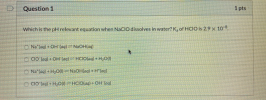 Question 1 1 pts Which is the pH relevant equation when NaClO dissolves in water? K, of HCIO is 2.9 x 10⁸ O Na (aq) + OH (aq) =NaOH(aq) CIO lag)+OH (aq) HCIO(aq) + H2O() O Na (aq) +H2O) NaOH(aq) + H'(aq) HCIO(aq ) + O O CIO (aq)+ H20(0 (aq)
Which of the following can donate a proton, H+ , to water? Group of answer choices...
Which of the following can donate a proton, H+ , to water? Group of answer choices KI HBr C2H6 NH3
i need help with these 4 questions please ! The net ionic equation for any aqueous...
 i need help with these 4 questions please !
The net ionic equation for any aqueous acid-base neutralization reaction is O a. H+ (aq) + OH- (aq) → H20 (1). b. Na+ (aq) + CH- (aq) → NaCl (s). O c. 4 H+ (aq) + O2 (g) → 2 H20 (1). d. Na+ (aq) + OH-(aq) NaOH (aq). How many moles of KF are present in 15.2 grams of KF? O a. 0.262 O b.3.82 O c. 6.02 d. 882...
i need help with these 4 questions please !
The net ionic equation for any aqueous acid-base neutralization reaction is O a. H+ (aq) + OH- (aq) → H20 (1). b. Na+ (aq) + CH- (aq) → NaCl (s). O c. 4 H+ (aq) + O2 (g) → 2 H20 (1). d. Na+ (aq) + OH-(aq) NaOH (aq). How many moles of KF are present in 15.2 grams of KF? O a. 0.262 O b.3.82 O c. 6.02 d. 882...
In which one of the following is the oxidation number of nitrogen given incorrectly? O H2N202...
 In which one of the following is the oxidation number of nitrogen given incorrectly? O H2N202 (+1) O N203 (+3) O HNO, (+3) O N2H4 (-2) O NaN3 (-1) What is the net ionic equation for the acid-base reaction that occurs when acetic acid and sodium hydroxide solutions are mixed? O C2H302 (aq) + H+ (aq) + Na+(aq) + OH-(aq) ——Na+(aq) + C2H302(aq) + H2O(1) O H+(aq) + OH(aq) → H2O(1) O HC2H2O2(aq) + NaOH-(aq) —-NaC2H302 (aq) + H20(1) O...
in the table below, predict which of the following reactant combinations will produce precipitates and write...
 in the table below, predict which of the following reactant
combinations will produce precipitates and write all the products
that form (including states of matters- l, s, aq, g; write
"ss" if it is slightly soluble). Useful information is
also below.
TABLE 4.1 | Simple Rules for the Solubility of Salts in Water 1. Most nitrate (NO3-) salts are soluble. 2. Most salts containing the alkali metal ions (Li+, Na+, K+, Cst, Rb+) and the ammonium ion (NH4+) are soluble....
in the table below, predict which of the following reactant
combinations will produce precipitates and write all the products
that form (including states of matters- l, s, aq, g; write
"ss" if it is slightly soluble). Useful information is
also below.
TABLE 4.1 | Simple Rules for the Solubility of Salts in Water 1. Most nitrate (NO3-) salts are soluble. 2. Most salts containing the alkali metal ions (Li+, Na+, K+, Cst, Rb+) and the ammonium ion (NH4+) are soluble....
10. Select the compound that can not be made using the malonic ester synthesis: O O...
 10. Select the compound that can not be made using the malonic ester synthesis: O O OH MeO Оме OH Ph OH A. B. Ph C. D. 11. In general both the malonic ester and acetoacetate synthesis require the addition of dilute acid in order to generate the final product. Why? A. the alkoxy cation needs to be eliminated C. the ionized cation partitions to the aqueous layer B. the stabilized enolate adds a proton in the separatory funnel D....
 can comeone help
QUESTION 15 Which of the following is the net ionic reaction between hydrochloric acid and aqueous sodium hydroxide? NaOH(aq) + HCl(aq) + NaCl(aq) + H20 (1) H(aq) + OH(aq) + H20 (1) Nat (aq) + C (aq) - NaCl (aq) b. NaOH(aq) + HCl(aq) + NaCl (aq) + H20 (1) Na* (na) + OH' (aq) + NaOH(aq) Od
can comeone help
QUESTION 15 Which of the following is the net ionic reaction between hydrochloric acid and aqueous sodium hydroxide? NaOH(aq) + HCl(aq) + NaCl(aq) + H20 (1) H(aq) + OH(aq) + H20 (1) Nat (aq) + C (aq) - NaCl (aq) b. NaOH(aq) + HCl(aq) + NaCl (aq) + H20 (1) Na* (na) + OH' (aq) + NaOH(aq) Od
 QUESTION 7 Which of the following is the net ionic reaction between hydrochloric acid and aqueous sodium hydroxide NaOH(aq) + HCl(aq) - NaCl(aq) + H20 (1) H(aq) + OH (aq) - H20 (1) Na* (aq) +Cr (aq) - NaCl (aq) b. c. NaOH (aq) + HCl(aq) - NaCl (aq) + H20 (1) Na" (aq) - OH(aq) - NaOH(aq) CSP and Suhtel it
 Question 1 1 pts Which is the pH relevant equation when NaClO dissolves in water? K, of HCIO is 2.9 x 10⁸ O Na (aq) + OH (aq) =NaOH(aq) CIO lag)+OH (aq) HCIO(aq) + H2O() O Na (aq) +H2O) NaOH(aq) + H'(aq) HCIO(aq ) + O O CIO (aq)+ H20(0 (aq)
 i need help with these 4 questions please !
The net ionic equation for any aqueous acid-base neutralization reaction is O a. H+ (aq) + OH- (aq) → H20 (1). b. Na+ (aq) + CH- (aq) → NaCl (s). O c. 4 H+ (aq) + O2 (g) → 2 H20 (1). d. Na+ (aq) + OH-(aq) NaOH (aq). How many moles of KF are present in 15.2 grams of KF? O a. 0.262 O b.3.82 O c. 6.02 d. 882...
i need help with these 4 questions please !
The net ionic equation for any aqueous acid-base neutralization reaction is O a. H+ (aq) + OH- (aq) → H20 (1). b. Na+ (aq) + CH- (aq) → NaCl (s). O c. 4 H+ (aq) + O2 (g) → 2 H20 (1). d. Na+ (aq) + OH-(aq) NaOH (aq). How many moles of KF are present in 15.2 grams of KF? O a. 0.262 O b.3.82 O c. 6.02 d. 882...
 In which one of the following is the oxidation number of nitrogen given incorrectly? O H2N202 (+1) O N203 (+3) O HNO, (+3) O N2H4 (-2) O NaN3 (-1) What is the net ionic equation for the acid-base reaction that occurs when acetic acid and sodium hydroxide solutions are mixed? O C2H302 (aq) + H+ (aq) + Na+(aq) + OH-(aq) ——Na+(aq) + C2H302(aq) + H2O(1) O H+(aq) + OH(aq) → H2O(1) O HC2H2O2(aq) + NaOH-(aq) —-NaC2H302 (aq) + H20(1) O...
 in the table below, predict which of the following reactant
combinations will produce precipitates and write all the products
that form (including states of matters- l, s, aq, g; write
"ss" if it is slightly soluble). Useful information is
also below.
TABLE 4.1 | Simple Rules for the Solubility of Salts in Water 1. Most nitrate (NO3-) salts are soluble. 2. Most salts containing the alkali metal ions (Li+, Na+, K+, Cst, Rb+) and the ammonium ion (NH4+) are soluble....
in the table below, predict which of the following reactant
combinations will produce precipitates and write all the products
that form (including states of matters- l, s, aq, g; write
"ss" if it is slightly soluble). Useful information is
also below.
TABLE 4.1 | Simple Rules for the Solubility of Salts in Water 1. Most nitrate (NO3-) salts are soluble. 2. Most salts containing the alkali metal ions (Li+, Na+, K+, Cst, Rb+) and the ammonium ion (NH4+) are soluble....
 10. Select the compound that can not be made using the malonic ester synthesis: O O OH MeO Оме OH Ph OH A. B. Ph C. D. 11. In general both the malonic ester and acetoacetate synthesis require the addition of dilute acid in order to generate the final product. Why? A. the alkoxy cation needs to be eliminated C. the ionized cation partitions to the aqueous layer B. the stabilized enolate adds a proton in the separatory funnel D....
Most questions answered within 3 hours.
-
Where is the error in this code sequence?
String s1 = "Hello";
String s2 = "ello";...
asked 11 months ago -
Financial data for Joel de Paris, Inc., for last year
follow:
Joel de Paris, Inc.
Balance...
asked 11 months ago -
Consider this reaction:
Al2(SO4)3 (aq)+ BaCl3
(aq) Al2Cl6 (aq)- +
3BaSO4(s) . What is the...
asked 11 months ago -
Suppose that Savneet is considering increasing her
recent random sample from 20 car rentals to 40...
asked 11 months ago -
Trucks arrive at an unloading terminal at an average rate of 120
per hour.
Trucks arrive...
asked 11 months ago -
Why are methanol and ethanol completely soluble in water while
octanol is not very little soluble....
asked 11 months ago -
A facilities manager at a university reads in a research report
that the mean amount of...
asked 11 months ago -
When the CuSO4 is rehydrated by adding water to the anhydrous
compound, is this an endothermic...
asked 11 months ago -
A ray of sunlight is passing from diamond into crown glass; the
angle of incidence is...
asked 11 months ago -
A block of mass 0.249 kg is placed on top of a light, vertical
spring of...
asked 11 months ago -
how do the kidneys compensate in the presences of acidosis
a) trigger hyperventilate
b) reserve acid...
asked 11 months ago -
Question 501 pts
The rental rate of capital to the firm increases. Which of the
following...
asked 11 months ago