
Homework Answers

Add Answer to:
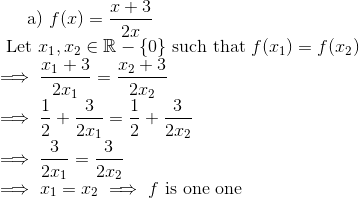
x+3 2x Define f(x) for all real numbers x = 0. Is f a one-to-one function?...
how do u do 6? F-'(C-D)= F-'(C)-F-'(D). 4. (10 points) In following questions a function f...
 how do u do 6?
F-'(C-D)= F-'(C)-F-'(D). 4. (10 points) In following questions a function f is defined on a set of real numbers. Determine whether or not f is one-to-one and justify your answers. (a) f(x) = **!, for all real numbers x #0 (6) f(x) = x, for all real numbers x (c) f(x) = 3x=!, for all real numbers x 70 (d) f(x) = **, for all real numbers x 1 (e) f(x) = for all real...
how do u do 6?
F-'(C-D)= F-'(C)-F-'(D). 4. (10 points) In following questions a function f is defined on a set of real numbers. Determine whether or not f is one-to-one and justify your answers. (a) f(x) = **!, for all real numbers x #0 (6) f(x) = x, for all real numbers x (c) f(x) = 3x=!, for all real numbers x 70 (d) f(x) = **, for all real numbers x 1 (e) f(x) = for all real...
Question 1: Let R be the set of real numbers and let 2R be the set...
 Question 1: Let R be the set of real numbers and let 2R be the set of all subsets of the real numbers. Prove that 2 cannot be in one-to-one correspondence with R. Proof: Suppose 2 is in one-to-one correspondence with R. Then by definition of one- to-one correspondence there is a 1-to-1 and onto function B:R 2. Therefore, for each x in R, ?(x) is a function from R to {0, 1]. Moreover, since ? is onto, for every...
Problem 3: Let f(x) be a function on the set of real numbers r > 1....
 Problem 3: Let f(x) be a function on the set of real numbers r > 1. Define the function g(x) for x by 1 g(s)-Σf(r/n). 1<nsr Prove that f(s) -Σμ(n)g (r/n). = 1nsz Here is the Möbius function
Let F be the set of all real-valued functions having as domain the set R of...
 Let F be the set of all real-valued functions having as domain the set R of all real numbers. Example 2.7 defined the binary operations +- and oon F. In Exercises 29 through 35, either prove the given statement or give a counterexample. 29. Function addition + on F is associative. 30. Function subtraction - on is commutative
(10 points) Define a function on a set of real numbers by the rule f(x) =...
 (10 points) Define a function on a set of real numbers by the rule f(x) = 2 Is ſ a one-to-one correspondence (bijective)? If so find its inverse. Formally justify your answer.
Need help in proof There are two functions f(x) and g(x) and two real numbers a,...
Need help in proof There are two functions f(x) and g(x) and two real numbers a, b. the period of the function f(x) is T1 and the period of the function g(x) is T2. How do I prove that if T1 and T2 have common multiple, the function y = a*f(x) ± b*g(x) is periodic function and her period is equal to the lowest common multiple of T1 and T2?
1. a) Let A = {2n|n ∈ ℤ} (ie, A is the set of even numbers)...
1. a) Let A = {2n|n ∈ ℤ} (ie, A is the set of even numbers) and define function f: ℝ → {0,1}, where f(x) = XA(x) That is, f is the characteristic function of set A; it maps elements of the domain that are in set A (ie, those that are even integers) to 1 and all other elements of the domain to 0. By demonstrating a counter-example, show that the function f is not injective (not one-to-one). b)...
x?. Is f a one-to-one 3. (10 points) Define a function f on a set of...
 x?. Is f a one-to-one 3. (10 points) Define a function f on a set of real numbers by the rule f(x) correspondence (bijective)? If so find its inverse. Formally justify your answer.
The domain of the function is all real numbers except for where equals f(r)x 12 9...
 The domain of the function
is all real numbers
except for where
equals
f(r)x 12 9 4.x12
The domain of the function
is all real numbers
except for where
equals
f(r)x 12 9 4.x12
6. (Extra Credit) Let I be the interval (0,1). Define F(I) = {f:I+I:f is a function},...
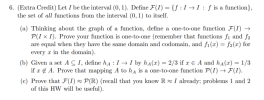 6. (Extra Credit) Let I be the interval (0,1). Define F(I) = {f:I+I:f is a function}, the set of all functions from the interval (0,1) to itself. (a) Thinking about the graph of a function, define a one-to-one function F(1) ► PIXI). Prove your function is one-to-one (remember that functions fi and f2 are equal when they have the same domain and codomain, and fi(x) = f2(x) for every x in the domain). (b) Given a set A CI, define...
 how do u do 6?
F-'(C-D)= F-'(C)-F-'(D). 4. (10 points) In following questions a function f is defined on a set of real numbers. Determine whether or not f is one-to-one and justify your answers. (a) f(x) = **!, for all real numbers x #0 (6) f(x) = x, for all real numbers x (c) f(x) = 3x=!, for all real numbers x 70 (d) f(x) = **, for all real numbers x 1 (e) f(x) = for all real...
how do u do 6?
F-'(C-D)= F-'(C)-F-'(D). 4. (10 points) In following questions a function f is defined on a set of real numbers. Determine whether or not f is one-to-one and justify your answers. (a) f(x) = **!, for all real numbers x #0 (6) f(x) = x, for all real numbers x (c) f(x) = 3x=!, for all real numbers x 70 (d) f(x) = **, for all real numbers x 1 (e) f(x) = for all real...
 Question 1: Let R be the set of real numbers and let 2R be the set of all subsets of the real numbers. Prove that 2 cannot be in one-to-one correspondence with R. Proof: Suppose 2 is in one-to-one correspondence with R. Then by definition of one- to-one correspondence there is a 1-to-1 and onto function B:R 2. Therefore, for each x in R, ?(x) is a function from R to {0, 1]. Moreover, since ? is onto, for every...
 Problem 3: Let f(x) be a function on the set of real numbers r > 1. Define the function g(x) for x by 1 g(s)-Σf(r/n). 1<nsr Prove that f(s) -Σμ(n)g (r/n). = 1nsz Here is the Möbius function
 Let F be the set of all real-valued functions having as domain the set R of all real numbers. Example 2.7 defined the binary operations +- and oon F. In Exercises 29 through 35, either prove the given statement or give a counterexample. 29. Function addition + on F is associative. 30. Function subtraction - on is commutative
 (10 points) Define a function on a set of real numbers by the rule f(x) = 2 Is ſ a one-to-one correspondence (bijective)? If so find its inverse. Formally justify your answer.
 x?. Is f a one-to-one 3. (10 points) Define a function f on a set of real numbers by the rule f(x) correspondence (bijective)? If so find its inverse. Formally justify your answer.
 The domain of the function
is all real numbers
except for where
equals
f(r)x 12 9 4.x12
The domain of the function
is all real numbers
except for where
equals
f(r)x 12 9 4.x12
 6. (Extra Credit) Let I be the interval (0,1). Define F(I) = {f:I+I:f is a function}, the set of all functions from the interval (0,1) to itself. (a) Thinking about the graph of a function, define a one-to-one function F(1) ► PIXI). Prove your function is one-to-one (remember that functions fi and f2 are equal when they have the same domain and codomain, and fi(x) = f2(x) for every x in the domain). (b) Given a set A CI, define...
Most questions answered within 3 hours.
-
Where is the error in this code sequence?
String s1 = "Hello";
String s2 = "ello";...
asked 11 months ago -
Financial data for Joel de Paris, Inc., for last year
follow:
Joel de Paris, Inc.
Balance...
asked 11 months ago -
Consider this reaction:
Al2(SO4)3 (aq)+ BaCl3
(aq) Al2Cl6 (aq)- +
3BaSO4(s) . What is the...
asked 11 months ago -
Suppose that Savneet is considering increasing her
recent random sample from 20 car rentals to 40...
asked 11 months ago -
Trucks arrive at an unloading terminal at an average rate of 120
per hour.
Trucks arrive...
asked 11 months ago -
Why are methanol and ethanol completely soluble in water while
octanol is not very little soluble....
asked 11 months ago -
A facilities manager at a university reads in a research report
that the mean amount of...
asked 11 months ago -
When the CuSO4 is rehydrated by adding water to the anhydrous
compound, is this an endothermic...
asked 11 months ago -
A ray of sunlight is passing from diamond into crown glass; the
angle of incidence is...
asked 11 months ago -
A block of mass 0.249 kg is placed on top of a light, vertical
spring of...
asked 11 months ago -
how do the kidneys compensate in the presences of acidosis
a) trigger hyperventilate
b) reserve acid...
asked 11 months ago -
Question 501 pts
The rental rate of capital to the firm increases. Which of the
following...
asked 11 months ago