
Homework Answers
External validity : external validity refers to the extent to which results from a study can be generalized to the population. By controlling several variables, the results may not be an accurate representation of the population
Add Answer to:
In a between-subjects design, holding a potential confounding variable constant helps to reduce the variance within...
An advantage of a within-subjects design as compared to a between-subjects design is... a. All of...
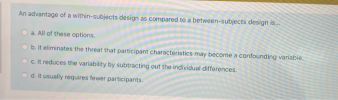 An advantage of a within-subjects design as compared to a between-subjects design is... a. All of these options. b. it eliminates the threat that participant characteristics may become a confounding variable. c. it reduces the variability by subtracting out the individual differences. d. it usually requires fewer participants.
For a between-subjects experiment, the primary threat to internal validity is... a. Holding variables constant. b....
 For a between-subjects experiment, the primary threat to internal validity is... a. Holding variables constant. b. Restricting a variables' range. c. It requires extensive efforts to counterbalance conditions. d. The groups may be different from each other on key characteristics.
6. Typically, when comparing a within-subjects design to a between-groups design which of the following describe...
 6. Typically, when comparing a within-subjects design to a between-groups design which of the following describe their differences in error variance? a. Within-subjects designs results in less error variance than between-groups. b. A within-subjects design results in more error variance than a between-groups design. C. A within-subjects design results in the same amount of error variance as a between-groups design d. There is no error variance in a within-subjects design, whereas a between- groups design does present some error variance....
Why is random assignment used in between-subjects experimental designs? a. To increase the variance within the...
 Why is random assignment used in between-subjects experimental designs? a. To increase the variance within the groups. b. To eliminate systematic differences between the groups. c. To manipulate the independent variable. d. To avoid volunteerism.
answer all please In an analysis of variance, the MS between and MS within represent the...
 answer all please
In an analysis of variance, the MS between and MS within represent the means of the squared variability between and within conditions. True • False QUESTION 14 If an analysis of variance produces SS between 30 and MS between 10, then the ANOVA is comparing three treatment conditions. True False QUESTION 15 Compared to an independent measures design a repeated measures study is more likely to find a statistically significant effect because it reduces the contribution of...
answer all please
In an analysis of variance, the MS between and MS within represent the means of the squared variability between and within conditions. True • False QUESTION 14 If an analysis of variance produces SS between 30 and MS between 10, then the ANOVA is comparing three treatment conditions. True False QUESTION 15 Compared to an independent measures design a repeated measures study is more likely to find a statistically significant effect because it reduces the contribution of...
A within-subjects design is to the whereas a between-subjects design is to the a. Repeated-measures ANOVA;...
 A within-subjects design is to the whereas a between-subjects design is to the a. Repeated-measures ANOVA; One-way ANOVA. b. One-way ANOVA; Chi-square test for independence, c. One-way ANOVA; Repeated-measures ANOVA. d. Dependent samples t-test; Repeated-measures ANOVA
Dr. Strange is attempting to counterbalance his within-subjects research design that has 3 conditions, but he...
 Dr. Strange is attempting to counterbalance his within-subjects research design that has 3 conditions, but he isn't sure whether to use complete or partial counterbalancing. If Dr. Strange uses complete counterbalancing he would have groups, whereas if he uses partial counterbalancing he would have groups. In this example, groups = number of orders of treatment conditions. a. 6;3 b. 3; 6 c. 9,5 d. Cannot answer without more information
1-Which of the following alternative explanations should be ruled in order to consider a study valid?...
1-Which of the following alternative explanations should be ruled in order to consider a study valid? a-Bias b-Confounding c-Random error d-All of the above 2-Which of the following defines confounding? a-An error committed by the investigator either in the design or conduct of study that leads to a false association between the exposure and disease b-A natural mixing of effects between an exposure, an outcome, and a third extraneous variable c-A result of false association between the exposure and disease...
1) Which of the following must be found in order to observe an effect of the...
1) Which of the following must be found in order to observe an effect of the independent variable in an experiment ? A. high between group variance B. High error variance C. high standards deviations D. high group means 2) what kind of validity is threatened when we cannot generalized the results of the study? A. construct validity B. External validity C. Internal validity D. Statistical validity 3) which cofounding variable is most likely to occur when participants are selected...
10.________ is the proportion of variance in the dependent variable that is accounted for by the...
10.________ is the proportion of variance in the dependent variable that is accounted for by the independent variable. Select one: A. z B. R2 C. t D. Cohen's d 11. Using the following incomplete source table, what decision can be made about the hypotheses being tested? Source SS df MS F Between-groups 10.1 2 5.05 Subjects 7.4 4 1.85 Within-groups 8.5 8 1.063 Total 26 14 Select one: A. Fail to reject the null hypothesis because the F statistic does...
 An advantage of a within-subjects design as compared to a between-subjects design is... a. All of these options. b. it eliminates the threat that participant characteristics may become a confounding variable. c. it reduces the variability by subtracting out the individual differences. d. it usually requires fewer participants.
 For a between-subjects experiment, the primary threat to internal validity is... a. Holding variables constant. b. Restricting a variables' range. c. It requires extensive efforts to counterbalance conditions. d. The groups may be different from each other on key characteristics.
 6. Typically, when comparing a within-subjects design to a between-groups design which of the following describe their differences in error variance? a. Within-subjects designs results in less error variance than between-groups. b. A within-subjects design results in more error variance than a between-groups design. C. A within-subjects design results in the same amount of error variance as a between-groups design d. There is no error variance in a within-subjects design, whereas a between- groups design does present some error variance....
 Why is random assignment used in between-subjects experimental designs? a. To increase the variance within the groups. b. To eliminate systematic differences between the groups. c. To manipulate the independent variable. d. To avoid volunteerism.
 answer all please
In an analysis of variance, the MS between and MS within represent the means of the squared variability between and within conditions. True • False QUESTION 14 If an analysis of variance produces SS between 30 and MS between 10, then the ANOVA is comparing three treatment conditions. True False QUESTION 15 Compared to an independent measures design a repeated measures study is more likely to find a statistically significant effect because it reduces the contribution of...
answer all please
In an analysis of variance, the MS between and MS within represent the means of the squared variability between and within conditions. True • False QUESTION 14 If an analysis of variance produces SS between 30 and MS between 10, then the ANOVA is comparing three treatment conditions. True False QUESTION 15 Compared to an independent measures design a repeated measures study is more likely to find a statistically significant effect because it reduces the contribution of...
 A within-subjects design is to the whereas a between-subjects design is to the a. Repeated-measures ANOVA; One-way ANOVA. b. One-way ANOVA; Chi-square test for independence, c. One-way ANOVA; Repeated-measures ANOVA. d. Dependent samples t-test; Repeated-measures ANOVA
 Dr. Strange is attempting to counterbalance his within-subjects research design that has 3 conditions, but he isn't sure whether to use complete or partial counterbalancing. If Dr. Strange uses complete counterbalancing he would have groups, whereas if he uses partial counterbalancing he would have groups. In this example, groups = number of orders of treatment conditions. a. 6;3 b. 3; 6 c. 9,5 d. Cannot answer without more information
Most questions answered within 3 hours.
-
Where is the error in this code sequence?
String s1 = "Hello";
String s2 = "ello";...
asked 10 months ago -
Financial data for Joel de Paris, Inc., for last year
follow:
Joel de Paris, Inc.
Balance...
asked 10 months ago -
Consider this reaction:
Al2(SO4)3 (aq)+ BaCl3
(aq) Al2Cl6 (aq)- +
3BaSO4(s) . What is the...
asked 10 months ago -
Suppose that Savneet is considering increasing her
recent random sample from 20 car rentals to 40...
asked 10 months ago -
Trucks arrive at an unloading terminal at an average rate of 120
per hour.
Trucks arrive...
asked 10 months ago -
Why are methanol and ethanol completely soluble in water while
octanol is not very little soluble....
asked 10 months ago -
A facilities manager at a university reads in a research report
that the mean amount of...
asked 10 months ago -
When the CuSO4 is rehydrated by adding water to the anhydrous
compound, is this an endothermic...
asked 10 months ago -
A ray of sunlight is passing from diamond into crown glass; the
angle of incidence is...
asked 10 months ago -
A block of mass 0.249 kg is placed on top of a light, vertical
spring of...
asked 10 months ago -
how do the kidneys compensate in the presences of acidosis
a) trigger hyperventilate
b) reserve acid...
asked 10 months ago -
Question 501 pts
The rental rate of capital to the firm increases. Which of the
following...
asked 10 months ago