
Homework Answers
Request Answer!
We need at least 10 more requests to produce the answer.
0 / 10 have requested this problem solution
The more requests, the faster the answer.
Add Answer to:
For which of the following reactions is AS° > 0. Choose all that apply. CH4(g) +...
For which of the following reactions is AS™ > 0. Choose all that apply. CH4(g) +...
 For which of the following reactions is AS™ > 0. Choose all that apply. CH4(g) + H2O(g) + 3H2(g) + CO(g) NH,HS() + NH3(g) + H2S(g) 2H2O(g) + 2Cl2(g) + 4HCl(g) + O2(g) 2NO(g) + 2H2(g) → N2(g) + 2H2O(1) 2N2(g) + O2(g) → 2N2O(g) ООО Submit Answer Try Another Version 3 item attempts remaining ot pt pt The molar solubility of silver chromate in a 0.246 M sodium chromate solution is M Submit Answer Try Another Version 3 item...
For which of the following reactions is AS° >0. Choose all that apply. NH4Cl(s) + NH3(g)...
 For which of the following reactions is AS° >0. Choose all that apply. NH4Cl(s) + NH3(g) + HCl(g) 2C2H6(g) + 702(g) + 4CO2(g) + 6H2O(g) 2NH3(g) + 2O2(g) → N2O(g) + 3H2O(1) N2(g) + 202(g) + 2NO2(g) C2H2(g) + 4H2O(g) + 2CO2(g) + 5H2(g) Which of the following transformations represent an increase in the entropy of the system. Choose all that apply 20 g Hg (liquid, 244K) 20 g Hg (liquid, 620K) 1 mol CO2 (0.874 atm, 440K) 1 mol...
For which of the following reactions is AS° > 0. Choose all that apply. 2C2H6(g) +...
 For which of the following reactions is AS° > 0. Choose all that apply. 2C2H6(g) + 702(g) + 4CO2(g) + 6H2O(g) ONH4HS(s) + NH3(g) + H2S(g) S(s,rhombic) + 2CO(g) → SO2(g) + 2C(s,graphite) N2(g) + 3H2(g) + 2NH3(g) 2H2O(g) + 2Cl2(g) + 4HCI(g) + O2(g) Submit Answer Retry Entire Group 6 more group attempts remaining
Predict whether AS for each reaction would be greater than zero, less than zero, or too...
 Predict whether AS for each reaction would be greater than zero, less than zero, or too close to zero to decide. Clear All H2(g) + Cl (9)— 2HCl(g) 2503(9)_ 2802(g) + 02(9) AS > 0 CH_(g) +202(g)—— CO2(g) + 2H20 (9) AS <0 2CO2(g) + 5H2(g) → CH2(g) + 4H2O(g) too close to decide CaCO3(s) ºCaO(s); CO2(g) For which of the following reactions is AS'>0. Choose all that apply. NH4Cl(s) + NH3(9) + HCl(9) H.CO(g) + O2(g) + CO2(g) +...
For which of the following reactions is AS™ > 0. Choose all that apply 2NO(g) +...
 For which of the following reactions is AS™ > 0. Choose all that apply 2NO(g) + 2H2(g) + N2(g) + 2H2O(1) H2(g) + C2H4(9) + CH (9) D NHI(s)+ NH4(g) + HI(g) 2002(g) + N2(g) 2CO(g) + 2NO(g) 4NH3(9) +502(9)→ 4NO(g) + 6H20(g) Submit Answer Retry Entire Group 3 more group attempts remaining Which of the following transformations represent an increase in the entropy of the system. Choose all that apply 44 g Ag (liquid, 1.234x10°K) 44 g Ag (solid,...
Answer the following questions ans please show your calculation. = 24,7 +402.8 = 1 AH,º= -447KJ AH2O= -484KJ AH;O=...
 Answer the following questions ans please show your calculation.
= 24,7 +402.8 = 1 AH,º= -447KJ AH2O= -484KJ AH;O= -429KJ AHRO= HW12 Using the following reactions: A+B+ 2C LA +3D+ 2E 2D+B+ 2F Calculate AH for the process 4E+ 5B → 4C +6F HW13 Using the following reactions: N2(g) + O2(g) → 2NO(g) N2(g) + 3H2(g) + 2NH3(g) 2H2(8) + O2(g) → 2H20(8) Calculate AH for the process 4NH3(g) + 502(8) → 4NO(g) + 6H2O(8) AH =+180.6 kg AH,O= -91.8...
Answer the following questions ans please show your calculation.
= 24,7 +402.8 = 1 AH,º= -447KJ AH2O= -484KJ AH;O= -429KJ AHRO= HW12 Using the following reactions: A+B+ 2C LA +3D+ 2E 2D+B+ 2F Calculate AH for the process 4E+ 5B → 4C +6F HW13 Using the following reactions: N2(g) + O2(g) → 2NO(g) N2(g) + 3H2(g) + 2NH3(g) 2H2(8) + O2(g) → 2H20(8) Calculate AH for the process 4NH3(g) + 502(8) → 4NO(g) + 6H2O(8) AH =+180.6 kg AH,O= -91.8...
Exercise C For each of the reactions listed below. use the reactions after it to determine...
 Exercise C For each of the reactions listed below. use the reactions after it to determine the enthalpy of the first reaction. Reaction 1 Find the AH for the reaction below. given the following reactions and subsequent AH values: 4 NH3(g) + 5O2(g) - 4NO(g) + 6H2O(g) N2(g) + O2(g) - 2NO(g) AH = +180.6 kJ N2(g) + 3H2(g) + 2NH3(g) AH = -91.8 kJ 2 H2(g) + O2(g) 2H2O(9) AH = -483.7 kJ Reaction 2 Find the AH for...
Chapter 9 59. The following sequence of reactions occurs in the commercial production of aqueous nitric...
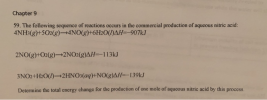 Chapter 9 59. The following sequence of reactions occurs in the commercial production of aqueous nitric acid: 4NH3(g)+502(g)-4NO(g)+6H2O(1)AH=-907kJ 2NO(g)+O2(g)—2NO2(g)AH--113kJ 3NO2+H2O(1)-2HNO3(aq)+NO(g)AH--139kJ Determine the total energy change for the production of one mole of aqueous nitric acid by this process.
The commercial production of nitric acid involves the following chemical reactions: (a) 4NH3(g)+5O2(g)⟶4NO(g)+6H2O(g) (b) 2NO(g)+O2(g)⟶2NO2(g) (c)...
The commercial production of nitric acid involves the following chemical reactions: (a) 4NH3(g)+5O2(g)⟶4NO(g)+6H2O(g) (b) 2NO(g)+O2(g)⟶2NO2(g) (c) 3NO2(g)+H2O(l)⟶2HNO3(aq)+NO(g) How many grams of ammonia must you start with to make 800.00 L of a 0.150 M aqueous solution of nitric acid? Assume all the reactions give 100% yield.
Determine the heat involved in the combustion of liquid hydrazine by using the following reactions. Use...
Determine the heat involved in the combustion of liquid hydrazine by using the following reactions. Use the balanced equation determined on the previous slide to begin. 2NH3(g) + 3N2O(g) → 4N2(g) + 3H2O(ℓ) ΔH° = –1013 kJ/mol N2O(g) + 3H2(g) → N2H4(ℓ) + H2O(ℓ) ΔH° = –317 kJ/mol 2NH3(g) + ½O2(g) → N2H4(ℓ) + H2O(ℓ) ΔH° = –142.9 kJ/mol H2(g) + ½ O2(g) → H2O(ℓ) ΔH° = –285.8 kJ/mol Launching a small spacecraft to study Jupiter required approximately 28 million...
 For which of the following reactions is AS™ > 0. Choose all that apply. CH4(g) + H2O(g) + 3H2(g) + CO(g) NH,HS() + NH3(g) + H2S(g) 2H2O(g) + 2Cl2(g) + 4HCl(g) + O2(g) 2NO(g) + 2H2(g) → N2(g) + 2H2O(1) 2N2(g) + O2(g) → 2N2O(g) ООО Submit Answer Try Another Version 3 item attempts remaining ot pt pt The molar solubility of silver chromate in a 0.246 M sodium chromate solution is M Submit Answer Try Another Version 3 item...
 For which of the following reactions is AS° >0. Choose all that apply. NH4Cl(s) + NH3(g) + HCl(g) 2C2H6(g) + 702(g) + 4CO2(g) + 6H2O(g) 2NH3(g) + 2O2(g) → N2O(g) + 3H2O(1) N2(g) + 202(g) + 2NO2(g) C2H2(g) + 4H2O(g) + 2CO2(g) + 5H2(g) Which of the following transformations represent an increase in the entropy of the system. Choose all that apply 20 g Hg (liquid, 244K) 20 g Hg (liquid, 620K) 1 mol CO2 (0.874 atm, 440K) 1 mol...
 For which of the following reactions is AS° > 0. Choose all that apply. 2C2H6(g) + 702(g) + 4CO2(g) + 6H2O(g) ONH4HS(s) + NH3(g) + H2S(g) S(s,rhombic) + 2CO(g) → SO2(g) + 2C(s,graphite) N2(g) + 3H2(g) + 2NH3(g) 2H2O(g) + 2Cl2(g) + 4HCI(g) + O2(g) Submit Answer Retry Entire Group 6 more group attempts remaining
 Predict whether AS for each reaction would be greater than zero, less than zero, or too close to zero to decide. Clear All H2(g) + Cl (9)— 2HCl(g) 2503(9)_ 2802(g) + 02(9) AS > 0 CH_(g) +202(g)—— CO2(g) + 2H20 (9) AS <0 2CO2(g) + 5H2(g) → CH2(g) + 4H2O(g) too close to decide CaCO3(s) ºCaO(s); CO2(g) For which of the following reactions is AS'>0. Choose all that apply. NH4Cl(s) + NH3(9) + HCl(9) H.CO(g) + O2(g) + CO2(g) +...
 For which of the following reactions is AS™ > 0. Choose all that apply 2NO(g) + 2H2(g) + N2(g) + 2H2O(1) H2(g) + C2H4(9) + CH (9) D NHI(s)+ NH4(g) + HI(g) 2002(g) + N2(g) 2CO(g) + 2NO(g) 4NH3(9) +502(9)→ 4NO(g) + 6H20(g) Submit Answer Retry Entire Group 3 more group attempts remaining Which of the following transformations represent an increase in the entropy of the system. Choose all that apply 44 g Ag (liquid, 1.234x10°K) 44 g Ag (solid,...
 Answer the following questions ans please show your calculation.
= 24,7 +402.8 = 1 AH,º= -447KJ AH2O= -484KJ AH;O= -429KJ AHRO= HW12 Using the following reactions: A+B+ 2C LA +3D+ 2E 2D+B+ 2F Calculate AH for the process 4E+ 5B → 4C +6F HW13 Using the following reactions: N2(g) + O2(g) → 2NO(g) N2(g) + 3H2(g) + 2NH3(g) 2H2(8) + O2(g) → 2H20(8) Calculate AH for the process 4NH3(g) + 502(8) → 4NO(g) + 6H2O(8) AH =+180.6 kg AH,O= -91.8...
Answer the following questions ans please show your calculation.
= 24,7 +402.8 = 1 AH,º= -447KJ AH2O= -484KJ AH;O= -429KJ AHRO= HW12 Using the following reactions: A+B+ 2C LA +3D+ 2E 2D+B+ 2F Calculate AH for the process 4E+ 5B → 4C +6F HW13 Using the following reactions: N2(g) + O2(g) → 2NO(g) N2(g) + 3H2(g) + 2NH3(g) 2H2(8) + O2(g) → 2H20(8) Calculate AH for the process 4NH3(g) + 502(8) → 4NO(g) + 6H2O(8) AH =+180.6 kg AH,O= -91.8...
 Exercise C For each of the reactions listed below. use the reactions after it to determine the enthalpy of the first reaction. Reaction 1 Find the AH for the reaction below. given the following reactions and subsequent AH values: 4 NH3(g) + 5O2(g) - 4NO(g) + 6H2O(g) N2(g) + O2(g) - 2NO(g) AH = +180.6 kJ N2(g) + 3H2(g) + 2NH3(g) AH = -91.8 kJ 2 H2(g) + O2(g) 2H2O(9) AH = -483.7 kJ Reaction 2 Find the AH for...
 Chapter 9 59. The following sequence of reactions occurs in the commercial production of aqueous nitric acid: 4NH3(g)+502(g)-4NO(g)+6H2O(1)AH=-907kJ 2NO(g)+O2(g)—2NO2(g)AH--113kJ 3NO2+H2O(1)-2HNO3(aq)+NO(g)AH--139kJ Determine the total energy change for the production of one mole of aqueous nitric acid by this process.
Most questions answered within 3 hours.
-
Where is the error in this code sequence?
String s1 = "Hello";
String s2 = "ello";...
asked 11 months ago -
Financial data for Joel de Paris, Inc., for last year
follow:
Joel de Paris, Inc.
Balance...
asked 11 months ago -
Consider this reaction:
Al2(SO4)3 (aq)+ BaCl3
(aq) Al2Cl6 (aq)- +
3BaSO4(s) . What is the...
asked 11 months ago -
Suppose that Savneet is considering increasing her
recent random sample from 20 car rentals to 40...
asked 11 months ago -
Trucks arrive at an unloading terminal at an average rate of 120
per hour.
Trucks arrive...
asked 11 months ago -
Why are methanol and ethanol completely soluble in water while
octanol is not very little soluble....
asked 11 months ago -
A facilities manager at a university reads in a research report
that the mean amount of...
asked 11 months ago -
When the CuSO4 is rehydrated by adding water to the anhydrous
compound, is this an endothermic...
asked 11 months ago -
A ray of sunlight is passing from diamond into crown glass; the
angle of incidence is...
asked 11 months ago -
A block of mass 0.249 kg is placed on top of a light, vertical
spring of...
asked 11 months ago -
how do the kidneys compensate in the presences of acidosis
a) trigger hyperventilate
b) reserve acid...
asked 11 months ago -
Question 501 pts
The rental rate of capital to the firm increases. Which of the
following...
asked 11 months ago