
Homework Answers
Add Answer to:
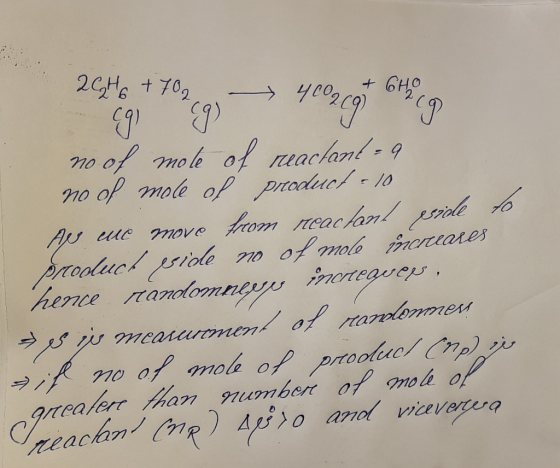
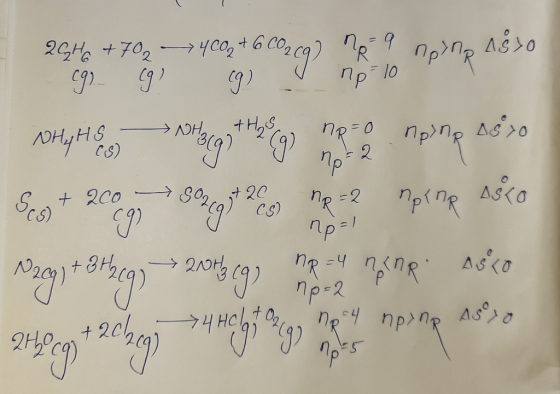
For which of the following reactions is AS° > 0. Choose all that apply. 2C2H6(g) +...
For which of the following reactions is AS° >0. Choose all that apply. NH4Cl(s) + NH3(g)...
 For which of the following reactions is AS° >0. Choose all that apply. NH4Cl(s) + NH3(g) + HCl(g) 2C2H6(g) + 702(g) + 4CO2(g) + 6H2O(g) 2NH3(g) + 2O2(g) → N2O(g) + 3H2O(1) N2(g) + 202(g) + 2NO2(g) C2H2(g) + 4H2O(g) + 2CO2(g) + 5H2(g) Which of the following transformations represent an increase in the entropy of the system. Choose all that apply 20 g Hg (liquid, 244K) 20 g Hg (liquid, 620K) 1 mol CO2 (0.874 atm, 440K) 1 mol...
For which of the following reactions is AS° > 0. Choose all that apply. CH4(g) +...
 For which of the following reactions is AS° > 0. Choose all that apply. CH4(g) + H2O(g) + CO(g) + 3H2(g) 4NH3(g) + 502(g) → 4NO(g) + 6H2O(g) 2CO(g) + O2(g) + 2C02(g) NH4Cl(s) + NH3(g) + HCl(g) 2NH3(g) + 202(g) + N2O(g) + 3H2O(1)
For which of the following reactions is AS™ > 0. Choose all that apply. CH4(g) +...
 For which of the following reactions is AS™ > 0. Choose all that apply. CH4(g) + H2O(g) + 3H2(g) + CO(g) NH,HS() + NH3(g) + H2S(g) 2H2O(g) + 2Cl2(g) + 4HCl(g) + O2(g) 2NO(g) + 2H2(g) → N2(g) + 2H2O(1) 2N2(g) + O2(g) → 2N2O(g) ООО Submit Answer Try Another Version 3 item attempts remaining ot pt pt The molar solubility of silver chromate in a 0.246 M sodium chromate solution is M Submit Answer Try Another Version 3 item...
8. Find ∆H◦ of the reaction 2C2H6(g) + 7O2(g) = 4CO2(g) + 6H2O(g), as it is...
8. Find ∆H◦ of the reaction 2C2H6(g) + 7O2(g) = 4CO2(g) + 6H2O(g), as it is written, given the following: 2C(s) + 3H2(g) = C2H6(g), ∆H◦ = −84.68 kJ, 2H2(g) + O2(g) = 2H2O(g), ∆H◦ = −483.6 kJ, C(s) + O2(g) = CO2(g), ∆H◦ = −393.5 kJ. (A) −3194 kJ (B) −3109 kJ (C) −2940 kJ (D) −2855 kJ (E) −1428 kJ
Determine the sign of As for each of the following reactions. a. CH4(g) + 202(g) →...
 Determine the sign of As for each of the following reactions. a. CH4(g) + 202(g) → 2H2O(l) + CO2(g) b. 2C2H6(g) + 702(g) + 6H2O(l) + 4CO2(g) c. Ca(OH)2(s) > CaO(s) + H2O0) .
For which of the following reactions is AS™ > 0. Choose all that apply 2NO(g) +...
 For which of the following reactions is AS™ > 0. Choose all that apply 2NO(g) + 2H2(g) + N2(g) + 2H2O(1) H2(g) + C2H4(9) + CH (9) D NHI(s)+ NH4(g) + HI(g) 2002(g) + N2(g) 2CO(g) + 2NO(g) 4NH3(9) +502(9)→ 4NO(g) + 6H20(g) Submit Answer Retry Entire Group 3 more group attempts remaining Which of the following transformations represent an increase in the entropy of the system. Choose all that apply 44 g Ag (liquid, 1.234x10°K) 44 g Ag (solid,...
Which of the following reactions could be considered a "precipitation" reaction? NaOH(aq) + HCl(aq) + NaCl(aq)...
 Which of the following reactions could be considered a "precipitation" reaction? NaOH(aq) + HCl(aq) + NaCl(aq) + H2O(1) 2H2O(1) + 2H2(g) + O2(g) + 2Nal(aq) + Pb(NO3)2(aq) + 2NaNO3(aq) + Pbl2(s) 2C2H6(g) + 702(g) + 4CO2(g) + 6H2O(1) None of these
17.51 Calculate the entropy change for the following processes. (a) 1.00 mol H,O(s) melts at 0...
 17.51 Calculate the entropy change for the following processes. (a) 1.00 mol H,O(s) melts at 0 °C. AH = 6.01 kJ/mol. (b) 2.00 mol CH.() vaporizes at 80.0 °C. AH vap = 30.7 kJ/mol. 17.52 - Calculate the entropy change for the following processes. (a) 2.00 mol NH3(e) vaporizes at -33.0 °C. AHvap = 23.35 kJ/mol. (b) 1.00 mol C,H,OH(s) melts at -114 °C. AHjus = 5.0 kJ/mol. 17.53 Use data from Appendix G to calculate the standard entropy change...
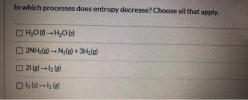
explanation pls In which processes does entropy decrease? Choose all that apply. H2O(1) H20 (5) 2NH3(g)...
 explanation pls
In which processes does entropy decrease? Choose all that apply. H2O(1) H20 (5) 2NH3(g) → N2(g) + 3H2(g) 21 (5) 12 (8) D 12 (s) 12 (8)
explanation pls
In which processes does entropy decrease? Choose all that apply. H2O(1) H20 (5) 2NH3(g) → N2(g) + 3H2(g) 21 (5) 12 (8) D 12 (s) 12 (8)
Consider the reaction 4NH3(g) +502(9) +4NO(g) + 6H2O(9) for which AH° = -905.2 kJ and A...
 Consider the reaction 4NH3(g) +502(9) +4NO(g) + 6H2O(9) for which AH° = -905.2 kJ and A Sº = 180.5 JK at 298.15 K. (1) Calculate the entropy change of the UNIVERSE when 1.669 moles of NH3(g) react under standard conditions at 298.15 K. = A Suniverse JK (2) Is this reaction reactant or product favored under standard conditions? (3) If the reaction is product favored, is it enthalpy favored, entropy favored, or favored by both enthalpy and entropy? If the...
 For which of the following reactions is AS° >0. Choose all that apply. NH4Cl(s) + NH3(g) + HCl(g) 2C2H6(g) + 702(g) + 4CO2(g) + 6H2O(g) 2NH3(g) + 2O2(g) → N2O(g) + 3H2O(1) N2(g) + 202(g) + 2NO2(g) C2H2(g) + 4H2O(g) + 2CO2(g) + 5H2(g) Which of the following transformations represent an increase in the entropy of the system. Choose all that apply 20 g Hg (liquid, 244K) 20 g Hg (liquid, 620K) 1 mol CO2 (0.874 atm, 440K) 1 mol...
 For which of the following reactions is AS° > 0. Choose all that apply. CH4(g) + H2O(g) + CO(g) + 3H2(g) 4NH3(g) + 502(g) → 4NO(g) + 6H2O(g) 2CO(g) + O2(g) + 2C02(g) NH4Cl(s) + NH3(g) + HCl(g) 2NH3(g) + 202(g) + N2O(g) + 3H2O(1)
 For which of the following reactions is AS™ > 0. Choose all that apply. CH4(g) + H2O(g) + 3H2(g) + CO(g) NH,HS() + NH3(g) + H2S(g) 2H2O(g) + 2Cl2(g) + 4HCl(g) + O2(g) 2NO(g) + 2H2(g) → N2(g) + 2H2O(1) 2N2(g) + O2(g) → 2N2O(g) ООО Submit Answer Try Another Version 3 item attempts remaining ot pt pt The molar solubility of silver chromate in a 0.246 M sodium chromate solution is M Submit Answer Try Another Version 3 item...
 Determine the sign of As for each of the following reactions. a. CH4(g) + 202(g) → 2H2O(l) + CO2(g) b. 2C2H6(g) + 702(g) + 6H2O(l) + 4CO2(g) c. Ca(OH)2(s) > CaO(s) + H2O0) .
 For which of the following reactions is AS™ > 0. Choose all that apply 2NO(g) + 2H2(g) + N2(g) + 2H2O(1) H2(g) + C2H4(9) + CH (9) D NHI(s)+ NH4(g) + HI(g) 2002(g) + N2(g) 2CO(g) + 2NO(g) 4NH3(9) +502(9)→ 4NO(g) + 6H20(g) Submit Answer Retry Entire Group 3 more group attempts remaining Which of the following transformations represent an increase in the entropy of the system. Choose all that apply 44 g Ag (liquid, 1.234x10°K) 44 g Ag (solid,...
 Which of the following reactions could be considered a "precipitation" reaction? NaOH(aq) + HCl(aq) + NaCl(aq) + H2O(1) 2H2O(1) + 2H2(g) + O2(g) + 2Nal(aq) + Pb(NO3)2(aq) + 2NaNO3(aq) + Pbl2(s) 2C2H6(g) + 702(g) + 4CO2(g) + 6H2O(1) None of these
 17.51 Calculate the entropy change for the following processes. (a) 1.00 mol H,O(s) melts at 0 °C. AH = 6.01 kJ/mol. (b) 2.00 mol CH.() vaporizes at 80.0 °C. AH vap = 30.7 kJ/mol. 17.52 - Calculate the entropy change for the following processes. (a) 2.00 mol NH3(e) vaporizes at -33.0 °C. AHvap = 23.35 kJ/mol. (b) 1.00 mol C,H,OH(s) melts at -114 °C. AHjus = 5.0 kJ/mol. 17.53 Use data from Appendix G to calculate the standard entropy change...
 explanation pls
In which processes does entropy decrease? Choose all that apply. H2O(1) H20 (5) 2NH3(g) → N2(g) + 3H2(g) 21 (5) 12 (8) D 12 (s) 12 (8)
explanation pls
In which processes does entropy decrease? Choose all that apply. H2O(1) H20 (5) 2NH3(g) → N2(g) + 3H2(g) 21 (5) 12 (8) D 12 (s) 12 (8)
 Consider the reaction 4NH3(g) +502(9) +4NO(g) + 6H2O(9) for which AH° = -905.2 kJ and A Sº = 180.5 JK at 298.15 K. (1) Calculate the entropy change of the UNIVERSE when 1.669 moles of NH3(g) react under standard conditions at 298.15 K. = A Suniverse JK (2) Is this reaction reactant or product favored under standard conditions? (3) If the reaction is product favored, is it enthalpy favored, entropy favored, or favored by both enthalpy and entropy? If the...
Most questions answered within 3 hours.
-
Where is the error in this code sequence?
String s1 = "Hello";
String s2 = "ello";...
asked 11 months ago -
Financial data for Joel de Paris, Inc., for last year
follow:
Joel de Paris, Inc.
Balance...
asked 11 months ago -
Consider this reaction:
Al2(SO4)3 (aq)+ BaCl3
(aq) Al2Cl6 (aq)- +
3BaSO4(s) . What is the...
asked 11 months ago -
Suppose that Savneet is considering increasing her
recent random sample from 20 car rentals to 40...
asked 11 months ago -
Trucks arrive at an unloading terminal at an average rate of 120
per hour.
Trucks arrive...
asked 11 months ago -
Why are methanol and ethanol completely soluble in water while
octanol is not very little soluble....
asked 11 months ago -
A facilities manager at a university reads in a research report
that the mean amount of...
asked 11 months ago -
When the CuSO4 is rehydrated by adding water to the anhydrous
compound, is this an endothermic...
asked 11 months ago -
A ray of sunlight is passing from diamond into crown glass; the
angle of incidence is...
asked 11 months ago -
A block of mass 0.249 kg is placed on top of a light, vertical
spring of...
asked 11 months ago -
how do the kidneys compensate in the presences of acidosis
a) trigger hyperventilate
b) reserve acid...
asked 11 months ago -
Question 501 pts
The rental rate of capital to the firm increases. Which of the
following...
asked 11 months ago