
Homework Answers
(2/3) - (1/3)i (-1/3) + (2/3)i Let B= . Is B (2/3) (-5/3) unitary? If not,...
 (2/3) - (1/3)i (-1/3) + (2/3)i Let B= . Is B (2/3) (-5/3) unitary? If not, explain why the columns of B fail to be an orthonormal basis for C2.
int a[5]; a[4] = 3; for (int i=3; i >= 0; i--) { a[i] = 2*a[i+1]...
int a[5]; a[4] = 3; for (int i=3; i >= 0; i--) { a[i] = 2*a[i+1] - i; cout << a[i]; }
1 int i, j, k; 2 for (i = 1; i <= 4; i++) 3 {...
1 int i, j, k; 2 for (i = 1; i <= 4; i++) 3 { 4 j = 1; 5 while (j < 4) 6 { 7 if (i % 2 == j % 2) 8 k = 100*i + 10*j; 9 else 10 k = 100*j + 10*i; 11 j++; 12 } 13 } What will be the value of the variable k at the end of the third, sixth, ninth, and twelfth iteration of the while loop
Exercise 24. Let 2 1 A =-1 3 1 0 -2 2 3 SDS-1. (i) Find...
 Exercise 24. Let 2 1 A =-1 3 1 0 -2 2 3 SDS-1. (i) Find a nonsingular matrix S and a diagonal matrix D such that A (ii) Find a matrix B that satisfies B2 = A
Exercise 24. Let 2 1 A =-1 3 1 0 -2 2 3 SDS-1. (i) Find a nonsingular matrix S and a diagonal matrix D such that A (ii) Find a matrix B that satisfies B2 = A
Exercise 24. Let 2 1 A =-1 3 1 0 -2 2 3 SDS-1. (i) Find a nonsingular matrix S and a diagonal matrix D such that A (ii) Find a matrix B that satisfies B2 = A
3. Suppose we are doing a sequence of operations (numbered 1, 2, 3, ...) such that the ith operation: - costs 1 if i is not a power of 2 - costs i if i is a power of 2. For example, the following...
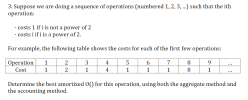 3. Suppose we are doing a sequence of operations (numbered 1,
2, 3, ...) such that the ith
operation:
- costs 1 if i is not a power of 2
- costs i if i is a power of 2.
For example, the following table shows the costs for each of
the first few operations:
Operation 1 2 3 4 5 6 7 8 9 …
Cost 1 2 1 4 1 1 1 8 1 …
Determine the best...
3. Suppose we are doing a sequence of operations (numbered 1,
2, 3, ...) such that the ith
operation:
- costs 1 if i is not a power of 2
- costs i if i is a power of 2.
For example, the following table shows the costs for each of
the first few operations:
Operation 1 2 3 4 5 6 7 8 9 …
Cost 1 2 1 4 1 1 1 8 1 …
Determine the best...
Consider the square matrices D (3x3)= 1 −1 1 3 2 2 3 -3 5 (i)...
Consider the square matrices D (3x3)= 1 −1 1 3 2 2 3 -3 5 (i) Compute det(D). Write down det(D3), without computing D3
1-3 I. Cus)+AgNOga) 1. II II. I. Pb)Cu(NO)2() 2. II. II teor n I. Zn)+Pb(NO)2a) 3....
 1-3
I. Cus)+AgNOga) 1. II II. I. Pb)Cu(NO)2() 2. II. II teor n I. Zn)+Pb(NO)2a) 3. II.
1-3
I. Cus)+AgNOga) 1. II II. I. Pb)Cu(NO)2() 2. II. II teor n I. Zn)+Pb(NO)2a) 3. II.
I g(x) = { 1, x = 1 2 2 = 1, 2, 3 ... Does...
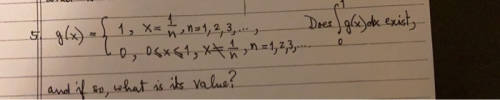 I g(x) = { 1, x = 1 2 2 = 1, 2, 3 ... Does / gle) dx exist lo, Os 51, XX 1, n = 1, 2, 3 ... and if so, what is its value?
2. Desk check this code. var sum = 0; for (var i=1; i <=3; i++) if...
 2. Desk check this code. var sum = 0; for (var i=1; i <=3; i++) if ((i % 2) 0) { sum += i; else sum-= 1; Desk Check i % 2 sum
Find (I – A)-1 for the given matrix A. 4 3 A= 2 - 3 (1...
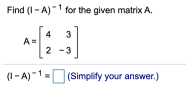 Find (I – A)-1 for the given matrix A. 4 3 A= 2 - 3 (1 - A)-1 = (Simplify your answer.)
 (2/3) - (1/3)i (-1/3) + (2/3)i Let B= . Is B (2/3) (-5/3) unitary? If not, explain why the columns of B fail to be an orthonormal basis for C2.
 Exercise 24. Let 2 1 A =-1 3 1 0 -2 2 3 SDS-1. (i) Find a nonsingular matrix S and a diagonal matrix D such that A (ii) Find a matrix B that satisfies B2 = A
Exercise 24. Let 2 1 A =-1 3 1 0 -2 2 3 SDS-1. (i) Find a nonsingular matrix S and a diagonal matrix D such that A (ii) Find a matrix B that satisfies B2 = A
Exercise 24. Let 2 1 A =-1 3 1 0 -2 2 3 SDS-1. (i) Find a nonsingular matrix S and a diagonal matrix D such that A (ii) Find a matrix B that satisfies B2 = A
 3. Suppose we are doing a sequence of operations (numbered 1,
2, 3, ...) such that the ith
operation:
- costs 1 if i is not a power of 2
- costs i if i is a power of 2.
For example, the following table shows the costs for each of
the first few operations:
Operation 1 2 3 4 5 6 7 8 9 …
Cost 1 2 1 4 1 1 1 8 1 …
Determine the best...
3. Suppose we are doing a sequence of operations (numbered 1,
2, 3, ...) such that the ith
operation:
- costs 1 if i is not a power of 2
- costs i if i is a power of 2.
For example, the following table shows the costs for each of
the first few operations:
Operation 1 2 3 4 5 6 7 8 9 …
Cost 1 2 1 4 1 1 1 8 1 …
Determine the best...
 1-3
I. Cus)+AgNOga) 1. II II. I. Pb)Cu(NO)2() 2. II. II teor n I. Zn)+Pb(NO)2a) 3. II.
1-3
I. Cus)+AgNOga) 1. II II. I. Pb)Cu(NO)2() 2. II. II teor n I. Zn)+Pb(NO)2a) 3. II.
 I g(x) = { 1, x = 1 2 2 = 1, 2, 3 ... Does / gle) dx exist lo, Os 51, XX 1, n = 1, 2, 3 ... and if so, what is its value?
 2. Desk check this code. var sum = 0; for (var i=1; i <=3; i++) if ((i % 2) 0) { sum += i; else sum-= 1; Desk Check i % 2 sum
 Find (I – A)-1 for the given matrix A. 4 3 A= 2 - 3 (1 - A)-1 = (Simplify your answer.)
Most questions answered within 3 hours.
-
Where is the error in this code sequence?
String s1 = "Hello";
String s2 = "ello";...
asked 11 months ago -
Financial data for Joel de Paris, Inc., for last year
follow:
Joel de Paris, Inc.
Balance...
asked 11 months ago -
Consider this reaction:
Al2(SO4)3 (aq)+ BaCl3
(aq) Al2Cl6 (aq)- +
3BaSO4(s) . What is the...
asked 11 months ago -
Suppose that Savneet is considering increasing her
recent random sample from 20 car rentals to 40...
asked 11 months ago -
Trucks arrive at an unloading terminal at an average rate of 120
per hour.
Trucks arrive...
asked 11 months ago -
Why are methanol and ethanol completely soluble in water while
octanol is not very little soluble....
asked 11 months ago -
A facilities manager at a university reads in a research report
that the mean amount of...
asked 11 months ago -
When the CuSO4 is rehydrated by adding water to the anhydrous
compound, is this an endothermic...
asked 11 months ago -
A ray of sunlight is passing from diamond into crown glass; the
angle of incidence is...
asked 11 months ago -
A block of mass 0.249 kg is placed on top of a light, vertical
spring of...
asked 11 months ago -
how do the kidneys compensate in the presences of acidosis
a) trigger hyperventilate
b) reserve acid...
asked 11 months ago -
Question 501 pts
The rental rate of capital to the firm increases. Which of the
following...
asked 11 months ago