
Homework Answers
Add Answer to:
A particle is following a path defined by the equation y = 1.5x? The particles's speed...
please report answers in atleast 3 significant figures. thank you, will upvote! A particle is following...
 please report answers in atleast 3 significant
figures. thank you, will upvote!
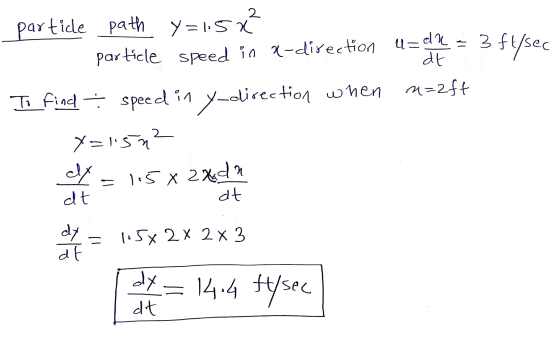
A particle is following a path defined by the equation y = 1.5 x2. The particles's speed in the x-direction is 3 ft/s (constant). What is the speed in the y-direction when x = 2 feet? Report your answer in ft/s.
please report answers in atleast 3 significant
figures. thank you, will upvote!
A particle is following a path defined by the equation y = 1.5 x2. The particles's speed in the x-direction is 3 ft/s (constant). What is the speed in the y-direction when x = 2 feet? Report your answer in ft/s.
This airplane is flying along a parabolic path defined by the equation shown, where x and...
 This airplane is flying along a parabolic path defined by the equation shown, where x and y are both in feet. During this portion of the flight, the speed is being held constant at 350 feet/second. Find the acceleration of the plane at point A (where x -0). Be sure to specify both the magnitude and the direction. . y (0.0001x2500) ft
Given: Particle P travels within the x-y plane along a path given by y (x) =...
Given: Particle P travels within the x-y plane along a path given by y (x) = x^ 2/2 − 10x, where x and y are given in feet. The x-component of the position for P is changing at a constant rate of x'. (a) Make a sketch of the path of particle P. (b) Determine the velocity and acceleration of P. (c) Show the velocity and acceleration vectors of P in your sketch of P’s path. (d) Determine the rate...
7. [2 points] A particle is moving at a constant speed in a circular path centered...
 7. [2 points] A particle is moving at a constant speed in a circular path centered at the origin on an xy coordinate system. At one point (x=4m, y=0), the particle has a velocity of 5ġ m/s. a. State whether the particle is moving clockwise or counter-clockwise on the circular track. b. What is the constant speed of the particle throughout its circular trajectory? c. What is the acceleration (expressed as a vector) of the particle when it is at...
1. <Problem Due> A particle is traveling along the path defined by y=(x - 1)?. If...
 1. <Problem Due> A particle is traveling along the path defined by y=(x - 1)?. If x = 0.562 m, where t is in seconds, calculate the magnitudes of the particle's velocity ū and acceleration ā when t = 1 s. Also, sketch your results and show the directions of ū and ā when t= 1 s.
Le Problem 3.3 The motion of a particle is defined by the equations x=(4cos -2) (2...
 Le Problem 3.3 The motion of a particle is defined by the equations x=(4cos -2) (2 - cos act) and y =(3 sin TI)/(2 - cos al), where x and y are expressed in feet and / is expressed in seconds. Show that the path of the particle is part of the ellipse shown, and determine the velocity when (a) / -0. (b)/ 1/3 s, (c) 1 = 1 s.
The position of a particle along a straight line path is defined by s = (t^3...
The position of a particle along a straight line path is defined by s = (t^3 - 6t^2 - 15t +25) ft, where t is in seconds. What is the particle's initial velocity?
Problem 2: A particle is traveling with uniform (constant) speed, v. Answer the following questions carefully...
 Problem 2: A particle is traveling with uniform (constant) speed, v. Answer the following questions carefully a. If the particle is traveling along a straight line path, with this constant speed, what is the magnitude of its acceleration vector? What is the direction of the acceleration vector? b. If the particle is traveling along a circular path of radius of curvature, p. what is the magnitude of the acceleration vector? What is the direction of the acceleration vector? Why is...
A particle moves on a counter clockwise, origin-centered circular path in the x y-plane at a...
 A particle moves on a counter clockwise, origin-centered circular path in the x y-plane at a constant rate. The radius of the circle is r, the mass of the particle is m, and the particle completes one revolu tion in time τ a) Neatly draw the following things 1. The path of the particle 2. A dot on the path when the particle is at 00 90° and 210° where 0 is mea sured from the x-axis (posi tive counter-clockwise)...
The position of a particle along a straight-line path is defined by s=(t3−6t2−15t+7) ft, wheret is...
The position of a particle along a straight-line path is defined by s=(t3−6t2−15t+7) ft, wheret is in seconds. Part A: Determine the total distance traveled when t = 8.3 s . Part B: What are the particle's average velocity at the time given in part A? Part C: What are the particle's average speed at the time given in part A? Part D: What are the particle's instantaneous velocity at the time given in part A? Part E: What are...
 please report answers in atleast 3 significant
figures. thank you, will upvote!
A particle is following a path defined by the equation y = 1.5 x2. The particles's speed in the x-direction is 3 ft/s (constant). What is the speed in the y-direction when x = 2 feet? Report your answer in ft/s.
please report answers in atleast 3 significant
figures. thank you, will upvote!
A particle is following a path defined by the equation y = 1.5 x2. The particles's speed in the x-direction is 3 ft/s (constant). What is the speed in the y-direction when x = 2 feet? Report your answer in ft/s.
 This airplane is flying along a parabolic path defined by the equation shown, where x and y are both in feet. During this portion of the flight, the speed is being held constant at 350 feet/second. Find the acceleration of the plane at point A (where x -0). Be sure to specify both the magnitude and the direction. . y (0.0001x2500) ft
 7. [2 points] A particle is moving at a constant speed in a circular path centered at the origin on an xy coordinate system. At one point (x=4m, y=0), the particle has a velocity of 5ġ m/s. a. State whether the particle is moving clockwise or counter-clockwise on the circular track. b. What is the constant speed of the particle throughout its circular trajectory? c. What is the acceleration (expressed as a vector) of the particle when it is at...
 1. <Problem Due> A particle is traveling along the path defined by y=(x - 1)?. If x = 0.562 m, where t is in seconds, calculate the magnitudes of the particle's velocity ū and acceleration ā when t = 1 s. Also, sketch your results and show the directions of ū and ā when t= 1 s.
 Le Problem 3.3 The motion of a particle is defined by the equations x=(4cos -2) (2 - cos act) and y =(3 sin TI)/(2 - cos al), where x and y are expressed in feet and / is expressed in seconds. Show that the path of the particle is part of the ellipse shown, and determine the velocity when (a) / -0. (b)/ 1/3 s, (c) 1 = 1 s.
 Problem 2: A particle is traveling with uniform (constant) speed, v. Answer the following questions carefully a. If the particle is traveling along a straight line path, with this constant speed, what is the magnitude of its acceleration vector? What is the direction of the acceleration vector? b. If the particle is traveling along a circular path of radius of curvature, p. what is the magnitude of the acceleration vector? What is the direction of the acceleration vector? Why is...
 A particle moves on a counter clockwise, origin-centered circular path in the x y-plane at a constant rate. The radius of the circle is r, the mass of the particle is m, and the particle completes one revolu tion in time τ a) Neatly draw the following things 1. The path of the particle 2. A dot on the path when the particle is at 00 90° and 210° where 0 is mea sured from the x-axis (posi tive counter-clockwise)...
Most questions answered within 3 hours.
-
Where is the error in this code sequence?
String s1 = "Hello";
String s2 = "ello";...
asked 10 months ago -
Financial data for Joel de Paris, Inc., for last year
follow:
Joel de Paris, Inc.
Balance...
asked 10 months ago -
Consider this reaction:
Al2(SO4)3 (aq)+ BaCl3
(aq) Al2Cl6 (aq)- +
3BaSO4(s) . What is the...
asked 10 months ago -
Suppose that Savneet is considering increasing her
recent random sample from 20 car rentals to 40...
asked 10 months ago -
Trucks arrive at an unloading terminal at an average rate of 120
per hour.
Trucks arrive...
asked 10 months ago -
Why are methanol and ethanol completely soluble in water while
octanol is not very little soluble....
asked 10 months ago -
A facilities manager at a university reads in a research report
that the mean amount of...
asked 10 months ago -
When the CuSO4 is rehydrated by adding water to the anhydrous
compound, is this an endothermic...
asked 10 months ago -
A ray of sunlight is passing from diamond into crown glass; the
angle of incidence is...
asked 10 months ago -
A block of mass 0.249 kg is placed on top of a light, vertical
spring of...
asked 10 months ago -
how do the kidneys compensate in the presences of acidosis
a) trigger hyperventilate
b) reserve acid...
asked 10 months ago -
Question 501 pts
The rental rate of capital to the firm increases. Which of the
following...
asked 10 months ago