Given: Particle P travels within the x-y plane along a path given by y (x) =...
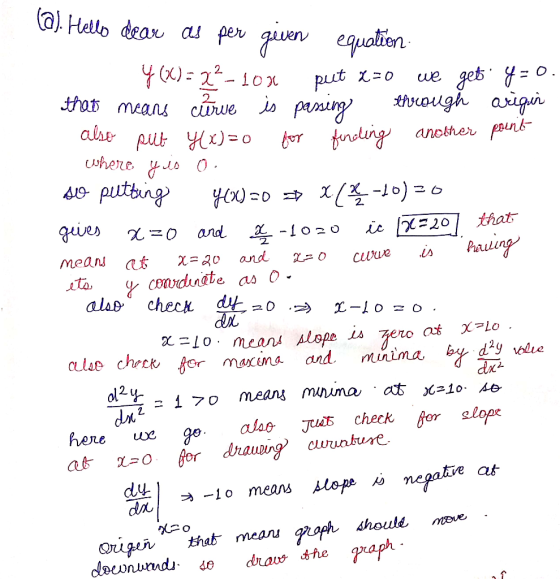
Given: Particle P travels within the x-y plane along a path given by y (x) = x^ 2/2 − 10x, where x and y are given in feet. The x-component of the position for P is changing at a constant rate of x'.
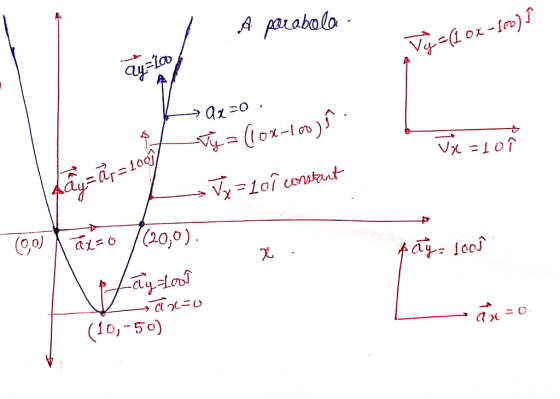
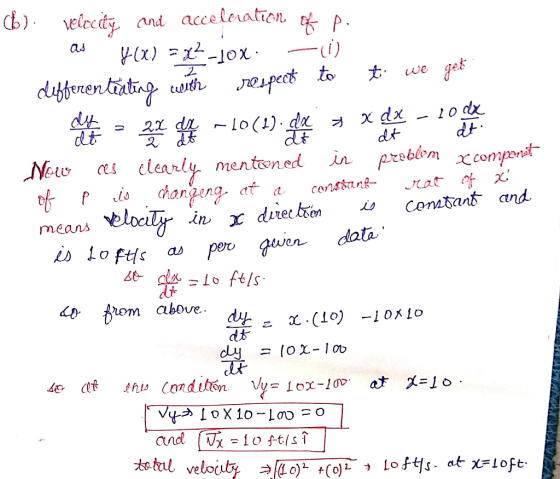
(a) Make a sketch of the path of particle P. (b) Determine the velocity and acceleration of P. (c) Show the velocity and acceleration vectors of P in your sketch of P’s path. (d) Determine the rate of change of speed of P.
Use the following parameters in your analysis: ˙x = 10 ft/s and x = 10 ft.
Homework Answers
 i hope u understood dear it is
very good conceptual question
i hope u understood dear it is
very good conceptual question
Which is pure mathematical also uses concept of kinematics
First we are going to plot of y as a function of x and then we will use the given information that velociy is constant in x direction which simply implies that acceleration is 0 in x direction that is throughout velocity that is rate of change of displacement is 0.
Then simply go for dy/dt ie velociy in y direction ....
Thanks ...
Add Answer to:
Given: Particle P travels within the x-y plane along a path
given by y (x) =...
Problem H1.B Given: A particle P travels on a path described by the Cartesian coordinates of...
 Problem H1.B Given: A particle P travels on a path described by the Cartesian coordinates of y ca(b - ) where and y have the units of meters.The -component of velocity, i, for P is constamt. Find: For this problem (a) Make a sketch of the path of P over the range of 0 <b. (b) Determine the Cartesian components of the velocity and acceleration of P at 0. Add sketch of the velocity and acceleration vectors for P to...
F12-18. A particle travels along a straight-line path y 0.5x. If the x component of the...
 F12-18. A particle travels along a straight-line path y 0.5x. If the x component of the particle's velocity is vr= (2) m/s, where t is in seconds, determine the magnitude of the particle's velocity and acceleration when = 4 s. y =0.5x Prob. F12-18 F12-19. A particle is traveling along the parabolic path y 0.25x. If x 8 m. , 8 m/s, and a, 4 m/s2 when 2 s. determine the magnitude of the particle's velocity and acceleration at this...
A particle in the xy plane travels along a spiral path C beginning at a point...
 A particle in the xy plane travels along a spiral path C
beginning at a point P that is 8 units from the origin and ending
at a point Q that is 2 units from origin.
The particle makes 2.5 revolutions aroung the origin along the
way.
What is work done by the gravitational field
F(x, y) =
i +
j in moving the particle along its path?
(x2 + y2) 3/2)
A particle in the xy plane travels along a spiral path C
beginning at a point P that is 8 units from the origin and ending
at a point Q that is 2 units from origin.
The particle makes 2.5 revolutions aroung the origin along the
way.
What is work done by the gravitational field
F(x, y) =
i +
j in moving the particle along its path?
(x2 + y2) 3/2)
1) 2D kinematics (rectangular coordinates) - A particle moving in the x-y plane has an acceleration...
 1) 2D kinematics (rectangular coordinates) - A particle moving in the x-y plane has an acceleration in the y-direction given as ay -3t ft/s2 and an x-position ofx 3t + 2 ft. When t0, yo3ft and Vo, -4ft/s. a) Derive expressions for x, vx, ax, V, Vy, ay as functions of time. b) At times t 0,1,2 seconds, calculate the magnitude of velocity and the angle it makes with the x-axis. c) At times t 0,1,2 seconds, calculate the magnitude...
Example 3 A particle travels along the path y-2x2. At a given instant, x-1 m and...
 Example 3 A particle travels along the path y-2x2. At a given instant, x-1 m and dx/dt - 2 m/s which is a constant value. Find the magnitude of velocity at this instant. (Answer: v-8.25 m/s)
A particle travels along the circular path x2 +y-r, when the time t = 0 the...
 A particle travels along the circular path x2 +y-r, when the time t = 0 the particle it's at-r meter and y =0 m. If the y components of the particle's velocity is Vy 2r cos2t, determine: (a) the x and y components of its acceleration at any instant. (b) Draw the trajectory with the vector velocity and acceleration at t = π/4 sec. (c) calculate the average vector velocity between 0 and t/4 sec. (d) the distance travelled when...
A particle travels counterclockwise along a circular path of radius R with a linear velocity V....
 A particle travels counterclockwise along a circular path of radius R with a linear velocity V. Assume that V = constant-10m /s, R-10m, θ-450 For the specified coordinate O-xy system as shown in the figure below determine the velocity and acceleration components in the corresponding Cartesian, polar, and tangential and normal coordinate systems, respectively, at the position and also the magnitude and direction of the velocity and acceleration vectors You may summarize your results in the following table. Coordinate Components...
parts a through e please with work. A particle travels along the circular path x2 +y-r,...
 parts a through e please with work.
A particle travels along the circular path x2 +y-r, when the time t = 0 the particle it's at-r meter and y =0 m. If the y components of the particle's velocity is Vy 2r cos2t, determine: (a) the x and y components of its acceleration at any instant. (b) Draw the trajectory with the vector velocity and acceleration at t = π/4 sec. (c) calculate the average vector velocity between 0 and...
parts a through e please with work.
A particle travels along the circular path x2 +y-r, when the time t = 0 the particle it's at-r meter and y =0 m. If the y components of the particle's velocity is Vy 2r cos2t, determine: (a) the x and y components of its acceleration at any instant. (b) Draw the trajectory with the vector velocity and acceleration at t = π/4 sec. (c) calculate the average vector velocity between 0 and...
An object travels along the sinusoidal path defined by the y sin(0.5(rad/m) x). If the component...
 An object travels along the sinusoidal path defined by the y sin(0.5(rad/m) x). If the component of velocity along the x axis is t? m/s where t is in seconds, determine the objects distance from the origin O and its acceleration when t- 1.5 s. When t 0,x-O,y-0
2) A particle moves in the x-y plane. Known information about the particle’s motion is given...
2) A particle moves in the x-y plane. Known information about the particle’s motion is given below: ???? = 150?? ft/sec. and at time t = 0, x = 6 ft ?? =5??3+50?? ft a) Derive, as functions of time, the position (x), acceleration (ax), velocity (vy), and acceleration (ay). b) Using your functions, calculate, at time t = 0.25 seconds, the total magnitude of velocity ?? of the particle and the angle ????the velocity vector makes with the x-axis....
 Problem H1.B Given: A particle P travels on a path described by the Cartesian coordinates of y ca(b - ) where and y have the units of meters.The -component of velocity, i, for P is constamt. Find: For this problem (a) Make a sketch of the path of P over the range of 0 <b. (b) Determine the Cartesian components of the velocity and acceleration of P at 0. Add sketch of the velocity and acceleration vectors for P to...
 F12-18. A particle travels along a straight-line path y 0.5x. If the x component of the particle's velocity is vr= (2) m/s, where t is in seconds, determine the magnitude of the particle's velocity and acceleration when = 4 s. y =0.5x Prob. F12-18 F12-19. A particle is traveling along the parabolic path y 0.25x. If x 8 m. , 8 m/s, and a, 4 m/s2 when 2 s. determine the magnitude of the particle's velocity and acceleration at this...
 A particle in the xy plane travels along a spiral path C
beginning at a point P that is 8 units from the origin and ending
at a point Q that is 2 units from origin.
The particle makes 2.5 revolutions aroung the origin along the
way.
What is work done by the gravitational field
F(x, y) =
i +
j in moving the particle along its path?
(x2 + y2) 3/2)
A particle in the xy plane travels along a spiral path C
beginning at a point P that is 8 units from the origin and ending
at a point Q that is 2 units from origin.
The particle makes 2.5 revolutions aroung the origin along the
way.
What is work done by the gravitational field
F(x, y) =
i +
j in moving the particle along its path?
(x2 + y2) 3/2)
 1) 2D kinematics (rectangular coordinates) - A particle moving in the x-y plane has an acceleration in the y-direction given as ay -3t ft/s2 and an x-position ofx 3t + 2 ft. When t0, yo3ft and Vo, -4ft/s. a) Derive expressions for x, vx, ax, V, Vy, ay as functions of time. b) At times t 0,1,2 seconds, calculate the magnitude of velocity and the angle it makes with the x-axis. c) At times t 0,1,2 seconds, calculate the magnitude...
 Example 3 A particle travels along the path y-2x2. At a given instant, x-1 m and dx/dt - 2 m/s which is a constant value. Find the magnitude of velocity at this instant. (Answer: v-8.25 m/s)
 A particle travels along the circular path x2 +y-r, when the time t = 0 the particle it's at-r meter and y =0 m. If the y components of the particle's velocity is Vy 2r cos2t, determine: (a) the x and y components of its acceleration at any instant. (b) Draw the trajectory with the vector velocity and acceleration at t = π/4 sec. (c) calculate the average vector velocity between 0 and t/4 sec. (d) the distance travelled when...
 A particle travels counterclockwise along a circular path of radius R with a linear velocity V. Assume that V = constant-10m /s, R-10m, θ-450 For the specified coordinate O-xy system as shown in the figure below determine the velocity and acceleration components in the corresponding Cartesian, polar, and tangential and normal coordinate systems, respectively, at the position and also the magnitude and direction of the velocity and acceleration vectors You may summarize your results in the following table. Coordinate Components...
 parts a through e please with work.
A particle travels along the circular path x2 +y-r, when the time t = 0 the particle it's at-r meter and y =0 m. If the y components of the particle's velocity is Vy 2r cos2t, determine: (a) the x and y components of its acceleration at any instant. (b) Draw the trajectory with the vector velocity and acceleration at t = π/4 sec. (c) calculate the average vector velocity between 0 and...
parts a through e please with work.
A particle travels along the circular path x2 +y-r, when the time t = 0 the particle it's at-r meter and y =0 m. If the y components of the particle's velocity is Vy 2r cos2t, determine: (a) the x and y components of its acceleration at any instant. (b) Draw the trajectory with the vector velocity and acceleration at t = π/4 sec. (c) calculate the average vector velocity between 0 and...
 An object travels along the sinusoidal path defined by the y sin(0.5(rad/m) x). If the component of velocity along the x axis is t? m/s where t is in seconds, determine the objects distance from the origin O and its acceleration when t- 1.5 s. When t 0,x-O,y-0
Most questions answered within 3 hours.
-
Where is the error in this code sequence?
String s1 = "Hello";
String s2 = "ello";...
asked 11 months ago -
Financial data for Joel de Paris, Inc., for last year
follow:
Joel de Paris, Inc.
Balance...
asked 11 months ago -
Consider this reaction:
Al2(SO4)3 (aq)+ BaCl3
(aq) Al2Cl6 (aq)- +
3BaSO4(s) . What is the...
asked 11 months ago -
Suppose that Savneet is considering increasing her
recent random sample from 20 car rentals to 40...
asked 11 months ago -
Trucks arrive at an unloading terminal at an average rate of 120
per hour.
Trucks arrive...
asked 11 months ago -
Why are methanol and ethanol completely soluble in water while
octanol is not very little soluble....
asked 11 months ago -
A facilities manager at a university reads in a research report
that the mean amount of...
asked 11 months ago -
When the CuSO4 is rehydrated by adding water to the anhydrous
compound, is this an endothermic...
asked 11 months ago -
A ray of sunlight is passing from diamond into crown glass; the
angle of incidence is...
asked 11 months ago -
A block of mass 0.249 kg is placed on top of a light, vertical
spring of...
asked 11 months ago -
how do the kidneys compensate in the presences of acidosis
a) trigger hyperventilate
b) reserve acid...
asked 11 months ago -
Question 501 pts
The rental rate of capital to the firm increases. Which of the
following...
asked 11 months ago