Construct a derivation from the premise to the conclusion.
Premise1: (Y ⊃ B)
Premise2: (B&T) ⊃ D
Premise3: D ⊃∼ Y
Premise4: B ⊃ (O ∨ T)
Premise5: ∼ O
Conclusion: ∼ Y
ex) This is the example from the textbook which I have to do the same for my question only using &, ~, ∨, ≡, ⊃ I, E.
![Derive: L & D Assumption Assumption 1-N 2 (NL) & [D = (-N VA)] 3 -NL 4L 5 D = (NVA) 6-NVA 7 D 8 L&D 2 &E 1, 3 DE 2 &E 1 VI 5,](http://img.homeworklib.com/questions/c64d5120-e3e1-11ea-9884-559d2c808e6a.png?x-oss-process=image/resize,w_560)
Homework Answers

Add Answer to:
Construct a derivation from the premise to the conclusion.
Premise1: (Y ⊃ B)
Premise2: (B&T) ⊃...
How do I derive these using the laws of Sentential Derivation Problem 6.1 Construct a derivation...
 How do I derive these using the laws of Sentential
Derivation
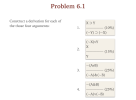
Problem 6.1 Construct a derivation for each of the those four arguments: 1. XY (10%) (~Y) – (~X) (-X)vY X 2. (15%) Y 3. ~(AvB) (25%) (~A)&(~B) 4. ~(A&B) (25%) (~A)v(~B)
How do I derive these using the laws of Sentential
Derivation
Problem 6.1 Construct a derivation for each of the those four arguments: 1. XY (10%) (~Y) – (~X) (-X)vY X 2. (15%) Y 3. ~(AvB) (25%) (~A)&(~B) 4. ~(A&B) (25%) (~A)v(~B)
Complete the proof. [}proof{]; 1. AvB, premise; 2.A>(C&D), premise; 3.B>(~C&D),premisel:D>C Answer: efs in Three Jump to......
 Complete the proof. [}proof{]; 1. AvB, premise; 2.A>(C&D), premise; 3.B>(~C&D),premisel:D>C Answer: efs in Three Jump to... ns Complete the proof. [}proof{l; 1. (A&B)>C, premise; 2.B,premisel:~AVC Answer: Complete the proof. [}proof{]; 1.A,premise; 2.Bvc, premise| : ~(A&B)>(A&C) Answer:
Part A: What is the (forward) Euler method to solve the IVP y(t) = f(t, y(t))...
 Part A: What is the (forward) Euler method to solve the IVP y(t) = f(t, y(t)) te [0.tfinal] y(0) = 1 Part B: Derive the (forward) Euler method using an integration rule or by a Taylor series argument. Part C: Based on that derivation, state the local error (order of accuracy) for this Euler method. Part D: Assume that you apply this Euler method n times over an interval [a,b]. What is the global error here? Show your work.
why is this wrong for vectors vector<char> decrypt{ {'B', 'C', 'D', 'E', 'F', 'G', 'H', 'I',...
why is this wrong for vectors vector<char> decrypt{ {'B', 'C', 'D', 'E', 'F', 'G', 'H', 'I', 'J', 'K', 'L', 'M', 'N', 'O', 'P', 'Q', 'R', 'S', 'T', 'U', 'V', 'W', 'X', 'Y', 'Z', '1', '2', '3', '4', '5', '6', '7', '8', '9', 'A'}, {'C', 'D', 'E', 'F', 'G', 'H', 'I', 'J', 'K', 'L', 'M', 'N', 'O', 'P', 'Q', 'R', 'S', 'T', 'U', 'V', 'W', 'X', 'Y', 'Z', '1', '2', '3', '4', '5', '6', '7', '8', '9', 'A', 'B'}, }; for(int...
5. (Hints: This derivation is presented in your textbook briefly. I also discussed that in the cl...
 plz if you could make it clear.
will thumb up
5. (Hints: This derivation is presented in your textbook briefly. I also discussed that in the class. I would like you to provide step-by-step process for this mathematical derivation. You need to use the continuity equation (Eq. 6-21) for the derivation process) Starting from the first law of Thermodynamics for a differential control volume, derive the general governing equation for temperature (6-35) for a 2D flow over flat plate. Using...
plz if you could make it clear.
will thumb up
5. (Hints: This derivation is presented in your textbook briefly. I also discussed that in the class. I would like you to provide step-by-step process for this mathematical derivation. You need to use the continuity equation (Eq. 6-21) for the derivation process) Starting from the first law of Thermodynamics for a differential control volume, derive the general governing equation for temperature (6-35) for a 2D flow over flat plate. Using...
Consider the neoclassical closed economy model: Y=COY-T)+1(t) + G Y=F(K.L) M/P L(r+z* Y) CY-T) is describing...
 Consider the neoclassical closed economy model: Y=COY-T)+1(t) + G Y=F(K.L) M/P L(r+z* Y) CY-T) is describing consumptions as a function of disposable income, Kand L are fixed and do not change over time, G and T are chosen by government. And are exogenous and fixed. 1- Suppose K 150, L=500 Y-2.5 K"L- C 12+0.7(Y-T) 250 G 250, T I60-400r P 1 a 0.3 a) Calculate GDP value: I Derive the equations for marginal product of labor & marginal product of...
Which of the set of quantum numbers below is NOT allowed?QXYZ n 4 567l0031 ml 0...
Which of the set of quantum numbers below is NOT allowed?QXYZ n 4 567l0031 ml 0 1 0 1 ms +12/ −12/ −12/ +12/ W h i c h o f t h e s e t o f q u a n t u m n u m b e r s b e l o w i s N O T a l l o w e d ? n l m l m s Q 4 0...
prove: part "a.i" and "a.ii" that is do a full derivation show each step x(t) 1...
 prove: part "a.i" and "a.ii"
that is do a full derivation show each step
x(t) 1 h(t) = e-3[t y(t) t -T +Tt FIGURE 4.55 Block box system diagram of Example 4.10. Example 4.10 Analyze by hand and using MATLAB (include pretty) the block box system diagram shown in Figure 4.55, and obtain a. Analytical expressions of i. X(w) ii. H(w) iii. Y(w) iv. y(t) b. Create the script file syst_anal that returns the following plots: i. X(w) versus w...
prove: part "a.i" and "a.ii"
that is do a full derivation show each step
x(t) 1 h(t) = e-3[t y(t) t -T +Tt FIGURE 4.55 Block box system diagram of Example 4.10. Example 4.10 Analyze by hand and using MATLAB (include pretty) the block box system diagram shown in Figure 4.55, and obtain a. Analytical expressions of i. X(w) ii. H(w) iii. Y(w) iv. y(t) b. Create the script file syst_anal that returns the following plots: i. X(w) versus w...
help 3. Answer each part for the following CFG G (The * symbom in the derivation...
 help
3. Answer each part for the following CFG G (The * symbom in the derivation means with any number of steps): R + XRXS S + aTb | b Ta T→ XTX | x | 6 X + ab (a) What are the variables of G? (b) What are the terminals of G? (c) Which is the start variable of G? (d) Give three strings in L(G) (e) Give three strings not in L(G) (f) True or False: T...
help
3. Answer each part for the following CFG G (The * symbom in the derivation means with any number of steps): R + XRXS S + aTb | b Ta T→ XTX | x | 6 X + ab (a) What are the variables of G? (b) What are the terminals of G? (c) Which is the start variable of G? (d) Give three strings in L(G) (e) Give three strings not in L(G) (f) True or False: T...
A.9. First-order linear non-homogeneous ODEs having one dependent variable are of the form dy + P(x)y...
 A.9. First-order linear non-homogeneous ODEs having one dependent variable are of the form dy + P(x)y = f(x). Beginning with yp = uyż, where yı = e-SP(x)dx and is thus a solution to Y + P(x)y = 0, and given that the general solution y = cyı + Yp, use variation of parameters to derive the formula for the general solution to first-order linear non-homogeneous ODES: dx y = e-SP(x)dx (S eS P(x)dx f(x)dx + c). You may use the...
 How do I derive these using the laws of Sentential
Derivation
Problem 6.1 Construct a derivation for each of the those four arguments: 1. XY (10%) (~Y) – (~X) (-X)vY X 2. (15%) Y 3. ~(AvB) (25%) (~A)&(~B) 4. ~(A&B) (25%) (~A)v(~B)
How do I derive these using the laws of Sentential
Derivation
Problem 6.1 Construct a derivation for each of the those four arguments: 1. XY (10%) (~Y) – (~X) (-X)vY X 2. (15%) Y 3. ~(AvB) (25%) (~A)&(~B) 4. ~(A&B) (25%) (~A)v(~B)
 Complete the proof. [}proof{]; 1. AvB, premise; 2.A>(C&D), premise; 3.B>(~C&D),premisel:D>C Answer: efs in Three Jump to... ns Complete the proof. [}proof{l; 1. (A&B)>C, premise; 2.B,premisel:~AVC Answer: Complete the proof. [}proof{]; 1.A,premise; 2.Bvc, premise| : ~(A&B)>(A&C) Answer:
 Part A: What is the (forward) Euler method to solve the IVP y(t) = f(t, y(t)) te [0.tfinal] y(0) = 1 Part B: Derive the (forward) Euler method using an integration rule or by a Taylor series argument. Part C: Based on that derivation, state the local error (order of accuracy) for this Euler method. Part D: Assume that you apply this Euler method n times over an interval [a,b]. What is the global error here? Show your work.
 plz if you could make it clear.
will thumb up
5. (Hints: This derivation is presented in your textbook briefly. I also discussed that in the class. I would like you to provide step-by-step process for this mathematical derivation. You need to use the continuity equation (Eq. 6-21) for the derivation process) Starting from the first law of Thermodynamics for a differential control volume, derive the general governing equation for temperature (6-35) for a 2D flow over flat plate. Using...
plz if you could make it clear.
will thumb up
5. (Hints: This derivation is presented in your textbook briefly. I also discussed that in the class. I would like you to provide step-by-step process for this mathematical derivation. You need to use the continuity equation (Eq. 6-21) for the derivation process) Starting from the first law of Thermodynamics for a differential control volume, derive the general governing equation for temperature (6-35) for a 2D flow over flat plate. Using...
 Consider the neoclassical closed economy model: Y=COY-T)+1(t) + G Y=F(K.L) M/P L(r+z* Y) CY-T) is describing consumptions as a function of disposable income, Kand L are fixed and do not change over time, G and T are chosen by government. And are exogenous and fixed. 1- Suppose K 150, L=500 Y-2.5 K"L- C 12+0.7(Y-T) 250 G 250, T I60-400r P 1 a 0.3 a) Calculate GDP value: I Derive the equations for marginal product of labor & marginal product of...
 prove: part "a.i" and "a.ii"
that is do a full derivation show each step
x(t) 1 h(t) = e-3[t y(t) t -T +Tt FIGURE 4.55 Block box system diagram of Example 4.10. Example 4.10 Analyze by hand and using MATLAB (include pretty) the block box system diagram shown in Figure 4.55, and obtain a. Analytical expressions of i. X(w) ii. H(w) iii. Y(w) iv. y(t) b. Create the script file syst_anal that returns the following plots: i. X(w) versus w...
prove: part "a.i" and "a.ii"
that is do a full derivation show each step
x(t) 1 h(t) = e-3[t y(t) t -T +Tt FIGURE 4.55 Block box system diagram of Example 4.10. Example 4.10 Analyze by hand and using MATLAB (include pretty) the block box system diagram shown in Figure 4.55, and obtain a. Analytical expressions of i. X(w) ii. H(w) iii. Y(w) iv. y(t) b. Create the script file syst_anal that returns the following plots: i. X(w) versus w...
 help
3. Answer each part for the following CFG G (The * symbom in the derivation means with any number of steps): R + XRXS S + aTb | b Ta T→ XTX | x | 6 X + ab (a) What are the variables of G? (b) What are the terminals of G? (c) Which is the start variable of G? (d) Give three strings in L(G) (e) Give three strings not in L(G) (f) True or False: T...
help
3. Answer each part for the following CFG G (The * symbom in the derivation means with any number of steps): R + XRXS S + aTb | b Ta T→ XTX | x | 6 X + ab (a) What are the variables of G? (b) What are the terminals of G? (c) Which is the start variable of G? (d) Give three strings in L(G) (e) Give three strings not in L(G) (f) True or False: T...
 A.9. First-order linear non-homogeneous ODEs having one dependent variable are of the form dy + P(x)y = f(x). Beginning with yp = uyż, where yı = e-SP(x)dx and is thus a solution to Y + P(x)y = 0, and given that the general solution y = cyı + Yp, use variation of parameters to derive the formula for the general solution to first-order linear non-homogeneous ODES: dx y = e-SP(x)dx (S eS P(x)dx f(x)dx + c). You may use the...
Most questions answered within 3 hours.
-
Where is the error in this code sequence?
String s1 = "Hello";
String s2 = "ello";...
asked 10 months ago -
Financial data for Joel de Paris, Inc., for last year
follow:
Joel de Paris, Inc.
Balance...
asked 10 months ago -
Consider this reaction:
Al2(SO4)3 (aq)+ BaCl3
(aq) Al2Cl6 (aq)- +
3BaSO4(s) . What is the...
asked 10 months ago -
Suppose that Savneet is considering increasing her
recent random sample from 20 car rentals to 40...
asked 10 months ago -
Trucks arrive at an unloading terminal at an average rate of 120
per hour.
Trucks arrive...
asked 10 months ago -
Why are methanol and ethanol completely soluble in water while
octanol is not very little soluble....
asked 10 months ago -
A facilities manager at a university reads in a research report
that the mean amount of...
asked 10 months ago -
When the CuSO4 is rehydrated by adding water to the anhydrous
compound, is this an endothermic...
asked 10 months ago -
A ray of sunlight is passing from diamond into crown glass; the
angle of incidence is...
asked 10 months ago -
A block of mass 0.249 kg is placed on top of a light, vertical
spring of...
asked 10 months ago -
how do the kidneys compensate in the presences of acidosis
a) trigger hyperventilate
b) reserve acid...
asked 10 months ago -
Question 501 pts
The rental rate of capital to the firm increases. Which of the
following...
asked 10 months ago