
Homework Answers
 please
feel free to ask questions, Thank you.
please
feel free to ask questions, Thank you.
Add Answer to:
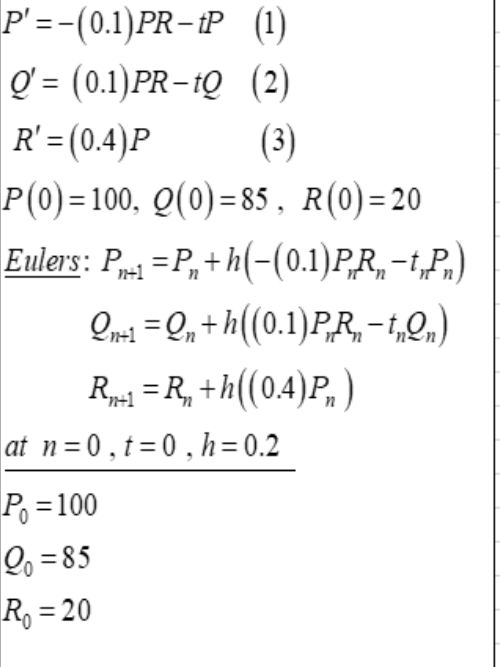
9. Here is a system of differential equations tracking three quantities P, Q, and R: P'...
5. Consider the system of differential equations yi = y1 + 2y2, y = -41/2 +...
 5. Consider the system of differential equations yi = y1 + 2y2, y = -41/2 + y2 with initial conditions yi(0) = 1, y2(0= 0. This has exact solution yı(t) = exp(t) cos(t), yz(t) = - exp(t) sin(t)/2. (a) Apply Euler's method with h=1/4 and find the global truncation error by comparing with the exact solution over the interval [0, 1]. (b) Apply the RK4 method with h=1 and find the global truncation error by comparing with the exact solution...
(15 points) This problem is related to Problem 7.23-24 in the text. Given the differential equati...
 (15 points) This problem is related to Problem 7.23-24 in the text. Given the differential equation"+20 5v (cos(9 t)u(t) Write the matrix equation for using Euler's method to compute v(t +h) from information of the function at time t, i.e., you know v(t) and initial conditions. It is assumed you will use two auxiliary functions, vi() and u2) vi(t+ h) v2(t+h vi(t) tr(t) vi (t) u2(t) For h-0.1, compute the solution for ț-0, 0.1, 0.2, 0.3, when the initial conditions...
Assignment 2 Q.1 Find the numerical solution of system of differential equation y" =t+2y + y',...
 Assignment 2 Q.1 Find the numerical solution of system of differential equation y" =t+2y + y', y(0)=0, at x = 0.2 and step length h=0.2 by Modified Euler method y'0)=1 Q.2. Write the formula of the PDE Uxx + 3y = x + 4 by finite difference Method . Q.3. Solve the initial value problem by Runga - Kutta method (order 4): y" + y' – 6y = sinx ; y(0) = 1 ; y'(0) = 0 at x =...
Question 20 1 pts Problem 20: Numerical solution of Ordinary differential equations Consider the following initial...
 Question 20 1 pts Problem 20: Numerical solution of Ordinary differential equations Consider the following initial value problem GE: H+ 15y =t 1.C:y(0) = 0.5 Carry out two consecutive steps of the Euler solution from the initial condition with a time step of At = 0.2. and the predicted solutions are None of the above. y(0.2)--0.25 and y(0.4)-0.13 (0.2)-0.05 and y(0.4)-0.03 y(0.2) -- 1.00 and y(0.4)-2.04 y(0.2)-0.13 and y(0.4)-0.20
A system of two first order differential equations can be written as: A second order explicit R...
A system of two first order differential equations can be written as: A second order explicit Runge-Kutta scheme for the system of two first order equations is Consider the following second order differential equation: Use the Runge-kutta scheme to find an approximate solution of the second order differential equation, at x = 0.2, if the step size h = 0.1. Maintain at least eight decimal digit accuracy throughout all your calculations. You may express your answer as a five decimal...
help, pls tq. 4. Consider the first order autonomous system d13-1 0)-1. (a) Estimate the solution of the system (1) at t0.2 using two steps of Euler's method with 2v, u(0)0 step-size h 0.1 T1+C2+...
 help, pls tq.
4. Consider the first order autonomous system d13-1 0)-1. (a) Estimate the solution of the system (1) at t0.2 using two steps of Euler's method with 2v, u(0)0 step-size h 0.1 T1+C2+A1-4 (b) An autonomous system of two first order differential equations can be written as: du dt=f(mu), u(to) = uo, dv dt=g(u, u), u(to) to. The Improved Euler's scheme for the system of two first order equations is tn+1 = tn + h, Use the Improved...
help, pls tq.
4. Consider the first order autonomous system d13-1 0)-1. (a) Estimate the solution of the system (1) at t0.2 using two steps of Euler's method with 2v, u(0)0 step-size h 0.1 T1+C2+A1-4 (b) An autonomous system of two first order differential equations can be written as: du dt=f(mu), u(to) = uo, dv dt=g(u, u), u(to) to. The Improved Euler's scheme for the system of two first order equations is tn+1 = tn + h, Use the Improved...
( x Question 19 1 pts Problem 19: Numerical solution of Ordinary differential equations Consider the...
 ( x Question 19 1 pts Problem 19: Numerical solution of Ordinary differential equations Consider the following initial value problem GE: +15y = t 1.C:y(0) = 0.5 Using Euler's method, and a time step of At 0.2. do you expect the numerical solution not to oscillate and to be stable? None of the above. No, because Euler's method is implicit and there is not stability limit on At. Yes, because Euler's method is explicit and there is not stability limit...
Here are three oscillator differential equations: y''[t] + 0.1 y'[t] + 5.8 y[t] = 0 ,...
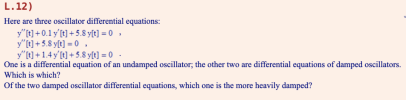 Here are three oscillator
differential equations: y''[t] + 0.1 y'[t] + 5.8 y[t] = 0 , y''[t]
+ 5.8 y[t] = 0 , y''[t] + 1.4 y'[t] + 5.8 y[t] = 0 . One is a
differential equation of an undamped oscillator; the other two are
differential equations of damped oscillators. Which is which? Of
the two damped oscillator differential equations, which one is the
more heavily damped?
PLEASE INCLUDE EXPLANATION!!!
L. 12) Here are three oscillator differential equations: y"[t]0.1...
Here are three oscillator
differential equations: y''[t] + 0.1 y'[t] + 5.8 y[t] = 0 , y''[t]
+ 5.8 y[t] = 0 , y''[t] + 1.4 y'[t] + 5.8 y[t] = 0 . One is a
differential equation of an undamped oscillator; the other two are
differential equations of damped oscillators. Which is which? Of
the two damped oscillator differential equations, which one is the
more heavily damped?
PLEASE INCLUDE EXPLANATION!!!
L. 12) Here are three oscillator differential equations: y"[t]0.1...
Find the value of x(0.5) for the initial value problem at = thx(0)=1 using Euler's method with step size h 0.05 Find the value of x(0.4) for the coupled first order differential equations toge...
 Find the value of x(0.5) for the initial value problem at = thx(0)=1 using Euler's method with step size h 0.05 Find the value of x(0.4) for the coupled first order differential equations together with initial conditions with step size 0.1: 2. dt t+x 3. dx dt = y, dy dt x(0) = 1.2 and --ty +xt2 + y(o) 0.8
Find the value of x(0.5) for the initial value problem at = thx(0)=1 using Euler's method with step size h...
Find the value of x(0.5) for the initial value problem at = thx(0)=1 using Euler's method with step size h 0.05 Find the value of x(0.4) for the coupled first order differential equations together with initial conditions with step size 0.1: 2. dt t+x 3. dx dt = y, dy dt x(0) = 1.2 and --ty +xt2 + y(o) 0.8
Find the value of x(0.5) for the initial value problem at = thx(0)=1 using Euler's method with step size h...
I'm trying to solve this differential equations by using matlab and I've got a plot from the code attached. But...
 I'm
trying to solve this differential equations by using matlab and
I've got a plot from the code attached. But I wanna get a plot of
completely sinusoidal form. If I can magnify the plot and expand
x-axis, maybe we can get the sinusoidal form. So help me with this
problem by using matlab. Example is attached in below. One is the
plot from this code and another is example.
function second_order_ode2
t=[0:0.001:1];
initial_x=0;
initial_dxdt=0;
[t,x]=ode45(@rhs,t,[initial_x initial_dxdt]);
plot(t,x(:,1))
xlabel('t')
ylabel('x')...
I'm
trying to solve this differential equations by using matlab and
I've got a plot from the code attached. But I wanna get a plot of
completely sinusoidal form. If I can magnify the plot and expand
x-axis, maybe we can get the sinusoidal form. So help me with this
problem by using matlab. Example is attached in below. One is the
plot from this code and another is example.
function second_order_ode2
t=[0:0.001:1];
initial_x=0;
initial_dxdt=0;
[t,x]=ode45(@rhs,t,[initial_x initial_dxdt]);
plot(t,x(:,1))
xlabel('t')
ylabel('x')...
 5. Consider the system of differential equations yi = y1 + 2y2, y = -41/2 + y2 with initial conditions yi(0) = 1, y2(0= 0. This has exact solution yı(t) = exp(t) cos(t), yz(t) = - exp(t) sin(t)/2. (a) Apply Euler's method with h=1/4 and find the global truncation error by comparing with the exact solution over the interval [0, 1]. (b) Apply the RK4 method with h=1 and find the global truncation error by comparing with the exact solution...
 (15 points) This problem is related to Problem 7.23-24 in the text. Given the differential equation"+20 5v (cos(9 t)u(t) Write the matrix equation for using Euler's method to compute v(t +h) from information of the function at time t, i.e., you know v(t) and initial conditions. It is assumed you will use two auxiliary functions, vi() and u2) vi(t+ h) v2(t+h vi(t) tr(t) vi (t) u2(t) For h-0.1, compute the solution for ț-0, 0.1, 0.2, 0.3, when the initial conditions...
 Assignment 2 Q.1 Find the numerical solution of system of differential equation y" =t+2y + y', y(0)=0, at x = 0.2 and step length h=0.2 by Modified Euler method y'0)=1 Q.2. Write the formula of the PDE Uxx + 3y = x + 4 by finite difference Method . Q.3. Solve the initial value problem by Runga - Kutta method (order 4): y" + y' – 6y = sinx ; y(0) = 1 ; y'(0) = 0 at x =...
 Question 20 1 pts Problem 20: Numerical solution of Ordinary differential equations Consider the following initial value problem GE: H+ 15y =t 1.C:y(0) = 0.5 Carry out two consecutive steps of the Euler solution from the initial condition with a time step of At = 0.2. and the predicted solutions are None of the above. y(0.2)--0.25 and y(0.4)-0.13 (0.2)-0.05 and y(0.4)-0.03 y(0.2) -- 1.00 and y(0.4)-2.04 y(0.2)-0.13 and y(0.4)-0.20
 help, pls tq.
4. Consider the first order autonomous system d13-1 0)-1. (a) Estimate the solution of the system (1) at t0.2 using two steps of Euler's method with 2v, u(0)0 step-size h 0.1 T1+C2+A1-4 (b) An autonomous system of two first order differential equations can be written as: du dt=f(mu), u(to) = uo, dv dt=g(u, u), u(to) to. The Improved Euler's scheme for the system of two first order equations is tn+1 = tn + h, Use the Improved...
help, pls tq.
4. Consider the first order autonomous system d13-1 0)-1. (a) Estimate the solution of the system (1) at t0.2 using two steps of Euler's method with 2v, u(0)0 step-size h 0.1 T1+C2+A1-4 (b) An autonomous system of two first order differential equations can be written as: du dt=f(mu), u(to) = uo, dv dt=g(u, u), u(to) to. The Improved Euler's scheme for the system of two first order equations is tn+1 = tn + h, Use the Improved...
 ( x Question 19 1 pts Problem 19: Numerical solution of Ordinary differential equations Consider the following initial value problem GE: +15y = t 1.C:y(0) = 0.5 Using Euler's method, and a time step of At 0.2. do you expect the numerical solution not to oscillate and to be stable? None of the above. No, because Euler's method is implicit and there is not stability limit on At. Yes, because Euler's method is explicit and there is not stability limit...
 Here are three oscillator
differential equations: y''[t] + 0.1 y'[t] + 5.8 y[t] = 0 , y''[t]
+ 5.8 y[t] = 0 , y''[t] + 1.4 y'[t] + 5.8 y[t] = 0 . One is a
differential equation of an undamped oscillator; the other two are
differential equations of damped oscillators. Which is which? Of
the two damped oscillator differential equations, which one is the
more heavily damped?
PLEASE INCLUDE EXPLANATION!!!
L. 12) Here are three oscillator differential equations: y"[t]0.1...
Here are three oscillator
differential equations: y''[t] + 0.1 y'[t] + 5.8 y[t] = 0 , y''[t]
+ 5.8 y[t] = 0 , y''[t] + 1.4 y'[t] + 5.8 y[t] = 0 . One is a
differential equation of an undamped oscillator; the other two are
differential equations of damped oscillators. Which is which? Of
the two damped oscillator differential equations, which one is the
more heavily damped?
PLEASE INCLUDE EXPLANATION!!!
L. 12) Here are three oscillator differential equations: y"[t]0.1...
 Find the value of x(0.5) for the initial value problem at = thx(0)=1 using Euler's method with step size h 0.05 Find the value of x(0.4) for the coupled first order differential equations together with initial conditions with step size 0.1: 2. dt t+x 3. dx dt = y, dy dt x(0) = 1.2 and --ty +xt2 + y(o) 0.8
Find the value of x(0.5) for the initial value problem at = thx(0)=1 using Euler's method with step size h...
Find the value of x(0.5) for the initial value problem at = thx(0)=1 using Euler's method with step size h 0.05 Find the value of x(0.4) for the coupled first order differential equations together with initial conditions with step size 0.1: 2. dt t+x 3. dx dt = y, dy dt x(0) = 1.2 and --ty +xt2 + y(o) 0.8
Find the value of x(0.5) for the initial value problem at = thx(0)=1 using Euler's method with step size h...
 I'm
trying to solve this differential equations by using matlab and
I've got a plot from the code attached. But I wanna get a plot of
completely sinusoidal form. If I can magnify the plot and expand
x-axis, maybe we can get the sinusoidal form. So help me with this
problem by using matlab. Example is attached in below. One is the
plot from this code and another is example.
function second_order_ode2
t=[0:0.001:1];
initial_x=0;
initial_dxdt=0;
[t,x]=ode45(@rhs,t,[initial_x initial_dxdt]);
plot(t,x(:,1))
xlabel('t')
ylabel('x')...
I'm
trying to solve this differential equations by using matlab and
I've got a plot from the code attached. But I wanna get a plot of
completely sinusoidal form. If I can magnify the plot and expand
x-axis, maybe we can get the sinusoidal form. So help me with this
problem by using matlab. Example is attached in below. One is the
plot from this code and another is example.
function second_order_ode2
t=[0:0.001:1];
initial_x=0;
initial_dxdt=0;
[t,x]=ode45(@rhs,t,[initial_x initial_dxdt]);
plot(t,x(:,1))
xlabel('t')
ylabel('x')...
Most questions answered within 3 hours.
-
Where is the error in this code sequence?
String s1 = "Hello";
String s2 = "ello";...
asked 10 months ago -
Financial data for Joel de Paris, Inc., for last year
follow:
Joel de Paris, Inc.
Balance...
asked 10 months ago -
Consider this reaction:
Al2(SO4)3 (aq)+ BaCl3
(aq) Al2Cl6 (aq)- +
3BaSO4(s) . What is the...
asked 10 months ago -
Suppose that Savneet is considering increasing her
recent random sample from 20 car rentals to 40...
asked 10 months ago -
Trucks arrive at an unloading terminal at an average rate of 120
per hour.
Trucks arrive...
asked 10 months ago -
Why are methanol and ethanol completely soluble in water while
octanol is not very little soluble....
asked 10 months ago -
A facilities manager at a university reads in a research report
that the mean amount of...
asked 10 months ago -
When the CuSO4 is rehydrated by adding water to the anhydrous
compound, is this an endothermic...
asked 10 months ago -
A ray of sunlight is passing from diamond into crown glass; the
angle of incidence is...
asked 10 months ago -
A block of mass 0.249 kg is placed on top of a light, vertical
spring of...
asked 10 months ago -
how do the kidneys compensate in the presences of acidosis
a) trigger hyperventilate
b) reserve acid...
asked 10 months ago -
Question 501 pts
The rental rate of capital to the firm increases. Which of the
following...
asked 10 months ago