
Homework Answers
Request Answer!
We need at least 10 more requests to produce the answer.
0 / 10 have requested this problem solution
The more requests, the faster the answer.
Add Answer to:
8. state what will happen according to the statements
below.
8. C2H4 (g) + Cl2 (g)...
6 4 points For the reaction shown here: COCI, () --> CO(g) + Cl2 (8) has...
 6 4 points For the reaction shown here: COCI, () --> CO(g) + Cl2 (8) has a standard Gibb's Free Energy of -12.5 kJ. For each change listed below, indicated how it would affect the spontaneity of the reaction. Remove CO Add C12 Increase the temperature Increase Spontaneity Decrease Spontaneity Increase Spontaneity Decrease Spontaneity Increase Pressure
Indicate whether the actions below will shift the following reaction: RIGHT, LEFT or NO CHANGE. Heat...
 Indicate whether the actions below will shift the following reaction: RIGHT, LEFT or NO CHANGE. Heat + NH4CO2NHz(s) <=> 2 NH3(g) + CO2(g) Increasing the quantity of NH4CO2NH2(s) Removing CO2(g) Increasing the volume of the container Increasing the temperature Adding a catalyst right left no change
Question 26 6 pts 26. Consider the following chemical reaction: CO(g) + Cl2(8) -------------> COC12 (8)...
 Question 26 6 pts 26. Consider the following chemical reaction: CO(g) + Cl2(8) -------------> COC12 (8) At the beginning 0.400 M CO(g) is mixed with 0.0500 M Cl2(g). At equilibrium, 0.0100 M of the product is produced. Calculate the equilibrium constant. OK -8.81 K-1.20 x 10exp-5 K=0.641 OK = 1.99x 10exp-3 Question 27 6 pts 27. Consider the following chemical reaction: N2(g) + 202(8) 2NO2(g) decreasing the pressure of reaction mixture will decrease amounts of O2(g) increase amounts of NO2(g)...
Additional Questions Consider the following reaction at equilibrium: PCB (g) + Cl2(g) ---PC1s (8) + Heat...
 Additional Questions Consider the following reaction at equilibrium: PCB (g) + Cl2(g) ---PC1s (8) + Heat Fill in the table below by indicating what direction the equilibrium will shift when the changes indicated are made, and the shift will have on each species in the reaction mixture. You may use lelt and right arrows for the shift, and up or down arrows to indicate concentration changes. Indicate no change by writing NC Stress Eq Shift PCI, Conc. Cl2 Conc. PCIs...
) Given: CS2(g) + 3 Cl2() <= > CCl4 (8) + S2Cl2 (8) AH = -238...
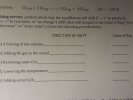 ) Given: CS2(g) + 3 Cl2() <= > CCl4 (8) + S2Cl2 (8) AH = -238 kJ Using arrows predict which way the equilibrium will shift ("---->" to products, <---"to reactants, or "no change") AND what will happen to the value of keq ("incr decrease", or "stays same"). Given the following perturbations: DIRECTION OF SHIFT Value of Keq ) A halving of the volume b) Adding Ne gas to the vessel -) Removing some CCIA 3) Lowering the temperature_ e)...
10. Examine the reaction: 2NOCI(g) 2NO (g) + Cl2(g) When the above reaction reaches equilibrium the...
 10. Examine the reaction: 2NOCI(g) 2NO (g) + Cl2(g) When the above reaction reaches equilibrium the concentration of each component is [NOCI] = 2.9 M. [NO] =1.1 Mand [Cl2] = 0.65 M. What is the equilibrium constant, K for this reaction? Does the equilibrium lie on the left side or the right side of the equilibrium? 9. The following equilibrium is endothermic. In the box below, show how the reaction will shift response to the indicated stress by writing,, or...
1) For the following reaction: SO2Cl2(g)<-> SO2(g) + Cl2 (g) Kp=2.91x10^3 at 298K In the reaction...
1) For the following reaction: SO2Cl2(g)<-> SO2(g) + Cl2 (g) Kp=2.91x10^3 at 298K In the reaction at equilibrium, the partial pressure of SO2 is 137 torr and that of CL2 is 285 torr. The partial pressure of SO2Cl2 is [x]torr. 2) For the following reaction:NH4HS(s)<->NH3(g) + H2S (g) Kc=8.5x10^-3 At any given point the reaction mixture has solid NH4HS, NH3 at 0.166M and H2S at 0.166M. a) Is the reaction at equilibrium? b)Will more of the solid form, or will...
CO(g) + Cl2(g) <==-=> COCI2(8) AH = 58 kJ Determine Kp at 500°C if the pressure...
 CO(g) + Cl2(g) <==-=> COCI2(8) AH = 58 kJ Determine Kp at 500°C if the pressure is in atm and Kc is 5.55 x 10¹⁰ A 5.82 x 10⁻⁵ B 2.28 x 10¹² 5.30 x 1025 1.35 x 10° E 8.75 x 10⁸
questions: 2,3 & 4 1. Consider the following reaction: PCI (1) + Cu(a) PCIS (s) +...
 questions: 2,3 & 4
1. Consider the following reaction: PCI (1) + Cu(a) PCIS (s) + BBkJ Equilibrium will shift ? (or How wil this affect the amoun no change) of CI, ? increase, decrease.no Change change) Increase the temperature Backwand Increase Add a catalyst unchanged unchange Increase the amount of chlorine Forward Decrease Add more PCI Do change No Change Increase the volume Balk ward increase Increase the pressure Forward I fecrease 2. What is equal at equilibrium? 3....
questions: 2,3 & 4
1. Consider the following reaction: PCI (1) + Cu(a) PCIS (s) + BBkJ Equilibrium will shift ? (or How wil this affect the amoun no change) of CI, ? increase, decrease.no Change change) Increase the temperature Backwand Increase Add a catalyst unchanged unchange Increase the amount of chlorine Forward Decrease Add more PCI Do change No Change Increase the volume Balk ward increase Increase the pressure Forward I fecrease 2. What is equal at equilibrium? 3....
5. Carbonyl fluoride, COF2, can be prepared by the following reaction? CO2(8) + CF4(g) < +...
 5. Carbonyl fluoride, COF2, can be prepared by the following reaction? CO2(8) + CF4(g) < + 2COF2(g) At 1000°C, K for this reaction is 0.50. What are the partial pressures of all the gases at equilibrium when the initial partial pressures of CO2 and CF4 are 0.513 atm.
 6 4 points For the reaction shown here: COCI, () --> CO(g) + Cl2 (8) has a standard Gibb's Free Energy of -12.5 kJ. For each change listed below, indicated how it would affect the spontaneity of the reaction. Remove CO Add C12 Increase the temperature Increase Spontaneity Decrease Spontaneity Increase Spontaneity Decrease Spontaneity Increase Pressure
 Indicate whether the actions below will shift the following reaction: RIGHT, LEFT or NO CHANGE. Heat + NH4CO2NHz(s) <=> 2 NH3(g) + CO2(g) Increasing the quantity of NH4CO2NH2(s) Removing CO2(g) Increasing the volume of the container Increasing the temperature Adding a catalyst right left no change
 Question 26 6 pts 26. Consider the following chemical reaction: CO(g) + Cl2(8) -------------> COC12 (8) At the beginning 0.400 M CO(g) is mixed with 0.0500 M Cl2(g). At equilibrium, 0.0100 M of the product is produced. Calculate the equilibrium constant. OK -8.81 K-1.20 x 10exp-5 K=0.641 OK = 1.99x 10exp-3 Question 27 6 pts 27. Consider the following chemical reaction: N2(g) + 202(8) 2NO2(g) decreasing the pressure of reaction mixture will decrease amounts of O2(g) increase amounts of NO2(g)...
 Additional Questions Consider the following reaction at equilibrium: PCB (g) + Cl2(g) ---PC1s (8) + Heat Fill in the table below by indicating what direction the equilibrium will shift when the changes indicated are made, and the shift will have on each species in the reaction mixture. You may use lelt and right arrows for the shift, and up or down arrows to indicate concentration changes. Indicate no change by writing NC Stress Eq Shift PCI, Conc. Cl2 Conc. PCIs...
 ) Given: CS2(g) + 3 Cl2() <= > CCl4 (8) + S2Cl2 (8) AH = -238 kJ Using arrows predict which way the equilibrium will shift ("---->" to products, <---"to reactants, or "no change") AND what will happen to the value of keq ("incr decrease", or "stays same"). Given the following perturbations: DIRECTION OF SHIFT Value of Keq ) A halving of the volume b) Adding Ne gas to the vessel -) Removing some CCIA 3) Lowering the temperature_ e)...
 10. Examine the reaction: 2NOCI(g) 2NO (g) + Cl2(g) When the above reaction reaches equilibrium the concentration of each component is [NOCI] = 2.9 M. [NO] =1.1 Mand [Cl2] = 0.65 M. What is the equilibrium constant, K for this reaction? Does the equilibrium lie on the left side or the right side of the equilibrium? 9. The following equilibrium is endothermic. In the box below, show how the reaction will shift response to the indicated stress by writing,, or...
 CO(g) + Cl2(g) <==-=> COCI2(8) AH = 58 kJ Determine Kp at 500°C if the pressure is in atm and Kc is 5.55 x 10¹⁰ A 5.82 x 10⁻⁵ B 2.28 x 10¹² 5.30 x 1025 1.35 x 10° E 8.75 x 10⁸
 questions: 2,3 & 4
1. Consider the following reaction: PCI (1) + Cu(a) PCIS (s) + BBkJ Equilibrium will shift ? (or How wil this affect the amoun no change) of CI, ? increase, decrease.no Change change) Increase the temperature Backwand Increase Add a catalyst unchanged unchange Increase the amount of chlorine Forward Decrease Add more PCI Do change No Change Increase the volume Balk ward increase Increase the pressure Forward I fecrease 2. What is equal at equilibrium? 3....
questions: 2,3 & 4
1. Consider the following reaction: PCI (1) + Cu(a) PCIS (s) + BBkJ Equilibrium will shift ? (or How wil this affect the amoun no change) of CI, ? increase, decrease.no Change change) Increase the temperature Backwand Increase Add a catalyst unchanged unchange Increase the amount of chlorine Forward Decrease Add more PCI Do change No Change Increase the volume Balk ward increase Increase the pressure Forward I fecrease 2. What is equal at equilibrium? 3....
 5. Carbonyl fluoride, COF2, can be prepared by the following reaction? CO2(8) + CF4(g) < + 2COF2(g) At 1000°C, K for this reaction is 0.50. What are the partial pressures of all the gases at equilibrium when the initial partial pressures of CO2 and CF4 are 0.513 atm.
Most questions answered within 3 hours.
-
Where is the error in this code sequence?
String s1 = "Hello";
String s2 = "ello";...
asked 10 months ago -
Financial data for Joel de Paris, Inc., for last year
follow:
Joel de Paris, Inc.
Balance...
asked 10 months ago -
Consider this reaction:
Al2(SO4)3 (aq)+ BaCl3
(aq) Al2Cl6 (aq)- +
3BaSO4(s) . What is the...
asked 10 months ago -
Suppose that Savneet is considering increasing her
recent random sample from 20 car rentals to 40...
asked 10 months ago -
Trucks arrive at an unloading terminal at an average rate of 120
per hour.
Trucks arrive...
asked 10 months ago -
Why are methanol and ethanol completely soluble in water while
octanol is not very little soluble....
asked 10 months ago -
A facilities manager at a university reads in a research report
that the mean amount of...
asked 10 months ago -
When the CuSO4 is rehydrated by adding water to the anhydrous
compound, is this an endothermic...
asked 10 months ago -
A ray of sunlight is passing from diamond into crown glass; the
angle of incidence is...
asked 10 months ago -
A block of mass 0.249 kg is placed on top of a light, vertical
spring of...
asked 10 months ago -
how do the kidneys compensate in the presences of acidosis
a) trigger hyperventilate
b) reserve acid...
asked 10 months ago -
Question 501 pts
The rental rate of capital to the firm increases. Which of the
following...
asked 10 months ago