
Homework Answers
Add Answer to:
HI, PLEASE ANSWER ALL PARTS AND PLEASE SHOW ALL WORKINGS STEP BY STEP. THANK YOU. Question...
HI, PLEASE ANSWER ALL PARTS AND PLEASE SHOW ALL WORKINGS STEP BY STEP. THANK YOU. a)...
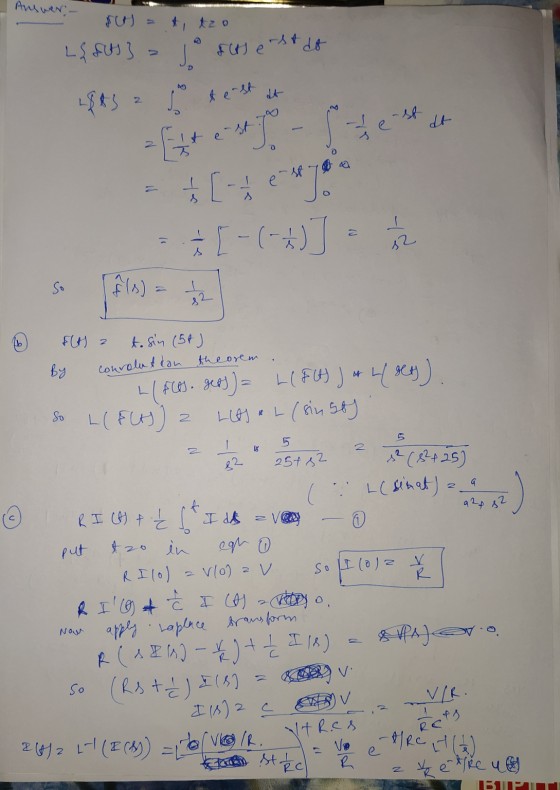
 HI, PLEASE ANSWER ALL PARTS AND PLEASE SHOW ALL WORKINGS STEP BY STEP. THANK YOU. a) Show from first principles that the Laplace transform of the function (0)=1, a 20 is f(3) = Make a note of any conditions imposed on the transform variable "s" to ensure the transform exists. (8 Marks) b) Find, using the appropriate theorem, the Laplace transform of a function f(t): f(t) = e-3t.sin(4t) OR Find the inverse Laplace transform of the following: ses f(s) =...
HI, PLEASE ANSWER ALL PARTS AND PLEASE SHOW ALL WORKINGS STEP BY STEP. THANK YOU. a)...
 HI, PLEASE ANSWER ALL PARTS AND PLEASE SHOW ALL WORKINGS STEP BY STEP. THANK YOU. a) Find the Fourier transform of f(t) = 14 -1sts1 lo otherwise (8 Marks) b) Use the solution of Q3 (a) to find the Fourier transform of f(t) 54 1sts3 to otherwise (4 Marks) c) Use the solution from Q3(a) and the appropriate theorem to find the Fourier transform of the following function; g(t) = eitf(t) (4 Marks) d) Find the convolution, f*g, of the...
HI, PLEASE ANSWER ALL PARTS AND PLEASE SHOW ALL WORKINGS STEP BY STEP. THANK YOU. a)...
 HI, PLEASE ANSWER ALL PARTS AND PLEASE SHOW ALL WORKINGS STEP BY STEP. THANK YOU. a) A discrete-time filter is defined by the difference equation; Vk - 0.5yk-1= xk Describe the filter response to a unit step input applied at k = 0, for the range 0 Sk <5. (8 Marks) b) Show from first principles the z-transform of the following; i. Z{e-k), where k = 0,1,2... c) Draw a block diagram to represent the system modelled by the difference...
HI, PLEASE ANSWER ALL PARTS AND PLEASE SHOW ALL WORKINGS STEP BY STEP. THANK YOU. a)...
 HI, PLEASE ANSWER ALL PARTS AND PLEASE SHOW ALL WORKINGS STEP BY STEP. THANK YOU. a) Draw the block diagram representation of the discrete-time system Yk+2+ Yk+1 +0.5yk = Ux (8 Marks) b) Find the impulse response of the system with the z transfer function; Z G(z) = 22 + 3z + 2 c) Use z-transforms to solve the following difference equation; 6Yk+2 + Yk+1 - Yx = 3 subject to yo = y1 = 0
This is control system question. please answer all and show a clear step. Thank you! Question...
 This is control system question. please answer all and
show a clear step. Thank you!
Question 3 Given the translational system shown in Figure 2, an input force, f(t) is applied to the mass, M, causing the dashpot which has a viscosity B and the spring, a stiffness coefficient of k, to compress with output displacement X(t). Input force, f(t) M O F Fixed point Displacement, X(t) Figure 2: A translational system (a) Derive the system's equation in terms of...
This is control system question. please answer all and
show a clear step. Thank you!
Question 3 Given the translational system shown in Figure 2, an input force, f(t) is applied to the mass, M, causing the dashpot which has a viscosity B and the spring, a stiffness coefficient of k, to compress with output displacement X(t). Input force, f(t) M O F Fixed point Displacement, X(t) Figure 2: A translational system (a) Derive the system's equation in terms of...
System Modeling and Laplace transform: In this problem we will review the modeling proce- dure for the RLC circuit as shown below, and how to find the corresponding transfer function and step respons...
 System Modeling and Laplace transform: In this problem we will review the modeling proce- dure for the RLC circuit as shown below, and how to find the corresponding transfer function and step response Ri R2 Cv0) i2) i,(0) 3.1 Considering the input to be V(t) and the output to be Ve(t), find the transfer function of the system. To do that, first derive the differential equations for al the three loops and then take the Laplace transforms of them. 3.2...
Please help to answer this question and show the work clearly because I want to learn....
 Please help to answer this question and show the work clearly
because I want to learn. I will give thumbs up for sure, thank you
very much!!!
lebi, 03134\. The Assume that a circuit has the impulse response of h(t)= { 10, elsewhere input x(t) to the circuit is given by x(t)=6u(t), where u(t) is the unit step function. Assume that the circuit output is given by y(t). a) (20 pts) Use the convolution integral to derive the expressions for...
Please help to answer this question and show the work clearly
because I want to learn. I will give thumbs up for sure, thank you
very much!!!
lebi, 03134\. The Assume that a circuit has the impulse response of h(t)= { 10, elsewhere input x(t) to the circuit is given by x(t)=6u(t), where u(t) is the unit step function. Assume that the circuit output is given by y(t). a) (20 pts) Use the convolution integral to derive the expressions for...
Hi. please take your time to answer all parts of this question in great detail, please...
 Hi.
please take your time to answer all parts of this question in great
detail, please do not assume i know any shorthand on this question
because i do not. Please number all parts as you answer each
question and be as neat as possible and show all formulas and
calculations used as clear as possible, and please label the
diagram too.
Thanks in advance.
a) Draw the equivalent circuit of a shunt-wound DC motor, and write down its governing...
Hi.
please take your time to answer all parts of this question in great
detail, please do not assume i know any shorthand on this question
because i do not. Please number all parts as you answer each
question and be as neat as possible and show all formulas and
calculations used as clear as possible, and please label the
diagram too.
Thanks in advance.
a) Draw the equivalent circuit of a shunt-wound DC motor, and write down its governing...
Exercise 4) Consider the RC network shown, where v(t) is the input voltage and ve(t) is...
 Exercise 4) Consider the RC network shown, where v(t) is the input voltage and ve(t) is the circuit output voltage. R is the same for all resistors (4a) Write differential equations of the circuit in terms of the currents. Convert the equa tions to the Laplace domain (5 marks)v(oO 4b) Find the transfer function Ve(s)/V(s) (5 marks) (4c) Using the final value theorem, calculate the steady-state value of ve(t) for an unit step input of u(t), i.e., u(t)-1 V (2.5...
c) For the circuit shown in Figure 3, where u(t) is the unit step function, using...
 c) For the circuit shown in Figure 3, where u(t) is the unit step function, using Laplace transform methods and showing all working, find the response i(t) fort> 0. (9 marks) 4H 7e-u(t) v(1) 352 322 Figure 3
 HI, PLEASE ANSWER ALL PARTS AND PLEASE SHOW ALL WORKINGS STEP BY STEP. THANK YOU. a) Show from first principles that the Laplace transform of the function (0)=1, a 20 is f(3) = Make a note of any conditions imposed on the transform variable "s" to ensure the transform exists. (8 Marks) b) Find, using the appropriate theorem, the Laplace transform of a function f(t): f(t) = e-3t.sin(4t) OR Find the inverse Laplace transform of the following: ses f(s) =...
 HI, PLEASE ANSWER ALL PARTS AND PLEASE SHOW ALL WORKINGS STEP BY STEP. THANK YOU. a) Find the Fourier transform of f(t) = 14 -1sts1 lo otherwise (8 Marks) b) Use the solution of Q3 (a) to find the Fourier transform of f(t) 54 1sts3 to otherwise (4 Marks) c) Use the solution from Q3(a) and the appropriate theorem to find the Fourier transform of the following function; g(t) = eitf(t) (4 Marks) d) Find the convolution, f*g, of the...
 HI, PLEASE ANSWER ALL PARTS AND PLEASE SHOW ALL WORKINGS STEP BY STEP. THANK YOU. a) A discrete-time filter is defined by the difference equation; Vk - 0.5yk-1= xk Describe the filter response to a unit step input applied at k = 0, for the range 0 Sk <5. (8 Marks) b) Show from first principles the z-transform of the following; i. Z{e-k), where k = 0,1,2... c) Draw a block diagram to represent the system modelled by the difference...
 HI, PLEASE ANSWER ALL PARTS AND PLEASE SHOW ALL WORKINGS STEP BY STEP. THANK YOU. a) Draw the block diagram representation of the discrete-time system Yk+2+ Yk+1 +0.5yk = Ux (8 Marks) b) Find the impulse response of the system with the z transfer function; Z G(z) = 22 + 3z + 2 c) Use z-transforms to solve the following difference equation; 6Yk+2 + Yk+1 - Yx = 3 subject to yo = y1 = 0
 This is control system question. please answer all and
show a clear step. Thank you!
Question 3 Given the translational system shown in Figure 2, an input force, f(t) is applied to the mass, M, causing the dashpot which has a viscosity B and the spring, a stiffness coefficient of k, to compress with output displacement X(t). Input force, f(t) M O F Fixed point Displacement, X(t) Figure 2: A translational system (a) Derive the system's equation in terms of...
This is control system question. please answer all and
show a clear step. Thank you!
Question 3 Given the translational system shown in Figure 2, an input force, f(t) is applied to the mass, M, causing the dashpot which has a viscosity B and the spring, a stiffness coefficient of k, to compress with output displacement X(t). Input force, f(t) M O F Fixed point Displacement, X(t) Figure 2: A translational system (a) Derive the system's equation in terms of...
 System Modeling and Laplace transform: In this problem we will review the modeling proce- dure for the RLC circuit as shown below, and how to find the corresponding transfer function and step response Ri R2 Cv0) i2) i,(0) 3.1 Considering the input to be V(t) and the output to be Ve(t), find the transfer function of the system. To do that, first derive the differential equations for al the three loops and then take the Laplace transforms of them. 3.2...
 Please help to answer this question and show the work clearly
because I want to learn. I will give thumbs up for sure, thank you
very much!!!
lebi, 03134\. The Assume that a circuit has the impulse response of h(t)= { 10, elsewhere input x(t) to the circuit is given by x(t)=6u(t), where u(t) is the unit step function. Assume that the circuit output is given by y(t). a) (20 pts) Use the convolution integral to derive the expressions for...
Please help to answer this question and show the work clearly
because I want to learn. I will give thumbs up for sure, thank you
very much!!!
lebi, 03134\. The Assume that a circuit has the impulse response of h(t)= { 10, elsewhere input x(t) to the circuit is given by x(t)=6u(t), where u(t) is the unit step function. Assume that the circuit output is given by y(t). a) (20 pts) Use the convolution integral to derive the expressions for...
 Hi.
please take your time to answer all parts of this question in great
detail, please do not assume i know any shorthand on this question
because i do not. Please number all parts as you answer each
question and be as neat as possible and show all formulas and
calculations used as clear as possible, and please label the
diagram too.
Thanks in advance.
a) Draw the equivalent circuit of a shunt-wound DC motor, and write down its governing...
Hi.
please take your time to answer all parts of this question in great
detail, please do not assume i know any shorthand on this question
because i do not. Please number all parts as you answer each
question and be as neat as possible and show all formulas and
calculations used as clear as possible, and please label the
diagram too.
Thanks in advance.
a) Draw the equivalent circuit of a shunt-wound DC motor, and write down its governing...
 Exercise 4) Consider the RC network shown, where v(t) is the input voltage and ve(t) is the circuit output voltage. R is the same for all resistors (4a) Write differential equations of the circuit in terms of the currents. Convert the equa tions to the Laplace domain (5 marks)v(oO 4b) Find the transfer function Ve(s)/V(s) (5 marks) (4c) Using the final value theorem, calculate the steady-state value of ve(t) for an unit step input of u(t), i.e., u(t)-1 V (2.5...
 c) For the circuit shown in Figure 3, where u(t) is the unit step function, using Laplace transform methods and showing all working, find the response i(t) fort> 0. (9 marks) 4H 7e-u(t) v(1) 352 322 Figure 3
Most questions answered within 3 hours.
-
Where is the error in this code sequence?
String s1 = "Hello";
String s2 = "ello";...
asked 10 months ago -
Financial data for Joel de Paris, Inc., for last year
follow:
Joel de Paris, Inc.
Balance...
asked 10 months ago -
Consider this reaction:
Al2(SO4)3 (aq)+ BaCl3
(aq) Al2Cl6 (aq)- +
3BaSO4(s) . What is the...
asked 10 months ago -
Suppose that Savneet is considering increasing her
recent random sample from 20 car rentals to 40...
asked 10 months ago -
Trucks arrive at an unloading terminal at an average rate of 120
per hour.
Trucks arrive...
asked 10 months ago -
Why are methanol and ethanol completely soluble in water while
octanol is not very little soluble....
asked 10 months ago -
A facilities manager at a university reads in a research report
that the mean amount of...
asked 10 months ago -
When the CuSO4 is rehydrated by adding water to the anhydrous
compound, is this an endothermic...
asked 10 months ago -
A ray of sunlight is passing from diamond into crown glass; the
angle of incidence is...
asked 10 months ago -
A block of mass 0.249 kg is placed on top of a light, vertical
spring of...
asked 10 months ago -
how do the kidneys compensate in the presences of acidosis
a) trigger hyperventilate
b) reserve acid...
asked 10 months ago -
Question 501 pts
The rental rate of capital to the firm increases. Which of the
following...
asked 10 months ago