
This is control system question. please answer all and show a clear step. Thank you!
Homework Answers
Request Answer!
We need at least 10 more requests to produce the answer.
0 / 10 have requested this problem solution
The more requests, the faster the answer.
Add Answer to:
This is control system question. please answer all and
show a clear step. Thank you!
Question...
system modelling
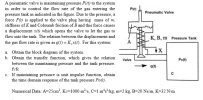 (please help)pneumatic valve is maintaining pressure Pi(t) to the system in order to control the flow rate of the gas entering the pressure tank as indicated in the figure. Due to the pressure, a force F(t) is applied to the valve plug having mass of m, stiffness of K and Coloumb friction of B and this force causes a displacement x(t) which opens the valve to let the gas to flow into the tank. The relation between the displacement and...
Introduction Many doors in public places are fitted with simple and inexpensive mechanisms that are designed...
 Introduction Many doors in public places are fitted with simple and inexpensive mechanisms that are designed to close the doors while reducing the slamming force to a minimum. Figure 1 Figure 1 depicts one such mechanism while Figure 2 provides a schematic description. The spring is mounted in order to push the door back to close once it is opened. The role of the hydraulic dashpot is to provide a viscous force that will prevent the door from slamming against...
Consider the mass-spring-damper system depicted in the figure below, where the input of the system is...
 Consider the mass-spring-damper system depicted in the figure below, where the input of the system is the applied force F(t) and the output of the system is xít) that is the displacement of the mass according to the coordinate system defined in that figure. Assume that force F(t) is applied for t> 0 and the system is in static equilibrium before t=0 and z(t) is measured from the static equilibrium. b m F Also, the mass of the block, the...
Introduction Many doors in public places are fitted with simple and inexpensive mechanisms that are designed...
 Introduction Many doors in public places are fitted with simple and inexpensive mechanisms that are designed to close the doors while reducing the slamming force to a minimum. Figure 1 Figure 1 depicts one such mechanism while Figure 2 provides a schematic description. The spring is mounted in order to push the door back to close once it is opened. The role of the hydraulic dashpot is to provide a viscous force that will prevent the door from slamming against...
HI, PLEASE ANSWER ALL PARTS AND PLEASE SHOW ALL WORKINGS STEP BY STEP. THANK YOU. a)...
 HI, PLEASE ANSWER ALL PARTS AND PLEASE SHOW ALL WORKINGS STEP BY STEP. THANK YOU. a) Show from first principles that the Laplace transform of the function (0)=1, a 20 is f(3) = Make a note of any conditions imposed on the transform variable "s" to ensure the transform exists. (8 Marks) b) Find, using the appropriate theorem, the Laplace transform of a function f(t): f(t) = e-3t.sin(4t) OR Find the inverse Laplace transform of the following: ses f(s) =...
please can you solve clearly and step by step GA Problem-5: The system given in the...
 please can you solve clearly and step by step
GA Problem-5: The system given in the following figure consists of a pulley with inertia ) and radius r, and a hanging object with mass m. The input of this system is the torque t applied on the pulley and angle is measured along CCW direction in radians. Assume that the effect of gravity is balanced by the springs before the torque is applied. a) Obtain a parametric mathematical model for...
please can you solve clearly and step by step
GA Problem-5: The system given in the following figure consists of a pulley with inertia ) and radius r, and a hanging object with mass m. The input of this system is the torque t applied on the pulley and angle is measured along CCW direction in radians. Assume that the effect of gravity is balanced by the springs before the torque is applied. a) Obtain a parametric mathematical model for...
Show ALL work. Include all units at every step. 2. For the system shown in the...
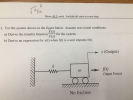 Show ALL work. Include all units at every step. 2. For the system shown in the figure below. Assume zero initial conditions. X(s) for the system. a) Derive the transfer function F(s) b) Derive an expression for x(t) when f(t) is a unit impulse 8(t). x(Output) f(t) (Input Force) ww No friction
63 Figure P6.3 shows a mass-damper system (no stiffness, Problem 2.3). Displacement x is measured...
 63 Figure P6.3 shows a mass-damper system (no stiffness, Problem 2.3). Displacement x is measured from an equilibrium position where the damper is at the "neutral" position. The external force () is a short-duration pulse function: f(!)-5N for 0SS002 s, and f,() = 0 for t > 0.02 s. The system parameters are mass m-0.5kg and viscous friction coefficient b 3 N-s/m and the system is initially at rest. Usc Simulink to determine the system response and plot displacement xit)...
PROBLEM 1 (35 %) The mechanical system in the figure below consists of a disk of radius r, a block of mass m, a spr...
 PROBLEM 1 (35 %) The mechanical system in the figure below consists of a disk of radius r, a block of mass m, a spring of stiffness (spring constant) k, and a damper with damping ratio b. The disk has moment of inertia Jabout its center of mass (pivot point O), and the block is subjected to an external force t) as shown in the figure. The spring is unstressed when x 0= 0. Assume small 0. (a) (10 points)...
For the system shown in Fig. 1, solve the following problems. (a) Find the transfer function, G(s...
 For the system shown in Fig. 1, solve the following problems. (a) Find the transfer function, G(s)X2 (s)/F(s) (b) Does the system oscillate with a unit step input (f (t))? Explain the reason (c) Decide if the system(x2 (t)) is stable with a unit step input (f (t))? Explain the reason 1. 320) 8 kg 2 N/m 4N-s/m 2N-s/m Fig. 1 2. There are two suspensions for a car as shown in Fig. 2 (a) Find the equations of each...
 Introduction Many doors in public places are fitted with simple and inexpensive mechanisms that are designed to close the doors while reducing the slamming force to a minimum. Figure 1 Figure 1 depicts one such mechanism while Figure 2 provides a schematic description. The spring is mounted in order to push the door back to close once it is opened. The role of the hydraulic dashpot is to provide a viscous force that will prevent the door from slamming against...
 Consider the mass-spring-damper system depicted in the figure below, where the input of the system is the applied force F(t) and the output of the system is xít) that is the displacement of the mass according to the coordinate system defined in that figure. Assume that force F(t) is applied for t> 0 and the system is in static equilibrium before t=0 and z(t) is measured from the static equilibrium. b m F Also, the mass of the block, the...
 Introduction Many doors in public places are fitted with simple and inexpensive mechanisms that are designed to close the doors while reducing the slamming force to a minimum. Figure 1 Figure 1 depicts one such mechanism while Figure 2 provides a schematic description. The spring is mounted in order to push the door back to close once it is opened. The role of the hydraulic dashpot is to provide a viscous force that will prevent the door from slamming against...
 HI, PLEASE ANSWER ALL PARTS AND PLEASE SHOW ALL WORKINGS STEP BY STEP. THANK YOU. a) Show from first principles that the Laplace transform of the function (0)=1, a 20 is f(3) = Make a note of any conditions imposed on the transform variable "s" to ensure the transform exists. (8 Marks) b) Find, using the appropriate theorem, the Laplace transform of a function f(t): f(t) = e-3t.sin(4t) OR Find the inverse Laplace transform of the following: ses f(s) =...
 please can you solve clearly and step by step
GA Problem-5: The system given in the following figure consists of a pulley with inertia ) and radius r, and a hanging object with mass m. The input of this system is the torque t applied on the pulley and angle is measured along CCW direction in radians. Assume that the effect of gravity is balanced by the springs before the torque is applied. a) Obtain a parametric mathematical model for...
please can you solve clearly and step by step
GA Problem-5: The system given in the following figure consists of a pulley with inertia ) and radius r, and a hanging object with mass m. The input of this system is the torque t applied on the pulley and angle is measured along CCW direction in radians. Assume that the effect of gravity is balanced by the springs before the torque is applied. a) Obtain a parametric mathematical model for...
 Show ALL work. Include all units at every step. 2. For the system shown in the figure below. Assume zero initial conditions. X(s) for the system. a) Derive the transfer function F(s) b) Derive an expression for x(t) when f(t) is a unit impulse 8(t). x(Output) f(t) (Input Force) ww No friction
 63 Figure P6.3 shows a mass-damper system (no stiffness, Problem 2.3). Displacement x is measured from an equilibrium position where the damper is at the "neutral" position. The external force () is a short-duration pulse function: f(!)-5N for 0SS002 s, and f,() = 0 for t > 0.02 s. The system parameters are mass m-0.5kg and viscous friction coefficient b 3 N-s/m and the system is initially at rest. Usc Simulink to determine the system response and plot displacement xit)...
 PROBLEM 1 (35 %) The mechanical system in the figure below consists of a disk of radius r, a block of mass m, a spring of stiffness (spring constant) k, and a damper with damping ratio b. The disk has moment of inertia Jabout its center of mass (pivot point O), and the block is subjected to an external force t) as shown in the figure. The spring is unstressed when x 0= 0. Assume small 0. (a) (10 points)...
 For the system shown in Fig. 1, solve the following problems. (a) Find the transfer function, G(s)X2 (s)/F(s) (b) Does the system oscillate with a unit step input (f (t))? Explain the reason (c) Decide if the system(x2 (t)) is stable with a unit step input (f (t))? Explain the reason 1. 320) 8 kg 2 N/m 4N-s/m 2N-s/m Fig. 1 2. There are two suspensions for a car as shown in Fig. 2 (a) Find the equations of each...
Most questions answered within 3 hours.
-
Where is the error in this code sequence?
String s1 = "Hello";
String s2 = "ello";...
asked 11 months ago -
Financial data for Joel de Paris, Inc., for last year
follow:
Joel de Paris, Inc.
Balance...
asked 11 months ago -
Consider this reaction:
Al2(SO4)3 (aq)+ BaCl3
(aq) Al2Cl6 (aq)- +
3BaSO4(s) . What is the...
asked 11 months ago -
Suppose that Savneet is considering increasing her
recent random sample from 20 car rentals to 40...
asked 11 months ago -
Trucks arrive at an unloading terminal at an average rate of 120
per hour.
Trucks arrive...
asked 11 months ago -
Why are methanol and ethanol completely soluble in water while
octanol is not very little soluble....
asked 11 months ago -
A facilities manager at a university reads in a research report
that the mean amount of...
asked 11 months ago -
When the CuSO4 is rehydrated by adding water to the anhydrous
compound, is this an endothermic...
asked 11 months ago -
A ray of sunlight is passing from diamond into crown glass; the
angle of incidence is...
asked 11 months ago -
A block of mass 0.249 kg is placed on top of a light, vertical
spring of...
asked 11 months ago -
how do the kidneys compensate in the presences of acidosis
a) trigger hyperventilate
b) reserve acid...
asked 11 months ago -
Question 501 pts
The rental rate of capital to the firm increases. Which of the
following...
asked 11 months ago