
![k с Mmm] M F Figure 2 N.B. Although the door will actually follow an angular trajectory, for the purposes of this assignment](http://img.homeworklib.com/questions/0b102730-fe12-11ea-bf82-6dfc19ee8961.png?x-oss-process=image/resize,w_560)


Homework Answers
Comments:
Please rate and upvote.
Add Answer to:
Introduction Many doors in public places are fitted with simple and inexpensive mechanisms that are designed...
Introduction Many doors in public places are fitted with simple and inexpensive mechanisms that are designed...
 Introduction Many doors in public places are fitted with simple and inexpensive mechanisms that are designed to close the doors while reducing the slamming force to a minimum. Figure 1 Figure 1 depicts one such mechanism while Figure 2 provides a schematic description. The spring is mounted in order to push the door back to close once it is opened. The role of the hydraulic dashpot is to provide a viscous force that will prevent the door from slamming against...
Introduction Many doors in public places are fitted with simple and inexpensive mechanisms that are designed...
 Introduction Many doors in public places are fitted with simple and inexpensive mechanisms that are designed to close the doors while reducing the slamming force to a minimum. Figure 1 Figure 1 depicts one such mechanism while Figure 2 provides a schematic description. The spring is mounted in order to push the door back to close once it is opened. The role of the hydraulic dashpot is to provide a viscous force that will prevent the door from slamming against...
Many doors in public places are fitted with simple and inexpensive mechanisms that are designed to...
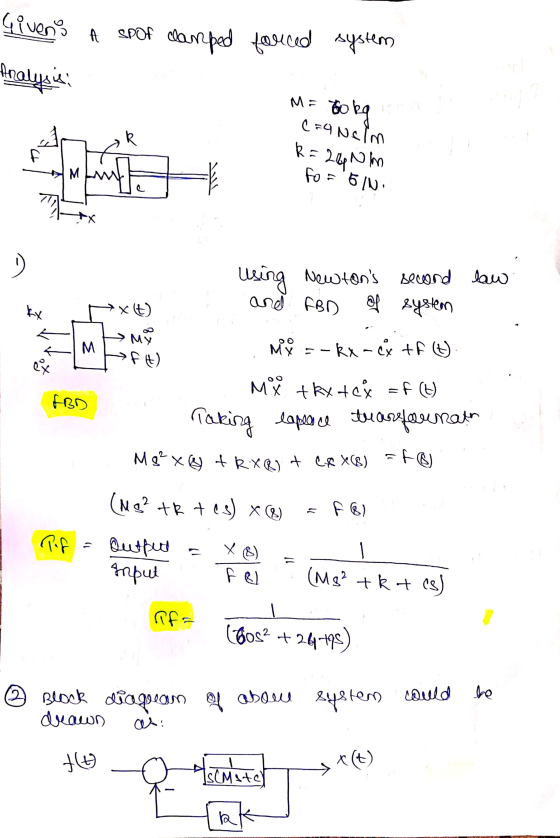
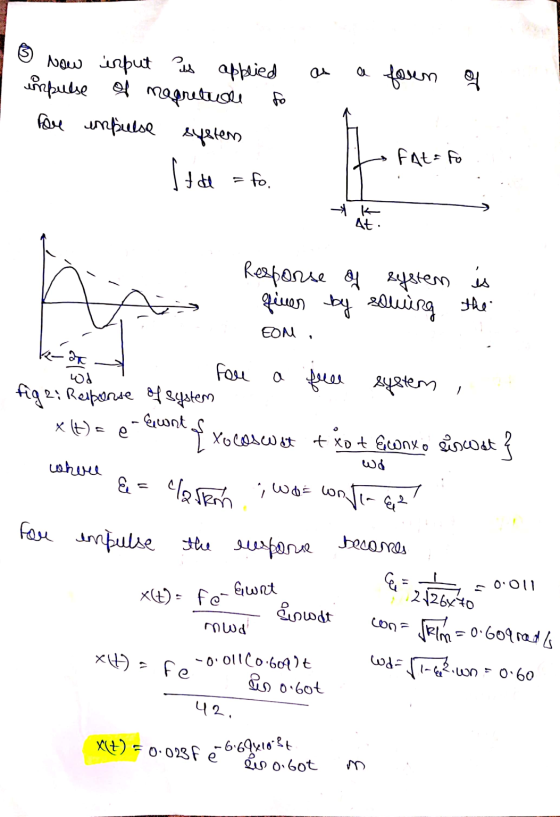
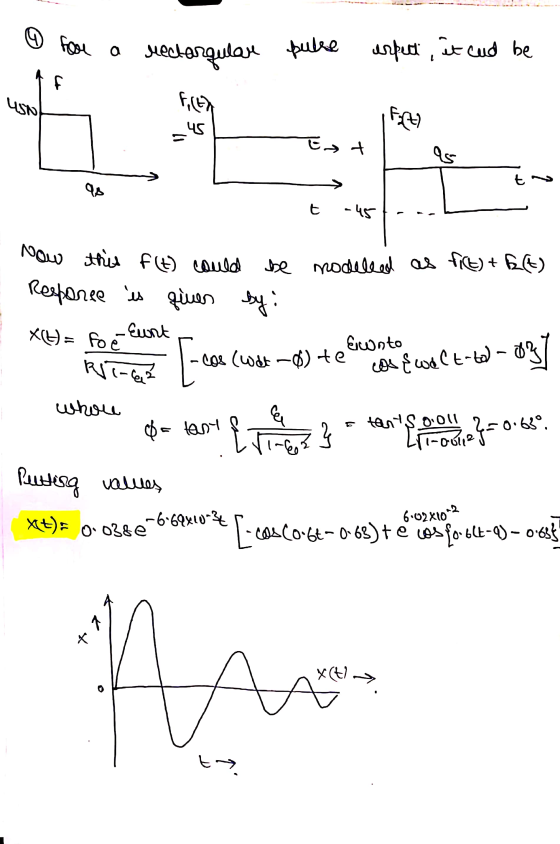
 Many doors in public places are fitted with simple and inexpensive mechanisms that are designed to close the doors while reducing the slamming force to a minimum. mm с M F M = 70kg C = 1Ns/m k = 26N/m FO = 5N/S 9 = 95 (duration of the couple in seconds) b = 45N (magnitude of the step in N) z = 2.4 (zero of the controller) p = 4.3 (pole of the controller) Assume you are a newly...
Many doors in public places are fitted with simple and inexpensive mechanisms that are designed to...
 Many doors in public places are fitted with simple and inexpensive mechanisms that are designed to close the doors while reducing the slamming force to a minimum. mm с M F M = 70kg C = 1Ns/m k = 26N/m FO = 5N/S 9 = 95 (duration of the couple in seconds) b = 45N (magnitude of the step in N) z = 2.4 (zero of the controller) p = 4.3 (pole of the controller) Assume you are a newly...
Many doors in public places are fitted with simple and inexpensive mechanisms that are designed to...
 Many doors in public places are fitted with simple and inexpensive mechanisms that are designed to close the doors while reducing the slamming force to a minimum. mm с M F M = 70kg C = 1Ns/m k = 26N/m FO = 5N/S 9 = 95 (duration of the couple in seconds) b = 45N (magnitude of the step in N) z = 2.4 (zero of the controller) p = 4.3 (pole of the controller) Assume you are a newly...
Many doors in public places are fitted with simple and inexpensive mechanisms that are designed to...
 Many doors in public places are fitted with simple and inexpensive mechanisms that are designed to close the doors while reducing the slamming force to a minimum. mm с M F M = 70kg C = 1Ns/m k = 26N/m FO = 5N/S 9 = 95 (duration of the couple in seconds) b = 45N (magnitude of the step in N) z = 2.4 (zero of the controller) p = 4.3 (pole of the controller) Assume you are a newly...
k c M mm] F M = 70kg C = 1 Ns/m k = 26N/m FO...
 k c M mm] F M = 70kg C = 1 Ns/m k = 26N/m FO = 5N/S a = 9s (duration of the couple in seconds) b = 45N (magnitude of the step in N) z = 2.4 (zero of the controller) p = 4.3 (pole of the controller) 1. Determine the transfer function of the system where force F is the input and displacement is the output variable. 2. Draw the block diagram of the system indicating clearly...
This is control system question. please answer all and show a clear step. Thank you! Question...
 This is control system question. please answer all and
show a clear step. Thank you!
Question 3 Given the translational system shown in Figure 2, an input force, f(t) is applied to the mass, M, causing the dashpot which has a viscosity B and the spring, a stiffness coefficient of k, to compress with output displacement X(t). Input force, f(t) M O F Fixed point Displacement, X(t) Figure 2: A translational system (a) Derive the system's equation in terms of...
This is control system question. please answer all and
show a clear step. Thank you!
Question 3 Given the translational system shown in Figure 2, an input force, f(t) is applied to the mass, M, causing the dashpot which has a viscosity B and the spring, a stiffness coefficient of k, to compress with output displacement X(t). Input force, f(t) M O F Fixed point Displacement, X(t) Figure 2: A translational system (a) Derive the system's equation in terms of...
Consider the mass-spring-damper system depicted in the figure below, where the input of the system is...
 Consider the mass-spring-damper system depicted in the figure below, where the input of the system is the applied force F(t) and the output of the system is xít) that is the displacement of the mass according to the coordinate system defined in that figure. Assume that force F(t) is applied for t> 0 and the system is in static equilibrium before t=0 and z(t) is measured from the static equilibrium. b m F Also, the mass of the block, the...
Explain why it is necessary to conduct vibrational tests for structures Q5 (a) (5 marks) The...
 Explain why it is necessary to conduct vibrational tests for structures Q5 (a) (5 marks) The block shown in Figure Q5 has a mass m and is supported on the solid ground by a spring with stiffness k and a parallel viscous damper with damping constant d. An out of balance force F(t) is exerted on the block. Suclh force F(t) is approximated by a harmonic function causing a steady state displacement x(t) shown in Figure Q5 The following relationship...
 Introduction Many doors in public places are fitted with simple and inexpensive mechanisms that are designed to close the doors while reducing the slamming force to a minimum. Figure 1 Figure 1 depicts one such mechanism while Figure 2 provides a schematic description. The spring is mounted in order to push the door back to close once it is opened. The role of the hydraulic dashpot is to provide a viscous force that will prevent the door from slamming against...
 Introduction Many doors in public places are fitted with simple and inexpensive mechanisms that are designed to close the doors while reducing the slamming force to a minimum. Figure 1 Figure 1 depicts one such mechanism while Figure 2 provides a schematic description. The spring is mounted in order to push the door back to close once it is opened. The role of the hydraulic dashpot is to provide a viscous force that will prevent the door from slamming against...
 Many doors in public places are fitted with simple and inexpensive mechanisms that are designed to close the doors while reducing the slamming force to a minimum. mm с M F M = 70kg C = 1Ns/m k = 26N/m FO = 5N/S 9 = 95 (duration of the couple in seconds) b = 45N (magnitude of the step in N) z = 2.4 (zero of the controller) p = 4.3 (pole of the controller) Assume you are a newly...
 Many doors in public places are fitted with simple and inexpensive mechanisms that are designed to close the doors while reducing the slamming force to a minimum. mm с M F M = 70kg C = 1Ns/m k = 26N/m FO = 5N/S 9 = 95 (duration of the couple in seconds) b = 45N (magnitude of the step in N) z = 2.4 (zero of the controller) p = 4.3 (pole of the controller) Assume you are a newly...
 Many doors in public places are fitted with simple and inexpensive mechanisms that are designed to close the doors while reducing the slamming force to a minimum. mm с M F M = 70kg C = 1Ns/m k = 26N/m FO = 5N/S 9 = 95 (duration of the couple in seconds) b = 45N (magnitude of the step in N) z = 2.4 (zero of the controller) p = 4.3 (pole of the controller) Assume you are a newly...
 Many doors in public places are fitted with simple and inexpensive mechanisms that are designed to close the doors while reducing the slamming force to a minimum. mm с M F M = 70kg C = 1Ns/m k = 26N/m FO = 5N/S 9 = 95 (duration of the couple in seconds) b = 45N (magnitude of the step in N) z = 2.4 (zero of the controller) p = 4.3 (pole of the controller) Assume you are a newly...
 k c M mm] F M = 70kg C = 1 Ns/m k = 26N/m FO = 5N/S a = 9s (duration of the couple in seconds) b = 45N (magnitude of the step in N) z = 2.4 (zero of the controller) p = 4.3 (pole of the controller) 1. Determine the transfer function of the system where force F is the input and displacement is the output variable. 2. Draw the block diagram of the system indicating clearly...
 This is control system question. please answer all and
show a clear step. Thank you!
Question 3 Given the translational system shown in Figure 2, an input force, f(t) is applied to the mass, M, causing the dashpot which has a viscosity B and the spring, a stiffness coefficient of k, to compress with output displacement X(t). Input force, f(t) M O F Fixed point Displacement, X(t) Figure 2: A translational system (a) Derive the system's equation in terms of...
This is control system question. please answer all and
show a clear step. Thank you!
Question 3 Given the translational system shown in Figure 2, an input force, f(t) is applied to the mass, M, causing the dashpot which has a viscosity B and the spring, a stiffness coefficient of k, to compress with output displacement X(t). Input force, f(t) M O F Fixed point Displacement, X(t) Figure 2: A translational system (a) Derive the system's equation in terms of...
 Consider the mass-spring-damper system depicted in the figure below, where the input of the system is the applied force F(t) and the output of the system is xít) that is the displacement of the mass according to the coordinate system defined in that figure. Assume that force F(t) is applied for t> 0 and the system is in static equilibrium before t=0 and z(t) is measured from the static equilibrium. b m F Also, the mass of the block, the...
 Explain why it is necessary to conduct vibrational tests for structures Q5 (a) (5 marks) The block shown in Figure Q5 has a mass m and is supported on the solid ground by a spring with stiffness k and a parallel viscous damper with damping constant d. An out of balance force F(t) is exerted on the block. Suclh force F(t) is approximated by a harmonic function causing a steady state displacement x(t) shown in Figure Q5 The following relationship...
Most questions answered within 3 hours.
-
Where is the error in this code sequence?
String s1 = "Hello";
String s2 = "ello";...
asked 11 months ago -
Financial data for Joel de Paris, Inc., for last year
follow:
Joel de Paris, Inc.
Balance...
asked 11 months ago -
Consider this reaction:
Al2(SO4)3 (aq)+ BaCl3
(aq) Al2Cl6 (aq)- +
3BaSO4(s) . What is the...
asked 11 months ago -
Suppose that Savneet is considering increasing her
recent random sample from 20 car rentals to 40...
asked 11 months ago -
Trucks arrive at an unloading terminal at an average rate of 120
per hour.
Trucks arrive...
asked 11 months ago -
Why are methanol and ethanol completely soluble in water while
octanol is not very little soluble....
asked 11 months ago -
A facilities manager at a university reads in a research report
that the mean amount of...
asked 11 months ago -
When the CuSO4 is rehydrated by adding water to the anhydrous
compound, is this an endothermic...
asked 11 months ago -
A ray of sunlight is passing from diamond into crown glass; the
angle of incidence is...
asked 11 months ago -
A block of mass 0.249 kg is placed on top of a light, vertical
spring of...
asked 11 months ago -
how do the kidneys compensate in the presences of acidosis
a) trigger hyperventilate
b) reserve acid...
asked 11 months ago -
Question 501 pts
The rental rate of capital to the firm increases. Which of the
following...
asked 11 months ago