system modelling
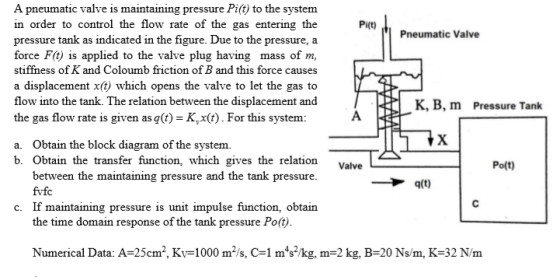
(please help)pneumatic valve is maintaining pressure Pi(t) to the system in order to control the flow rate of the gas entering the pressure tank as indicated in the figure. Due to the pressure, a force F(t) is applied to the valve plug having mass of m, stiffness of K and Coloumb friction of B and this force causes a displacement x(t) which opens the valve to let the gas to flow into the tank. The relation between the displacement and the gas flow rate is given as ) () ( t xK tq v . For this system:
a. Obtain the block diagram of the system. b. Obtain the transfer function, which gives the relation between the maintaining pressure and the tank pressure. fvfc c. If maintaining pressure is unit impulse function, obtain the time domain response of the tank pressure Po(t).
Numerical Data: A=25cm2, KV=1000 m2/s, C=1 m4s2/kg, m=2 kg, B=20 Ns/m, K=32 N/m
Homework Answers
Given that input pressure to control the flow rate of the gas is \(P_{i}(t)\) and
\(A\) is the area of the pressure tank.
The force acting on the valve plug is given as
\(F(t)=P_{i}(t) A\)
In Laplace Domain
\(\rightarrow \frac{F(s)}{P_{i}(s)}=A\)
The valve plug has mass \(m\), stiffness, \(K\), and Columb friction \(B\)
So the relation between Force and Displacement is given as
\(F=m \frac{d^{2} x(t)}{d t^{2}}+B \frac{d x(t)}{d t}+K x(t)\)
Taking Laplace Transform, we get;
\(\rightarrow F(s)=m s^{2} X(s)+B s X(s)+K X(s)\)
\(\rightarrow \frac{X(s)}{F(s)}=\frac{1}{m s^{2}+B s+K}\)
The displacement is related to flow as follows:
\(\rightarrow q(t)=K_{v} x(t)\)
\(\Rightarrow \frac{q(s)}{X(s)}=K_{v}\)
The output pressure is given as
\(P_{o}(t)=\frac{q(t)}{C_{0}}\)
\(\rightarrow \frac{P_{o}(s)}{q(s)}=\frac{1}{C_{0}}\)
a)
From (1) (2) (3) \& (4) we get the block diagram as follows:

b)
The transfer function can be obtained by multiplying (1) (2) (3) (4)
We get;
\(\rightarrow \frac{P_{o}(s)}{P_{i}(s)}=\frac{K_{v} A}{C\left(m s^{2}+B s+K\right)}\)
c)
The numerical data is given as follows:
\(A=25 \mathrm{~cm}^{2}=2.5 \times 10^{-3} \mathrm{~m}^{2}\)
\(K_{v}=1000 \mathrm{~m}^{2} / \mathrm{s}\)
\(C=1 m^{4} s^{2} / k g\)
\(m=2 k g\)
\(B=20 \mathrm{Ns} / \mathrm{m}\)
\(K=32 N / m\)
Substituting the values in (5), we get;
\(\rightarrow \frac{P_{o}(s)}{P_{i}(s)}=\frac{1000 \times 2.5 \times 10^{-3}}{1\left(2 s^{2}+20 s+32\right)}\)
\(\rightarrow \frac{P_{o}(s)}{P_{i}(s)}=\frac{2.5}{2 s^{2}+20 s+32}\)
\(\Rightarrow \frac{P_{o}(s)}{P_{i}(s)}=\frac{5}{4\left(s^{2}+10 s+16\right)}\)
For unit impulse maintaining pressure
\(\Rightarrow P_{o}(s)=\frac{5}{4\left(s^{2}+10 s+16\right)}\)
Taking inverse Laplace, we get the time domain of tank pressure as follows:
\(\Rightarrow P_{o}(t)=\frac{\left(5 e^{6 t}-5\right) e^{-8 t}}{24}\)
system modelling please help immediately
 In the figure, the suspension system is composed of a damper and spring having the damping and stiffness coefficients of \(\mathrm{C}=60[\mathrm{Ns} / \mathrm{m}]\) and \(\mathrm{K}=7200[\mathrm{~N} / \mathrm{m}]\)respectively. The test rig shown in the figure is used to obtain the oscillation characteristics of the suspension system in the \(y\) -direction. The input of the system is given as the road profile as a sine function and it is given by velocity \(V\) in \(x\) -direction. The tire attached at point \(O\)...
system modelling please help immediately 2
 For the cone water tank given in the figure, the relation between the flow rate \(q(t)\) and the water level \(h(t)\) is given as \(q(t)=0.005 h^{2}(t) \cdot q(t)\) is in \(\left[m^{3} / s\right]\) and \(h(t)\) in [m].a. When \(t=0\), the valve is closed and the water level is \(2[\mathrm{~m}]\). Find the level of the water after 60 seconds of the valve opening. b. Find the linearized expression for water flow rate \(q(t)\) about initial conditions.
Question 103 (1 point) A sequence valve is a compounded valve that comprises a normally closed pr...
 plz answer
Question 103 (1 point) A sequence valve is a compounded valve that comprises a normally closed pressure control valve and a flow control valve True False Question 104 (1 point) Shear stress depends of flow speed True False Question 105 (1 point) When Reynolds number is less than 2000 the flow regime is laminar True False Question 106 (1 point) What method is best used to minimize system pressure and redirect pump flow to tank during non-action periods?...
plz answer
Question 103 (1 point) A sequence valve is a compounded valve that comprises a normally closed pressure control valve and a flow control valve True False Question 104 (1 point) Shear stress depends of flow speed True False Question 105 (1 point) When Reynolds number is less than 2000 the flow regime is laminar True False Question 106 (1 point) What method is best used to minimize system pressure and redirect pump flow to tank during non-action periods?...
1. A rigid (constant volume) tank sealed by a valve initially contains 100 kg of air...
 1. A rigid (constant volume) tank sealed by a valve initially contains 100 kg of air at a pressure of 100 kPa and 300 K. At time t = 0, the valve for the air tank is opened in a controlled manner and air leaks out isothermally (constant temperature) of the tank at a constant mass flow rate of 1 kg/s. The valve is closed after 75 seconds. Answer the following questions: Assuming air is an ideal gas, what is...
For the mechanical system shown below find the input-output equation relating xolt) to the displacement input...
 For the mechanical system shown below find the input-output equation relating xolt) to the displacement input x(t) 1. ド ド Ki Derive the transfer function X,G)/X, (s)of the mechanical system shown below. The displacements x, and xo are measured from their respective equilibrium potions. Is the system a first-order system if so, what is the time constant? 2. k1 bz k2 3. Consider the mechanical system shown below. The system is initially at rest. The displacements x, and x2 are...
2. An active suspension system for AMTRAK trains uses a pneumatic actuator in parallel with the...
 2. An active suspension system for AMTRAK trains uses a pneumatic actuator in parallel with the passive suspension system. The force of the actuator subtracts from the force applied by the ground, as represented by displacement ⅞φ. Acceleration is sensed by an accelerometer, and signals proportional to acceleration and velocity are fed back to the force actuator (50pt). You may use MATLAB for this problem Obtain the transfer function s Im(S)/Yg(S) relating acceleration to ground displacement (15pt) Assuming that M=1,...
Question 1: For the plane (2D) truss shown below, evaluate the transformation matrix [T] and the stiffness matrix in the local axis system [KL] of all elements. Use these matrices to evaluate the ele...
 Question 1: For the plane (2D) truss shown below, evaluate the transformation matrix [T] and the stiffness matrix in the local axis system [KL] of all elements. Use these matrices to evaluate the element stiffness matrix in global axis system [KG] of the members and assembled them to generate the overall stiffness matrix [K of the truss. Modify the stiffness matrix [K] in order to incorporate boundary conditions following the elimination technique of rows and columns. Take E 200 GPa...
This is control system question. please answer all and show a clear step. Thank you! Question...
 This is control system question. please answer all and
show a clear step. Thank you!
Question 3 Given the translational system shown in Figure 2, an input force, f(t) is applied to the mass, M, causing the dashpot which has a viscosity B and the spring, a stiffness coefficient of k, to compress with output displacement X(t). Input force, f(t) M O F Fixed point Displacement, X(t) Figure 2: A translational system (a) Derive the system's equation in terms of...
This is control system question. please answer all and
show a clear step. Thank you!
Question 3 Given the translational system shown in Figure 2, an input force, f(t) is applied to the mass, M, causing the dashpot which has a viscosity B and the spring, a stiffness coefficient of k, to compress with output displacement X(t). Input force, f(t) M O F Fixed point Displacement, X(t) Figure 2: A translational system (a) Derive the system's equation in terms of...
4. Consider the mechanical system shown below with a spring with stiffness, k (N/m), in parallel...
 4. Consider the mechanical system shown below with a spring with stiffness, k (N/m), in parallel with a viscous damper with coefficient, h (Nós/m) and an externally applied force, Fexi(t) (N). u(t) a. Find the equation that relates the applied force, Fext(t) and the displacement, u(t). b. If the spring component has a stiffness of k = 75 N/m, the damper component has coefficient h = 50 N s/m and the externally applied force is a constant 4.5 N applied...
Consider 0.8 kg of N2 at 300 K, 1 bar contained in a rigid tank connected by a valve to another r...
Consider 0.8 kg of N2 at 300 K, 1 bar contained in a rigid tank connected by a valve to another rigid tank holding 0.3 kg of CO2 at 300 K, 1 bar. The valve is opened and gases are allowed to mix, achieving an equilibrium state at 280 K. Determine: (a) the volume of each tank, in m3. (Correct .7124 m^3 and .17 m^3) (b) the final pressure, in bar. (Correct 0.9331 bar) (c) the magnitude of the heat...
 plz answer
Question 103 (1 point) A sequence valve is a compounded valve that comprises a normally closed pressure control valve and a flow control valve True False Question 104 (1 point) Shear stress depends of flow speed True False Question 105 (1 point) When Reynolds number is less than 2000 the flow regime is laminar True False Question 106 (1 point) What method is best used to minimize system pressure and redirect pump flow to tank during non-action periods?...
plz answer
Question 103 (1 point) A sequence valve is a compounded valve that comprises a normally closed pressure control valve and a flow control valve True False Question 104 (1 point) Shear stress depends of flow speed True False Question 105 (1 point) When Reynolds number is less than 2000 the flow regime is laminar True False Question 106 (1 point) What method is best used to minimize system pressure and redirect pump flow to tank during non-action periods?...
 1. A rigid (constant volume) tank sealed by a valve initially contains 100 kg of air at a pressure of 100 kPa and 300 K. At time t = 0, the valve for the air tank is opened in a controlled manner and air leaks out isothermally (constant temperature) of the tank at a constant mass flow rate of 1 kg/s. The valve is closed after 75 seconds. Answer the following questions: Assuming air is an ideal gas, what is...
 For the mechanical system shown below find the input-output equation relating xolt) to the displacement input x(t) 1. ド ド Ki Derive the transfer function X,G)/X, (s)of the mechanical system shown below. The displacements x, and xo are measured from their respective equilibrium potions. Is the system a first-order system if so, what is the time constant? 2. k1 bz k2 3. Consider the mechanical system shown below. The system is initially at rest. The displacements x, and x2 are...
 2. An active suspension system for AMTRAK trains uses a pneumatic actuator in parallel with the passive suspension system. The force of the actuator subtracts from the force applied by the ground, as represented by displacement ⅞φ. Acceleration is sensed by an accelerometer, and signals proportional to acceleration and velocity are fed back to the force actuator (50pt). You may use MATLAB for this problem Obtain the transfer function s Im(S)/Yg(S) relating acceleration to ground displacement (15pt) Assuming that M=1,...
 Question 1: For the plane (2D) truss shown below, evaluate the transformation matrix [T] and the stiffness matrix in the local axis system [KL] of all elements. Use these matrices to evaluate the element stiffness matrix in global axis system [KG] of the members and assembled them to generate the overall stiffness matrix [K of the truss. Modify the stiffness matrix [K] in order to incorporate boundary conditions following the elimination technique of rows and columns. Take E 200 GPa...
 This is control system question. please answer all and
show a clear step. Thank you!
Question 3 Given the translational system shown in Figure 2, an input force, f(t) is applied to the mass, M, causing the dashpot which has a viscosity B and the spring, a stiffness coefficient of k, to compress with output displacement X(t). Input force, f(t) M O F Fixed point Displacement, X(t) Figure 2: A translational system (a) Derive the system's equation in terms of...
This is control system question. please answer all and
show a clear step. Thank you!
Question 3 Given the translational system shown in Figure 2, an input force, f(t) is applied to the mass, M, causing the dashpot which has a viscosity B and the spring, a stiffness coefficient of k, to compress with output displacement X(t). Input force, f(t) M O F Fixed point Displacement, X(t) Figure 2: A translational system (a) Derive the system's equation in terms of...
 4. Consider the mechanical system shown below with a spring with stiffness, k (N/m), in parallel with a viscous damper with coefficient, h (Nós/m) and an externally applied force, Fexi(t) (N). u(t) a. Find the equation that relates the applied force, Fext(t) and the displacement, u(t). b. If the spring component has a stiffness of k = 75 N/m, the damper component has coefficient h = 50 N s/m and the externally applied force is a constant 4.5 N applied...
Most questions answered within 3 hours.
-
Where is the error in this code sequence?
String s1 = "Hello";
String s2 = "ello";...
asked 11 months ago -
Financial data for Joel de Paris, Inc., for last year
follow:
Joel de Paris, Inc.
Balance...
asked 11 months ago -
Consider this reaction:
Al2(SO4)3 (aq)+ BaCl3
(aq) Al2Cl6 (aq)- +
3BaSO4(s) . What is the...
asked 11 months ago -
Suppose that Savneet is considering increasing her
recent random sample from 20 car rentals to 40...
asked 11 months ago -
Trucks arrive at an unloading terminal at an average rate of 120
per hour.
Trucks arrive...
asked 11 months ago -
Why are methanol and ethanol completely soluble in water while
octanol is not very little soluble....
asked 11 months ago -
A facilities manager at a university reads in a research report
that the mean amount of...
asked 11 months ago -
When the CuSO4 is rehydrated by adding water to the anhydrous
compound, is this an endothermic...
asked 11 months ago -
A ray of sunlight is passing from diamond into crown glass; the
angle of incidence is...
asked 11 months ago -
A block of mass 0.249 kg is placed on top of a light, vertical
spring of...
asked 11 months ago -
how do the kidneys compensate in the presences of acidosis
a) trigger hyperventilate
b) reserve acid...
asked 11 months ago -
Question 501 pts
The rental rate of capital to the firm increases. Which of the
following...
asked 11 months ago