
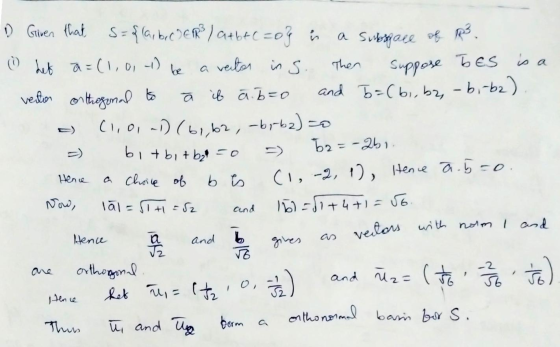
(i) Find an orthonormal basis {~u1, ~u2} for S
(ii) Consider the function f : R3 -> R3 that to each vector ~v
assigns the vector of S given by
f(~v) = <~u1, ~v>~u1 + <~u2; ~v>~u2. Show that it is a
linear function.
(iii) What is the matrix of f in the standard basis of R3?
(iv) What are the null space and the column space of the matrix
that you computed in the
previous point?
Homework Answers


Add Answer to:
(i) Find an orthonormal basis {~u1, ~u2} for S
(ii) Consider the function f : R3...
Find an ONB (orthonormal basis) for the following plane in R3 2 + y + 3z...
 Find an ONB (orthonormal basis) for the following plane in R3 2 + y + 3z = 0 First, solve the system, then assign parameters s and t to the free variables (in this order), and write the solution in vector form as su + tv. Now normalize u to have norm 1 and call it ū. Then find the component of v orthogonal to the line spanned by u and normalize it, call it ū. Below, enter the components...
1- 2- 3- 1 (10 points) Show that {u1, U2, U3} is an orthogonal basis for...
 1-
2-
3-
1 (10 points) Show that {u1, U2, U3} is an orthogonal basis for R3. Then express x as a linear 3 4 combination of the u's. u -3 U2 = 0 ,u3 5 6 -2 2 -1 (10 points) Suppose a vector y is orthogonal to vectors u and v. Prove that y is orthogonal to the vector 4u - 3v. 10. (2 points each) True or False: ( ) Eigenvalues must be nonzero scalars. ( )...
1-
2-
3-
1 (10 points) Show that {u1, U2, U3} is an orthogonal basis for R3. Then express x as a linear 3 4 combination of the u's. u -3 U2 = 0 ,u3 5 6 -2 2 -1 (10 points) Suppose a vector y is orthogonal to vectors u and v. Prove that y is orthogonal to the vector 4u - 3v. 10. (2 points each) True or False: ( ) Eigenvalues must be nonzero scalars. ( )...
Please attempt both questions. 5. Find an orthonormal basis for the plane viewed as a subspace...
 Please attempt both questions.
5. Find an orthonormal basis for the plane viewed as a subspace of R3. Z (-1,0,2) (0,-1,0) (0,1,0) X 6. Determine if each basis is orthogonal. Further, is the basis orthonormal? (a) In the vector space R3 (i.e. column vectors in 3-space): 1 2 5 -3 (b) In the vector space that consists of polynomial functions of degree less than or equal to 2: {f(x) = 22 - 3, 9() = 4, h(x) = 2² +2}...
Please attempt both questions.
5. Find an orthonormal basis for the plane viewed as a subspace of R3. Z (-1,0,2) (0,-1,0) (0,1,0) X 6. Determine if each basis is orthogonal. Further, is the basis orthonormal? (a) In the vector space R3 (i.e. column vectors in 3-space): 1 2 5 -3 (b) In the vector space that consists of polynomial functions of degree less than or equal to 2: {f(x) = 22 - 3, 9() = 4, h(x) = 2² +2}...
linear algebra -Answer the following question: If S ={ ui, U2, U3} is a set of...
 linear algebra
-Answer the following question: If S ={ ui, U2, U3} is a set of vectors in the vector space R', where új =(2,0,1), uz =(0,1,0), and uz =(-2,0,0). i) Determine whether the vector v=(2,4,2) is a linear combination of uı, U2 and uz or not. ii) Show that the set S is a spanning set for R or not. Why? iii) Is the set S linearly independent in R? iv) Determine whether S is basis for R' or...
linear algebra
-Answer the following question: If S ={ ui, U2, U3} is a set of vectors in the vector space R', where új =(2,0,1), uz =(0,1,0), and uz =(-2,0,0). i) Determine whether the vector v=(2,4,2) is a linear combination of uı, U2 and uz or not. ii) Show that the set S is a spanning set for R or not. Why? iii) Is the set S linearly independent in R? iv) Determine whether S is basis for R' or...
Let F be a field and V a vector space over F with the basis {v1, v2, ..., vn}. (a) Consider the s...
Let F be a field and V a vector space over F with the basis {v1, v2, ..., vn}. (a) Consider the set S = {T : V -> F | T is a linear transformation}. Define the operations: (T1 + T2)(v) := T1(v) + T2(v), (aT1)(v) = a(T1(v)) for any v in V, a in F. Prove tat S with these operations is a vector space over F. (b) In S, we have elements fi : V -> F...
Problem 2 Ul Consider twovectors, v and u , where Vj,Uj are complex U2 numbers a....
 Problem 2 Ul Consider twovectors, v and u , where Vj,Uj are complex U2 numbers a. Find the conditions that ensure normalization for each of these vectors b. Write down explicitly the tensor product v&u as a four-component vector c. Consider a square matrix A acting on v and a square matrix B acting on u, show that (AS>B) (v u)-Au Bu Using Dirac notation for the vectors: v- |v), u-|u) d. Write down the normalization condition for each vector...
ote: The norm of is denoted by |vand is calculated N a vector u Consider a subspace W of R4, W span(1, v2, v3, v4)). Where 0 из- 1. Find an orthonormal basis Qw of W and find the dimension of W 2. Fi...
 ote: The norm of is denoted by |vand is calculated N a vector u Consider a subspace W of R4, W span(1, v2, v3, v4)). Where 0 из- 1. Find an orthonormal basis Qw of W and find the dimension of W 2. Find an orthonormal basis QWL of WL and find the dimension of WL 3. GIven a vector u- . find the Qw coordinate of Projw(v) . find the Qwa coordinate of Projwi (v) » find the coordinate...
1 0 < x < 1, 2. Consider the Haar scaling function, p(x):= { +, and...
 1 0 < x < 1, 2. Consider the Haar scaling function, p(x):= { +, and (x) := { -1 10 otherwise 0 0 < x < 1/2, 1/2 < x < 1,. Sketch (by hand is okay) 7(2x) and 7(2x – 1). Show these functions form an orthogonal set. Find the otherwise corresponding orthonormal set. in 3. Let V be a vector space with a complex inner product (,) > Suppose that the set S= {U1, U2, ..., Un}...
Hi, could you post solutions to the following questions. Thanks. 2. (a) Let V be a vector space on R. Give the definition of a subspace W of V 2% (b) For each of the following subsets of IR3 sta...
 Hi,
could you post solutions to the following questions. Thanks.
2. (a) Let V be a vector space on R. Give the definition of a subspace W of V 2% (b) For each of the following subsets of IR3 state whether they are subepaces of R3 or not by clearly explaining your answer. 2% 2% (c) Consider the map F : R2 → R3 defined by for any z = (zi,Z2) E R2. 3% 3% 3% 3% i. Show that...
Hi,
could you post solutions to the following questions. Thanks.
2. (a) Let V be a vector space on R. Give the definition of a subspace W of V 2% (b) For each of the following subsets of IR3 state whether they are subepaces of R3 or not by clearly explaining your answer. 2% 2% (c) Consider the map F : R2 → R3 defined by for any z = (zi,Z2) E R2. 3% 3% 3% 3% i. Show that...
please answer all questions im out of questions to post. thats why i squeezed them in....
 please answer all questions im out of questions to post. thats why
i squeezed them in.
6. Let u = (0, -3,11) and v = (1, -5,0). (a) Find the distance between i and V. That is, find ||ū - v1|| (b) Find the angle between i and 0. (c) Find Proje(). (d) Find Projet) (e) Find i x i and show it is orthogonal to both u and . 6 For -~- al 7. (a) Let A -12 5-2...
please answer all questions im out of questions to post. thats why
i squeezed them in.
6. Let u = (0, -3,11) and v = (1, -5,0). (a) Find the distance between i and V. That is, find ||ū - v1|| (b) Find the angle between i and 0. (c) Find Proje(). (d) Find Projet) (e) Find i x i and show it is orthogonal to both u and . 6 For -~- al 7. (a) Let A -12 5-2...
 Find an ONB (orthonormal basis) for the following plane in R3 2 + y + 3z = 0 First, solve the system, then assign parameters s and t to the free variables (in this order), and write the solution in vector form as su + tv. Now normalize u to have norm 1 and call it ū. Then find the component of v orthogonal to the line spanned by u and normalize it, call it ū. Below, enter the components...
 1-
2-
3-
1 (10 points) Show that {u1, U2, U3} is an orthogonal basis for R3. Then express x as a linear 3 4 combination of the u's. u -3 U2 = 0 ,u3 5 6 -2 2 -1 (10 points) Suppose a vector y is orthogonal to vectors u and v. Prove that y is orthogonal to the vector 4u - 3v. 10. (2 points each) True or False: ( ) Eigenvalues must be nonzero scalars. ( )...
1-
2-
3-
1 (10 points) Show that {u1, U2, U3} is an orthogonal basis for R3. Then express x as a linear 3 4 combination of the u's. u -3 U2 = 0 ,u3 5 6 -2 2 -1 (10 points) Suppose a vector y is orthogonal to vectors u and v. Prove that y is orthogonal to the vector 4u - 3v. 10. (2 points each) True or False: ( ) Eigenvalues must be nonzero scalars. ( )...
 Please attempt both questions.
5. Find an orthonormal basis for the plane viewed as a subspace of R3. Z (-1,0,2) (0,-1,0) (0,1,0) X 6. Determine if each basis is orthogonal. Further, is the basis orthonormal? (a) In the vector space R3 (i.e. column vectors in 3-space): 1 2 5 -3 (b) In the vector space that consists of polynomial functions of degree less than or equal to 2: {f(x) = 22 - 3, 9() = 4, h(x) = 2² +2}...
Please attempt both questions.
5. Find an orthonormal basis for the plane viewed as a subspace of R3. Z (-1,0,2) (0,-1,0) (0,1,0) X 6. Determine if each basis is orthogonal. Further, is the basis orthonormal? (a) In the vector space R3 (i.e. column vectors in 3-space): 1 2 5 -3 (b) In the vector space that consists of polynomial functions of degree less than or equal to 2: {f(x) = 22 - 3, 9() = 4, h(x) = 2² +2}...
 linear algebra
-Answer the following question: If S ={ ui, U2, U3} is a set of vectors in the vector space R', where új =(2,0,1), uz =(0,1,0), and uz =(-2,0,0). i) Determine whether the vector v=(2,4,2) is a linear combination of uı, U2 and uz or not. ii) Show that the set S is a spanning set for R or not. Why? iii) Is the set S linearly independent in R? iv) Determine whether S is basis for R' or...
linear algebra
-Answer the following question: If S ={ ui, U2, U3} is a set of vectors in the vector space R', where új =(2,0,1), uz =(0,1,0), and uz =(-2,0,0). i) Determine whether the vector v=(2,4,2) is a linear combination of uı, U2 and uz or not. ii) Show that the set S is a spanning set for R or not. Why? iii) Is the set S linearly independent in R? iv) Determine whether S is basis for R' or...
 Problem 2 Ul Consider twovectors, v and u , where Vj,Uj are complex U2 numbers a. Find the conditions that ensure normalization for each of these vectors b. Write down explicitly the tensor product v&u as a four-component vector c. Consider a square matrix A acting on v and a square matrix B acting on u, show that (AS>B) (v u)-Au Bu Using Dirac notation for the vectors: v- |v), u-|u) d. Write down the normalization condition for each vector...
 ote: The norm of is denoted by |vand is calculated N a vector u Consider a subspace W of R4, W span(1, v2, v3, v4)). Where 0 из- 1. Find an orthonormal basis Qw of W and find the dimension of W 2. Find an orthonormal basis QWL of WL and find the dimension of WL 3. GIven a vector u- . find the Qw coordinate of Projw(v) . find the Qwa coordinate of Projwi (v) » find the coordinate...
 1 0 < x < 1, 2. Consider the Haar scaling function, p(x):= { +, and (x) := { -1 10 otherwise 0 0 < x < 1/2, 1/2 < x < 1,. Sketch (by hand is okay) 7(2x) and 7(2x – 1). Show these functions form an orthogonal set. Find the otherwise corresponding orthonormal set. in 3. Let V be a vector space with a complex inner product (,) > Suppose that the set S= {U1, U2, ..., Un}...
 Hi,
could you post solutions to the following questions. Thanks.
2. (a) Let V be a vector space on R. Give the definition of a subspace W of V 2% (b) For each of the following subsets of IR3 state whether they are subepaces of R3 or not by clearly explaining your answer. 2% 2% (c) Consider the map F : R2 → R3 defined by for any z = (zi,Z2) E R2. 3% 3% 3% 3% i. Show that...
Hi,
could you post solutions to the following questions. Thanks.
2. (a) Let V be a vector space on R. Give the definition of a subspace W of V 2% (b) For each of the following subsets of IR3 state whether they are subepaces of R3 or not by clearly explaining your answer. 2% 2% (c) Consider the map F : R2 → R3 defined by for any z = (zi,Z2) E R2. 3% 3% 3% 3% i. Show that...
 please answer all questions im out of questions to post. thats why
i squeezed them in.
6. Let u = (0, -3,11) and v = (1, -5,0). (a) Find the distance between i and V. That is, find ||ū - v1|| (b) Find the angle between i and 0. (c) Find Proje(). (d) Find Projet) (e) Find i x i and show it is orthogonal to both u and . 6 For -~- al 7. (a) Let A -12 5-2...
please answer all questions im out of questions to post. thats why
i squeezed them in.
6. Let u = (0, -3,11) and v = (1, -5,0). (a) Find the distance between i and V. That is, find ||ū - v1|| (b) Find the angle between i and 0. (c) Find Proje(). (d) Find Projet) (e) Find i x i and show it is orthogonal to both u and . 6 For -~- al 7. (a) Let A -12 5-2...
Most questions answered within 3 hours.
-
Where is the error in this code sequence?
String s1 = "Hello";
String s2 = "ello";...
asked 10 months ago -
Financial data for Joel de Paris, Inc., for last year
follow:
Joel de Paris, Inc.
Balance...
asked 10 months ago -
Consider this reaction:
Al2(SO4)3 (aq)+ BaCl3
(aq) Al2Cl6 (aq)- +
3BaSO4(s) . What is the...
asked 10 months ago -
Suppose that Savneet is considering increasing her
recent random sample from 20 car rentals to 40...
asked 10 months ago -
Trucks arrive at an unloading terminal at an average rate of 120
per hour.
Trucks arrive...
asked 10 months ago -
Why are methanol and ethanol completely soluble in water while
octanol is not very little soluble....
asked 10 months ago -
A facilities manager at a university reads in a research report
that the mean amount of...
asked 10 months ago -
When the CuSO4 is rehydrated by adding water to the anhydrous
compound, is this an endothermic...
asked 10 months ago -
A ray of sunlight is passing from diamond into crown glass; the
angle of incidence is...
asked 10 months ago -
A block of mass 0.249 kg is placed on top of a light, vertical
spring of...
asked 10 months ago -
how do the kidneys compensate in the presences of acidosis
a) trigger hyperventilate
b) reserve acid...
asked 10 months ago -
Question 501 pts
The rental rate of capital to the firm increases. Which of the
following...
asked 10 months ago