
Homework Answers
TRADITIONAL METHOD
given that,
mean(x)=7.9
standard deviation , s.d1=1.3
number(n1)=21
y(mean)=6.8
standard deviation, s.d2 =2.1
number(n2)=16
I.
standard error = sqrt(s.d1^2/n1)+(s.d2^2/n2)
where,
sd1, sd2 = standard deviation of both
n1, n2 = sample size
standard error = sqrt((1.69/21)+(4.41/16))
= 0.5967
II.
margin of error = t a/2 * (standard error)
where,
t a/2 = t -table value
level of significance, α = 0.05
from standard normal table,right tailed and
value of |t α| with min (n1-1, n2-1) i.e 15 d.f is 1.7531
margin of error = 1.753 * 0.5967
= 1.0461
III.
CI = (x1-x2) ± margin of error
confidence interval = [ (7.9-6.8) ± 1.0461 ]
= [0.0539 , 2.1461]
-----------------------------------------------------------------------------------------------
DIRECT METHOD
given that,
mean(x)=7.9
standard deviation , s.d1=1.3
sample size, n1=21
y(mean)=6.8
standard deviation, s.d2 =2.1
sample size,n2 =16
CI = x1 - x2 ± t a/2 * Sqrt ( sd1 ^2 / n1 + sd2 ^2 /n2 )
where,
x1,x2 = mean of populations
sd1,sd2 = standard deviations
n1,n2 = size of both
a = 1 - (confidence Level/100)
ta/2 = t-table value
CI = confidence interval
CI = [( 7.9-6.8) ± t a/2 * sqrt((1.69/21)+(4.41/16)]
= [ (1.1) ± t a/2 * 0.5967]
= [0.0539 , 2.1461]
-----------------------------------------------------------------------------------------------
interpretations:
1. we are 95% sure that the interval [0.0539 , 2.1461] contains the
true population proportion
2. If a large number of samples are collected, and a confidence
interval is created
for each sample, 95% of these intervals will contains the true
population proportion
Answer:
standard error = sqrt((1.69/21)+(4.41/16))
= 0.5967
Add Answer to:
Suppose we measure how much sleep students in first and second year at UVic get per...
Suppose we measure how much sleep students in first and second year at UVic get per...
Suppose we measure how much sleep students in first and second year at UVic get per night. A sample of 25 first year students slept an average of 8.4 hours per night with a standard deviation of 1.1 hours. A sample of 18 second year students slept an average of 7.6 hours per night with a standard deviation of 2.3 hours. Suppose we want to test if first year students sleep more than second year students. Assuming the number of...
Suppose we measure how much sleep students in first and second year at UVic get per...
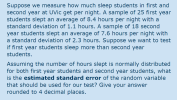 Suppose we measure how much sleep students in first and second year at UVic get per night. A sample of 25 first year students slept an average of 8.4 hours per night with a standard deviation of 1.1 hours. A sample of 18 second year students slept an average of 7.6 hours per night with a standard deviation of 2.3 hours. Suppose we want to test if first year students sleep more than second year students. Assuming the number of...
Suppose we measure how much sleep students in first and second year at UVic get per...
 Suppose we measure how much sleep students in first and second year at UVic get per night. A sample of 21 first year students slept an average of 7.9 hours per night with a standard deviation of 1.3 hours. A sample of 16 second year students slept an average of 6.8 hours per night with a standard deviation of 2.1 hours. Suppose we want to test if first year students sleep more than second year students. Assuming the number of...
Students who get more sleep get better grades. You want to estimate the hours of sleep...
Students who get more sleep get better grades. You want to estimate the hours of sleep per night that a college student gets. You select 29 students; on average they slept 6.2 hours with a standard deviation of 1.8 hours. Should a z-distribution or t-distribution be used in the analysis?
It is recommended that we get 8 hours of sleep on average per night! A random...
It is recommended that we get 8 hours of sleep on average per night! A random sample of 61 MCU students found for them that the average number of hours of sleep is 6.46 hours with a standard deviation of 1.68 hours. Do Marymount students sleep less than the recommended 8 hours? Use α = 0.05.
A scientific study was conducted to determine the hours of sleep that college students get per...
A scientific study was conducted to determine the hours of sleep that college students get per night. The college students surveyed slept an average of 7.8 hours per night. The margin of error of the survey was 0.5 hours. Construct a confidence interval for the average hours of sleep per night that college students get.
Students who get more sleep get better grades. You want to estimate the hours of sleep...
Students who get more sleep get better grades. You want to estimate the hours of sleep per night that a college student gets. You select 29 students; on average they slept 6.2 hours with a standard deviation of 1.8 hours. The standard error is 0.334. In order to be 90% confident of an estimate of the population mean, what is the critical value? A- 1.640 B- 1.960 C- 1.699 D- 1.701 E- 2.064
Conduct and Interpret a One-Mean Hypothesis Test Using the Critical Approach With an Unknown Standard Deviation...
 Conduct and Interpret a One-Mean Hypothesis Test Using the Critical Approach With an Unknown Standard Deviation Question According to a research study, college athletes slept 7.9 hours each night last year, on average. A random sample of 19 college athletes was surveyed and the mean amount of time per night each athlete slept was 8.2. This data has a sample standard deviation of0.8. (Assume that the scores are normally distributed.) Researchers conduct a one-mean hypothesis test at the 10% significance...
Suppose that we are interested in determining whether cats tend to sleep more than 12 hours...
 Suppose that we are interested in determining whether cats tend to sleep more than 12 hours a day on average let denote the true number of hours that cats sleep each night. You observe 32 cats for a day and record the number of hours that each of the cats slept. The average of your samples 13.1 hours and the sample standard deviation of your sample is 2.8 hours. Your confidence intervalis (a) Construct a 99% confidence interval for hours...
A professor at a university wants to estimate the average number of hours of sleep students...
A professor at a university wants to estimate the average number of hours of sleep students get during exam week. On the first day of exams, she asked 27 students how many hours they had slept the night before. The average of the sample was 3.79 with a standard deviation of 1.224. When estimating the average amount of sleep with a 99% confidence interval, what is the margin of error? 1) 0.3549 2) 0.6546 3) 0.5839 4) 0.2356 5) 0.6527
 Suppose we measure how much sleep students in first and second year at UVic get per night. A sample of 25 first year students slept an average of 8.4 hours per night with a standard deviation of 1.1 hours. A sample of 18 second year students slept an average of 7.6 hours per night with a standard deviation of 2.3 hours. Suppose we want to test if first year students sleep more than second year students. Assuming the number of...
 Suppose we measure how much sleep students in first and second year at UVic get per night. A sample of 21 first year students slept an average of 7.9 hours per night with a standard deviation of 1.3 hours. A sample of 16 second year students slept an average of 6.8 hours per night with a standard deviation of 2.1 hours. Suppose we want to test if first year students sleep more than second year students. Assuming the number of...
 Conduct and Interpret a One-Mean Hypothesis Test Using the Critical Approach With an Unknown Standard Deviation Question According to a research study, college athletes slept 7.9 hours each night last year, on average. A random sample of 19 college athletes was surveyed and the mean amount of time per night each athlete slept was 8.2. This data has a sample standard deviation of0.8. (Assume that the scores are normally distributed.) Researchers conduct a one-mean hypothesis test at the 10% significance...
 Suppose that we are interested in determining whether cats tend to sleep more than 12 hours a day on average let denote the true number of hours that cats sleep each night. You observe 32 cats for a day and record the number of hours that each of the cats slept. The average of your samples 13.1 hours and the sample standard deviation of your sample is 2.8 hours. Your confidence intervalis (a) Construct a 99% confidence interval for hours...
Most questions answered within 3 hours.
-
Where is the error in this code sequence?
String s1 = "Hello";
String s2 = "ello";...
asked 10 months ago -
Financial data for Joel de Paris, Inc., for last year
follow:
Joel de Paris, Inc.
Balance...
asked 10 months ago -
Consider this reaction:
Al2(SO4)3 (aq)+ BaCl3
(aq) Al2Cl6 (aq)- +
3BaSO4(s) . What is the...
asked 10 months ago -
Suppose that Savneet is considering increasing her
recent random sample from 20 car rentals to 40...
asked 10 months ago -
Trucks arrive at an unloading terminal at an average rate of 120
per hour.
Trucks arrive...
asked 10 months ago -
Why are methanol and ethanol completely soluble in water while
octanol is not very little soluble....
asked 10 months ago -
A facilities manager at a university reads in a research report
that the mean amount of...
asked 10 months ago -
When the CuSO4 is rehydrated by adding water to the anhydrous
compound, is this an endothermic...
asked 10 months ago -
A ray of sunlight is passing from diamond into crown glass; the
angle of incidence is...
asked 10 months ago -
A block of mass 0.249 kg is placed on top of a light, vertical
spring of...
asked 10 months ago -
how do the kidneys compensate in the presences of acidosis
a) trigger hyperventilate
b) reserve acid...
asked 10 months ago -
Question 501 pts
The rental rate of capital to the firm increases. Which of the
following...
asked 10 months ago