An electric heater is immersed in a well-stirred tank. Solvent at 17 ° C, which has...
An electric heater is immersed in a well-stirred tank. Solvent at 17 ° C, which has a heat capacity of 2.1 kJ / (kg ° C), is fed at a rate of 15 kg / h. The hot solvent is discharged at the same rate. The tank initially contains 120 kg of cold solvent at 6 ° C. The heat flow of the electric heater is 886 W. Do the following:
Draw the system with all its variables
Write the differential equation along with its initial condition
Calculate the time for the temperature of the solvent being discharged to be 63 ° C (write the answer in hours and with two decimals in the space of this question) (20 points)
Homework Answers
![Isugih Sd Given 17°C M = 1800g (Mossinton) m, amo=m= 15kg/h c=2014]/ngoci 120g. 1 Ishlah T at Tiensed Refeence OS 8061 Apply](http://img.homeworklib.com/questions/41517640-e4dc-11ea-9d6d-3df47fc2211d.png?x-oss-process=image/resize,w_560)
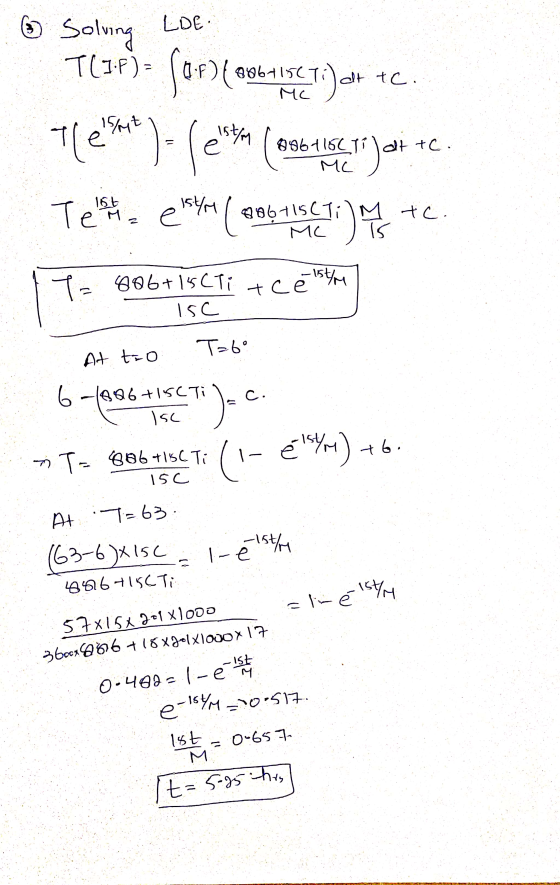
using energy balance and given data we can find the time
for any doubts write in comments
Add Answer to:
An electric heater is immersed in a well-stirred tank. Solvent
at 17 ° C, which has...
An electric heater is immersed in a well-stirred tank. Solvent at 19°C, which has a heat...
An electric heater is immersed in a well-stirred tank. Solvent at 19°C, which has a heat capacity of 2.1 kJ/(kg°C), is fed at a speed of 11 kg/h. The hot solvent is discharged at the same rate. The tank initially contains 180 kg of cold solvent at 10°C. The heat flow of the electric heater is 884 W. Do the following: a) Draw the system with all its variables. b) Write the differential equation along with its initial condition. c)...
An electric heater is immersed in a well-stirred tank. Solvent at 19°C, which has a heat...
An electric heater is immersed in a well-stirred tank. Solvent at 19°C, which has a heat capacity of 2.1 kJ/(kg°C), is fed at a speed of 11 kg/h. The hot solvent is discharged at the same rate. The tank initially contains 180 kg of cold solvent at 10°C. The heat flow of the electric heater is 884 W. Write the differential equation along with its initial condition.
An electric heater is immersed in a well-stirred tank. Solvent at 19°C, which has a heat...
An electric heater is immersed in a well-stirred tank. Solvent at 19°C, which has a heat capacity of 2.1 kJ/(kg°C), is fed at a speed of 11 kg/h. The hot solvent is discharged at the same rate. The tank initially contains 180 kg of cold solvent at 10°C. The heat flow of the electric heater is 884 W. Calculate the time for the temperature of the solvent being discharged to be 63°C (write the answer in hours and with two...
2. In the constant volume, stirred-tank heater shown in the figure below, the flow rates and...
 2. In the constant volume, stirred-tank heater shown in the figure below, the flow rates and material properties are held constant. The tank contains a heating element, which is initially off and the tank is the same temperature as the inlet stream. When t=0, the heater is turned on to a constant heating rate Q. For this material, assume C = C = Cp = Cy. m,Ti P,V,C, T(t) ń, r(t) o a. Write a transient thermal energy balance to...
Question 2 2.1 Consider a stirred tank heater which is characterised by the following equation: z4 pCpE The tank ha...
 Question 2 2.1 Consider a stirred tank heater which is characterised by the following equation: z4 pCpE The tank has a constant liquid volume V, 50 litres and a constant volumetric flow rate of F 10 litres/minute. For liquid water, the other parameters are pCp 1 kcal/ litre.°C. Determine the process gain and time constant of the system. 2.1.1 2.1.2 Write down the transfer function of the process. (9) 2.1.3 Determine the time-domain output of this process to a step...
A tank initially contains 3 m3 of water at 15 ° C, which is heated by...
A tank initially contains 3 m3 of water at 15 ° C, which is heated by a coil that supplies 1,250 kcal / min. Water is fed to the tank at a rate of 300 L / min at 65 ° C and is discharged at 400 L / min. It considers a density of 1.0 kg / L for water and a Ĉp of 1.0 kcal / kg K. The agitator in the tank has a 5 HP motor....
Exercise 10 Consider a 2-m-high electric hot water heater that has a diameter of 40 cm...
 Exercise 10 Consider a 2-m-high electric hot water heater that has a diameter of 40 cm and maintains the hot water at 55°C. The tank is located in a small room whose average temperature is 27°C, and the heat transfer coefficients on the inner and outer surfaces of the heater are 50 and 12 W/m2.°C, respectively. The tank is placed in another 46-cm-diameter sheet metal tank of negligible thickness, and the space between the two tanks is filled with foam...
An engineer is developing an electric water heater to provide acontinuous ("on demand") supply of hot...
 An engineer is developing an
electric water heater to provide acontinuous ("on demand") supply
of hot water. One trial design isshown in the figure. Water is
flowing at the rate F, the inlet thermometer registers
T_1, the voltmeter reads V, and the ammeter reads current I. Then
the power (i.e., the heat generated perunit time by the heating
element) is VI.
Assume that the heat capacity of water is C and that the heat
capacity of the heater apparatus is...
An engineer is developing an
electric water heater to provide acontinuous ("on demand") supply
of hot water. One trial design isshown in the figure. Water is
flowing at the rate F, the inlet thermometer registers
T_1, the voltmeter reads V, and the ammeter reads current I. Then
the power (i.e., the heat generated perunit time by the heating
element) is VI.
Assume that the heat capacity of water is C and that the heat
capacity of the heater apparatus is...
please answer the 2 questions :) Question 8 A tank of water has been outdoors in...
 please answer the 2 questions :)
Question 8 A tank of water has been outdoors in cold weather, and a slab of ice 3.9 cm thick has formed on its surface (see the figure). The air above the ice is at 13°C. Calculate the rate of formation of ice (in centimeters per hour) on the ice slab. Take the thermal conductivity of ice to be 0.0040 cal/s cm-C°, its density to be 0.92 g/cm3, and its latent heat of fusion...
please answer the 2 questions :)
Question 8 A tank of water has been outdoors in cold weather, and a slab of ice 3.9 cm thick has formed on its surface (see the figure). The air above the ice is at 13°C. Calculate the rate of formation of ice (in centimeters per hour) on the ice slab. Take the thermal conductivity of ice to be 0.0040 cal/s cm-C°, its density to be 0.92 g/cm3, and its latent heat of fusion...
 2. In the constant volume, stirred-tank heater shown in the figure below, the flow rates and material properties are held constant. The tank contains a heating element, which is initially off and the tank is the same temperature as the inlet stream. When t=0, the heater is turned on to a constant heating rate Q. For this material, assume C = C = Cp = Cy. m,Ti P,V,C, T(t) ń, r(t) o a. Write a transient thermal energy balance to...
 Question 2 2.1 Consider a stirred tank heater which is characterised by the following equation: z4 pCpE The tank has a constant liquid volume V, 50 litres and a constant volumetric flow rate of F 10 litres/minute. For liquid water, the other parameters are pCp 1 kcal/ litre.°C. Determine the process gain and time constant of the system. 2.1.1 2.1.2 Write down the transfer function of the process. (9) 2.1.3 Determine the time-domain output of this process to a step...
 Exercise 10 Consider a 2-m-high electric hot water heater that has a diameter of 40 cm and maintains the hot water at 55°C. The tank is located in a small room whose average temperature is 27°C, and the heat transfer coefficients on the inner and outer surfaces of the heater are 50 and 12 W/m2.°C, respectively. The tank is placed in another 46-cm-diameter sheet metal tank of negligible thickness, and the space between the two tanks is filled with foam...
 An engineer is developing an
electric water heater to provide acontinuous ("on demand") supply
of hot water. One trial design isshown in the figure. Water is
flowing at the rate F, the inlet thermometer registers
T_1, the voltmeter reads V, and the ammeter reads current I. Then
the power (i.e., the heat generated perunit time by the heating
element) is VI.
Assume that the heat capacity of water is C and that the heat
capacity of the heater apparatus is...
An engineer is developing an
electric water heater to provide acontinuous ("on demand") supply
of hot water. One trial design isshown in the figure. Water is
flowing at the rate F, the inlet thermometer registers
T_1, the voltmeter reads V, and the ammeter reads current I. Then
the power (i.e., the heat generated perunit time by the heating
element) is VI.
Assume that the heat capacity of water is C and that the heat
capacity of the heater apparatus is...
 please answer the 2 questions :)
Question 8 A tank of water has been outdoors in cold weather, and a slab of ice 3.9 cm thick has formed on its surface (see the figure). The air above the ice is at 13°C. Calculate the rate of formation of ice (in centimeters per hour) on the ice slab. Take the thermal conductivity of ice to be 0.0040 cal/s cm-C°, its density to be 0.92 g/cm3, and its latent heat of fusion...
please answer the 2 questions :)
Question 8 A tank of water has been outdoors in cold weather, and a slab of ice 3.9 cm thick has formed on its surface (see the figure). The air above the ice is at 13°C. Calculate the rate of formation of ice (in centimeters per hour) on the ice slab. Take the thermal conductivity of ice to be 0.0040 cal/s cm-C°, its density to be 0.92 g/cm3, and its latent heat of fusion...
Most questions answered within 3 hours.
-
Where is the error in this code sequence?
String s1 = "Hello";
String s2 = "ello";...
asked 11 months ago -
Financial data for Joel de Paris, Inc., for last year
follow:
Joel de Paris, Inc.
Balance...
asked 11 months ago -
Consider this reaction:
Al2(SO4)3 (aq)+ BaCl3
(aq) Al2Cl6 (aq)- +
3BaSO4(s) . What is the...
asked 11 months ago -
Suppose that Savneet is considering increasing her
recent random sample from 20 car rentals to 40...
asked 11 months ago -
Trucks arrive at an unloading terminal at an average rate of 120
per hour.
Trucks arrive...
asked 11 months ago -
Why are methanol and ethanol completely soluble in water while
octanol is not very little soluble....
asked 11 months ago -
A facilities manager at a university reads in a research report
that the mean amount of...
asked 11 months ago -
When the CuSO4 is rehydrated by adding water to the anhydrous
compound, is this an endothermic...
asked 11 months ago -
A ray of sunlight is passing from diamond into crown glass; the
angle of incidence is...
asked 11 months ago -
A block of mass 0.249 kg is placed on top of a light, vertical
spring of...
asked 11 months ago -
how do the kidneys compensate in the presences of acidosis
a) trigger hyperventilate
b) reserve acid...
asked 11 months ago -
Question 501 pts
The rental rate of capital to the firm increases. Which of the
following...
asked 11 months ago