
Homework Answers
If X follows Normal distribution then
(x -  ) /
) / follows standard normal distribution
A.
P(X < 19)
= P{(x -)
< (19 - 7)/7}
= P( Z < 1.71)
= 1 - P( Z > 1.71)
= 1 - 0.0436
= 0.9564
0.9564 proportion of population is less than 19
B.
P( X > 4)
= P{(x -)
> (4 - 7)/7}
= P( Z > - 0.43)
= 1 - P(Z < - 0.43)
= 1 - P( Z > 0.43)
(since standard normal distribution is symmetric around zero)
= 1 - 0.3336
= 0.6664
Add Answer to:
A normal population has mean = 7 and standard deviation - 7. (a) What proportion of...
A normal population has mean u = 9 and standard deviation = 5. (a) What proportion...
 A normal population has mean u = 9 and standard deviation = 5. (a) What proportion of the population is less than 20? (b) What is the probability that a randomly chosen value will be greater than 6? Round the answers to four decimal places. Part 1 of 2 The proportion of the population less than 20 is . Part 2 of 2 The probability that a randomly chosen value will be greater than 6 is .
A normal population has mean u=61 and standard deviation o=17. (a) What proportion of the population...
 A normal population has mean u=61 and standard deviation o=17. (a) What proportion of the population is greater than 100? (b) What is the probability that a randomly chosen value will be less than 82? Round the answers to four decimal places. Part 1 of 2 The proportion of the population greater than 100 is Part 2 of 2 The probability that a randomly chosen value will be less than 82 is
A normal population has mean = 9 and standard deviation -5. (a) What proportion of the...
 A normal population has mean = 9 and standard deviation -5. (a) What proportion of the population is less than 19? (b) What is the probability that a randomly chosen value will be greater than 4? Round the answers to four decimal places. Part 1 of 2 The proportion of the population less than 19 is Part 2 of 2 The probability that a randomly chosen value will be greater than 4 is : A normal population has mean =...
A NORMAL POPULATION HAS A MEAN=28 AND STANDARD DEVIATION=5. WHAT IS THE PROBABILITY THAT A RANDOMLY...
A NORMAL POPULATION HAS A MEAN=28 AND STANDARD DEVIATION=5. WHAT IS THE PROBABILITY THAT A RANDOMLY CHOSEN VALUE WILL BE GREATER THAN 19? A)0.6915 B)0.0359 C)0.9641 D)0.8849
U.I Seclol EXercise 4/, 48 (calc) 7 and standard deviation σ-& Round the answers to four...
 U.I Seclol EXercise 4/, 48 (calc) 7 and standard deviation σ-& Round the answers to four A normal population has m ean μ decimal places. Part 1 out of 2 What proportion of the population is less than 20? The proportion of the population less than 20 is CHECK NEXT Sa A normal population has mean μ four decimal places. 61 and standard deviation σ-20. Round the answers to Part I out of 2 What proportion of the population is...
A normal population has a mean of 19 and a standard deviation of 5. a. Compute...
 A normal population has a mean of 19 and a standard deviation of 5. a. Compute the z value associated with 22. (Round your answer to 2 decimal places.) Z 0.60| b. What proportion of the population is between 19 and 22? (Round z-score computation to 2 decimal places and your final answer to 4 decimal places.) Proportion c. What proportion of the population is less than 14? (Round z-score computation to 2 decimal places and your final answer to...
A normal population has a mean of 62 and a standard deviation of 14. You select...
A normal population has a mean of 62 and a standard deviation of 14. You select a random sample of 9. Compute the probability the sample mean is: (Round z values to 2 decimal places and final answers to 4 decimal places.) (a) Greater than 64. Probability (b) Less than 58. Probability (c) Between 58 and 64. Probability
= 23 and standard deviation o = 7. What proportion A normal population has a mean...
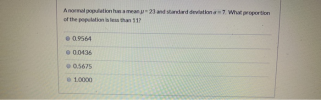 = 23 and standard deviation o = 7. What proportion A normal population has a mean of the population is less than 11? 0.9564 0.0436 0.5675 1.0000
A normal population has a mean of 18 and a standard deviation of 5. a. Compute...
 A normal population has a mean of 18 and a standard deviation of 5. a. Compute the z value associated with 24. (Round your answer to 2 decimal places.) 2 1.20 b. What proportion of the population is between 18 and 24? (Round z-score computation to 2 decimal places and your final answer to 4 decimal places.) Proportion c. What proportion of the population is less than 13? (Round z-score computation to 2 decimal places and your final answer to...
A normal population has a mean of 21.0 and a standard deviation of 5.0. a.) Compute...
A normal population has a mean of 21.0 and a standard deviation of 5.0. a.) Compute the z value associated with 24.0 c.) What proportion of the population is less than 18.0? (Round z-score computation to 2 decimal places and your final answer to 4 decimal places.)
 A normal population has mean u = 9 and standard deviation = 5. (a) What proportion of the population is less than 20? (b) What is the probability that a randomly chosen value will be greater than 6? Round the answers to four decimal places. Part 1 of 2 The proportion of the population less than 20 is . Part 2 of 2 The probability that a randomly chosen value will be greater than 6 is .
 A normal population has mean u=61 and standard deviation o=17. (a) What proportion of the population is greater than 100? (b) What is the probability that a randomly chosen value will be less than 82? Round the answers to four decimal places. Part 1 of 2 The proportion of the population greater than 100 is Part 2 of 2 The probability that a randomly chosen value will be less than 82 is
 A normal population has mean = 9 and standard deviation -5. (a) What proportion of the population is less than 19? (b) What is the probability that a randomly chosen value will be greater than 4? Round the answers to four decimal places. Part 1 of 2 The proportion of the population less than 19 is Part 2 of 2 The probability that a randomly chosen value will be greater than 4 is : A normal population has mean =...
 U.I Seclol EXercise 4/, 48 (calc) 7 and standard deviation σ-& Round the answers to four A normal population has m ean μ decimal places. Part 1 out of 2 What proportion of the population is less than 20? The proportion of the population less than 20 is CHECK NEXT Sa A normal population has mean μ four decimal places. 61 and standard deviation σ-20. Round the answers to Part I out of 2 What proportion of the population is...
 A normal population has a mean of 19 and a standard deviation of 5. a. Compute the z value associated with 22. (Round your answer to 2 decimal places.) Z 0.60| b. What proportion of the population is between 19 and 22? (Round z-score computation to 2 decimal places and your final answer to 4 decimal places.) Proportion c. What proportion of the population is less than 14? (Round z-score computation to 2 decimal places and your final answer to...
 = 23 and standard deviation o = 7. What proportion A normal population has a mean of the population is less than 11? 0.9564 0.0436 0.5675 1.0000
 A normal population has a mean of 18 and a standard deviation of 5. a. Compute the z value associated with 24. (Round your answer to 2 decimal places.) 2 1.20 b. What proportion of the population is between 18 and 24? (Round z-score computation to 2 decimal places and your final answer to 4 decimal places.) Proportion c. What proportion of the population is less than 13? (Round z-score computation to 2 decimal places and your final answer to...
Most questions answered within 3 hours.
-
Where is the error in this code sequence?
String s1 = "Hello";
String s2 = "ello";...
asked 10 months ago -
Financial data for Joel de Paris, Inc., for last year
follow:
Joel de Paris, Inc.
Balance...
asked 10 months ago -
Consider this reaction:
Al2(SO4)3 (aq)+ BaCl3
(aq) Al2Cl6 (aq)- +
3BaSO4(s) . What is the...
asked 10 months ago -
Suppose that Savneet is considering increasing her
recent random sample from 20 car rentals to 40...
asked 10 months ago -
Trucks arrive at an unloading terminal at an average rate of 120
per hour.
Trucks arrive...
asked 10 months ago -
Why are methanol and ethanol completely soluble in water while
octanol is not very little soluble....
asked 10 months ago -
A facilities manager at a university reads in a research report
that the mean amount of...
asked 10 months ago -
When the CuSO4 is rehydrated by adding water to the anhydrous
compound, is this an endothermic...
asked 10 months ago -
A ray of sunlight is passing from diamond into crown glass; the
angle of incidence is...
asked 10 months ago -
A block of mass 0.249 kg is placed on top of a light, vertical
spring of...
asked 10 months ago -
how do the kidneys compensate in the presences of acidosis
a) trigger hyperventilate
b) reserve acid...
asked 10 months ago -
Question 501 pts
The rental rate of capital to the firm increases. Which of the
following...
asked 10 months ago