Naked capsid animal viruses are commonly released from infected cells by __________ , a process the...
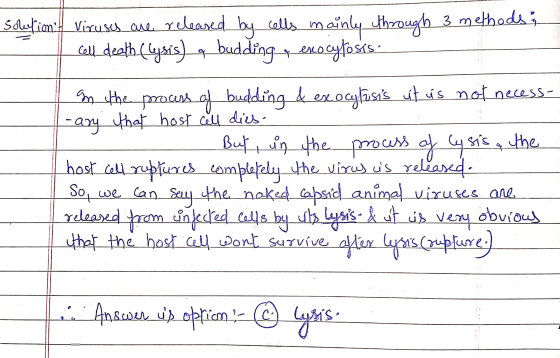
Naked capsid animal viruses are commonly released from infected cells by __________ , a process the host cell does not survive.
exocytosis
membrane fusion
lysis
budding
Homework Answers
Add Answer to:
Naked capsid animal viruses are commonly released from infected
cells by __________ , a process the...
Animal Viruses are released from the host cell by which method A. Budding B. Lysis C....
Animal Viruses are released from the host cell by which method A. Budding B. Lysis C. Exocytosis D. All of the above . E. None of the above
Compared to both prokaryotic and eukaryotic cells, viruses are not filterable. lack genetic material. are generally...
Compared to both prokaryotic and eukaryotic cells, viruses are not filterable. lack genetic material. are generally smaller. lack proteins. have similar metabolic processes. When a virus has an envelope, When a virus has an envelope, it is always a bacteriophage. it is always an RNA-containing virus. it likely escapes its host cell by budding. it may escape its host cell either by budding or by lysis. it likely escapes its host cell by lysis. Viral spikes Viral spikes allow the...
How do viruses acquire an envelope? Viruses manufacture cell membranes because it is encoded in their...
 How do viruses acquire an envelope? Viruses manufacture cell membranes because it is encoded in their nucleic acid. Animal viruses don't make membranous envelopes; these are only produced in phage viruses. Only DNA viruses make envelopes because they have a gene for phospholipid production. When virus are released from host cell, they take the host cell membrane along with synthesized viral glycoproteins.
- WERS ON THE SCANTRON SHEET PROVIDE 1. Viruses are known as obligate, intracellular A) Organisms...
 - WERS ON THE SCANTRON SHEET PROVIDE 1. Viruses are known as obligate, intracellular A) Organisms B) Symbionts C) Ornelles D) Pass 2. Which of the following is a property of life shared by pokaryote ndaryote A) nucleic acids used to store hereditary information B) the capacity to evolve C) the ability to replicate (reproduce) without invading a host cell D) presence of proteins E) the capacity to mutate , NOV 3. Which of the following is characteristic of the...
multiple choice question: microbiology A) What contents are released by NK cells into infected cells to...
multiple choice question: microbiology A) What contents are released by NK cells into infected cells to start the process of apoptosis? Antibodies. Granzymes. Viruses. T cell receptors. B) The T cell receptor of CD4 T cell recognizes: Free peptides. MHC I / peptide complex. MHC II / peptide complex. Both a and c. C) Th1 is a subset of CD4 T cell that are good for clearing: Viral infection. Extracellular bacterial infection. Intracellular bacterial infection. All of the above. D)...
Read pp. 396-400, MICRO CHECK page 400: 10. Which part of animal viruses is involved in...
 Read pp. 396-400, MICRO CHECK page 400: 10. Which part of animal viruses is involved in membrane fusion with a host cell? 13. How do negative-sense single-stranded RNA (-SSRNA) viruses generate mRNA? Read pp. 405-407; MICRO CHECK page 407: 16. How can prions be destroyed?
Which statement among A-D is false regarding animal viral infections? A. Uncoating refers to the process...
 Which statement among A-D is false regarding animal viral infections? A. Uncoating refers to the process of viral exit from the host cell. B. Depending on the virus type, assembly of viruses may occur in the nucleus or cytoplasm. C. Budding is a mechanism of virus exit that leads to acquisition of the envelope around the viral particles. D. Endosome formation is a mechanism that allows for the viral genome to be freed from the capsid. none of A-D are...
a,b and d please 1. (6 pts) The genomes of viruses are diverse. For animal viruses,...
 a,b and d please
1. (6 pts) The genomes of viruses are diverse. For animal viruses, they often encode and bring own polymerases to the infected host cell for viral replication. a. (1 pt) Viruses with single-stranded RNA as their genome for which the nucleotide sequence is the same as the viral mRNA are said to be viruses. (Circle one best answer.) A) plus-stranded; B) minus-stranded; C) mRNA-like; D) complete; E) defective b. (1 pt) A virus is an obligate...
a,b and d please
1. (6 pts) The genomes of viruses are diverse. For animal viruses, they often encode and bring own polymerases to the infected host cell for viral replication. a. (1 pt) Viruses with single-stranded RNA as their genome for which the nucleotide sequence is the same as the viral mRNA are said to be viruses. (Circle one best answer.) A) plus-stranded; B) minus-stranded; C) mRNA-like; D) complete; E) defective b. (1 pt) A virus is an obligate...
1. Which of the following is a valid argument against including viruses in the group of...
1. Which of the following is a valid argument against including viruses in the group of ‘life’? a) Viruses are very small b) SomeviruseshavegeneticmaterialmadeofRNA,notDNA c) Viruses are not capable of independent reproduction d) Virusesinfectawiderangeofhosts e) Viruses can evolve very rapidly 2. M13 is a bacteriophage (a type of virus) that infects E. coli cells, and is capable of integrating into the host genome, becoming a prophage. It is likely to enter the ____________ when conditions are not conducive for rapid...
1-1. The SARS-CoV-2 is an enveloped virus, meaning it is surrounded by a bilayer of membrane...
1-1. The SARS-CoV-2 is an enveloped virus, meaning it is surrounded by a bilayer of membrane that it acquires as it exits the host cell. a. What is the host membrane bilayer made of? b. What is the other main macromolecule that comprises the “fluid mosaic” model of a cell membrane? 1-2. To gain entry, spikes of the SARS-CoV-2 bind to angiotensin-converting enzyme 2 (ACE2) found in epithelial cells especially of the respiratory and oral passageways. As such, these cells...
 How do viruses acquire an envelope? Viruses manufacture cell membranes because it is encoded in their nucleic acid. Animal viruses don't make membranous envelopes; these are only produced in phage viruses. Only DNA viruses make envelopes because they have a gene for phospholipid production. When virus are released from host cell, they take the host cell membrane along with synthesized viral glycoproteins.
 - WERS ON THE SCANTRON SHEET PROVIDE 1. Viruses are known as obligate, intracellular A) Organisms B) Symbionts C) Ornelles D) Pass 2. Which of the following is a property of life shared by pokaryote ndaryote A) nucleic acids used to store hereditary information B) the capacity to evolve C) the ability to replicate (reproduce) without invading a host cell D) presence of proteins E) the capacity to mutate , NOV 3. Which of the following is characteristic of the...
 Read pp. 396-400, MICRO CHECK page 400: 10. Which part of animal viruses is involved in membrane fusion with a host cell? 13. How do negative-sense single-stranded RNA (-SSRNA) viruses generate mRNA? Read pp. 405-407; MICRO CHECK page 407: 16. How can prions be destroyed?
 Which statement among A-D is false regarding animal viral infections? A. Uncoating refers to the process of viral exit from the host cell. B. Depending on the virus type, assembly of viruses may occur in the nucleus or cytoplasm. C. Budding is a mechanism of virus exit that leads to acquisition of the envelope around the viral particles. D. Endosome formation is a mechanism that allows for the viral genome to be freed from the capsid. none of A-D are...
 a,b and d please
1. (6 pts) The genomes of viruses are diverse. For animal viruses, they often encode and bring own polymerases to the infected host cell for viral replication. a. (1 pt) Viruses with single-stranded RNA as their genome for which the nucleotide sequence is the same as the viral mRNA are said to be viruses. (Circle one best answer.) A) plus-stranded; B) minus-stranded; C) mRNA-like; D) complete; E) defective b. (1 pt) A virus is an obligate...
a,b and d please
1. (6 pts) The genomes of viruses are diverse. For animal viruses, they often encode and bring own polymerases to the infected host cell for viral replication. a. (1 pt) Viruses with single-stranded RNA as their genome for which the nucleotide sequence is the same as the viral mRNA are said to be viruses. (Circle one best answer.) A) plus-stranded; B) minus-stranded; C) mRNA-like; D) complete; E) defective b. (1 pt) A virus is an obligate...
Most questions answered within 3 hours.
-
Where is the error in this code sequence?
String s1 = "Hello";
String s2 = "ello";...
asked 10 months ago -
Financial data for Joel de Paris, Inc., for last year
follow:
Joel de Paris, Inc.
Balance...
asked 10 months ago -
Consider this reaction:
Al2(SO4)3 (aq)+ BaCl3
(aq) Al2Cl6 (aq)- +
3BaSO4(s) . What is the...
asked 10 months ago -
Suppose that Savneet is considering increasing her
recent random sample from 20 car rentals to 40...
asked 10 months ago -
Trucks arrive at an unloading terminal at an average rate of 120
per hour.
Trucks arrive...
asked 10 months ago -
Why are methanol and ethanol completely soluble in water while
octanol is not very little soluble....
asked 10 months ago -
A facilities manager at a university reads in a research report
that the mean amount of...
asked 10 months ago -
When the CuSO4 is rehydrated by adding water to the anhydrous
compound, is this an endothermic...
asked 10 months ago -
A ray of sunlight is passing from diamond into crown glass; the
angle of incidence is...
asked 10 months ago -
A block of mass 0.249 kg is placed on top of a light, vertical
spring of...
asked 10 months ago -
how do the kidneys compensate in the presences of acidosis
a) trigger hyperventilate
b) reserve acid...
asked 10 months ago -
Question 501 pts
The rental rate of capital to the firm increases. Which of the
following...
asked 10 months ago