

Homework Answers
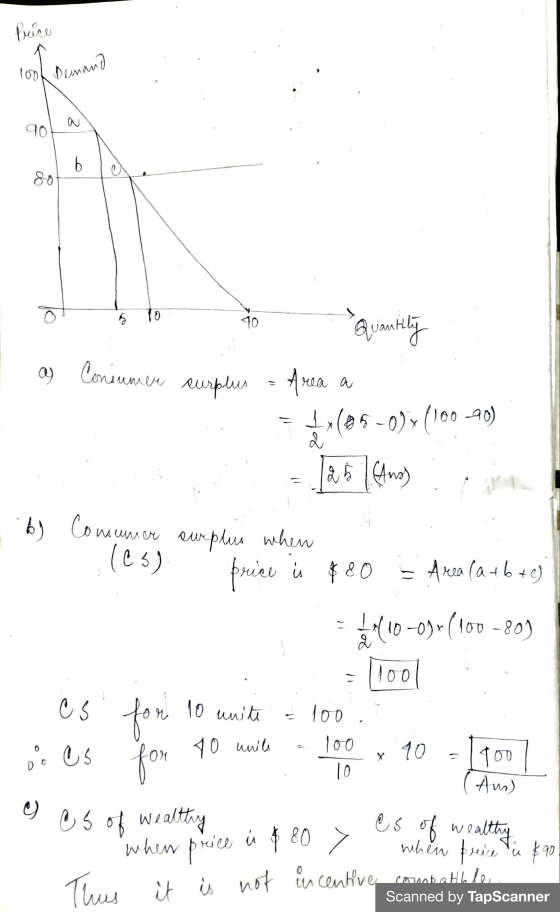
a. $25.
b. $400.
c. NO
The working is also shown below.
Add Answer to:
In the market for poultry there are two groups of people, those who are poor and...
In the market for poultry there are two groups of people, those who are poor and...
 In the market for poultry there are two groups of people, those who are poor and those who are wealthy. The wealthy have a more inelastic demand than those who are poor. The firm offers a price of $90 if consumers purchase 5 units and offers a price of $80 if consumers purchase 40 units. These values are indicated on the graph below. With this price scheme, the firm wants to incentivize the wealthy to pay the higher price and...
QUESTION 2 Suppose that a firm with market power wants to price discriminate and they decide...
 QUESTION 2 Suppose that a firm with market power wants to price discriminate and they decide to do so by offering quantity discounts. There are two groups of individuals in the market, males and females, with males having a more inelastic demand than females. The firm offers a price of $70 if males purchase 10 units and offers a price of $so if males purchase 50 units. These values are indicated on the graph below. Price 90 Demand Males 70...
1. Suppose market demand for oranges is given by QD = 500 - 10P where Qp...
 1. Suppose market demand for oranges is given by QD = 500 - 10P where Qp is quantity demanded and P is the market price. Market supply is given by Qs = -100 + 10P where Qs is quantity supplied and P is the market price. (a) Find the equilibrium price and quantity in this market. (b) What is the consumer surplus and producer surplus? (C) Suppose that the government imposes a $10 tax on the good, to be included...
Please mathematically explain the meaning of the line "additional profit it would have earned by selling...
 Please mathematically explain the meaning of the line "additional
profit it would have earned by selling Qc-Qm at price Pc" from the
above diagram.
Lost Consumer Surplus Deadweight Loss SS FROM MONOPOLY le and triangles show changes producer surplus when moving ice and quantity, P, and Q, to a d quantity, P, and Q Because of sumers lose A + B and producer dweight loss is B+ C AR Qe P, and Q, to the monopoly price and quantity, P...
Please mathematically explain the meaning of the line "additional
profit it would have earned by selling Qc-Qm at price Pc" from the
above diagram.
Lost Consumer Surplus Deadweight Loss SS FROM MONOPOLY le and triangles show changes producer surplus when moving ice and quantity, P, and Q, to a d quantity, P, and Q Because of sumers lose A + B and producer dweight loss is B+ C AR Qe P, and Q, to the monopoly price and quantity, P...
Suppose that a price-searcher firm had consumers who were all identical to each other. The individual...
Suppose that a price-searcher firm had consumers who were all identical to each other. The individual consumer's demand function is given by: qD= 40-4P. The firm decides to try a second-degree price discrimination scheme. The first 18 units will have a price of $5.50. After that, any units a consumer purchases will be only $2.75. The firm has a constant marginal cost of $1.00per unit. Calculate the consumer surplus.
Suppose that a price-searcher firm had consumers who were all identical to each other. The individual...
Suppose that a price-searcher firm had consumers who were all identical to each other. The individual consumer's demand function is given by: qD= 40 -3P. The firm decides to try a second-degree price discrimination scheme. The first 18 units will have a price of $7.33. After that, any units a consumer purchases will be only $2.33. The firm has a constant marginal cost of $1.33 per unit. Calculate the consumer surplus
The only four consumers in a market have the following willingness to pay for a goou:...
 The only four consumers in a market have the following willingness to pay for a goou: Buyer Willingness to Pay Carlos $15 bulana S25 Wilbur $35 Ming-la $45 a. If the market price for the good is $20, who will purchase the good? b. If there is only one unit of the good and if the buyers bid against each other for the right to purchase it, how much will the good will sell for and who will likely buy...
How do you do these problems? Can you please help me? 2nd Degree Price Discrimination Problem...
 How do you do these problems? Can you please help me?
2nd Degree Price Discrimination Problem Suppose there are 100 wealthy consumers, who value the 1" unit of a good at $15 and a 24 unit at S10. There are also 100 moderate income consumers, who value only the 1" unit at $12. For the producer, AC = MC = 6. There are no fixed costs. 1. No price discrimination. One unit sells for $15. 12. No price discrimination. One...
How do you do these problems? Can you please help me?
2nd Degree Price Discrimination Problem Suppose there are 100 wealthy consumers, who value the 1" unit of a good at $15 and a 24 unit at S10. There are also 100 moderate income consumers, who value only the 1" unit at $12. For the producer, AC = MC = 6. There are no fixed costs. 1. No price discrimination. One unit sells for $15. 12. No price discrimination. One...
If a $5 tax on each pack of cigarettes causes the market price of cigarettes to...
 If a $5 tax on each pack of cigarettes causes the market price of cigarettes to increase by $2.50 then which of the following statements is true? consumers must be more elastic than producers consumers must be less elastic than producers consumers and producers must be equally elastic Question 42 (1 point) If the elasticity of demand is -1.8 and the elasticity of supply is 1, then consumers are than producers and the relative consumer burden will equal . Hint:...
Question 11 Suppose that a price-searcher firm had consumers who were all identical to each other....
 Question 11 Suppose that a price-searcher firm had consumers who were all identical to each other. The individual consumer's demand function is given by: qp- 40 -3P. The firm decides to try a second-degree price discrimination scheme. The first 18 units will have a price of $7.33. After that, any units a consumer purchases will be only $2.33. The firm has a constant marginal cost of $1.33 per unit. Calculate the consumer surplus. Tries remaining:2 Points out of 8.33 Flag...
 In the market for poultry there are two groups of people, those who are poor and those who are wealthy. The wealthy have a more inelastic demand than those who are poor. The firm offers a price of $90 if consumers purchase 5 units and offers a price of $80 if consumers purchase 40 units. These values are indicated on the graph below. With this price scheme, the firm wants to incentivize the wealthy to pay the higher price and...
 QUESTION 2 Suppose that a firm with market power wants to price discriminate and they decide to do so by offering quantity discounts. There are two groups of individuals in the market, males and females, with males having a more inelastic demand than females. The firm offers a price of $70 if males purchase 10 units and offers a price of $so if males purchase 50 units. These values are indicated on the graph below. Price 90 Demand Males 70...
 1. Suppose market demand for oranges is given by QD = 500 - 10P where Qp is quantity demanded and P is the market price. Market supply is given by Qs = -100 + 10P where Qs is quantity supplied and P is the market price. (a) Find the equilibrium price and quantity in this market. (b) What is the consumer surplus and producer surplus? (C) Suppose that the government imposes a $10 tax on the good, to be included...
 Please mathematically explain the meaning of the line "additional
profit it would have earned by selling Qc-Qm at price Pc" from the
above diagram.
Lost Consumer Surplus Deadweight Loss SS FROM MONOPOLY le and triangles show changes producer surplus when moving ice and quantity, P, and Q, to a d quantity, P, and Q Because of sumers lose A + B and producer dweight loss is B+ C AR Qe P, and Q, to the monopoly price and quantity, P...
Please mathematically explain the meaning of the line "additional
profit it would have earned by selling Qc-Qm at price Pc" from the
above diagram.
Lost Consumer Surplus Deadweight Loss SS FROM MONOPOLY le and triangles show changes producer surplus when moving ice and quantity, P, and Q, to a d quantity, P, and Q Because of sumers lose A + B and producer dweight loss is B+ C AR Qe P, and Q, to the monopoly price and quantity, P...
 The only four consumers in a market have the following willingness to pay for a goou: Buyer Willingness to Pay Carlos $15 bulana S25 Wilbur $35 Ming-la $45 a. If the market price for the good is $20, who will purchase the good? b. If there is only one unit of the good and if the buyers bid against each other for the right to purchase it, how much will the good will sell for and who will likely buy...
 How do you do these problems? Can you please help me?
2nd Degree Price Discrimination Problem Suppose there are 100 wealthy consumers, who value the 1" unit of a good at $15 and a 24 unit at S10. There are also 100 moderate income consumers, who value only the 1" unit at $12. For the producer, AC = MC = 6. There are no fixed costs. 1. No price discrimination. One unit sells for $15. 12. No price discrimination. One...
How do you do these problems? Can you please help me?
2nd Degree Price Discrimination Problem Suppose there are 100 wealthy consumers, who value the 1" unit of a good at $15 and a 24 unit at S10. There are also 100 moderate income consumers, who value only the 1" unit at $12. For the producer, AC = MC = 6. There are no fixed costs. 1. No price discrimination. One unit sells for $15. 12. No price discrimination. One...
 If a $5 tax on each pack of cigarettes causes the market price of cigarettes to increase by $2.50 then which of the following statements is true? consumers must be more elastic than producers consumers must be less elastic than producers consumers and producers must be equally elastic Question 42 (1 point) If the elasticity of demand is -1.8 and the elasticity of supply is 1, then consumers are than producers and the relative consumer burden will equal . Hint:...
 Question 11 Suppose that a price-searcher firm had consumers who were all identical to each other. The individual consumer's demand function is given by: qp- 40 -3P. The firm decides to try a second-degree price discrimination scheme. The first 18 units will have a price of $7.33. After that, any units a consumer purchases will be only $2.33. The firm has a constant marginal cost of $1.33 per unit. Calculate the consumer surplus. Tries remaining:2 Points out of 8.33 Flag...
Most questions answered within 3 hours.
-
Where is the error in this code sequence?
String s1 = "Hello";
String s2 = "ello";...
asked 10 months ago -
Financial data for Joel de Paris, Inc., for last year
follow:
Joel de Paris, Inc.
Balance...
asked 10 months ago -
Consider this reaction:
Al2(SO4)3 (aq)+ BaCl3
(aq) Al2Cl6 (aq)- +
3BaSO4(s) . What is the...
asked 10 months ago -
Suppose that Savneet is considering increasing her
recent random sample from 20 car rentals to 40...
asked 10 months ago -
Trucks arrive at an unloading terminal at an average rate of 120
per hour.
Trucks arrive...
asked 10 months ago -
Why are methanol and ethanol completely soluble in water while
octanol is not very little soluble....
asked 10 months ago -
A facilities manager at a university reads in a research report
that the mean amount of...
asked 10 months ago -
When the CuSO4 is rehydrated by adding water to the anhydrous
compound, is this an endothermic...
asked 10 months ago -
A ray of sunlight is passing from diamond into crown glass; the
angle of incidence is...
asked 10 months ago -
A block of mass 0.249 kg is placed on top of a light, vertical
spring of...
asked 10 months ago -
how do the kidneys compensate in the presences of acidosis
a) trigger hyperventilate
b) reserve acid...
asked 10 months ago -
Question 501 pts
The rental rate of capital to the firm increases. Which of the
following...
asked 10 months ago