
Homework Answers
Add Answer to:
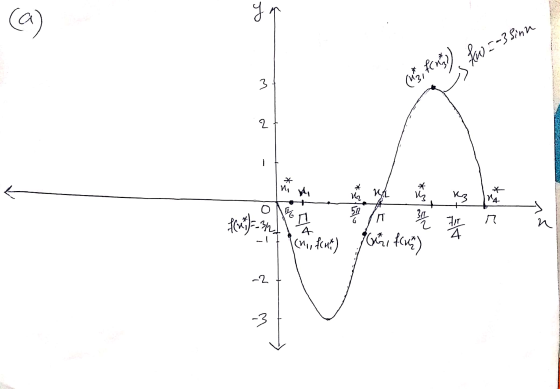
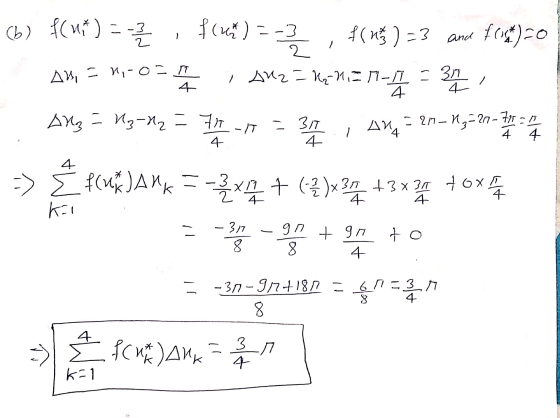
(a) Draw the curve and show the indicated partitions and (b) find Źr vi bark k=1...
Divide given [a,b] into n equal subinterval. (a) Draw the curve and the inscribed partitions or...
 Divide given [a,b] into n equal subinterval. (a) Draw the curve and the inscribed partitions or rectangles and compute the sum of the areas (b) draw the curve and the circumscribed partitions or rectangles and compute the sum of the areas. f(x) = – x2 + 25; (0,5); n = 5
(5) Recall that X ~Uniform(10, 1,2,... ,n - 1)) if if k E (0, 1,2,... ,n -1, P(x k)0 otherwise (a...
 (5) Recall that X ~Uniform(10, 1,2,... ,n - 1)) if if k E (0, 1,2,... ,n -1, P(x k)0 otherwise (a) Determine the MGF of such a random variable. (b) Let X1, X2, X3 be independent random variables with X1 Uniform(10,1)) X2 ~Uniform(f0, 1,2]) Xs~ Uniform(10, 1,2,3,4]). X3 ~ U x2 ~ Uniform(10, 1,2)) 13Uniform Find the laws of both Y1 X1 +2X2 +6X3 and Y2 15X1 +5X2 + X3. (c) What is the correlation coefficient of Yi and ½?...
Suppose X = Exp(1) and Y= -ln(x) (a)Find the cumulative distribution function of Y . (b)...
 Suppose X = Exp(1) and Y= -ln(x)
(a)Find the cumulative distribution function of Y .
(b) Find the probability density function of Y .
(c) Let X1, X2, ... , Xk be i.i.d. Exp(1), and let Mk =
max{X1,..... , Xk)(Maximum of X1, ..., Xk). Find the probability
density function of Mk.(Hint: P(min(X1, X2, X3) > k) = P(X1
>= k, X2 >= k, X3 >= kq, how about max ?)
(d) Show that as k → 00, the CDF...
Suppose X = Exp(1) and Y= -ln(x)
(a)Find the cumulative distribution function of Y .
(b) Find the probability density function of Y .
(c) Let X1, X2, ... , Xk be i.i.d. Exp(1), and let Mk =
max{X1,..... , Xk)(Maximum of X1, ..., Xk). Find the probability
density function of Mk.(Hint: P(min(X1, X2, X3) > k) = P(X1
>= k, X2 >= k, X3 >= kq, how about max ?)
(d) Show that as k → 00, the CDF...
(1 point) In this problem you will calculate the area between f(x) = x2 and the...
 (1 point) In this problem you will calculate the area between f(x) = x2 and the x-axis over the interval [3,12] using a limit of right-endpoint Riemann sums: Area = lim ( f(xxAx bir (3 forwar). Express the following quantities in terms of n, the number of rectangles in the Riemann sum, and k, the index for the rectangles in the Riemann sum. a. We start by subdividing [3, 12) into n equal width subintervals [x0, x1], [x1, x2),..., [Xn-1,...
6. (10 points) Suppose X – Exp(1) and Y = -In(X) (a) Find the cumulative distribution...
 6. (10 points) Suppose X – Exp(1) and Y = -In(X) (a) Find the cumulative distribution function of Y. (b) Find the probability density function of Y. (c) Let X1, X2,...,be i.i.d. Exp(1), and let Mk = max(X1,..., Xk) (Maximum of X1, ..., Xk). Find the probability density function of Mk (Hint: P(min(X1, X2, X3) > k) = P(X1 > k, X2 > k, X3 > k), how about max ?) (d) Show that as k- , the CDF of...
(b) ONLY! Though you can use the result from (a) without proof (a) Let F(x) =...
 (b) ONLY! Though you can use the result from (a) without
proof
(a) Let F(x) = x + x2 + x3 +... and let G(x) = x - x2 + x3 – x4.... Show that for k > 1 and n>k, (4")F(x)* = (n = 1) and if n < k then [x"]F(x)k = 0. (b) Show that G(F(x)) = x.
(b) ONLY! Though you can use the result from (a) without
proof
(a) Let F(x) = x + x2 + x3 +... and let G(x) = x - x2 + x3 – x4.... Show that for k > 1 and n>k, (4")F(x)* = (n = 1) and if n < k then [x"]F(x)k = 0. (b) Show that G(F(x)) = x.
Show that any two eigenvectors of the symmetric matrix corresponding to distinct eigenvalues are orthogonal. -1...
 Show that any two eigenvectors of the symmetric matrix corresponding to distinct eigenvalues are orthogonal. -1 0 -1 0-1 0 - 1 0 5 Find the characteristic polynomial of A. - A - Find the eigenvalues of A. (Enter your answers from smallest to largest.) (1, 12, 13) = ]) Find the general form for every eigenvector corresponding to N. (Uses as your parameter.) X1 = Find the general form for every eigenvector corresponding to 12. (Use t as your...
Question 1 Suppose that the market demand curve and the market supply curve are described, respectively,...
 Question 1 Suppose that the market demand curve and the market supply curve are described, respectively, by D(p) 240 3p and S(p) 5p. Compute the equilibrium price-quantity pair (p*,q*) (A) (20, 100) (B) (20, 180) (C) (30, 150) (D) (35, 135) (E) (40,200) Question 2 The setup is the same as in Question 1, except that the government now levies a quantity tax in the amount of $8 per unit of the good. Letting pf denote the price buyers pay...
3. [3 marks] Show that for a plane curve described by r = c(t)i + y(t)j,...
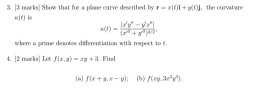 3. [3 marks] Show that for a plane curve described by r = c(t)i + y(t)j, the curvature k(t) is I'Y' - YX| (x2 + y2)3/27 where a prime denotes differentiation with respect to t. 4. [2 marks] Let f(x, y) = xy +3. Find (a) f(x + y, x - y); (b) f(xy, 3.22y).
Show that the following functions are homothetic but not homogeneous: (a) f(x1, xa) = k + xỉ 1/2x...
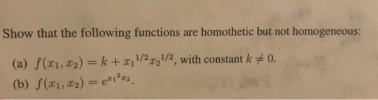 Show that the following functions are homothetic but not homogeneous: (a) f(x1, xa) = k + xỉ 1/2x21/2, with constant kメ0. (b) f(x1,x2)= ezi'm
Show that the following functions are homothetic but not homogeneous: (a) f(x1, xa) = k + xỉ 1/2x21/2, with constant kメ0. (b) f(x1,x2)= ezi'm
Show that the following functions are homothetic but not homogeneous: (a) f(x1, xa) = k + xỉ 1/2x21/2, with constant kメ0. (b) f(x1,x2)= ezi'm
 Divide given [a,b] into n equal subinterval. (a) Draw the curve and the inscribed partitions or rectangles and compute the sum of the areas (b) draw the curve and the circumscribed partitions or rectangles and compute the sum of the areas. f(x) = – x2 + 25; (0,5); n = 5
 (5) Recall that X ~Uniform(10, 1,2,... ,n - 1)) if if k E (0, 1,2,... ,n -1, P(x k)0 otherwise (a) Determine the MGF of such a random variable. (b) Let X1, X2, X3 be independent random variables with X1 Uniform(10,1)) X2 ~Uniform(f0, 1,2]) Xs~ Uniform(10, 1,2,3,4]). X3 ~ U x2 ~ Uniform(10, 1,2)) 13Uniform Find the laws of both Y1 X1 +2X2 +6X3 and Y2 15X1 +5X2 + X3. (c) What is the correlation coefficient of Yi and ½?...
 Suppose X = Exp(1) and Y= -ln(x)
(a)Find the cumulative distribution function of Y .
(b) Find the probability density function of Y .
(c) Let X1, X2, ... , Xk be i.i.d. Exp(1), and let Mk =
max{X1,..... , Xk)(Maximum of X1, ..., Xk). Find the probability
density function of Mk.(Hint: P(min(X1, X2, X3) > k) = P(X1
>= k, X2 >= k, X3 >= kq, how about max ?)
(d) Show that as k → 00, the CDF...
Suppose X = Exp(1) and Y= -ln(x)
(a)Find the cumulative distribution function of Y .
(b) Find the probability density function of Y .
(c) Let X1, X2, ... , Xk be i.i.d. Exp(1), and let Mk =
max{X1,..... , Xk)(Maximum of X1, ..., Xk). Find the probability
density function of Mk.(Hint: P(min(X1, X2, X3) > k) = P(X1
>= k, X2 >= k, X3 >= kq, how about max ?)
(d) Show that as k → 00, the CDF...
 (1 point) In this problem you will calculate the area between f(x) = x2 and the x-axis over the interval [3,12] using a limit of right-endpoint Riemann sums: Area = lim ( f(xxAx bir (3 forwar). Express the following quantities in terms of n, the number of rectangles in the Riemann sum, and k, the index for the rectangles in the Riemann sum. a. We start by subdividing [3, 12) into n equal width subintervals [x0, x1], [x1, x2),..., [Xn-1,...
 6. (10 points) Suppose X – Exp(1) and Y = -In(X) (a) Find the cumulative distribution function of Y. (b) Find the probability density function of Y. (c) Let X1, X2,...,be i.i.d. Exp(1), and let Mk = max(X1,..., Xk) (Maximum of X1, ..., Xk). Find the probability density function of Mk (Hint: P(min(X1, X2, X3) > k) = P(X1 > k, X2 > k, X3 > k), how about max ?) (d) Show that as k- , the CDF of...
 (b) ONLY! Though you can use the result from (a) without
proof
(a) Let F(x) = x + x2 + x3 +... and let G(x) = x - x2 + x3 – x4.... Show that for k > 1 and n>k, (4")F(x)* = (n = 1) and if n < k then [x"]F(x)k = 0. (b) Show that G(F(x)) = x.
(b) ONLY! Though you can use the result from (a) without
proof
(a) Let F(x) = x + x2 + x3 +... and let G(x) = x - x2 + x3 – x4.... Show that for k > 1 and n>k, (4")F(x)* = (n = 1) and if n < k then [x"]F(x)k = 0. (b) Show that G(F(x)) = x.
 Show that any two eigenvectors of the symmetric matrix corresponding to distinct eigenvalues are orthogonal. -1 0 -1 0-1 0 - 1 0 5 Find the characteristic polynomial of A. - A - Find the eigenvalues of A. (Enter your answers from smallest to largest.) (1, 12, 13) = ]) Find the general form for every eigenvector corresponding to N. (Uses as your parameter.) X1 = Find the general form for every eigenvector corresponding to 12. (Use t as your...
 Question 1 Suppose that the market demand curve and the market supply curve are described, respectively, by D(p) 240 3p and S(p) 5p. Compute the equilibrium price-quantity pair (p*,q*) (A) (20, 100) (B) (20, 180) (C) (30, 150) (D) (35, 135) (E) (40,200) Question 2 The setup is the same as in Question 1, except that the government now levies a quantity tax in the amount of $8 per unit of the good. Letting pf denote the price buyers pay...
 3. [3 marks] Show that for a plane curve described by r = c(t)i + y(t)j, the curvature k(t) is I'Y' - YX| (x2 + y2)3/27 where a prime denotes differentiation with respect to t. 4. [2 marks] Let f(x, y) = xy +3. Find (a) f(x + y, x - y); (b) f(xy, 3.22y).
 Show that the following functions are homothetic but not homogeneous: (a) f(x1, xa) = k + xỉ 1/2x21/2, with constant kメ0. (b) f(x1,x2)= ezi'm
Show that the following functions are homothetic but not homogeneous: (a) f(x1, xa) = k + xỉ 1/2x21/2, with constant kメ0. (b) f(x1,x2)= ezi'm
Show that the following functions are homothetic but not homogeneous: (a) f(x1, xa) = k + xỉ 1/2x21/2, with constant kメ0. (b) f(x1,x2)= ezi'm
Most questions answered within 3 hours.
-
Where is the error in this code sequence?
String s1 = "Hello";
String s2 = "ello";...
asked 10 months ago -
Financial data for Joel de Paris, Inc., for last year
follow:
Joel de Paris, Inc.
Balance...
asked 10 months ago -
Consider this reaction:
Al2(SO4)3 (aq)+ BaCl3
(aq) Al2Cl6 (aq)- +
3BaSO4(s) . What is the...
asked 10 months ago -
Suppose that Savneet is considering increasing her
recent random sample from 20 car rentals to 40...
asked 10 months ago -
Trucks arrive at an unloading terminal at an average rate of 120
per hour.
Trucks arrive...
asked 10 months ago -
Why are methanol and ethanol completely soluble in water while
octanol is not very little soluble....
asked 10 months ago -
A facilities manager at a university reads in a research report
that the mean amount of...
asked 10 months ago -
When the CuSO4 is rehydrated by adding water to the anhydrous
compound, is this an endothermic...
asked 10 months ago -
A ray of sunlight is passing from diamond into crown glass; the
angle of incidence is...
asked 10 months ago -
A block of mass 0.249 kg is placed on top of a light, vertical
spring of...
asked 10 months ago -
how do the kidneys compensate in the presences of acidosis
a) trigger hyperventilate
b) reserve acid...
asked 10 months ago -
Question 501 pts
The rental rate of capital to the firm increases. Which of the
following...
asked 10 months ago