Nearly all prions: deterioration of cardiac muscle demyelination of CNS neurons spongiform encephalopathies loss of vision
Nearly all prions:
deterioration of cardiac muscle
demyelination of CNS neurons
spongiform encephalopathies
loss of vision
Homework Answers
Answer- Spongiform encephalopathies
Nearly all prions causes the spongiform encephalopathies (degeneration of spongy tissue in brain) due to conformational change of the cellular prion protein (PrPc ) into diseased form of the prion protein (PrPTSE ).The loss of vision due to oculomotor dysfunction only occurs in 7-17 % of the cases in prion disease.The low level of the cellular prion protein (PrPc ) is found in the cardiac muscles whereas the cellular prion protein (PrPc ) was absent in the brain incase pf prion infection.The cellular prion protein (PrPc ) is required for the maintenance of the myelination of the CNS neurons.
Add Answer to:
Nearly all prions:
deterioration of cardiac muscle
demyelination of CNS neurons
spongiform encephalopathies
loss of vision
Motor neurons carrying information to smooth muscle cardiac muscle, and all other issues and organs except...
 Motor neurons carrying information to smooth muscle cardiac muscle, and all other issues and organs except skeletal muscle belong to the division of the peripheral nervous system O utonomic Osomatic Omidorain Olimbic Submit Request Answer
Saved Which of the following is/are a functional requirement of cardiac muscle tissue? Check all that...
 Saved Which of the following is/are a functional requirement of cardiac muscle tissue? Check all that apply. 2 0032:23 1 Cardiac muscle fibers must be able to contract without nervous stimulation Muscles must be voluntary as well as involuntary Cardiac muscle fatigues easily. Cardiac muscle must be independent of conscious control. Cardiac muscles contract in unison.
14.Post-mitotic cells found in human body include Cardiac cells Muscle cells Neurons Both A and C...
14.Post-mitotic cells found in human body include Cardiac cells Muscle cells Neurons Both A and C 18. In type 2 Diabetes, there is a change in the cell membrane that makes the absorption of this vital substance difficult. Chloride Potassium Glucose Sodium 19. DNA can be shared by Brothers and Sisters Parents and Children Identical Twins All of the Above 21.Organelles reside in which of the following The neclus The mitochondria the cytoplasm The Endoplasmic reticulum 22.Mitochondria, endoplasmic reticulum, Golgi...
Please answer all parts. Thanks in advance 19) Which statement(s) is(are) NOT true regarding cardiac muscle?...
 Please answer all parts. Thanks in advance
19) Which statement(s) is(are) NOT true regarding cardiac muscle? Choose ALL that apply. (2.5 pts) a) Autorhythmic cells do not contribute significantly to the force of heart contraction because they do not contain many myofibrils. b) Cardiac muscle consists of autorhythmic fibers and contractile fibers. c) Cardiac muscle is similar to skeletal muscle since t contains thick and thin filaments, d) Cardiac muscle is similar to skeletal muscle in that the muscle fibers...
Please answer all parts. Thanks in advance
19) Which statement(s) is(are) NOT true regarding cardiac muscle? Choose ALL that apply. (2.5 pts) a) Autorhythmic cells do not contribute significantly to the force of heart contraction because they do not contain many myofibrils. b) Cardiac muscle consists of autorhythmic fibers and contractile fibers. c) Cardiac muscle is similar to skeletal muscle since t contains thick and thin filaments, d) Cardiac muscle is similar to skeletal muscle in that the muscle fibers...
All of the following are true about the refractory period in cardiac muscle, except A. it...
All of the following are true about the refractory period in cardiac muscle, except A. it results from the plateau phase of the action potential. B. it is much longer than the refractory period in skeletal muscle. C. it is observed in both contractile and autorhythmic cardiocytes. D. it prevents complete tetanus. E. it prolongs the action potential until the muscle cell has begun to relax.
All cells have a membrane potential but only excitable cells like neurons or muscle cells can...
All cells have a membrane potential but only excitable cells like neurons or muscle cells can functionally respond to changes in voltage. True False
Check all those that are characteristic of cardiac muscle. 1. Cells are striated 2. Cells are...
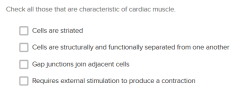 Check all those that are characteristic of cardiac muscle.
1. Cells are striated
2. Cells are structurally and functionally separated from one
another
3.Gap junctions join adjacent cells
4.Requires external stimulation to produce a contraction
Check all those that are characteristic of cardiac muscle.
1. Cells are striated
2. Cells are structurally and functionally separated from one
another
3.Gap junctions join adjacent cells
4.Requires external stimulation to produce a contraction
Disease Process System 1. Integumentary System Heat Stroke • • • Aging Process Collagen loss Thinning...
 Disease Process System 1. Integumentary System Heat Stroke • • • Aging Process Collagen loss Thinning and wrinkling skin Decrease collagen and elastin in skin 2. Nervous System Alzheimer's and Parkinson's Disease- loss of neurons in brain Dementia-memory loss 3. Vision • Thicker and opaque cornea and lens Lens muscles flatten and ciliary muscle relaxes Pupil decreases Increase lipofuscin • Loss of cones 4. Hearing • Presbycusis-inner ear/nerves are sensitive to high and low frequencies. Musculoskeletal System Older adults more...
All mammalian cells maintain the resting membrane potential across the plasma membrane. Neurons and muscle cells...
 All mammalian cells maintain the resting membrane potential across the plasma membrane. Neurons and muscle cells are capable of generating the action potential to communicate with each other. Below is a diagram showing a temporal change of the membrane potential in axon. Explain how such membrane potential is generated and/or maintained in each stage (1-3). Make sure to identify key membrane proteins and the movement of ion(s) through these membrane proteins in each stage. Calculate the membrane potential at the...
6. s the wasting away of muscle due to immobilization, inactivity, or loss of nerve functioning....
 6. s the wasting away of muscle due to immobilization, inactivity, or loss of nerve functioning. a. Myopathy b. Hypertrophy c. Atrophy d. Myelopathy 7. Slipped disc is also known as a. Golf b. IV disc herniation c. IV disc surgery 8. What are the 5 types of bones? 2. 4 9. The thalamus and they hypothalamus compose what structure? a. Cerebrum b. Diencephalon c. Cerebellum d. Brain stem 10. Known as Lou Gehrig disease, this disorder involves the degeneration...
 Motor neurons carrying information to smooth muscle cardiac muscle, and all other issues and organs except skeletal muscle belong to the division of the peripheral nervous system O utonomic Osomatic Omidorain Olimbic Submit Request Answer
 Saved Which of the following is/are a functional requirement of cardiac muscle tissue? Check all that apply. 2 0032:23 1 Cardiac muscle fibers must be able to contract without nervous stimulation Muscles must be voluntary as well as involuntary Cardiac muscle fatigues easily. Cardiac muscle must be independent of conscious control. Cardiac muscles contract in unison.
 Please answer all parts. Thanks in advance
19) Which statement(s) is(are) NOT true regarding cardiac muscle? Choose ALL that apply. (2.5 pts) a) Autorhythmic cells do not contribute significantly to the force of heart contraction because they do not contain many myofibrils. b) Cardiac muscle consists of autorhythmic fibers and contractile fibers. c) Cardiac muscle is similar to skeletal muscle since t contains thick and thin filaments, d) Cardiac muscle is similar to skeletal muscle in that the muscle fibers...
Please answer all parts. Thanks in advance
19) Which statement(s) is(are) NOT true regarding cardiac muscle? Choose ALL that apply. (2.5 pts) a) Autorhythmic cells do not contribute significantly to the force of heart contraction because they do not contain many myofibrils. b) Cardiac muscle consists of autorhythmic fibers and contractile fibers. c) Cardiac muscle is similar to skeletal muscle since t contains thick and thin filaments, d) Cardiac muscle is similar to skeletal muscle in that the muscle fibers...
 Check all those that are characteristic of cardiac muscle.
1. Cells are striated
2. Cells are structurally and functionally separated from one
another
3.Gap junctions join adjacent cells
4.Requires external stimulation to produce a contraction
Check all those that are characteristic of cardiac muscle.
1. Cells are striated
2. Cells are structurally and functionally separated from one
another
3.Gap junctions join adjacent cells
4.Requires external stimulation to produce a contraction
 Disease Process System 1. Integumentary System Heat Stroke • • • Aging Process Collagen loss Thinning and wrinkling skin Decrease collagen and elastin in skin 2. Nervous System Alzheimer's and Parkinson's Disease- loss of neurons in brain Dementia-memory loss 3. Vision • Thicker and opaque cornea and lens Lens muscles flatten and ciliary muscle relaxes Pupil decreases Increase lipofuscin • Loss of cones 4. Hearing • Presbycusis-inner ear/nerves are sensitive to high and low frequencies. Musculoskeletal System Older adults more...
 All mammalian cells maintain the resting membrane potential across the plasma membrane. Neurons and muscle cells are capable of generating the action potential to communicate with each other. Below is a diagram showing a temporal change of the membrane potential in axon. Explain how such membrane potential is generated and/or maintained in each stage (1-3). Make sure to identify key membrane proteins and the movement of ion(s) through these membrane proteins in each stage. Calculate the membrane potential at the...
 6. s the wasting away of muscle due to immobilization, inactivity, or loss of nerve functioning. a. Myopathy b. Hypertrophy c. Atrophy d. Myelopathy 7. Slipped disc is also known as a. Golf b. IV disc herniation c. IV disc surgery 8. What are the 5 types of bones? 2. 4 9. The thalamus and they hypothalamus compose what structure? a. Cerebrum b. Diencephalon c. Cerebellum d. Brain stem 10. Known as Lou Gehrig disease, this disorder involves the degeneration...
Most questions answered within 3 hours.
-
Where is the error in this code sequence?
String s1 = "Hello";
String s2 = "ello";...
asked 11 months ago -
Financial data for Joel de Paris, Inc., for last year
follow:
Joel de Paris, Inc.
Balance...
asked 11 months ago -
Consider this reaction:
Al2(SO4)3 (aq)+ BaCl3
(aq) Al2Cl6 (aq)- +
3BaSO4(s) . What is the...
asked 11 months ago -
Suppose that Savneet is considering increasing her
recent random sample from 20 car rentals to 40...
asked 11 months ago -
Trucks arrive at an unloading terminal at an average rate of 120
per hour.
Trucks arrive...
asked 11 months ago -
Why are methanol and ethanol completely soluble in water while
octanol is not very little soluble....
asked 11 months ago -
A facilities manager at a university reads in a research report
that the mean amount of...
asked 11 months ago -
When the CuSO4 is rehydrated by adding water to the anhydrous
compound, is this an endothermic...
asked 11 months ago -
A ray of sunlight is passing from diamond into crown glass; the
angle of incidence is...
asked 11 months ago -
A block of mass 0.249 kg is placed on top of a light, vertical
spring of...
asked 11 months ago -
how do the kidneys compensate in the presences of acidosis
a) trigger hyperventilate
b) reserve acid...
asked 11 months ago -
Question 501 pts
The rental rate of capital to the firm increases. Which of the
following...
asked 11 months ago