
Homework Answers

Add Answer to:
15 5. Let P2 and Pz denote the vector space of polynomials of degrees atmost 2...
Let T : P2 --> P4 be the transformation that maps a polynomial p(t) into the...
Let T : P2 --> P4 be the transformation that maps a polynomial p(t) into the polynomial p(t) + t2p(t). (a) Find the image of p(t) = 2 - t + t2 (b) Show that T is a linear transformation. (c) Find the matrix for T relative to the bases {1, t, t2} and {1, t, t2, t3, t4}
Problem 2 [25 pts.] Let T: P2 → P4 be the transformation that maps a polynomial...
 Problem 2 [25 pts.] Let T: P2 → P4 be the transformation that maps a polynomial p(t) into the polynomial p(t) + tap(t). a. Find the image of p(t) 2 - t+t2. b. Show that T is a linear transformation. c. Find the matrix for T relative to the bases {1, t, ta} and {1, t, t2, t3, +4}.
Q3. Consider the vector space P, consisting of all polynomials of degree at most two together...
 Q3. Consider the vector space P, consisting of all polynomials of degree at most two together with the zero polynomial. Let S = {p.(t), p2(t)} be a set of polynomials in P, where: pi(t) = -4 +5, po(t) = -3° - 34+5 (a) Determine whether the set S = {P1(t).pz(t)} is linearly independent in Py? Provide a clear justification for your solution. (8 pts) (b) Determine whether the set S = {p(t),p2(t)} spans the vector space P ? Provide a...
let P3 denote the vector space of polynomials of degree 3 or less, with an inner product defined by 14. Let Ps denote the vector space of polynomials of degree 3 or less, with an inner product def...
 let P3 denote the vector space of polynomials of degree 3 or
less, with an inner product defined by
14. Let Ps denote the vector space of polynomials of degree 3 or less, with an inner product defined by (p, q) Ji p(x)q(x) dr. Find an orthogo- nal basis for Ps that contains the vector 1+r. Find the norm (length) of each of your basis elements
14. Let Ps denote the vector space of polynomials of degree 3 or less,...
let P3 denote the vector space of polynomials of degree 3 or
less, with an inner product defined by
14. Let Ps denote the vector space of polynomials of degree 3 or less, with an inner product defined by (p, q) Ji p(x)q(x) dr. Find an orthogo- nal basis for Ps that contains the vector 1+r. Find the norm (length) of each of your basis elements
14. Let Ps denote the vector space of polynomials of degree 3 or less,...
Not sure why this is wrong. If B is the standard basis of the space Pz...
 Not sure why this is wrong.
If B is the standard basis of the space Pz of polynomials, then let B={1, t, t2, t3). Use coordinate vectors to test the linear independence of the set of polynomials below. Explain your work. (2 – t), (-3 – t)2, 1 + 18t - 5t? +43 Write the coordinate vector for the polynomial (2 – t)º, denoted p.. py = |(8,- 12,6, - 1)
Not sure why this is wrong.
If B is the standard basis of the space Pz of polynomials, then let B={1, t, t2, t3). Use coordinate vectors to test the linear independence of the set of polynomials below. Explain your work. (2 – t), (-3 – t)2, 1 + 18t - 5t? +43 Write the coordinate vector for the polynomial (2 – t)º, denoted p.. py = |(8,- 12,6, - 1)
Please provide answer in neat handwriting. Thank you Let P2 be the vector space of all polynomials with degree at most 2, and B be the basis {1,T,T*). T(p(x))-p(kr); thus, Consider the linear operato...
 Please provide answer in neat handwriting. Thank you
Let P2 be the vector space of all polynomials with degree at most 2, and B be the basis {1,T,T*). T(p(x))-p(kr); thus, Consider the linear operator T : P) → given by where k 0 is a parameter (a) Find the matrix Tg,b representing T in the basis B (b) Verify whether T is one-to-one and whether or not it is onto. (c) Find the eigenvalues and the corresponding eigenspaces of the...
Please provide answer in neat handwriting. Thank you
Let P2 be the vector space of all polynomials with degree at most 2, and B be the basis {1,T,T*). T(p(x))-p(kr); thus, Consider the linear operator T : P) → given by where k 0 is a parameter (a) Find the matrix Tg,b representing T in the basis B (b) Verify whether T is one-to-one and whether or not it is onto. (c) Find the eigenvalues and the corresponding eigenspaces of the...
: 2: Let T : P1 → P2 be the linear map taking a polynomial p(t)...
 : 2: Let T : P1 → P2 be the linear map taking a polynomial p(t) to its antiderivative P(t) satisfying P(0) = 0 (e.g. T(5 + 2t) 5t + t2). Find two matrices A, B representing the corresponding linear map R2 + R3, the first with respect to the standard bases of P2 and P3, and the second with respect to the bases B = {1,1+t} B' = {1,1 +t, 1+t+t2}
6. (16 points) For the two linear transformations defined as T: Pz → P3, T1(p) =...
 6. (16 points) For the two linear transformations defined as T: Pz → P3, T1(p) = xp' T2 :P3 → P1, T2(p) = 3p". a) Determine whether Ti is an isomorphism? (Clearly show your work and explain.) b) Show how to find the image of p(x) = 3 - 4x + 2x² – 5x’ through the T2 transformation. c) Show how to find the standard matrix for the linear transformation that is T =T, •T,. d) Show how to find...
Let P2 be the real vector space of polynomials in a of degree at most 2, and let T be the real vector space of upper tr...
 Let P2 be the real vector space of polynomials in a of degree at most 2, and let T be the real vector space of upper triangular 2 x 2 matrica b,cERThe vector space P2 is equipped with the inner product 〈p(x), q(x)-1 p(z)q(z) dr, and the vector space T is equipped with the inner product 〈A.B)=tr(AB), where tr denotes trace. Let L: P2→T be 1.p(z)dr]. Find L 0 c given by L(p(z)):-17(1) .CE :J ) 1 2 0 p(-1)...
: Let L: P1 → Pz be defined by L[p(t)] = t_p(t). Let S {t, 1}...
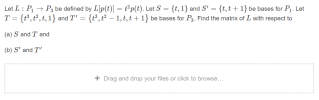 : Let L: P1 → Pz be defined by L[p(t)] = t_p(t). Let S {t, 1} and S' = {t,t +1} be bases for P1. Let T = {t”, t², t, 1} and T' {tº, t? – 1,7,t+1} be bases for P3. Find the matrix of L with respect to (a) S and T and (b) S' and T + Drag and drop your files or click to browse...
 Problem 2 [25 pts.] Let T: P2 → P4 be the transformation that maps a polynomial p(t) into the polynomial p(t) + tap(t). a. Find the image of p(t) 2 - t+t2. b. Show that T is a linear transformation. c. Find the matrix for T relative to the bases {1, t, ta} and {1, t, t2, t3, +4}.
 Q3. Consider the vector space P, consisting of all polynomials of degree at most two together with the zero polynomial. Let S = {p.(t), p2(t)} be a set of polynomials in P, where: pi(t) = -4 +5, po(t) = -3° - 34+5 (a) Determine whether the set S = {P1(t).pz(t)} is linearly independent in Py? Provide a clear justification for your solution. (8 pts) (b) Determine whether the set S = {p(t),p2(t)} spans the vector space P ? Provide a...
 let P3 denote the vector space of polynomials of degree 3 or
less, with an inner product defined by
14. Let Ps denote the vector space of polynomials of degree 3 or less, with an inner product defined by (p, q) Ji p(x)q(x) dr. Find an orthogo- nal basis for Ps that contains the vector 1+r. Find the norm (length) of each of your basis elements
14. Let Ps denote the vector space of polynomials of degree 3 or less,...
let P3 denote the vector space of polynomials of degree 3 or
less, with an inner product defined by
14. Let Ps denote the vector space of polynomials of degree 3 or less, with an inner product defined by (p, q) Ji p(x)q(x) dr. Find an orthogo- nal basis for Ps that contains the vector 1+r. Find the norm (length) of each of your basis elements
14. Let Ps denote the vector space of polynomials of degree 3 or less,...
 Not sure why this is wrong.
If B is the standard basis of the space Pz of polynomials, then let B={1, t, t2, t3). Use coordinate vectors to test the linear independence of the set of polynomials below. Explain your work. (2 – t), (-3 – t)2, 1 + 18t - 5t? +43 Write the coordinate vector for the polynomial (2 – t)º, denoted p.. py = |(8,- 12,6, - 1)
Not sure why this is wrong.
If B is the standard basis of the space Pz of polynomials, then let B={1, t, t2, t3). Use coordinate vectors to test the linear independence of the set of polynomials below. Explain your work. (2 – t), (-3 – t)2, 1 + 18t - 5t? +43 Write the coordinate vector for the polynomial (2 – t)º, denoted p.. py = |(8,- 12,6, - 1)
 Please provide answer in neat handwriting. Thank you
Let P2 be the vector space of all polynomials with degree at most 2, and B be the basis {1,T,T*). T(p(x))-p(kr); thus, Consider the linear operator T : P) → given by where k 0 is a parameter (a) Find the matrix Tg,b representing T in the basis B (b) Verify whether T is one-to-one and whether or not it is onto. (c) Find the eigenvalues and the corresponding eigenspaces of the...
Please provide answer in neat handwriting. Thank you
Let P2 be the vector space of all polynomials with degree at most 2, and B be the basis {1,T,T*). T(p(x))-p(kr); thus, Consider the linear operator T : P) → given by where k 0 is a parameter (a) Find the matrix Tg,b representing T in the basis B (b) Verify whether T is one-to-one and whether or not it is onto. (c) Find the eigenvalues and the corresponding eigenspaces of the...
 : 2: Let T : P1 → P2 be the linear map taking a polynomial p(t) to its antiderivative P(t) satisfying P(0) = 0 (e.g. T(5 + 2t) 5t + t2). Find two matrices A, B representing the corresponding linear map R2 + R3, the first with respect to the standard bases of P2 and P3, and the second with respect to the bases B = {1,1+t} B' = {1,1 +t, 1+t+t2}
 6. (16 points) For the two linear transformations defined as T: Pz → P3, T1(p) = xp' T2 :P3 → P1, T2(p) = 3p". a) Determine whether Ti is an isomorphism? (Clearly show your work and explain.) b) Show how to find the image of p(x) = 3 - 4x + 2x² – 5x’ through the T2 transformation. c) Show how to find the standard matrix for the linear transformation that is T =T, •T,. d) Show how to find...
 Let P2 be the real vector space of polynomials in a of degree at most 2, and let T be the real vector space of upper triangular 2 x 2 matrica b,cERThe vector space P2 is equipped with the inner product 〈p(x), q(x)-1 p(z)q(z) dr, and the vector space T is equipped with the inner product 〈A.B)=tr(AB), where tr denotes trace. Let L: P2→T be 1.p(z)dr]. Find L 0 c given by L(p(z)):-17(1) .CE :J ) 1 2 0 p(-1)...
 : Let L: P1 → Pz be defined by L[p(t)] = t_p(t). Let S {t, 1} and S' = {t,t +1} be bases for P1. Let T = {t”, t², t, 1} and T' {tº, t? – 1,7,t+1} be bases for P3. Find the matrix of L with respect to (a) S and T and (b) S' and T + Drag and drop your files or click to browse...
Most questions answered within 3 hours.
-
Where is the error in this code sequence?
String s1 = "Hello";
String s2 = "ello";...
asked 10 months ago -
Financial data for Joel de Paris, Inc., for last year
follow:
Joel de Paris, Inc.
Balance...
asked 10 months ago -
Consider this reaction:
Al2(SO4)3 (aq)+ BaCl3
(aq) Al2Cl6 (aq)- +
3BaSO4(s) . What is the...
asked 10 months ago -
Suppose that Savneet is considering increasing her
recent random sample from 20 car rentals to 40...
asked 10 months ago -
Trucks arrive at an unloading terminal at an average rate of 120
per hour.
Trucks arrive...
asked 10 months ago -
Why are methanol and ethanol completely soluble in water while
octanol is not very little soluble....
asked 10 months ago -
A facilities manager at a university reads in a research report
that the mean amount of...
asked 10 months ago -
When the CuSO4 is rehydrated by adding water to the anhydrous
compound, is this an endothermic...
asked 10 months ago -
A ray of sunlight is passing from diamond into crown glass; the
angle of incidence is...
asked 10 months ago -
A block of mass 0.249 kg is placed on top of a light, vertical
spring of...
asked 10 months ago -
how do the kidneys compensate in the presences of acidosis
a) trigger hyperventilate
b) reserve acid...
asked 10 months ago -
Question 501 pts
The rental rate of capital to the firm increases. Which of the
following...
asked 10 months ago