
Homework Answers
Add Answer to:
PLEASE DO BOTH
(5) (5 pts) Prove the identity (1) () = (x) (---), whenever n,...
PLEASE DO BOTH (9) (5 pts) How many solutions are there to the inequality 11 +*2+I3...
 PLEASE DO BOTH
(9) (5 pts) How many solutions are there to the inequality 11 +*2+I3 <11, where 21, 22, and 13 are non-negative integers? Hint: Introduce an auxiliary variable In such that 21+12+13+14 = 11. (10) (5 pts) How many terms are there in the expansion of (2x + 3y + 5z)50?
PLEASE DO BOTH
(9) (5 pts) How many solutions are there to the inequality 11 +*2+I3 <11, where 21, 22, and 13 are non-negative integers? Hint: Introduce an auxiliary variable In such that 21+12+13+14 = 11. (10) (5 pts) How many terms are there in the expansion of (2x + 3y + 5z)50?
please do both 4 and 5 and show work! will upvote fast Problem VII.4. How many...
 please do both 4 and 5 and show work! will upvote fast
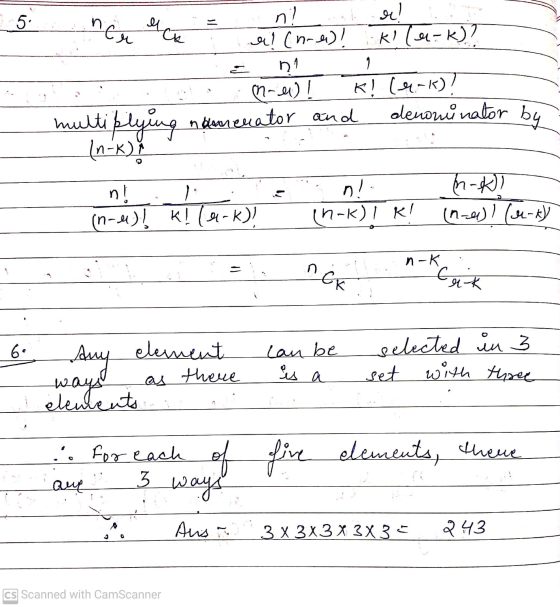
Problem VII.4. How many non-negative integer vectors are there such that where exactly k of the entries zero? N Problem VII.5. Prove the following: () ik
please do both 4 and 5 and show work! will upvote fast
Problem VII.4. How many non-negative integer vectors are there such that where exactly k of the entries zero? N Problem VII.5. Prove the following: () ik
5. Prove each of the following set equalities both by Venn Diagram and by algebraic method....
 5. Prove each of the following set equalities both by Venn
Diagram and by algebraic method.
(a) A - (B C) = (A - B)
(A - C)
(b) A - (B C) = (A - B)
(A - C)
(c) A (B - C) = (A
B) - C = (A
B) - (A C)
Hint: To prove the last form, use the equality
A C' =
A (A'
C').
(d) A (B - C) = (A
B) (A...
5. Prove each of the following set equalities both by Venn
Diagram and by algebraic method.
(a) A - (B C) = (A - B)
(A - C)
(b) A - (B C) = (A - B)
(A - C)
(c) A (B - C) = (A
B) - C = (A
B) - (A C)
Hint: To prove the last form, use the equality
A C' =
A (A'
C').
(d) A (B - C) = (A
B) (A...
Problem 5 5.a Consider the following identity. For all positive integers n and k with n...
 Problem 5 5.a Consider the following identity. For all positive integers n and k with n 2k, (n choose k) + (n choose k-1) = (n+1 choose k). This can be demonstrated either algebraically or via a story proof. To prove the identity algebraically, we can write (n choose k) + (n choose k-1) = n!/[k!(n-k)!] + n!/[(k-1)!(n-k+1)!] = [(n-k+1)n! + (k)n!]/[k!(n-k+1)!] [n!(n+1)/k!(n-k+1)!] = (n+1 choose k). Which of the following is a story proof of the identity? Consider a...
Please send me solutions for the above five questions. The questions are based on Pigeonhole Principle. 3. A shop co...
 Please send me solutions for the above five
questions.
The questions are based on Pigeonhole Principle.
3. A shop contains twelve samples of read shirts, seven samples of white shirts, and N samples of blue shirts. Suppose that the smallest K such that choosing K samples from the collection guarantees that you have six samples of the same color of shirt is K-15. What is N? 4. Show that among any n1 positive integers not exceeding 2nthere must be integer...
Please send me solutions for the above five
questions.
The questions are based on Pigeonhole Principle.
3. A shop contains twelve samples of read shirts, seven samples of white shirts, and N samples of blue shirts. Suppose that the smallest K such that choosing K samples from the collection guarantees that you have six samples of the same color of shirt is K-15. What is N? 4. Show that among any n1 positive integers not exceeding 2nthere must be integer...
Optional Extra Points (20 points) (a) [5 points Suppose that k and n are integers with 1 Sk
 Optional Extra Points (20 points) (a) [5 points Suppose that k and n are integers with 1 Sk<n. Prove the hexagon identity which relates terms n Pascal's triangle that form a hexagon A circular r-permutation of n people is a seating of r of thesen people around a circular table, where seatings are considered to be the same if they can be obtained from each other by rotating the table. (b) [3 points Find the number of circular 3-permutations of...
PLEASE DO BOTH (7) (5 pts) A croissant shop has plain croissants, cherry croissants, chocolate croissants,...
 PLEASE DO BOTH
(7) (5 pts) A croissant shop has plain croissants, cherry croissants, chocolate croissants, almond croissants, apple croissants, and broccoli croissants. How many ways are there to choose (a) a dozen croissants? (b) two dozen croissants with at least two of each kind? (8) (5 pts) How many solutions are there to the equation 11 +12+13 +In+ 15 + 16 = 29, where I, for i = 1,2,3,4,5,6, is a non-negative integer such that (a) Ii > 1...
PLEASE DO BOTH
(7) (5 pts) A croissant shop has plain croissants, cherry croissants, chocolate croissants, almond croissants, apple croissants, and broccoli croissants. How many ways are there to choose (a) a dozen croissants? (b) two dozen croissants with at least two of each kind? (8) (5 pts) How many solutions are there to the equation 11 +12+13 +In+ 15 + 16 = 29, where I, for i = 1,2,3,4,5,6, is a non-negative integer such that (a) Ii > 1...
Prove the Binomial Theorem, that is Exercises 173 (vi) x+y y for all n e N...
 Prove the Binomial Theorem, that is Exercises 173 (vi) x+y y for all n e N C) Recall that for all 0rS L is divisible by 8 when n is an odd natural number vii))Show that 2 (vin) Prove Leibniz's Theorem for repeated differentiation of a product: If ande are functions of x, then prove that d (uv) d + +Mat0 for all n e N, where u, and d'a d/v and dy da respectively denote (You will need to...
PLEASE DO BOTH (1) (5 pts) How many ways can you permute the letters in BANANA?...
 PLEASE DO BOTH
(1) (5 pts) How many ways can you permute the letters in BANANA? (2) (5 pts) At a Chinese restaurant, dinner for 8 people consists of 3 items from column A, 4 items from column B and 3 items from column C. If columns A, B and C have 5, 7 and 6 items respectively how many different dinner combinations are possible?
PLEASE DO BOTH
(1) (5 pts) How many ways can you permute the letters in BANANA? (2) (5 pts) At a Chinese restaurant, dinner for 8 people consists of 3 items from column A, 4 items from column B and 3 items from column C. If columns A, B and C have 5, 7 and 6 items respectively how many different dinner combinations are possible?
prove that A is non singular 5.(25 pts) For each positive integer n, let f()(+2)(1)(0,1. Let...
 prove that A is non singular
5.(25 pts) For each positive integer n, let f()(+2)(1)(0,1. Let f()-0, (1) Prove that (fn) converges to fpointwisely on (0, 1) (2) Does (n) converges to f uniformly on (0, 1]?
prove that A is non singular
5.(25 pts) For each positive integer n, let f()(+2)(1)(0,1. Let f()-0, (1) Prove that (fn) converges to fpointwisely on (0, 1) (2) Does (n) converges to f uniformly on (0, 1]?
 PLEASE DO BOTH
(9) (5 pts) How many solutions are there to the inequality 11 +*2+I3 <11, where 21, 22, and 13 are non-negative integers? Hint: Introduce an auxiliary variable In such that 21+12+13+14 = 11. (10) (5 pts) How many terms are there in the expansion of (2x + 3y + 5z)50?
PLEASE DO BOTH
(9) (5 pts) How many solutions are there to the inequality 11 +*2+I3 <11, where 21, 22, and 13 are non-negative integers? Hint: Introduce an auxiliary variable In such that 21+12+13+14 = 11. (10) (5 pts) How many terms are there in the expansion of (2x + 3y + 5z)50?
 please do both 4 and 5 and show work! will upvote fast
Problem VII.4. How many non-negative integer vectors are there such that where exactly k of the entries zero? N Problem VII.5. Prove the following: () ik
please do both 4 and 5 and show work! will upvote fast
Problem VII.4. How many non-negative integer vectors are there such that where exactly k of the entries zero? N Problem VII.5. Prove the following: () ik
 5. Prove each of the following set equalities both by Venn
Diagram and by algebraic method.
(a) A - (B C) = (A - B)
(A - C)
(b) A - (B C) = (A - B)
(A - C)
(c) A (B - C) = (A
B) - C = (A
B) - (A C)
Hint: To prove the last form, use the equality
A C' =
A (A'
C').
(d) A (B - C) = (A
B) (A...
5. Prove each of the following set equalities both by Venn
Diagram and by algebraic method.
(a) A - (B C) = (A - B)
(A - C)
(b) A - (B C) = (A - B)
(A - C)
(c) A (B - C) = (A
B) - C = (A
B) - (A C)
Hint: To prove the last form, use the equality
A C' =
A (A'
C').
(d) A (B - C) = (A
B) (A...
 Problem 5 5.a Consider the following identity. For all positive integers n and k with n 2k, (n choose k) + (n choose k-1) = (n+1 choose k). This can be demonstrated either algebraically or via a story proof. To prove the identity algebraically, we can write (n choose k) + (n choose k-1) = n!/[k!(n-k)!] + n!/[(k-1)!(n-k+1)!] = [(n-k+1)n! + (k)n!]/[k!(n-k+1)!] [n!(n+1)/k!(n-k+1)!] = (n+1 choose k). Which of the following is a story proof of the identity? Consider a...
 Please send me solutions for the above five
questions.
The questions are based on Pigeonhole Principle.
3. A shop contains twelve samples of read shirts, seven samples of white shirts, and N samples of blue shirts. Suppose that the smallest K such that choosing K samples from the collection guarantees that you have six samples of the same color of shirt is K-15. What is N? 4. Show that among any n1 positive integers not exceeding 2nthere must be integer...
Please send me solutions for the above five
questions.
The questions are based on Pigeonhole Principle.
3. A shop contains twelve samples of read shirts, seven samples of white shirts, and N samples of blue shirts. Suppose that the smallest K such that choosing K samples from the collection guarantees that you have six samples of the same color of shirt is K-15. What is N? 4. Show that among any n1 positive integers not exceeding 2nthere must be integer...
 Optional Extra Points (20 points) (a) [5 points Suppose that k and n are integers with 1 Sk<n. Prove the hexagon identity which relates terms n Pascal's triangle that form a hexagon A circular r-permutation of n people is a seating of r of thesen people around a circular table, where seatings are considered to be the same if they can be obtained from each other by rotating the table. (b) [3 points Find the number of circular 3-permutations of...
 PLEASE DO BOTH
(7) (5 pts) A croissant shop has plain croissants, cherry croissants, chocolate croissants, almond croissants, apple croissants, and broccoli croissants. How many ways are there to choose (a) a dozen croissants? (b) two dozen croissants with at least two of each kind? (8) (5 pts) How many solutions are there to the equation 11 +12+13 +In+ 15 + 16 = 29, where I, for i = 1,2,3,4,5,6, is a non-negative integer such that (a) Ii > 1...
PLEASE DO BOTH
(7) (5 pts) A croissant shop has plain croissants, cherry croissants, chocolate croissants, almond croissants, apple croissants, and broccoli croissants. How many ways are there to choose (a) a dozen croissants? (b) two dozen croissants with at least two of each kind? (8) (5 pts) How many solutions are there to the equation 11 +12+13 +In+ 15 + 16 = 29, where I, for i = 1,2,3,4,5,6, is a non-negative integer such that (a) Ii > 1...
 Prove the Binomial Theorem, that is Exercises 173 (vi) x+y y for all n e N C) Recall that for all 0rS L is divisible by 8 when n is an odd natural number vii))Show that 2 (vin) Prove Leibniz's Theorem for repeated differentiation of a product: If ande are functions of x, then prove that d (uv) d + +Mat0 for all n e N, where u, and d'a d/v and dy da respectively denote (You will need to...
 PLEASE DO BOTH
(1) (5 pts) How many ways can you permute the letters in BANANA? (2) (5 pts) At a Chinese restaurant, dinner for 8 people consists of 3 items from column A, 4 items from column B and 3 items from column C. If columns A, B and C have 5, 7 and 6 items respectively how many different dinner combinations are possible?
PLEASE DO BOTH
(1) (5 pts) How many ways can you permute the letters in BANANA? (2) (5 pts) At a Chinese restaurant, dinner for 8 people consists of 3 items from column A, 4 items from column B and 3 items from column C. If columns A, B and C have 5, 7 and 6 items respectively how many different dinner combinations are possible?
 prove that A is non singular
5.(25 pts) For each positive integer n, let f()(+2)(1)(0,1. Let f()-0, (1) Prove that (fn) converges to fpointwisely on (0, 1) (2) Does (n) converges to f uniformly on (0, 1]?
prove that A is non singular
5.(25 pts) For each positive integer n, let f()(+2)(1)(0,1. Let f()-0, (1) Prove that (fn) converges to fpointwisely on (0, 1) (2) Does (n) converges to f uniformly on (0, 1]?
Most questions answered within 3 hours.
-
Where is the error in this code sequence?
String s1 = "Hello";
String s2 = "ello";...
asked 10 months ago -
Financial data for Joel de Paris, Inc., for last year
follow:
Joel de Paris, Inc.
Balance...
asked 10 months ago -
Consider this reaction:
Al2(SO4)3 (aq)+ BaCl3
(aq) Al2Cl6 (aq)- +
3BaSO4(s) . What is the...
asked 10 months ago -
Suppose that Savneet is considering increasing her
recent random sample from 20 car rentals to 40...
asked 10 months ago -
Trucks arrive at an unloading terminal at an average rate of 120
per hour.
Trucks arrive...
asked 10 months ago -
Why are methanol and ethanol completely soluble in water while
octanol is not very little soluble....
asked 10 months ago -
A facilities manager at a university reads in a research report
that the mean amount of...
asked 10 months ago -
When the CuSO4 is rehydrated by adding water to the anhydrous
compound, is this an endothermic...
asked 10 months ago -
A ray of sunlight is passing from diamond into crown glass; the
angle of incidence is...
asked 10 months ago -
A block of mass 0.249 kg is placed on top of a light, vertical
spring of...
asked 10 months ago -
how do the kidneys compensate in the presences of acidosis
a) trigger hyperventilate
b) reserve acid...
asked 10 months ago -
Question 501 pts
The rental rate of capital to the firm increases. Which of the
following...
asked 10 months ago