
Homework Answers
5.a) Option 4
5.b) Option 4 because of the n tagged elks , k are to be chosen, this can be done in (n choose k) ways. The remaining (m-k) elks can be chosen from (N-n) untagged elks in ((N-n) choose (m-k)) ways. In general m elks can be selected from N elks in (N choose m) ways. Thus the required probability is
(n choose k)*((N-n) choose(m-k))/(N choose m)
Please give a thumbs up if you like the solution
Add Answer to:
Problem 5 5.a Consider the following identity. For all positive integers n and k with n...
QUESTION 8 Use the conclusions from the previous problem to derive the following identity, for n...
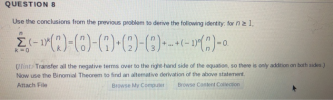 QUESTION 8 Use the conclusions from the previous problem to derive the following identity, for n 2 1. į (- 1)*(%)-(5)-(1)-(2)-( 3 ) +...+(-1)-()=0. k=0 (Hint: Transfer all the negative terms over to the right-hand side of the equation, so there is only addition on both sides.) Now use the Binomial Theorem to find an alterative derivation of the above statement Attach File Browse My Computer Browse Content Collection
Optional Extra Points (20 points) (a) [5 points Suppose that k and n are integers with 1 Sk
 Optional Extra Points (20 points) (a) [5 points Suppose that k and n are integers with 1 Sk<n. Prove the hexagon identity which relates terms n Pascal's triangle that form a hexagon A circular r-permutation of n people is a seating of r of thesen people around a circular table, where seatings are considered to be the same if they can be obtained from each other by rotating the table. (b) [3 points Find the number of circular 3-permutations of...
Consider the following problem: given n positive integers, separate them into two groups such that adding...
Consider the following problem: given n positive integers, separate them into two groups such that adding all the numbers in one group gives the same result as adding all the numbers in the other group. For example, if the numbers are 1, 2, 3, 4, then the two groups could be {1, 4} and {2, 3}, which both sum to 5. For another example, if the numbers are 5, 6, 11, then the two groups could be {5, 6} and...
Write short programs to simulate problem 16 and 22. For problem 22, use k=5, m=10, n=5....
Write short programs to simulate problem 16 and 22. For problem 22, use k=5, m=10, n=5. In Python Problem 16 We are given three coins: one has heads in both faces, the second has tails in both faces, and the third has a head in one face and a tail in the other. We choose a coin at random, toss it, and the result is heads. What is the probability that the opposite face is tails? Problem 22 Each of...
Consider a model for a single prey species with density N(t) given by dN/dt = r...
 Consider a model for a single prey species with density N(t) given by dN/dt = r N (1 - N/K) - a N P/1 + C_1 N + C_2 P where P is a predator density and a, r, K, C_1 and C_2 are all constants. Describe in words the biological effect of the two main terms on the right hand side of the equation. Elaborate and contrast particularly the meaning of the second term in the eases when C_1...
6. Consider the following basic problem. You're given an array A consisting of n integers A[1],...
 6. Consider the following basic problem. You're given an array A consisting of n integers A[1], A[2], , Aln]. You'd like to output a two-dimensional n-by-n array B in which B[i, j] (for i <j) contains the sum of array entries Ali] through Aj]-that is, the sum A[i] Ai 1]+ .. +Alj]. (The value of array entry B[i. Λ is left unspecified whenever i >j, so it doesn't matter what is output for these values.) Here's a simple algorithm to...
9. [10 points) Consider the following algorithm: procedure Algorithm(n: positive integer; ddd: distinet integers) for k:=1 to n-1 for 1-1 to n-k print(k, I, di,da...-1,dn) if ds dti then interch...
 9. [10 points) Consider the following algorithm: procedure Algorithm(n: positive integer; ddd: distinet integers) for k:=1 to n-1 for 1-1 to n-k print(k, I, di,da...-1,dn) if ds dti then interchange dy and d (a) Assume that this algorithm receives as input the integer n 6 and the input sequence 하하하하하하, Miss ^-ruteae rehen i12|3141516 Fill out the table below: ds ds (b) Assume that the algorithm receives the same input values as in part a). Once the algorithm finishes, what...
1. Let G be element. Consider the subgroups H = <a) = { a, b, c, d, e} and K = (j)-{ e, j, o, t} the group whose...
 1. Let G be element. Consider the subgroups H = <a) = { a, b, c, d, e} and K = (j)-{ e, j, o, t} the group whose Cayley diagram is shown below, and suppose e is the identity rl Carry out the following steps for both of these subgroups. Let the cosets element-wise. (e) Write G as a disjoint union of the subgroup's left cosets. (b) Write G as a disjoint union of the subgroup's right cosets. (c)...
Please address all the questions on the photo. 5. Consider the following binary tree: A B...
 Please address all the questions on the photo.
5. Consider the following binary tree: A B C E F e De G H. K . M NO RO P Q T a. What is the height of the tree? b. What is the height of vertex H? c. Write the preorder traversal representation of the tree. d. Write the array representation of the tree by completing the following table: Right Child Left Child Vertex A C D G H K...
Please address all the questions on the photo.
5. Consider the following binary tree: A B C E F e De G H. K . M NO RO P Q T a. What is the height of the tree? b. What is the height of vertex H? c. Write the preorder traversal representation of the tree. d. Write the array representation of the tree by completing the following table: Right Child Left Child Vertex A C D G H K...
 QUESTION 8 Use the conclusions from the previous problem to derive the following identity, for n 2 1. į (- 1)*(%)-(5)-(1)-(2)-( 3 ) +...+(-1)-()=0. k=0 (Hint: Transfer all the negative terms over to the right-hand side of the equation, so there is only addition on both sides.) Now use the Binomial Theorem to find an alterative derivation of the above statement Attach File Browse My Computer Browse Content Collection
 Optional Extra Points (20 points) (a) [5 points Suppose that k and n are integers with 1 Sk<n. Prove the hexagon identity which relates terms n Pascal's triangle that form a hexagon A circular r-permutation of n people is a seating of r of thesen people around a circular table, where seatings are considered to be the same if they can be obtained from each other by rotating the table. (b) [3 points Find the number of circular 3-permutations of...
 Consider a model for a single prey species with density N(t) given by dN/dt = r N (1 - N/K) - a N P/1 + C_1 N + C_2 P where P is a predator density and a, r, K, C_1 and C_2 are all constants. Describe in words the biological effect of the two main terms on the right hand side of the equation. Elaborate and contrast particularly the meaning of the second term in the eases when C_1...
 6. Consider the following basic problem. You're given an array A consisting of n integers A[1], A[2], , Aln]. You'd like to output a two-dimensional n-by-n array B in which B[i, j] (for i <j) contains the sum of array entries Ali] through Aj]-that is, the sum A[i] Ai 1]+ .. +Alj]. (The value of array entry B[i. Λ is left unspecified whenever i >j, so it doesn't matter what is output for these values.) Here's a simple algorithm to...
 9. [10 points) Consider the following algorithm: procedure Algorithm(n: positive integer; ddd: distinet integers) for k:=1 to n-1 for 1-1 to n-k print(k, I, di,da...-1,dn) if ds dti then interchange dy and d (a) Assume that this algorithm receives as input the integer n 6 and the input sequence 하하하하하하, Miss ^-ruteae rehen i12|3141516 Fill out the table below: ds ds (b) Assume that the algorithm receives the same input values as in part a). Once the algorithm finishes, what...
 1. Let G be element. Consider the subgroups H = <a) = { a, b, c, d, e} and K = (j)-{ e, j, o, t} the group whose Cayley diagram is shown below, and suppose e is the identity rl Carry out the following steps for both of these subgroups. Let the cosets element-wise. (e) Write G as a disjoint union of the subgroup's left cosets. (b) Write G as a disjoint union of the subgroup's right cosets. (c)...
 Please address all the questions on the photo.
5. Consider the following binary tree: A B C E F e De G H. K . M NO RO P Q T a. What is the height of the tree? b. What is the height of vertex H? c. Write the preorder traversal representation of the tree. d. Write the array representation of the tree by completing the following table: Right Child Left Child Vertex A C D G H K...
Please address all the questions on the photo.
5. Consider the following binary tree: A B C E F e De G H. K . M NO RO P Q T a. What is the height of the tree? b. What is the height of vertex H? c. Write the preorder traversal representation of the tree. d. Write the array representation of the tree by completing the following table: Right Child Left Child Vertex A C D G H K...
Most questions answered within 3 hours.
-
Where is the error in this code sequence?
String s1 = "Hello";
String s2 = "ello";...
asked 10 months ago -
Financial data for Joel de Paris, Inc., for last year
follow:
Joel de Paris, Inc.
Balance...
asked 10 months ago -
Consider this reaction:
Al2(SO4)3 (aq)+ BaCl3
(aq) Al2Cl6 (aq)- +
3BaSO4(s) . What is the...
asked 10 months ago -
Suppose that Savneet is considering increasing her
recent random sample from 20 car rentals to 40...
asked 10 months ago -
Trucks arrive at an unloading terminal at an average rate of 120
per hour.
Trucks arrive...
asked 10 months ago -
Why are methanol and ethanol completely soluble in water while
octanol is not very little soluble....
asked 10 months ago -
A facilities manager at a university reads in a research report
that the mean amount of...
asked 10 months ago -
When the CuSO4 is rehydrated by adding water to the anhydrous
compound, is this an endothermic...
asked 10 months ago -
A ray of sunlight is passing from diamond into crown glass; the
angle of incidence is...
asked 10 months ago -
A block of mass 0.249 kg is placed on top of a light, vertical
spring of...
asked 10 months ago -
how do the kidneys compensate in the presences of acidosis
a) trigger hyperventilate
b) reserve acid...
asked 10 months ago -
Question 501 pts
The rental rate of capital to the firm increases. Which of the
following...
asked 10 months ago