
Homework Answers
a)N represents prey species density that is number of species in a region and a particular time in population.
P-predator density number of predator in a population at a particular time.
K is the carrying capacity of its local environmental setting
b)dN/dt=rN(1-N/K)
equation s usaly known as Lotka–Volterra equation
Population equilibrium occurs in the model when neither of the population levels is changing, i.e. when both of the derivatives are equal to 0
Add Answer to:
Consider a model for a single prey species with density N(t) given by dN/dt = r...
I need everyone question please!! Predator prey model captures the dynamics of the both organisms using...
 I need everyone question please!!
Predator prey model captures the dynamics of the both organisms using the following equation: dN -=rN - ANP 4 = baNP-mP dt 1) What is the meaning of the parameters r, a, b and m in this model? (20pts) 2) In the first equation dN/dt=rN-aNP, explain what is the logic behind multiplying the abundances of the prey and the predator (NP). (10pts) Using this model and posing each equation equals to zero and solving this,...
I need everyone question please!!
Predator prey model captures the dynamics of the both organisms using the following equation: dN -=rN - ANP 4 = baNP-mP dt 1) What is the meaning of the parameters r, a, b and m in this model? (20pts) 2) In the first equation dN/dt=rN-aNP, explain what is the logic behind multiplying the abundances of the prey and the predator (NP). (10pts) Using this model and posing each equation equals to zero and solving this,...
3. 1101 Consider the following population model: dN dt (a) [3] Rewrite your model using nondimens...
 3. 1101 Consider the following population model: dN dt (a) [3] Rewrite your model using nondimensional population size r and and time unit T to time τ, and choose a proper population unit simplify your model to the following form dx: dt 22 ad identify α as a cornbímnation of the original parameters b, d and a. (b) [41 Show that, if 0 < α < 1/4, then there exists two equilibrium 〉 xỈ 〉 0, such that x(r) →...
4. Problem 4, Chapter 1 The predation P(N) on a population N(t) is very fast and...
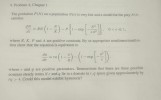 4. Problem 4, Chapter 1 The predation P(N) on a population N(t) is very fast and a model for the prey N() satisfies N2 dN dt P 1-exp where R. K, P and A are positive constants. By an appropriate nondimensionalisa- tion show that the equation is equivalent to du dT it where r and q are positive parameters. Demonstrate that there are three possible nonzero steady states if r and q lie in a domain in r. q space...
Exercise 3, Section 9.5. Modified Lotka- Volterra Predator-Prey model Consider two species (rabbits and foxes) such that the population R (rabbits) and F (foxrs) obey the system of equations dR d...
 Exercise 3, Section 9.5. Modified Lotka- Volterra Predator-Prey model Consider two species (rabbits and foxes) such that the population R (rabbits) and F (foxrs) obey the system of equations dR dt dF dt R2-R)-12RF . What happens to the population of rabbits if the number of foxes is arro? (Use the phase line analysis from Chapter 2) What happens to the population of foxes if the number of rabbits is zero? 3. Using the method of nullclines, draw an approximate...
can anyone help me with these questions for ecology. thanks! the 1000 IN-dN/dt A Population size...
 can
anyone help me with these questions for ecology. thanks!
the 1000 IN-dN/dt A Population size the dN/dt = IN (K-N)/K y = 164.170.1387x bio Number of individuals 10 3512 909 95209 Time FIGURE 1 29 3 10 Time years FIGURE 4 Population densities of individual species 000.01 Environmental gradient- (such as temperature or moisture) 09 FIGURE 2 9812 909 Life table of a hypothetical population FIGURE 5 00001 Total # indiv in survivorship fecundity next time period Current #...
can
anyone help me with these questions for ecology. thanks!
the 1000 IN-dN/dt A Population size the dN/dt = IN (K-N)/K y = 164.170.1387x bio Number of individuals 10 3512 909 95209 Time FIGURE 1 29 3 10 Time years FIGURE 4 Population densities of individual species 000.01 Environmental gradient- (such as temperature or moisture) 09 FIGURE 2 9812 909 Life table of a hypothetical population FIGURE 5 00001 Total # indiv in survivorship fecundity next time period Current #...
Consider the neoclassical closed economy model: Y=COY-T)+1(t) + G Y=F(K.L) M/P L(r+z* Y) CY-T) is describing...
 Consider the neoclassical closed economy model: Y=COY-T)+1(t) + G Y=F(K.L) M/P L(r+z* Y) CY-T) is describing consumptions as a function of disposable income, Kand L are fixed and do not change over time, G and T are chosen by government. And are exogenous and fixed. 1- Suppose K 150, L=500 Y-2.5 K"L- C 12+0.7(Y-T) 250 G 250, T I60-400r P 1 a 0.3 a) Calculate GDP value: I Derive the equations for marginal product of labor & marginal product of...
 I need everyone question please!!
Predator prey model captures the dynamics of the both organisms using the following equation: dN -=rN - ANP 4 = baNP-mP dt 1) What is the meaning of the parameters r, a, b and m in this model? (20pts) 2) In the first equation dN/dt=rN-aNP, explain what is the logic behind multiplying the abundances of the prey and the predator (NP). (10pts) Using this model and posing each equation equals to zero and solving this,...
I need everyone question please!!
Predator prey model captures the dynamics of the both organisms using the following equation: dN -=rN - ANP 4 = baNP-mP dt 1) What is the meaning of the parameters r, a, b and m in this model? (20pts) 2) In the first equation dN/dt=rN-aNP, explain what is the logic behind multiplying the abundances of the prey and the predator (NP). (10pts) Using this model and posing each equation equals to zero and solving this,...
 3. 1101 Consider the following population model: dN dt (a) [3] Rewrite your model using nondimensional population size r and and time unit T to time τ, and choose a proper population unit simplify your model to the following form dx: dt 22 ad identify α as a cornbímnation of the original parameters b, d and a. (b) [41 Show that, if 0 < α < 1/4, then there exists two equilibrium 〉 xỈ 〉 0, such that x(r) →...
 4. Problem 4, Chapter 1 The predation P(N) on a population N(t) is very fast and a model for the prey N() satisfies N2 dN dt P 1-exp where R. K, P and A are positive constants. By an appropriate nondimensionalisa- tion show that the equation is equivalent to du dT it where r and q are positive parameters. Demonstrate that there are three possible nonzero steady states if r and q lie in a domain in r. q space...
 Exercise 3, Section 9.5. Modified Lotka- Volterra Predator-Prey model Consider two species (rabbits and foxes) such that the population R (rabbits) and F (foxrs) obey the system of equations dR dt dF dt R2-R)-12RF . What happens to the population of rabbits if the number of foxes is arro? (Use the phase line analysis from Chapter 2) What happens to the population of foxes if the number of rabbits is zero? 3. Using the method of nullclines, draw an approximate...
 can
anyone help me with these questions for ecology. thanks!
the 1000 IN-dN/dt A Population size the dN/dt = IN (K-N)/K y = 164.170.1387x bio Number of individuals 10 3512 909 95209 Time FIGURE 1 29 3 10 Time years FIGURE 4 Population densities of individual species 000.01 Environmental gradient- (such as temperature or moisture) 09 FIGURE 2 9812 909 Life table of a hypothetical population FIGURE 5 00001 Total # indiv in survivorship fecundity next time period Current #...
can
anyone help me with these questions for ecology. thanks!
the 1000 IN-dN/dt A Population size the dN/dt = IN (K-N)/K y = 164.170.1387x bio Number of individuals 10 3512 909 95209 Time FIGURE 1 29 3 10 Time years FIGURE 4 Population densities of individual species 000.01 Environmental gradient- (such as temperature or moisture) 09 FIGURE 2 9812 909 Life table of a hypothetical population FIGURE 5 00001 Total # indiv in survivorship fecundity next time period Current #...
 Consider the neoclassical closed economy model: Y=COY-T)+1(t) + G Y=F(K.L) M/P L(r+z* Y) CY-T) is describing consumptions as a function of disposable income, Kand L are fixed and do not change over time, G and T are chosen by government. And are exogenous and fixed. 1- Suppose K 150, L=500 Y-2.5 K"L- C 12+0.7(Y-T) 250 G 250, T I60-400r P 1 a 0.3 a) Calculate GDP value: I Derive the equations for marginal product of labor & marginal product of...
Most questions answered within 3 hours.
-
Where is the error in this code sequence?
String s1 = "Hello";
String s2 = "ello";...
asked 10 months ago -
Financial data for Joel de Paris, Inc., for last year
follow:
Joel de Paris, Inc.
Balance...
asked 10 months ago -
Consider this reaction:
Al2(SO4)3 (aq)+ BaCl3
(aq) Al2Cl6 (aq)- +
3BaSO4(s) . What is the...
asked 10 months ago -
Suppose that Savneet is considering increasing her
recent random sample from 20 car rentals to 40...
asked 10 months ago -
Trucks arrive at an unloading terminal at an average rate of 120
per hour.
Trucks arrive...
asked 10 months ago -
Why are methanol and ethanol completely soluble in water while
octanol is not very little soluble....
asked 10 months ago -
A facilities manager at a university reads in a research report
that the mean amount of...
asked 10 months ago -
When the CuSO4 is rehydrated by adding water to the anhydrous
compound, is this an endothermic...
asked 10 months ago -
A ray of sunlight is passing from diamond into crown glass; the
angle of incidence is...
asked 10 months ago -
A block of mass 0.249 kg is placed on top of a light, vertical
spring of...
asked 10 months ago -
how do the kidneys compensate in the presences of acidosis
a) trigger hyperventilate
b) reserve acid...
asked 10 months ago -
Question 501 pts
The rental rate of capital to the firm increases. Which of the
following...
asked 10 months ago