
Homework Answers
The dendritic cells are a specialized group of cells that are capable of presenting the pathogenic antigens to the T cells after attacking the pathogens. Cells with the capability of presenting the pathogen antigens are called antigen-presenting cells (APC). These cells encounter the pathogen at the site of infection as part of innate immune system defenses and try to destroy pathogens via phagocytosis, secreting proteins that signal other immune cells to reach the site of infection, etc.. After digesting the pathogen, the pathogenic proteins are presented on to the cell membrane of these APCs. When dendritic cells or APCs migrate to lymph nodes the naive T cells are presented with these antigens expressed on the APC surface resulting in T cell activation. Now the adaptive immune system is activated. Thus we can say dendritic cells are connecting the link between innate and adaptive immune systems. Dendritic cells are the most efficient APC for naive- T cell activation.
Add Answer to:
Question 35 O pts What is the role of dendritic cells in the transition between innate...
Explain the role of innate immune cells such as macrophages and dendritic cells in adaptive immunity...
Explain the role of innate immune cells such as macrophages and dendritic cells in adaptive immunity in regards to cancer.
please answer all 4 questions asap Question 15 3 pts Several types of innate immune cells...
 please answer all 4 questions asap
Question 15 3 pts Several types of innate immune cells attack antigens by: o Promoting apoptosis in cells containing the antigen o Producing antibodies that neutralize the antigen o Scaring them away o Phagocytosis and digestion internally Question 16 3 pts In a primary response, what part of the immune response responds the most quickly to a novel antigen? o Humoral adaptive immunity o Cell-mediated adaptive immunity O Innate immunity Question 17 3 pts...
please answer all 4 questions asap
Question 15 3 pts Several types of innate immune cells attack antigens by: o Promoting apoptosis in cells containing the antigen o Producing antibodies that neutralize the antigen o Scaring them away o Phagocytosis and digestion internally Question 16 3 pts In a primary response, what part of the immune response responds the most quickly to a novel antigen? o Humoral adaptive immunity o Cell-mediated adaptive immunity O Innate immunity Question 17 3 pts...
Answer all QUESTION 11 Complement is a component of both innate and adaptive defenses. O True...
 Answer all
QUESTION 11 Complement is a component of both innate and adaptive defenses. O True o False QUESTION 12 Explain the differences between helper and cytotoxic T cells. Arial : 3 (12pt) Path: p QUESTION 13 Explain how macrophages and dendritic cells are similar and how they are different. Path: p QUESTION 14 triggers an immune response when foreign.
Answer all
QUESTION 11 Complement is a component of both innate and adaptive defenses. O True o False QUESTION 12 Explain the differences between helper and cytotoxic T cells. Arial : 3 (12pt) Path: p QUESTION 13 Explain how macrophages and dendritic cells are similar and how they are different. Path: p QUESTION 14 triggers an immune response when foreign.
Question 13 0.25 pts There are two different major classes of dendritic cells, which class is...
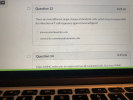 Question 13 0.25 pts There are two different major classes of dendritic cells, which class is responsible for induction of T cell responses against most antigens? plasmacytoid dendritic cells classical (or conventional) dendritic cells Question 14 0.25 pts Class II MHC molecules are expressed on all nucleated cells, but class I MHC
What would an increase in neutrophils indicate? Which cells are part of the innate immune response?...
 What would an increase in neutrophils indicate? Which cells are part of the innate immune response? Which cells are part of the adaptive immune response? What is the difference between serum and plasma?
Investigate the different parts of the human immune system and explain which cells/products of innate and...
 Investigate the different parts of the human immune system and explain which cells/products of innate and adaptive immunity are responsible for recognizing antigens on the surface of T. brucei and clearing the parasite. What would happen if T. brucei suddenly loss the ability to undergo antigenic variation? If researchers developed a drug that could prevent T. brucei from undergoing antigenic variation, do you think it could be successful in eradicating African Sleeping Sickness? Would the drug have to be administered...
23. In adaptive (acquired) immunity, what plays a role in the cell-mediated immune response? Plasma cells...
23. In adaptive (acquired) immunity, what plays a role in the cell-mediated immune response? Plasma cells Opsonization Destruction of pathogens via phagocytosis Release of cytokines by helper T cells The complement system
Question 9 1 pts Natural killer cells target cells that lack MHC-Ion their surface. True O...
 Question 9 1 pts Natural killer cells target cells that lack MHC-Ion their surface. True O False 1 pts Question 10 the difference between innate Question 12 1 pts Match the term with the method of complement activation classical pathway [Choose] alternate pathway [Choose] lectin pathway ✓ [Choose) BPD binding to a Sathogen antibody binding to an antigen T cytotoxic cells binding to MHC- lectin binding to RBD lectin binding to mannose 1 pts 13
QUESTION 41 Which cells produce plasma cells that secrete antibodies? O reticular cells macrophages O dendritic...
 QUESTION 41 Which cells produce plasma cells that secrete antibodies? O reticular cells macrophages O dendritic cells Tlymphocytes OB lymphocytes QUESTION 42 The layers of the adrenal cortex, in order from most superficial to deepest are: cortex, medulla zona glomerulosa, zona fasciculata, zona reticularis zona reticularis, zona fasciculata, zona glomerulosa Omedulla, zona glomerulosa zona medulla, zona cortica, zona fasciculata QUESTION 43 Which of the following statements is true? individuals with type AB blood have type A agglutinogens and anti-B agglutinins...
D Question 7 1 pts Subunit vaccines and toxoids often contain O coloring O antibodies O...
 D Question 7 1 pts Subunit vaccines and toxoids often contain O coloring O antibodies O antibiotics DQuestion 8 1 pts Live, attenuated viral vaccines produce: O short-term innate immunity O short-term specific im O long-term specific immunity nity
 please answer all 4 questions asap
Question 15 3 pts Several types of innate immune cells attack antigens by: o Promoting apoptosis in cells containing the antigen o Producing antibodies that neutralize the antigen o Scaring them away o Phagocytosis and digestion internally Question 16 3 pts In a primary response, what part of the immune response responds the most quickly to a novel antigen? o Humoral adaptive immunity o Cell-mediated adaptive immunity O Innate immunity Question 17 3 pts...
please answer all 4 questions asap
Question 15 3 pts Several types of innate immune cells attack antigens by: o Promoting apoptosis in cells containing the antigen o Producing antibodies that neutralize the antigen o Scaring them away o Phagocytosis and digestion internally Question 16 3 pts In a primary response, what part of the immune response responds the most quickly to a novel antigen? o Humoral adaptive immunity o Cell-mediated adaptive immunity O Innate immunity Question 17 3 pts...
 Answer all
QUESTION 11 Complement is a component of both innate and adaptive defenses. O True o False QUESTION 12 Explain the differences between helper and cytotoxic T cells. Arial : 3 (12pt) Path: p QUESTION 13 Explain how macrophages and dendritic cells are similar and how they are different. Path: p QUESTION 14 triggers an immune response when foreign.
Answer all
QUESTION 11 Complement is a component of both innate and adaptive defenses. O True o False QUESTION 12 Explain the differences between helper and cytotoxic T cells. Arial : 3 (12pt) Path: p QUESTION 13 Explain how macrophages and dendritic cells are similar and how they are different. Path: p QUESTION 14 triggers an immune response when foreign.
 Question 13 0.25 pts There are two different major classes of dendritic cells, which class is responsible for induction of T cell responses against most antigens? plasmacytoid dendritic cells classical (or conventional) dendritic cells Question 14 0.25 pts Class II MHC molecules are expressed on all nucleated cells, but class I MHC
 What would an increase in neutrophils indicate? Which cells are part of the innate immune response? Which cells are part of the adaptive immune response? What is the difference between serum and plasma?
 Investigate the different parts of the human immune system and explain which cells/products of innate and adaptive immunity are responsible for recognizing antigens on the surface of T. brucei and clearing the parasite. What would happen if T. brucei suddenly loss the ability to undergo antigenic variation? If researchers developed a drug that could prevent T. brucei from undergoing antigenic variation, do you think it could be successful in eradicating African Sleeping Sickness? Would the drug have to be administered...
 Question 9 1 pts Natural killer cells target cells that lack MHC-Ion their surface. True O False 1 pts Question 10 the difference between innate Question 12 1 pts Match the term with the method of complement activation classical pathway [Choose] alternate pathway [Choose] lectin pathway ✓ [Choose) BPD binding to a Sathogen antibody binding to an antigen T cytotoxic cells binding to MHC- lectin binding to RBD lectin binding to mannose 1 pts 13
 QUESTION 41 Which cells produce plasma cells that secrete antibodies? O reticular cells macrophages O dendritic cells Tlymphocytes OB lymphocytes QUESTION 42 The layers of the adrenal cortex, in order from most superficial to deepest are: cortex, medulla zona glomerulosa, zona fasciculata, zona reticularis zona reticularis, zona fasciculata, zona glomerulosa Omedulla, zona glomerulosa zona medulla, zona cortica, zona fasciculata QUESTION 43 Which of the following statements is true? individuals with type AB blood have type A agglutinogens and anti-B agglutinins...
 D Question 7 1 pts Subunit vaccines and toxoids often contain O coloring O antibodies O antibiotics DQuestion 8 1 pts Live, attenuated viral vaccines produce: O short-term innate immunity O short-term specific im O long-term specific immunity nity
Most questions answered within 3 hours.
-
Where is the error in this code sequence?
String s1 = "Hello";
String s2 = "ello";...
asked 11 months ago -
Financial data for Joel de Paris, Inc., for last year
follow:
Joel de Paris, Inc.
Balance...
asked 11 months ago -
Consider this reaction:
Al2(SO4)3 (aq)+ BaCl3
(aq) Al2Cl6 (aq)- +
3BaSO4(s) . What is the...
asked 11 months ago -
Suppose that Savneet is considering increasing her
recent random sample from 20 car rentals to 40...
asked 11 months ago -
Trucks arrive at an unloading terminal at an average rate of 120
per hour.
Trucks arrive...
asked 11 months ago -
Why are methanol and ethanol completely soluble in water while
octanol is not very little soluble....
asked 11 months ago -
A facilities manager at a university reads in a research report
that the mean amount of...
asked 11 months ago -
When the CuSO4 is rehydrated by adding water to the anhydrous
compound, is this an endothermic...
asked 11 months ago -
A ray of sunlight is passing from diamond into crown glass; the
angle of incidence is...
asked 11 months ago -
A block of mass 0.249 kg is placed on top of a light, vertical
spring of...
asked 11 months ago -
how do the kidneys compensate in the presences of acidosis
a) trigger hyperventilate
b) reserve acid...
asked 11 months ago -
Question 501 pts
The rental rate of capital to the firm increases. Which of the
following...
asked 11 months ago