
Homework Answers
False because energy is required.
In exothermic reaction energy will evolve ,but in endothermic reaction energy will be given to complete reaction
Add Answer to:
If the reaction that you are performing in your lab experiment requires 2224 kJ of energy,...
Experiment #9: Heats of Reaction Pre-Lab Questions Name Date Lab Mamal helps in answering the following...
 Experiment #9: Heats of Reaction Pre-Lab Questions Name Date Lab Mamal helps in answering the following questions 1. A reaction in which heat is absorbed is called a. Endothermic b. Exothermic c. Cooling d. Heating 2. A reaction where heat is released is called a. Endothermic b. Exothermic c. Cooling d. Heating 3. The energy change of a reaction that occurs at constant pressure is called the a. Total energy change b. Work c. Heat of reaction d pressure 4....
True or False A manufacturing company requires 157 kJ of energy to power one of its...
True or False A manufacturing company requires 157 kJ of energy to power one of its machines for a day. The reaction shown below would be able to provide a sufficient amount of energy for this purpose. 2 HgO(s) → 2 Hg(l) + O2(g) ΔH = 182 kJ
Part A When performing today’s experiment, your lab partner decides to add all the reagents into...
Part A When performing today’s experiment, your lab partner decides to add all the reagents into one beaker instead of two separate beakers. After adding everything together and waiting a significant amount of time, you see no reaction occur. What was the problem?
Here is ergy diagram for the reaction: 400 300 energy 200 (kJ/mol) 100 C D reaction coordinate Us...
 Here is ergy diagram for the reaction: 400 300 energy 200 (kJ/mol) 100 C D reaction coordinate Use the energy diagram to answer these questions. kJ/mol Exothermic Endothermic Neither Yes, it's kJ/mol What is the heat of reaction? Is the reaction exothermic or endothermic? Can you determine the activation energy? O Yes, it'skJ/mol Can you determine the activation energy of the reverse reaction? No.
Here is ergy diagram for the reaction: 400 300 energy 200 (kJ/mol) 100 C D reaction...
Here is ergy diagram for the reaction: 400 300 energy 200 (kJ/mol) 100 C D reaction coordinate Use the energy diagram to answer these questions. kJ/mol Exothermic Endothermic Neither Yes, it's kJ/mol What is the heat of reaction? Is the reaction exothermic or endothermic? Can you determine the activation energy? O Yes, it'skJ/mol Can you determine the activation energy of the reverse reaction? No.
Here is ergy diagram for the reaction: 400 300 energy 200 (kJ/mol) 100 C D reaction...
8 Fe2O3 (s) 16 FeO (s) + 8 02 (g) If the reaction shown below requires...
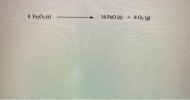 8 Fe2O3 (s) 16 FeO (s) + 8 02 (g) If the reaction shown below requires 2224 kJ, how much energy would be required for 12 moles of Fe2O3 06.C.pdf -556.0 kJ O b. 556.0 kJ Oc. -3336 kJ 3336 kJ Od
calorimetry experiment Guidelines for Discussion: Answer the following questions, as per your experimental observations. 1. What...
 calorimetry experiment
Guidelines for Discussion: Answer the following questions, as per your experimental observations. 1. What happens if initial temperature is not recorded in each experiment? 2. What happens if the calorimeter is not covered properly? 3. How will you get the final temperature? 4. What are the techniques used in this experiment? 5. Comment on possible accuracy of your results Guidelines for Conclusion: 1. What is your result considering the objective (s) of the experiment? 2. What did you...
calorimetry experiment
Guidelines for Discussion: Answer the following questions, as per your experimental observations. 1. What happens if initial temperature is not recorded in each experiment? 2. What happens if the calorimeter is not covered properly? 3. How will you get the final temperature? 4. What are the techniques used in this experiment? 5. Comment on possible accuracy of your results Guidelines for Conclusion: 1. What is your result considering the objective (s) of the experiment? 2. What did you...
1. Based on the following energy diagram: free energy, kJ/mol reaction coordinate C. D. The reaction...
 1. Based on the following energy diagram: free energy, kJ/mol reaction coordinate C. D. The reaction is exothermic and the first step is rate limiting. The reaction is exothermic and the second step is rate limiting. The reaction is endothermic and the first step is rate limiting. The reaction is endothermic and the second step is rate limiting. The reaction is one step endothermic.
a. You perform a coffee cup calorimetry experiment to determine the enthalpy change for the dissolution...
a. You perform a coffee cup calorimetry experiment to determine the enthalpy change for the dissolution of sodium chloride in water. You add 10g of NaCl to 100 ml of water at 20.00 degrees C and mix well. The final temperature is 19.80 degrees celsius which of the following statements is true. -energy moves from the surroundings to the system due to the endothermic reaction -energy moves from the system to the surroundings due to the endothermic reaction -energy moves...
5. For today's experiment, you will be performing the first step of your multistep synthesis to...
 5. For today's experiment, you will be performing the first step of your multistep synthesis to make trans- 1,2-cyclohexanol from hexanol. You will be using distillation to separate the product of the first step in the synthesis. (see the procedure below for diagrams and photos of what distillation setup looks like. Check the boiling points provided in the chemical table for starting material and product. Which compound boils at a lower boiling point? Explain briefly based on boiling point differences...
In your lab, you will be performing an SN1 Reaction using 2-methyl-2-propanol and hydrochloric acid. 1....
In your lab, you will be performing an SN1 Reaction using 2-methyl-2-propanol and hydrochloric acid. 1. Write out the balanced equation. 2. What is the theoretical yield in this reaction if 10g of 2-methyl 2-propanol were reacted with 10g of 12M HCl?
 Experiment #9: Heats of Reaction Pre-Lab Questions Name Date Lab Mamal helps in answering the following questions 1. A reaction in which heat is absorbed is called a. Endothermic b. Exothermic c. Cooling d. Heating 2. A reaction where heat is released is called a. Endothermic b. Exothermic c. Cooling d. Heating 3. The energy change of a reaction that occurs at constant pressure is called the a. Total energy change b. Work c. Heat of reaction d pressure 4....
 Here is ergy diagram for the reaction: 400 300 energy 200 (kJ/mol) 100 C D reaction coordinate Use the energy diagram to answer these questions. kJ/mol Exothermic Endothermic Neither Yes, it's kJ/mol What is the heat of reaction? Is the reaction exothermic or endothermic? Can you determine the activation energy? O Yes, it'skJ/mol Can you determine the activation energy of the reverse reaction? No.
Here is ergy diagram for the reaction: 400 300 energy 200 (kJ/mol) 100 C D reaction...
Here is ergy diagram for the reaction: 400 300 energy 200 (kJ/mol) 100 C D reaction coordinate Use the energy diagram to answer these questions. kJ/mol Exothermic Endothermic Neither Yes, it's kJ/mol What is the heat of reaction? Is the reaction exothermic or endothermic? Can you determine the activation energy? O Yes, it'skJ/mol Can you determine the activation energy of the reverse reaction? No.
Here is ergy diagram for the reaction: 400 300 energy 200 (kJ/mol) 100 C D reaction...
 8 Fe2O3 (s) 16 FeO (s) + 8 02 (g) If the reaction shown below requires 2224 kJ, how much energy would be required for 12 moles of Fe2O3 06.C.pdf -556.0 kJ O b. 556.0 kJ Oc. -3336 kJ 3336 kJ Od
 calorimetry experiment
Guidelines for Discussion: Answer the following questions, as per your experimental observations. 1. What happens if initial temperature is not recorded in each experiment? 2. What happens if the calorimeter is not covered properly? 3. How will you get the final temperature? 4. What are the techniques used in this experiment? 5. Comment on possible accuracy of your results Guidelines for Conclusion: 1. What is your result considering the objective (s) of the experiment? 2. What did you...
calorimetry experiment
Guidelines for Discussion: Answer the following questions, as per your experimental observations. 1. What happens if initial temperature is not recorded in each experiment? 2. What happens if the calorimeter is not covered properly? 3. How will you get the final temperature? 4. What are the techniques used in this experiment? 5. Comment on possible accuracy of your results Guidelines for Conclusion: 1. What is your result considering the objective (s) of the experiment? 2. What did you...
 1. Based on the following energy diagram: free energy, kJ/mol reaction coordinate C. D. The reaction is exothermic and the first step is rate limiting. The reaction is exothermic and the second step is rate limiting. The reaction is endothermic and the first step is rate limiting. The reaction is endothermic and the second step is rate limiting. The reaction is one step endothermic.
 5. For today's experiment, you will be performing the first step of your multistep synthesis to make trans- 1,2-cyclohexanol from hexanol. You will be using distillation to separate the product of the first step in the synthesis. (see the procedure below for diagrams and photos of what distillation setup looks like. Check the boiling points provided in the chemical table for starting material and product. Which compound boils at a lower boiling point? Explain briefly based on boiling point differences...
Most questions answered within 3 hours.
-
Where is the error in this code sequence?
String s1 = "Hello";
String s2 = "ello";...
asked 10 months ago -
Financial data for Joel de Paris, Inc., for last year
follow:
Joel de Paris, Inc.
Balance...
asked 10 months ago -
Consider this reaction:
Al2(SO4)3 (aq)+ BaCl3
(aq) Al2Cl6 (aq)- +
3BaSO4(s) . What is the...
asked 10 months ago -
Suppose that Savneet is considering increasing her
recent random sample from 20 car rentals to 40...
asked 10 months ago -
Trucks arrive at an unloading terminal at an average rate of 120
per hour.
Trucks arrive...
asked 10 months ago -
Why are methanol and ethanol completely soluble in water while
octanol is not very little soluble....
asked 10 months ago -
A facilities manager at a university reads in a research report
that the mean amount of...
asked 10 months ago -
When the CuSO4 is rehydrated by adding water to the anhydrous
compound, is this an endothermic...
asked 10 months ago -
A ray of sunlight is passing from diamond into crown glass; the
angle of incidence is...
asked 10 months ago -
A block of mass 0.249 kg is placed on top of a light, vertical
spring of...
asked 10 months ago -
how do the kidneys compensate in the presences of acidosis
a) trigger hyperventilate
b) reserve acid...
asked 10 months ago -
Question 501 pts
The rental rate of capital to the firm increases. Which of the
following...
asked 10 months ago