
Homework Answers
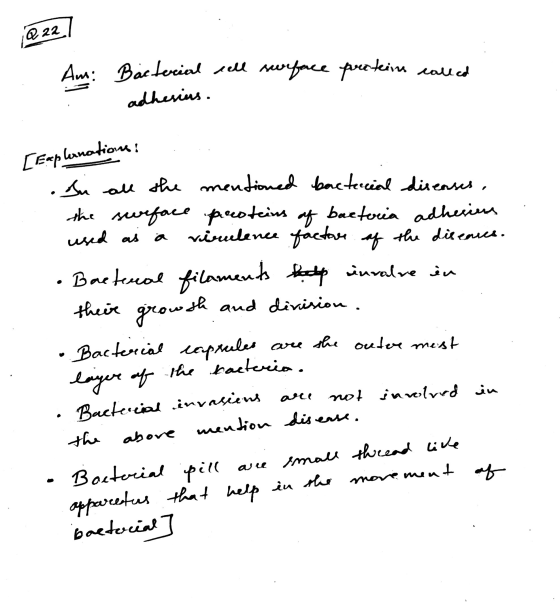
Bacterial cell surface protein called adhesinsis used as a
virulenece factor for the mentioned diseases.
Add Answer to:
QUESTION 22 These cell wall proteins allow many bacteria to adhere tightly to host cells, colonize,...
QUESTION 18 These structures are protein tubules with adhesive tips that the bacterium can change. The...
 QUESTION 18 These structures are protein tubules with adhesive tips that the bacterium can change. The adhesive tips are able to adhere to receptors on host cells, enabling the bacterium to colonize and resist flushing. They are used as a virulence factor by such bacteria as Neisseria gonorrhoeae and Neisseria meningitides, and Pseudomonas aeruginosa. This best describes what? Bacterial flagella and axial filaments. Bacteria cell surface proteins called adhesins, Bacteria capsules (glycocalyces) Bacteria invasions Bacteria pili
QUESTION 19 These structures are usually composed of a polysaccharide slime that enables some bacteria to...
 QUESTION 19 These structures are usually composed of a polysaccharide slime that enables some bacteria to resist phagocytic engulfment and adhere to host cells, often as biofilms. They are used as a virulence factor by Streptococcus pneumoniae, Haemophilus influenzae, and Streptococcus mutans. This best describes what? Bacterial flagella and axial filaments, Bacterial cell surface proteins called adhesins. Bacterial capsules (glycocalyces), Bacterial invasions. Bacterial pili.
QUESTION 21 These proteins, often injected into host cells by a type 3 secretion system, allow...
 QUESTION 21 These proteins, often injected into host cells by a type 3 secretion system, allow certain bacteria to penetrate cells by inducing phagocytosis of the bacteria by the host cell. As a result, these bacteria don't have to compete for nutrients and can resist many body defense molecules. This is used as a virulence factor by Shigella, Yersinia, and Salmonella. This best describes what? Bacterial flagella and axial filaments. Bacterial cell surface proteins called adhesins. Bacterial capsules (glycocalyces). Bacterial...
QUESTION 20 These structures enable some bacteria to move through mucous and contact mucosal epithelial cells...
 QUESTION 20 These structures enable some bacteria to move through mucous and contact mucosal epithelial cells in order to colonize. They also enable spirochetes to penetrate mucous membranes, skin abrasions, and cell membranes, enter blood vessels and disseminate to other locations in the body. This is used as a virulence factor by Helicobacter pylori, Treponema pallidum and Borrelia bergdorferi. This best describes what? Bacterial flagella and axial filaments. Bacterial cell surface proteins called invasins. Bacterial capsules (glycocalyces). Bacterial cilia and...
Puzzles, I need one or two word answer for each question. Thank you An acidic dye...
Puzzles, I need one or two word answer for each question. Thank you An acidic dye will give a ___________ stain. Dye in which the color portion resides in the positive ion. A bacterial cell wall containing only 2-3 layers of peptidoglycan and surrounded by an outer membrane composed of phospholipids, lipopolysaccharide, lipoprotein, and proteins. (2 words) During starch hydrolysis, starch is broken down to __________. Secreted by bacteria into the surrounding environment in order to break down larger nutrient...
 QUESTION 18 These structures are protein tubules with adhesive tips that the bacterium can change. The adhesive tips are able to adhere to receptors on host cells, enabling the bacterium to colonize and resist flushing. They are used as a virulence factor by such bacteria as Neisseria gonorrhoeae and Neisseria meningitides, and Pseudomonas aeruginosa. This best describes what? Bacterial flagella and axial filaments. Bacteria cell surface proteins called adhesins, Bacteria capsules (glycocalyces) Bacteria invasions Bacteria pili
 QUESTION 19 These structures are usually composed of a polysaccharide slime that enables some bacteria to resist phagocytic engulfment and adhere to host cells, often as biofilms. They are used as a virulence factor by Streptococcus pneumoniae, Haemophilus influenzae, and Streptococcus mutans. This best describes what? Bacterial flagella and axial filaments, Bacterial cell surface proteins called adhesins. Bacterial capsules (glycocalyces), Bacterial invasions. Bacterial pili.
 QUESTION 21 These proteins, often injected into host cells by a type 3 secretion system, allow certain bacteria to penetrate cells by inducing phagocytosis of the bacteria by the host cell. As a result, these bacteria don't have to compete for nutrients and can resist many body defense molecules. This is used as a virulence factor by Shigella, Yersinia, and Salmonella. This best describes what? Bacterial flagella and axial filaments. Bacterial cell surface proteins called adhesins. Bacterial capsules (glycocalyces). Bacterial...
 QUESTION 20 These structures enable some bacteria to move through mucous and contact mucosal epithelial cells in order to colonize. They also enable spirochetes to penetrate mucous membranes, skin abrasions, and cell membranes, enter blood vessels and disseminate to other locations in the body. This is used as a virulence factor by Helicobacter pylori, Treponema pallidum and Borrelia bergdorferi. This best describes what? Bacterial flagella and axial filaments. Bacterial cell surface proteins called invasins. Bacterial capsules (glycocalyces). Bacterial cilia and...
Most questions answered within 3 hours.
-
Where is the error in this code sequence?
String s1 = "Hello";
String s2 = "ello";...
asked 10 months ago -
Financial data for Joel de Paris, Inc., for last year
follow:
Joel de Paris, Inc.
Balance...
asked 10 months ago -
Consider this reaction:
Al2(SO4)3 (aq)+ BaCl3
(aq) Al2Cl6 (aq)- +
3BaSO4(s) . What is the...
asked 10 months ago -
Suppose that Savneet is considering increasing her
recent random sample from 20 car rentals to 40...
asked 10 months ago -
Trucks arrive at an unloading terminal at an average rate of 120
per hour.
Trucks arrive...
asked 10 months ago -
Why are methanol and ethanol completely soluble in water while
octanol is not very little soluble....
asked 10 months ago -
A facilities manager at a university reads in a research report
that the mean amount of...
asked 10 months ago -
When the CuSO4 is rehydrated by adding water to the anhydrous
compound, is this an endothermic...
asked 10 months ago -
A ray of sunlight is passing from diamond into crown glass; the
angle of incidence is...
asked 10 months ago -
A block of mass 0.249 kg is placed on top of a light, vertical
spring of...
asked 10 months ago -
how do the kidneys compensate in the presences of acidosis
a) trigger hyperventilate
b) reserve acid...
asked 10 months ago -
Question 501 pts
The rental rate of capital to the firm increases. Which of the
following...
asked 10 months ago