
Homework Answers
1. c that is total energy difference between product and reactant
2. positive ... as energy is require for this reaction
3. a
4. d
hope this help
Add Answer to:
400 (b) Products 300 Potential Energy (a) 200 (d) (c) 100 Reactants Reaction Pathway Which letter...
Here is ergy diagram for the reaction: 400 300 energy 200 (kJ/mol) 100 C D reaction coordinate Us...
 Here is ergy diagram for the reaction: 400 300 energy 200 (kJ/mol) 100 C D reaction coordinate Use the energy diagram to answer these questions. kJ/mol Exothermic Endothermic Neither Yes, it's kJ/mol What is the heat of reaction? Is the reaction exothermic or endothermic? Can you determine the activation energy? O Yes, it'skJ/mol Can you determine the activation energy of the reverse reaction? No.
Here is ergy diagram for the reaction: 400 300 energy 200 (kJ/mol) 100 C D reaction...
Here is ergy diagram for the reaction: 400 300 energy 200 (kJ/mol) 100 C D reaction coordinate Use the energy diagram to answer these questions. kJ/mol Exothermic Endothermic Neither Yes, it's kJ/mol What is the heat of reaction? Is the reaction exothermic or endothermic? Can you determine the activation energy? O Yes, it'skJ/mol Can you determine the activation energy of the reverse reaction? No.
Here is ergy diagram for the reaction: 400 300 energy 200 (kJ/mol) 100 C D reaction...
QUESTION 33 Match each arrow letter with the proper label. B C Potential Energy D A...
 QUESTION 33 Match each arrow letter with the proper label. B C Potential Energy D A E Reaction Coordinate CH(g) + 2O5(g)-CO-(g) + 2H2O + S90,4kg 1. Potential energy of the reactants Click Save and Submit to save and submit. Click Save an Answers to save all ansers Type here to search O 994 Reaction Coordinate CH,(g) + 20g) - CO2(g) + 2H2O(0) + 890.4 kJ 1. Potential energy of the reactants Arrow A 2. Activation Energy of the forward...
1. 2. Question 10 1 pts The graphs show potential energy diagrams for the same reaction...
 1.
2.
Question 10 1 pts The graphs show potential energy diagrams for the same reaction at T-900. K R P 1) uncatalysed process; 2) catalysed reaction Uncatalyzed Reaction 400 300 reactants 200 100 products Reaction coordinate Uncatalysed reaction: Potential Energy (P.E.) vs reaction coordinate. Energy is measured from O to 400. kJ, and the reaction coordinate is associated with the evolution of the reaction. The PE of the reactants is 225 kJ. Then the energy grows to 400. kJ,...
1.
2.
Question 10 1 pts The graphs show potential energy diagrams for the same reaction at T-900. K R P 1) uncatalysed process; 2) catalysed reaction Uncatalyzed Reaction 400 300 reactants 200 100 products Reaction coordinate Uncatalysed reaction: Potential Energy (P.E.) vs reaction coordinate. Energy is measured from O to 400. kJ, and the reaction coordinate is associated with the evolution of the reaction. The PE of the reactants is 225 kJ. Then the energy grows to 400. kJ,...
Part B The graph shows three reaction pathways for the same biological reaction One reaction pathway...
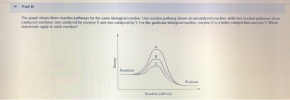 Part B The graph shows three reaction pathways for the same biological reaction One reaction pathway shows an uncatalyzed reaction, while two reaction pathways show catalyzed reactions: one catalyzed by enzyme X and one catalyzed by Y. For this particular biological reaction, enzyme X is a better catalyst than enzyme Y. Which statements apply to each reaction? Products Reaction pathway Reset slowest reaction catalyzed by enzyme X uncatalyzed reaction lowest activation energy fastest reaction highest activation energy catalyzed by enzyme...
c. b. A+B e. a Free Energy d. Progress of the Reaction Given the energy diagram...
 c. b. A+B e. a Free Energy d. Progress of the Reaction Given the energy diagram for the reaction of A+B --> C above, what is represented by the arrow marked d.? Select one: O A. Activation energy of the reverse catalyzed reaction o B. Energy difference between the catalyzed and uncatalyzed reactions OC. Activation energy of the reverse uncatalyzed reaction o D. Energy difference between the reactants and products
Model 1 - Potential Energy Diagrams 1) The energy (enthalpy) change of a reaction can be...
 Model 1 - Potential Energy Diagrams 1) The energy (enthalpy) change of a reaction can be determined by the following expression: Activated Complex Transition State AH = Energy products - Energy reactants Activation Energy, E Reactants Consider the energy change for the reaction in Model 1 (the graph to the left). Potential Energy (kJ/mol) Energy change (AH) Products a) The energy change shown is (positive/negative). b) This reaction is (endothermic / exothermic). c) These (reactants / transition state) has more...
An enzyme facilitates chemical reactions by: Select one: a. Increasing the free-energy difference between reactants and...
An enzyme facilitates chemical reactions by: Select one: a. Increasing the free-energy difference between reactants and products. b. Decreasing the free-energy difference between reactants and products. c. Lowering the activation energy of the reaction. d. Raising the activation energy of the reaction. e. None of the above. Q2. Enzymes are important components of biological systems because they: Select one: a. Speed up reactions. b. Reduce the activation energy of reactions allowing them to occur. c. Catalyze specific reactions, allowing for...
12. Which of the following statements is true of enzyme catalysts? A B C To be...
 12. Which of the following statements is true of enzyme catalysts? A B C To be effective, they must be present at the same concentration as their substrate. They can increase the equilibrium constant for a given reaction by a thousand-fold or more. They lower the activation energy for conversion of substrate to product. Their catalytic activity is independent of pH. They are generally equally active on D and L isomers of a given substrate. D E 13. In competitive...
If the reaction A + B → C has an equilibrium constant of 10-6. Which of...
If the reaction A + B → C has an equilibrium constant of 10-6. Which of the following statements are necessarily true? Make sure to select all of the correct responses At equilibrium there will be more products than reactants At equilibrium there will be more reactants than products the reaction is spontaneous the reaction is not spontaneous The reaction is fast The reaction is slow The chemical potential energy of the products is greater than that of the reactants...
products B.) ..eaction coordinate D.) 14.) Using the Potential Energy diagram pictured above, and the terms...
 products B.) ..eaction coordinate D.) 14.) Using the Potential Energy diagram pictured above, and the terms listed below write the correct terms next to the corresponding letter(s) on the diagram. (10 pts) TERMS: Transition State Rxn Coordinate Potential Energy Intermediate Reactants Pr oducts Place the correct terms / definitions where they would fit within the Potential Energy Reaction Coordinate pictured above: (A-F (2 pts each)) A.) B.) C.) D.) E.) A.) reactants products B.) -C.) Jeaction coordinate D.)
 Here is ergy diagram for the reaction: 400 300 energy 200 (kJ/mol) 100 C D reaction coordinate Use the energy diagram to answer these questions. kJ/mol Exothermic Endothermic Neither Yes, it's kJ/mol What is the heat of reaction? Is the reaction exothermic or endothermic? Can you determine the activation energy? O Yes, it'skJ/mol Can you determine the activation energy of the reverse reaction? No.
Here is ergy diagram for the reaction: 400 300 energy 200 (kJ/mol) 100 C D reaction...
Here is ergy diagram for the reaction: 400 300 energy 200 (kJ/mol) 100 C D reaction coordinate Use the energy diagram to answer these questions. kJ/mol Exothermic Endothermic Neither Yes, it's kJ/mol What is the heat of reaction? Is the reaction exothermic or endothermic? Can you determine the activation energy? O Yes, it'skJ/mol Can you determine the activation energy of the reverse reaction? No.
Here is ergy diagram for the reaction: 400 300 energy 200 (kJ/mol) 100 C D reaction...
 QUESTION 33 Match each arrow letter with the proper label. B C Potential Energy D A E Reaction Coordinate CH(g) + 2O5(g)-CO-(g) + 2H2O + S90,4kg 1. Potential energy of the reactants Click Save and Submit to save and submit. Click Save an Answers to save all ansers Type here to search O 994 Reaction Coordinate CH,(g) + 20g) - CO2(g) + 2H2O(0) + 890.4 kJ 1. Potential energy of the reactants Arrow A 2. Activation Energy of the forward...
 1.
2.
Question 10 1 pts The graphs show potential energy diagrams for the same reaction at T-900. K R P 1) uncatalysed process; 2) catalysed reaction Uncatalyzed Reaction 400 300 reactants 200 100 products Reaction coordinate Uncatalysed reaction: Potential Energy (P.E.) vs reaction coordinate. Energy is measured from O to 400. kJ, and the reaction coordinate is associated with the evolution of the reaction. The PE of the reactants is 225 kJ. Then the energy grows to 400. kJ,...
1.
2.
Question 10 1 pts The graphs show potential energy diagrams for the same reaction at T-900. K R P 1) uncatalysed process; 2) catalysed reaction Uncatalyzed Reaction 400 300 reactants 200 100 products Reaction coordinate Uncatalysed reaction: Potential Energy (P.E.) vs reaction coordinate. Energy is measured from O to 400. kJ, and the reaction coordinate is associated with the evolution of the reaction. The PE of the reactants is 225 kJ. Then the energy grows to 400. kJ,...
 Part B The graph shows three reaction pathways for the same biological reaction One reaction pathway shows an uncatalyzed reaction, while two reaction pathways show catalyzed reactions: one catalyzed by enzyme X and one catalyzed by Y. For this particular biological reaction, enzyme X is a better catalyst than enzyme Y. Which statements apply to each reaction? Products Reaction pathway Reset slowest reaction catalyzed by enzyme X uncatalyzed reaction lowest activation energy fastest reaction highest activation energy catalyzed by enzyme...
 c. b. A+B e. a Free Energy d. Progress of the Reaction Given the energy diagram for the reaction of A+B --> C above, what is represented by the arrow marked d.? Select one: O A. Activation energy of the reverse catalyzed reaction o B. Energy difference between the catalyzed and uncatalyzed reactions OC. Activation energy of the reverse uncatalyzed reaction o D. Energy difference between the reactants and products
 Model 1 - Potential Energy Diagrams 1) The energy (enthalpy) change of a reaction can be determined by the following expression: Activated Complex Transition State AH = Energy products - Energy reactants Activation Energy, E Reactants Consider the energy change for the reaction in Model 1 (the graph to the left). Potential Energy (kJ/mol) Energy change (AH) Products a) The energy change shown is (positive/negative). b) This reaction is (endothermic / exothermic). c) These (reactants / transition state) has more...
 12. Which of the following statements is true of enzyme catalysts? A B C To be effective, they must be present at the same concentration as their substrate. They can increase the equilibrium constant for a given reaction by a thousand-fold or more. They lower the activation energy for conversion of substrate to product. Their catalytic activity is independent of pH. They are generally equally active on D and L isomers of a given substrate. D E 13. In competitive...
 products B.) ..eaction coordinate D.) 14.) Using the Potential Energy diagram pictured above, and the terms listed below write the correct terms next to the corresponding letter(s) on the diagram. (10 pts) TERMS: Transition State Rxn Coordinate Potential Energy Intermediate Reactants Pr oducts Place the correct terms / definitions where they would fit within the Potential Energy Reaction Coordinate pictured above: (A-F (2 pts each)) A.) B.) C.) D.) E.) A.) reactants products B.) -C.) Jeaction coordinate D.)
Most questions answered within 3 hours.
-
Where is the error in this code sequence?
String s1 = "Hello";
String s2 = "ello";...
asked 11 months ago -
Financial data for Joel de Paris, Inc., for last year
follow:
Joel de Paris, Inc.
Balance...
asked 11 months ago -
Consider this reaction:
Al2(SO4)3 (aq)+ BaCl3
(aq) Al2Cl6 (aq)- +
3BaSO4(s) . What is the...
asked 11 months ago -
Suppose that Savneet is considering increasing her
recent random sample from 20 car rentals to 40...
asked 11 months ago -
Trucks arrive at an unloading terminal at an average rate of 120
per hour.
Trucks arrive...
asked 11 months ago -
Why are methanol and ethanol completely soluble in water while
octanol is not very little soluble....
asked 11 months ago -
A facilities manager at a university reads in a research report
that the mean amount of...
asked 11 months ago -
When the CuSO4 is rehydrated by adding water to the anhydrous
compound, is this an endothermic...
asked 11 months ago -
A ray of sunlight is passing from diamond into crown glass; the
angle of incidence is...
asked 11 months ago -
A block of mass 0.249 kg is placed on top of a light, vertical
spring of...
asked 11 months ago -
how do the kidneys compensate in the presences of acidosis
a) trigger hyperventilate
b) reserve acid...
asked 11 months ago -
Question 501 pts
The rental rate of capital to the firm increases. Which of the
following...
asked 11 months ago