
Homework Answers
LOCATION OF CENTROIDS
Naming the shaded spaces, we get
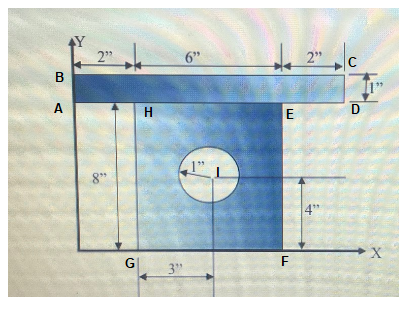
Now the areas and centroids are as follows. The -ve area means that the area is to be subtracted from the geometry
| Part Name | Area (in^2) | Centroid (x,y) | Ax (in^3) | Ay (in^3) |
| ABCD | 10 | 5,8.05 | 50 | 80.5 |
| EFGH | 48 | 5,4 | 240 | 192 |
| Circle I | -3.142 | 5,4 | -15.71 | -12.56 |
Thus
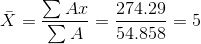

MOMENT OF INERTIA
Let us add the centroidal axes of each part parallel to X axis to the diagram
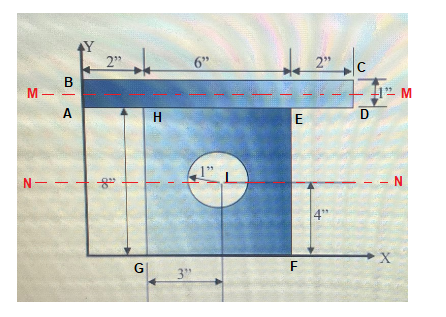
Before we start, the parallel axis therom says that

where
 is the moment of inertia about axis 'a'
 is the moment of inertia about centroidal axis 'b'
- A is the area of the structure.
- t is the perpendicular distance between axis 'a' and 'b'
 is the moment of inertia about axis 'a'
 is the moment of inertia about centroidal axis 'b'
Now let us proceed to find the moment of inertia about X axis of the individual areas
| Part Name | Area (in^2) |  (in^4)
 |
t (in) |  (in^4)
 |
| ABCD | 10 |  |
8.05 |  |
| EFGH | 48 |  |
4 |  |
| Circle I | -3.142 |  |
4 |  |
Thus moment of inertia about X axis is

Let us add the centroidal axes of each part parallel to Y axis to the diagram
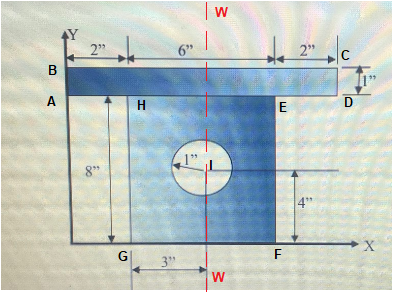
Now let us proceed to find the moment of inertia about X axis of the individual areas
| Part Name | Area (in^2) |
(in^4) |
t (in) |  (in^4)
 |
| ABCD | 10 |  |
5 |  |
| EFGH | 48 |  |
5 |  |
| Circle I | -3.142 | |
5 |  |
Thus moment of inertia about X axis is

RADIUS OF GYRATION
Using the formulae provided, we get


*A humble request* - If you have any doubt, please use the
comment section to communicate. Please be a little patient, it is
an honest promise I will reply as soon as possible. This will
clarify your doubt, and also help me to get better at answering
your next questions. At the same time, If my answer helped you,
please consider leaving an upvote. I hope you understand my
viewpoint. Thank you :)
Add Answer to:
3. For the following composite area shown below. Shaded regions have material while white regions are...
3. For the following composite area shown below. Shaded regions have material while white regions are...
 3. For the following composite area shown below. Shaded regions have material while white regions are empty. Include proper units. a. Find the location of the centroid measured from the shown X and Y axes. b. Calculate the moment of inertia and radius of gyration about the indicated axes Yc centroidal Ixe = bh?/12 and Iye = hb/12 h Xc b Yc centroidal Ixe = 1 r*/4 and lye - r*/4 Xc KX - Ky = Lt 2" 6" X=...
Statics 3. For the following composite area shown below. Shaded regions have material while white regions...
 Statics
3. For the following composite area shown below. Shaded regions have material while white regions are empty. Include proper units. a. Find the location of the centroid measured from the shown X and Y axes. b. Calculate the moment of inertia and radius of gyration about the indicated axes Yc centroidal Ixe = bh?/12 and lyc = hb?/12 h Xc b Yc centroidal Ixe = r4/4 and Iye = 1r4/4 Xc ka nga X- Y- 8" (5 points) (5...
Statics
3. For the following composite area shown below. Shaded regions have material while white regions are empty. Include proper units. a. Find the location of the centroid measured from the shown X and Y axes. b. Calculate the moment of inertia and radius of gyration about the indicated axes Yc centroidal Ixe = bh?/12 and lyc = hb?/12 h Xc b Yc centroidal Ixe = r4/4 and Iye = 1r4/4 Xc ka nga X- Y- 8" (5 points) (5...
Please help with these questions. 2. If the position vector r= 151 - 10j +20k (m)...
 Please help with these questions.
2. If the position vector r= 151 - 10j +20k (m) and force F = 250i +400j - 600k (N). a) Find the angle between r and F in degrees. 8 = degrees (5 points) b) Calculate vector M = r XF= k (5 points) 3. For the following composite area shown below. Shaded regions have material while white regions are empty. Include proper units. a. Find the location of the centroid measured from the...
Please help with these questions.
2. If the position vector r= 151 - 10j +20k (m) and force F = 250i +400j - 600k (N). a) Find the angle between r and F in degrees. 8 = degrees (5 points) b) Calculate vector M = r XF= k (5 points) 3. For the following composite area shown below. Shaded regions have material while white regions are empty. Include proper units. a. Find the location of the centroid measured from the...
 3. For the following composite area shown below. Shaded regions have material while white regions are empty. Include proper units. a. Find the location of the centroid measured from the shown X and Y axes. b. Calculate the moment of inertia and radius of gyration about the indicated axes Yc centroidal Ixe = bh?/12 and Iye = hb/12 h Xc b Yc centroidal Ixe = 1 r*/4 and lye - r*/4 Xc KX - Ky = Lt 2" 6" X=...
 Statics
3. For the following composite area shown below. Shaded regions have material while white regions are empty. Include proper units. a. Find the location of the centroid measured from the shown X and Y axes. b. Calculate the moment of inertia and radius of gyration about the indicated axes Yc centroidal Ixe = bh?/12 and lyc = hb?/12 h Xc b Yc centroidal Ixe = r4/4 and Iye = 1r4/4 Xc ka nga X- Y- 8" (5 points) (5...
Statics
3. For the following composite area shown below. Shaded regions have material while white regions are empty. Include proper units. a. Find the location of the centroid measured from the shown X and Y axes. b. Calculate the moment of inertia and radius of gyration about the indicated axes Yc centroidal Ixe = bh?/12 and lyc = hb?/12 h Xc b Yc centroidal Ixe = r4/4 and Iye = 1r4/4 Xc ka nga X- Y- 8" (5 points) (5...
 Please help with these questions.
2. If the position vector r= 151 - 10j +20k (m) and force F = 250i +400j - 600k (N). a) Find the angle between r and F in degrees. 8 = degrees (5 points) b) Calculate vector M = r XF= k (5 points) 3. For the following composite area shown below. Shaded regions have material while white regions are empty. Include proper units. a. Find the location of the centroid measured from the...
Please help with these questions.
2. If the position vector r= 151 - 10j +20k (m) and force F = 250i +400j - 600k (N). a) Find the angle between r and F in degrees. 8 = degrees (5 points) b) Calculate vector M = r XF= k (5 points) 3. For the following composite area shown below. Shaded regions have material while white regions are empty. Include proper units. a. Find the location of the centroid measured from the...
Most questions answered within 3 hours.
-
Where is the error in this code sequence?
String s1 = "Hello";
String s2 = "ello";...
asked 10 months ago -
Financial data for Joel de Paris, Inc., for last year
follow:
Joel de Paris, Inc.
Balance...
asked 10 months ago -
Consider this reaction:
Al2(SO4)3 (aq)+ BaCl3
(aq) Al2Cl6 (aq)- +
3BaSO4(s) . What is the...
asked 10 months ago -
Suppose that Savneet is considering increasing her
recent random sample from 20 car rentals to 40...
asked 10 months ago -
Trucks arrive at an unloading terminal at an average rate of 120
per hour.
Trucks arrive...
asked 10 months ago -
Why are methanol and ethanol completely soluble in water while
octanol is not very little soluble....
asked 10 months ago -
A facilities manager at a university reads in a research report
that the mean amount of...
asked 10 months ago -
When the CuSO4 is rehydrated by adding water to the anhydrous
compound, is this an endothermic...
asked 10 months ago -
A ray of sunlight is passing from diamond into crown glass; the
angle of incidence is...
asked 10 months ago -
A block of mass 0.249 kg is placed on top of a light, vertical
spring of...
asked 10 months ago -
how do the kidneys compensate in the presences of acidosis
a) trigger hyperventilate
b) reserve acid...
asked 10 months ago -
Question 501 pts
The rental rate of capital to the firm increases. Which of the
following...
asked 10 months ago