A combined cycle gas turbine/vapor power plant uses the turbine exhaust as the energy source for...
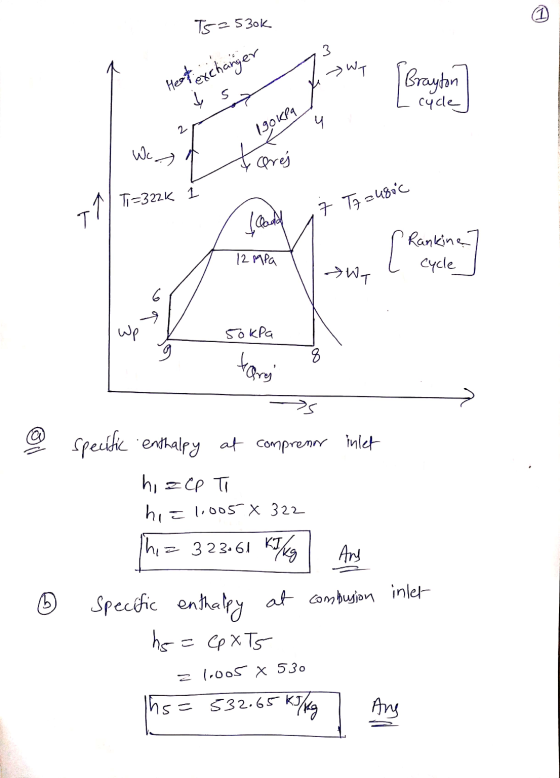
A combined cycle gas turbine/vapor power plant uses the turbine exhaust as the energy source for the boiler. Each power system uses a single turbine. The gas power system is modeled as an ideal air-standard Brayton cycle. The vapor power system is modeled as an ideal Rankine cycle. Given specific operating conditions determine the temperature and pressure at each state, the rate of heat transfer in the boiler, the power output of each turbine, and the overall efficiency.
--Given Values--
Brayton Compressor Inlet: T1 (K) = 322
Brayton Compressor Inlet: P1 (kPa) = 190
Brayton Heat Exchanger Exit: T5 (K) = 530
Brayton: rp = 9.7
Brayton: rc = 2.45
Brayton: AV (m3/s) = 2.2
Rankine Turbine Inlet: T7 (C) = 480
Rankine Turbine Inlet: P7 (MPa) = 12
Rankine Condenser Inlet: P8 (kPa) = 50
a) Determine the specific enthalpy (kJ/kg) at the compressor inlet.
b) Determine the specific enthalpy (kJ/kg) at the combustor inlet.
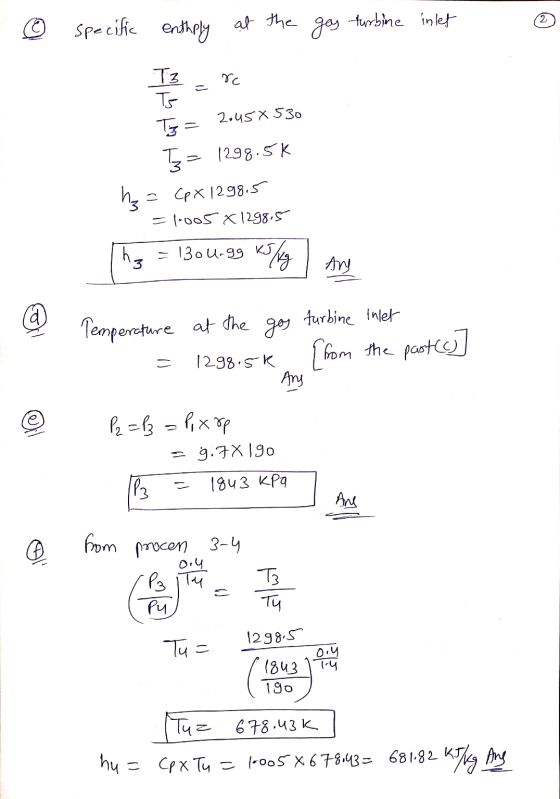
c) Determine the specific enthalpy (kJ/kg) at the gas turbine inlet.
d) Determine the temperature (K) at the gas turbine inlet.
e) Determine the pressure (kPa) at the gas turbine inlet.
f) Determine the specific enthalpy (kJ/kg) at the gas turbine exit.
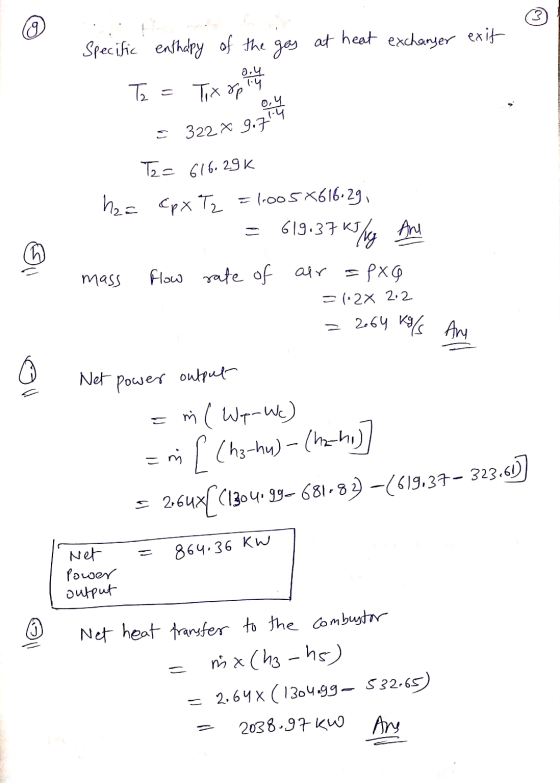
g) Determine the specific enthalpy (kJ/kg) of the gas at the heat exchanger exit.
h) Determine the mass flow rate of the air (kg/s) in the gas-power system.
i) Determine the net-power output (kW) of the Brayton cycle.
j) Determine the rate of heat transfer (kW) to the combustor.
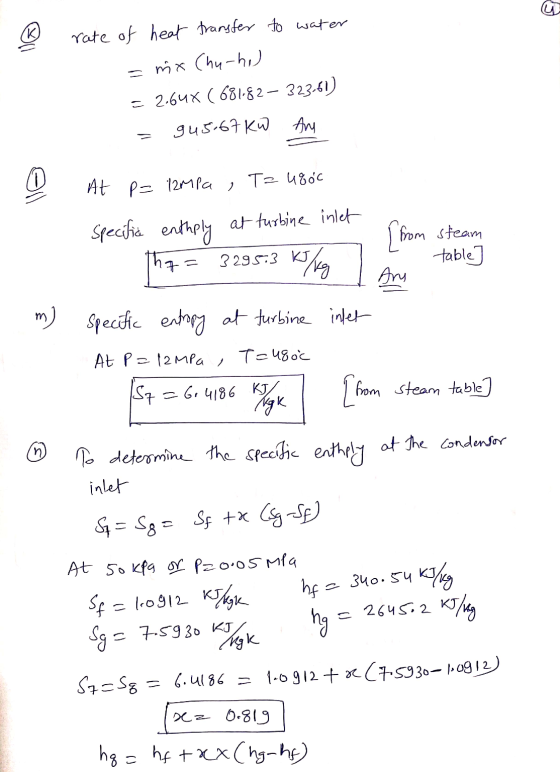
k) Determine the rate of heat transfer (kW) to the water in the boiler.
l) Determine the specific enthalpy at the turbine inlet (kJ/kg).
m) Determine the specific entropy (kJ/kg-K) at the turbine inlet.
n) Determine the specific enthalpy at the condenser inlet (kJ/kg).
o) Determine the specific enthalpy at the pump inlet (kJ/kg).
p) Determine the specific enthalpy at the pump exit (kJ/kg).
q) Determine the mass flow rate of the water (kg/s) in the vapor-power system.
r) Determine the net power (kW) of the Rankine cycle.
s) Determine the thermal efficiency (%) of the combined power plant.
Homework Answers

![© Wivet Net power (kw) of the Rankine Cycle (WT-Wpxm I(haha)-(as hy) Jxmi [(32953 95:3 -2228005) - (12:30)] X0:321 - s IWnet](http://img.homeworklib.com/questions/507cc8b0-e9fc-11ea-9c3e-d3a55bb8b997.png?x-oss-process=image/resize,w_560) A
thumbs up, pls !!
A
thumbs up, pls !!
Add Answer to:
A combined cycle gas turbine/vapor power plant uses the
turbine exhaust as the energy source for...
A combined cycle gas turbine / vapor power plant uses the turbine exhaust as the energy...
A combined cycle gas turbine / vapor power plant uses the turbine exhaust as the energy source for the boiler. Each power system uses a single turbine. The gas power system is modeled as an ideal air-standard Brayton cycle. The vapor power system is modeled as an ideal Rankine cycle. Given specific operating conditions determine the temperature and pressure at each state, the rate of heat transfer in the boiler, the power output of each turbine, and the overall efficiency....
please show work for all sub parts A combined cycle gas turbine / vapor power plant...
 please show work for all sub parts
A combined cycle gas turbine / vapor power plant uses the turbine exhaust as the energy source for the boiler. Each power system uses a single turbine. The gas power system is modeled as an ideal air-standard Brayton cycle. The vapor power system is modeled as an ideal Rankine cycle. Given specific operating conditions determine the temperature and pressure at each state, the rate of heat transfer in the boiler, the power output...
please show work for all sub parts
A combined cycle gas turbine / vapor power plant uses the turbine exhaust as the energy source for the boiler. Each power system uses a single turbine. The gas power system is modeled as an ideal air-standard Brayton cycle. The vapor power system is modeled as an ideal Rankine cycle. Given specific operating conditions determine the temperature and pressure at each state, the rate of heat transfer in the boiler, the power output...
A combined cycle power plant has a net power output of 272 MW. Air enters the...
A combined cycle power plant has a net power output of 272 MW. Air enters the compressor of the Brayton cycle at 100 kPa and 17oC. The pressure ratio is 19, the turbine inlet temperature is 1660 K and the gases leaving the turbine are used to heat the steam of the Rankine cycle to 600oC and 5 MPa. The combustion gas leaves the heat exchanger (HRSG) at 390 K and the condenser pressure is 20 kPa. The isentropic efficiency...
1. (10 points) A combined gas turbine-vapor power plant has a net power output of 45...
 1. (10 points) A combined gas turbine-vapor power plant has a net power output of 45 MW. Air enters the compressor of the gas turbine at 100 kPa, 300 K, and is compressed to 1200 kPa. The isentropic efficiency of the compressor is 84%. The condition at the inlet to the turbine is 1200 kPa, 1400 K. Air expands through the turbine, which has an isentropic efficiency of 88%, to a pressure of 100 kPa. The air then passes through...
Combined cycle power plants are common because of their high efficiency and scalability. They typically combine a gas turbine cycle (the Brayton Cycle) with a steam turbine cycle (the Rankine Cycle) [...
Combined cycle power plants are common because of their high efficiency and scalability. They typically combine a gas turbine cycle (the Brayton Cycle) with a steam turbine cycle (the Rankine Cycle) [1]. The goal of this project is to determine the operating efficiency and profitability of a realistic combined cycle power plant. The power plant is as follows: 1. A natural gas-fired Brayton cycle with mÛ air,Br = 1.25 kg s−1 . (a) Ambient air at 1 bar and 300...
A combined gas-steam power plant uses a simple gas turbine for the topping cycle and a...
 A combined gas-steam power plant uses a simple gas turbine for
the topping cycle and a simple Rankine cycle for the bottoming
cycle. Atmospheric air enters the compressor at 101 kPa and 20 °C,
and the maximum gas cycle temperature is 1100 °C. The
compressor pressure ratio is 8. The gas stream leaves the heat
exchanger at the saturation temperature of the steam flowing
through the heat exchanger. Steam enters the heat exchanger at a
pressure of 6 MPa and...
A combined gas-steam power plant uses a simple gas turbine for
the topping cycle and a simple Rankine cycle for the bottoming
cycle. Atmospheric air enters the compressor at 101 kPa and 20 °C,
and the maximum gas cycle temperature is 1100 °C. The
compressor pressure ratio is 8. The gas stream leaves the heat
exchanger at the saturation temperature of the steam flowing
through the heat exchanger. Steam enters the heat exchanger at a
pressure of 6 MPa and...
WGTC η.cn = 95% Gas turbine cycle (GTc) e,I = 100 kW Compressor Turbine Generator 께,- Combustor ...
 wGTC η.cn = 95% Gas turbine cycle (GTc) e,I = 100 kW Compressor Turbine Generator 께,- Combustor Pi 100 kPa Regenerator Evaporator Turbine Generator Vapor turbine cycde (VTC) T, = T, + 20 K Condenser 10 Pump Saturated liquid A combined cycle plant operates with a topping gas turbine and a bottoming vapor turbine cycle. The working fluid in the vapor turbine cycle is water. The gas turbine cycle (GTC) electric generator produces 100kW of electric power For air use...
Section B – combined cycles Overview: a combined gas – steam power cycle in Sweden provides...
Section B – combined cycles Overview: a combined gas – steam power cycle in Sweden provides electricity and hot water for heating duties for a small city. The gas turbine drives an electricity generator with an efficiency of 97%. A sub-critical coal fired boiler is used as a heat recovery steam generator, as well as providing additional steam from coal during the winter months. The steam turbine drives an electricity generator with an efficiency of 95%. The plant is located...
A gas-turbine power plant operating on an ideal Brayton cycle has a pressure ratio of 9....
A gas-turbine power plant operating on an ideal Brayton cycle has a pressure ratio of 9. The gas temperature is 438 K at the compressor inlet and 1582 K at the turbine inlet. Utilizing the air-standard assumptions (A-17 tables), determine (1) The gas temperature at the exit of the compressor K (2) The gas temperature at the exit of the turbine K (3) Work input to the compressor kJ/kg (4) Work output of the turbine kJ/kg (5) Total heat input...
A simple Rankine cycle uses water as the working fluid. The boiler operates at 6000 kPa...
 A simple Rankine cycle uses water as the working fluid. The boiler operates at 6000 kPa and the condenser at 40 kPa. At the entrance to the turbine, the temperature is 380 °C. The isentropic efficiency of the turbine is 88 %, pressure and pump losses are negligible, and the water leaving the condenser is subcooled by 5.9 °C. The boiler is sized for a mass flow rate of 17 kg/s. Determine the following values. °C m®/kg 1 kJ/kg (1)...
 please show work for all sub parts
A combined cycle gas turbine / vapor power plant uses the turbine exhaust as the energy source for the boiler. Each power system uses a single turbine. The gas power system is modeled as an ideal air-standard Brayton cycle. The vapor power system is modeled as an ideal Rankine cycle. Given specific operating conditions determine the temperature and pressure at each state, the rate of heat transfer in the boiler, the power output...
please show work for all sub parts
A combined cycle gas turbine / vapor power plant uses the turbine exhaust as the energy source for the boiler. Each power system uses a single turbine. The gas power system is modeled as an ideal air-standard Brayton cycle. The vapor power system is modeled as an ideal Rankine cycle. Given specific operating conditions determine the temperature and pressure at each state, the rate of heat transfer in the boiler, the power output...
 1. (10 points) A combined gas turbine-vapor power plant has a net power output of 45 MW. Air enters the compressor of the gas turbine at 100 kPa, 300 K, and is compressed to 1200 kPa. The isentropic efficiency of the compressor is 84%. The condition at the inlet to the turbine is 1200 kPa, 1400 K. Air expands through the turbine, which has an isentropic efficiency of 88%, to a pressure of 100 kPa. The air then passes through...
 A combined gas-steam power plant uses a simple gas turbine for
the topping cycle and a simple Rankine cycle for the bottoming
cycle. Atmospheric air enters the compressor at 101 kPa and 20 °C,
and the maximum gas cycle temperature is 1100 °C. The
compressor pressure ratio is 8. The gas stream leaves the heat
exchanger at the saturation temperature of the steam flowing
through the heat exchanger. Steam enters the heat exchanger at a
pressure of 6 MPa and...
A combined gas-steam power plant uses a simple gas turbine for
the topping cycle and a simple Rankine cycle for the bottoming
cycle. Atmospheric air enters the compressor at 101 kPa and 20 °C,
and the maximum gas cycle temperature is 1100 °C. The
compressor pressure ratio is 8. The gas stream leaves the heat
exchanger at the saturation temperature of the steam flowing
through the heat exchanger. Steam enters the heat exchanger at a
pressure of 6 MPa and...
 wGTC η.cn = 95% Gas turbine cycle (GTc) e,I = 100 kW Compressor Turbine Generator 께,- Combustor Pi 100 kPa Regenerator Evaporator Turbine Generator Vapor turbine cycde (VTC) T, = T, + 20 K Condenser 10 Pump Saturated liquid A combined cycle plant operates with a topping gas turbine and a bottoming vapor turbine cycle. The working fluid in the vapor turbine cycle is water. The gas turbine cycle (GTC) electric generator produces 100kW of electric power For air use...
 A simple Rankine cycle uses water as the working fluid. The boiler operates at 6000 kPa and the condenser at 40 kPa. At the entrance to the turbine, the temperature is 380 °C. The isentropic efficiency of the turbine is 88 %, pressure and pump losses are negligible, and the water leaving the condenser is subcooled by 5.9 °C. The boiler is sized for a mass flow rate of 17 kg/s. Determine the following values. °C m®/kg 1 kJ/kg (1)...
Most questions answered within 3 hours.
-
Where is the error in this code sequence?
String s1 = "Hello";
String s2 = "ello";...
asked 11 months ago -
Financial data for Joel de Paris, Inc., for last year
follow:
Joel de Paris, Inc.
Balance...
asked 11 months ago -
Consider this reaction:
Al2(SO4)3 (aq)+ BaCl3
(aq) Al2Cl6 (aq)- +
3BaSO4(s) . What is the...
asked 11 months ago -
Suppose that Savneet is considering increasing her
recent random sample from 20 car rentals to 40...
asked 11 months ago -
Trucks arrive at an unloading terminal at an average rate of 120
per hour.
Trucks arrive...
asked 11 months ago -
Why are methanol and ethanol completely soluble in water while
octanol is not very little soluble....
asked 11 months ago -
A facilities manager at a university reads in a research report
that the mean amount of...
asked 11 months ago -
When the CuSO4 is rehydrated by adding water to the anhydrous
compound, is this an endothermic...
asked 11 months ago -
A ray of sunlight is passing from diamond into crown glass; the
angle of incidence is...
asked 11 months ago -
A block of mass 0.249 kg is placed on top of a light, vertical
spring of...
asked 11 months ago -
how do the kidneys compensate in the presences of acidosis
a) trigger hyperventilate
b) reserve acid...
asked 11 months ago -
Question 501 pts
The rental rate of capital to the firm increases. Which of the
following...
asked 11 months ago