
Homework Answers
Request Answer!
We need at least 10 more requests to produce the answer.
0 / 10 have requested this problem solution
The more requests, the faster the answer.
Add Answer to:
any help would be appreciated.
A first-order chemical reaction is observed to have a rate constant...
A chemical reaction that is first order in X is observed to have a rate constant...
 A chemical reaction that is first order in X is observed to have a rate constant of 2.3 x 10⁻²⁵-1. If the initial concentration of X is 1.0 M, what is the concentration of X after 210 s? 0.52M 130 M 0.17M 0.0080 M 0.99 M
For a first-order reaction, the half-life is constant. It depends only on the rate constant k...
For a first-order reaction, the half-life is constant. It depends only on the rate constant k k and not on the reactant concentration. It is expressed as t1/2=0.693k t 1 / 2 = 0.693 k For a second-order reaction, the half-life depends on the rate constant and the concentration of the reactant and so is expressed as t1/2=1k[A]0. A certain first-order reaction (A→products A → p r o d u c t s ) has a rate constant of 9.30×10⁻³...
A first-order chemical reaction is observed to have a particular reaction rate at 20°C. If its...
A first-order chemical reaction is observed to have a particular reaction rate at 20°C. If its activation energy is 27.5 kJ/mol, how much of an increase in temperature (in °C) would be necessary in order to triple the reaction rate.
2. A first-order chemical reaction is observed to have a particular reaction rate at 20°C. If...
 2. A first-order chemical reaction is observed to have a particular reaction rate at 20°C. If its activation energy is 27.5 kJ/mol, how much of an increase in temperature in °C) would be necessary in order to triple the reaction rate.
2. Answer the following questions by connecting the half-life of each first-order reaction to the rate...
2. Answer the following questions by connecting the half-life of each first-order reaction to the rate constant. a. The rate constant of a first-order reaction is 2.43 × 10⁻² min–1. What is the half-life of the reaction? (2 points) b. A first-order reaction has a rate constant of 0.547 min-1. How long will it take a reactant concentration 0.14 M to decrease to 0.07 M? (2 points) c. The half-life of a first-order reaction is 5.47 min. What is the...
3(12) The first-order reaction, 2N2O(g) + 2N2(g) + O2(g), has a rate constant of 0.76 s...
 3(12) The first-order reaction, 2N2O(g) + 2N2(g) + O2(g), has a rate constant of 0.76 s at 1000K. (a) Calculate the half-life of this reaction at 1000K. (b) How long will it take for the concentration of N20 to fall to 25% of its initial value at 1000K (c) How long will it take for reaction to be 90% complete? (d) If the half-life of the same reaction is 29 min at 800K, what is the rate constant at 800K?...
A chemical reaction of the general type: A → 2B is first-order, with a rate constant...
A chemical reaction of the general type: A → 2B is first-order, with a rate constant of 1.52 × 10⁻⁴ s-1. a) Calculate the half-life of A. b) Assuming the initial concentration of A is 0.067 mol L-1, calculate the time needed for the concentration to fall to 0.010 mol L-1.
1) A certain first order reaction has a rate constant of 0.038 min-1. How much of...
1) A certain first order reaction has a rate constant of 0.038 min-1. How much of the reactant will remain if the reaction is run for 2.5 hours and the initial concentration of the reactant is 0.35 M? 2)Which of the following correctly represents a first order integrated rate law? (Select all that are correct, there may be more than one.) A. [A]0 = [A]te-kt B. [A]t = [A]0ekt C. ln [A]t = ln [A]0 - kt D. [A]t =...
The rate constant for the first-order decomposition of a compound A in the reaction 2A rightarrow...
 The rate constant for the first-order decomposition of a compound A in the reaction 2A rightarrow P is k = 3.6 times 10^-7 s^-1 at 25 degree C. What is the half-life of A? What will be the pressure, initially 33 kPa, at 50s, 20 min after initiation of the reaction?
any problem(s) between 13 and 17 LES 3.00 x 13. The reaction. A + B is...
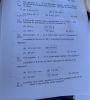 any problem(s) between 13 and
17
LES 3.00 x 13. The reaction. A + B is a first order reaction. At 760 K, 85% of a sample of A changes to B in 79.0 min. Calculate the value of the rate constant. (A) 6.10 x 10* s (B) 1.73 x 10-51 (D) 3.43 x 10' 51 (E) 4.00 x 10⁻² C) 4.03 x 10251 14. A first-order reaction has a rate constant of 3.0 x 10''. The time required for...
any problem(s) between 13 and
17
LES 3.00 x 13. The reaction. A + B is a first order reaction. At 760 K, 85% of a sample of A changes to B in 79.0 min. Calculate the value of the rate constant. (A) 6.10 x 10* s (B) 1.73 x 10-51 (D) 3.43 x 10' 51 (E) 4.00 x 10⁻² C) 4.03 x 10251 14. A first-order reaction has a rate constant of 3.0 x 10''. The time required for...
 A chemical reaction that is first order in X is observed to have a rate constant of 2.3 x 10⁻²⁵-1. If the initial concentration of X is 1.0 M, what is the concentration of X after 210 s? 0.52M 130 M 0.17M 0.0080 M 0.99 M
 2. A first-order chemical reaction is observed to have a particular reaction rate at 20°C. If its activation energy is 27.5 kJ/mol, how much of an increase in temperature in °C) would be necessary in order to triple the reaction rate.
 3(12) The first-order reaction, 2N2O(g) + 2N2(g) + O2(g), has a rate constant of 0.76 s at 1000K. (a) Calculate the half-life of this reaction at 1000K. (b) How long will it take for the concentration of N20 to fall to 25% of its initial value at 1000K (c) How long will it take for reaction to be 90% complete? (d) If the half-life of the same reaction is 29 min at 800K, what is the rate constant at 800K?...
 The rate constant for the first-order decomposition of a compound A in the reaction 2A rightarrow P is k = 3.6 times 10^-7 s^-1 at 25 degree C. What is the half-life of A? What will be the pressure, initially 33 kPa, at 50s, 20 min after initiation of the reaction?
 any problem(s) between 13 and
17
LES 3.00 x 13. The reaction. A + B is a first order reaction. At 760 K, 85% of a sample of A changes to B in 79.0 min. Calculate the value of the rate constant. (A) 6.10 x 10* s (B) 1.73 x 10-51 (D) 3.43 x 10' 51 (E) 4.00 x 10⁻² C) 4.03 x 10251 14. A first-order reaction has a rate constant of 3.0 x 10''. The time required for...
any problem(s) between 13 and
17
LES 3.00 x 13. The reaction. A + B is a first order reaction. At 760 K, 85% of a sample of A changes to B in 79.0 min. Calculate the value of the rate constant. (A) 6.10 x 10* s (B) 1.73 x 10-51 (D) 3.43 x 10' 51 (E) 4.00 x 10⁻² C) 4.03 x 10251 14. A first-order reaction has a rate constant of 3.0 x 10''. The time required for...
Most questions answered within 3 hours.
-
Where is the error in this code sequence?
String s1 = "Hello";
String s2 = "ello";...
asked 10 months ago -
Financial data for Joel de Paris, Inc., for last year
follow:
Joel de Paris, Inc.
Balance...
asked 10 months ago -
Consider this reaction:
Al2(SO4)3 (aq)+ BaCl3
(aq) Al2Cl6 (aq)- +
3BaSO4(s) . What is the...
asked 10 months ago -
Suppose that Savneet is considering increasing her
recent random sample from 20 car rentals to 40...
asked 10 months ago -
Trucks arrive at an unloading terminal at an average rate of 120
per hour.
Trucks arrive...
asked 10 months ago -
Why are methanol and ethanol completely soluble in water while
octanol is not very little soluble....
asked 10 months ago -
A facilities manager at a university reads in a research report
that the mean amount of...
asked 10 months ago -
When the CuSO4 is rehydrated by adding water to the anhydrous
compound, is this an endothermic...
asked 10 months ago -
A ray of sunlight is passing from diamond into crown glass; the
angle of incidence is...
asked 10 months ago -
A block of mass 0.249 kg is placed on top of a light, vertical
spring of...
asked 10 months ago -
how do the kidneys compensate in the presences of acidosis
a) trigger hyperventilate
b) reserve acid...
asked 10 months ago -
Question 501 pts
The rental rate of capital to the firm increases. Which of the
following...
asked 10 months ago