QUESTION: Show= (y − y0* )(y −
y1*) . .(y − yn* ) = 5

it is Part 1 at the bottom

Homework Answers


Problem 1: Recall that the Chebyshev nodes 20, 21, ...,.are determined on the interval (-1,1) as...
 Problem 1: Recall that the Chebyshev nodes 20, 21, ...,.are determined on the interval (-1,1) as the zeros of Tn+1(x) cos((n + 1) arccos(x)) and are given by 2; +17 Tj = COS , j = 0,1,...n. n+1 2 Consider now interpolating the function f(x) = 1/(1 + x2) on the interval (-5,5). We have seen in lecture that if equispaced nodes are used, the error grows unbound- edly as more points are used. The purpose of this problem is...
Part I: Show that (y − y ∗ 0 )(y − y ∗ 1 ). ....
 Part I: Show that (y − y ∗ 0 )(y − y ∗ 1 ). . .(y − y ∗ n ) = 5
n+1 2 n Tn+1(x), where x = y/5
Part II: It can be shown that there exists R > 0 such that |f
(n) (y)| ≤ Rn for all y ∈ [−5, 5]. Assuming this, show that limn→∞
max{|f(y) − Pn(y)|, y ∈ [−5, 5]} = 0
Ij = COS Problem 1: Recall that the Chebyshev...
Part I: Show that (y − y ∗ 0 )(y − y ∗ 1 ). . .(y − y ∗ n ) = 5
n+1 2 n Tn+1(x), where x = y/5
Part II: It can be shown that there exists R > 0 such that |f
(n) (y)| ≤ Rn for all y ∈ [−5, 5]. Assuming this, show that limn→∞
max{|f(y) − Pn(y)|, y ∈ [−5, 5]} = 0
Ij = COS Problem 1: Recall that the Chebyshev...
class: numerical analysis I wish if it was written in block letter Sorry I can't read...
 class: numerical analysis
I wish if it was written in block letter
Sorry I can't read cursive
= COS Problem 1: Recall that the Chebyshev nodes x4, x1,...,xy are determined on the interval (-1,1] as the zeros of Tn+1(x) = cos((n + 1) arccos(x)) and are given by 2j +10 Xj j = 0,1, ... 1 n+1 2 Consider now interpolating the function f(x) = 1/(1 + x2) on the interval (-5,5). We have seen in lecture that if equispaced...
class: numerical analysis
I wish if it was written in block letter
Sorry I can't read cursive
= COS Problem 1: Recall that the Chebyshev nodes x4, x1,...,xy are determined on the interval (-1,1] as the zeros of Tn+1(x) = cos((n + 1) arccos(x)) and are given by 2j +10 Xj j = 0,1, ... 1 n+1 2 Consider now interpolating the function f(x) = 1/(1 + x2) on the interval (-5,5). We have seen in lecture that if equispaced...
numerical methods 2+17), j = 0,1...... Problem 1: Recall that the Chebyshev nodes x0, 71,..., are...
 numerical methods
2+17), j = 0,1...... Problem 1: Recall that the Chebyshev nodes x0, 71,..., are determined on the interval (-1,1) as the zeros of Tn+1(x) = cos((n +1) arccos(x)) and are given by 2j +17 X; = cos in +12 Consider now interpolating the function f(x) = 1/(1+22) on the interval (-5,5). We have seen in lecture that if equispaced nodes are used, the error grows unbound- edly as more points are used. The purpose of this problem is...
numerical methods
2+17), j = 0,1...... Problem 1: Recall that the Chebyshev nodes x0, 71,..., are determined on the interval (-1,1) as the zeros of Tn+1(x) = cos((n +1) arccos(x)) and are given by 2j +17 X; = cos in +12 Consider now interpolating the function f(x) = 1/(1+22) on the interval (-5,5). We have seen in lecture that if equispaced nodes are used, the error grows unbound- edly as more points are used. The purpose of this problem is...
2. The polynomial p of degree n that interpolates a given function f at n+1 prescribed nodes is u...
 Please answer problem 4, thank you.
2. The polynomial p of degree n that interpolates a given function f at n+1 prescribed nodes is uniquely defined. Hence, there is a mapping f -> p. Denote this mapping by L and show that rl Show that L is linear; that is, 3. Prove that the algorithm for computing the coefficients ci in the Newton form of the interpolating polynomial involves n long operations (multiplications and divisions 4. Refer to Problem 2,...
Please answer problem 4, thank you.
2. The polynomial p of degree n that interpolates a given function f at n+1 prescribed nodes is uniquely defined. Hence, there is a mapping f -> p. Denote this mapping by L and show that rl Show that L is linear; that is, 3. Prove that the algorithm for computing the coefficients ci in the Newton form of the interpolating polynomial involves n long operations (multiplications and divisions 4. Refer to Problem 2,...
4. The fixed point iteration X (5) converges in some interval [a.b]. Find reasonable values for...
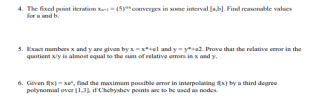 4. The fixed point iteration X (5) converges in some interval [a.b]. Find reasonable values for a and b. 5. Exact numbers x and y are given by x = x*+el and y = y*+e2. Prove that the relative error in the quotient x/y is almost equal to the sum of relative errors in x and y 6. Given f(x) xe, find the maximum possible error in interpolating f(x) by a third degree polynomial over 113]. if Chebyshev points are...
Matlab Matlab Matlab Matlab, Please solve this problem Problem 4 : Runge's phenomenon For this proble,...
 Matlab Matlab Matlab Matlab, Please solve this problem
Problem 4 : Runge's phenomenon For this proble, you wil interpolate the function h(x) = tanh(10x) in I [a, b, through n datapoints (xi, hx with equidistant nodes for several values of n, and observe the behavior of the interpolating polynomial as n increases. You should use the pair of functions polyfit and polyval In your prob40: (a) Interpolate the function tanh(10x) in [-1,1] using a uniform grid of n nodes, where...
Matlab Matlab Matlab Matlab, Please solve this problem
Problem 4 : Runge's phenomenon For this proble, you wil interpolate the function h(x) = tanh(10x) in I [a, b, through n datapoints (xi, hx with equidistant nodes for several values of n, and observe the behavior of the interpolating polynomial as n increases. You should use the pair of functions polyfit and polyval In your prob40: (a) Interpolate the function tanh(10x) in [-1,1] using a uniform grid of n nodes, where...
Suppose that Y1 , Y2 ,..., Yn denote a random sample of size n from a...
 Suppose
that Y1 , Y2 ,..., Yn denote a random sample of size n from a
normal population with mean μ and variance 2 .
Problem # 2: Suppose that Y , Y,,...,Y, denote a random sample of size n from a normal population with mean u and variance o . Then it can be shown that (n-1)S2 p_has a chi-square distribution with (n-1) degrees of freedom. o2 a. Show that S2 is an unbiased estimator of o. b....
Suppose
that Y1 , Y2 ,..., Yn denote a random sample of size n from a
normal population with mean μ and variance 2 .
Problem # 2: Suppose that Y , Y,,...,Y, denote a random sample of size n from a normal population with mean u and variance o . Then it can be shown that (n-1)S2 p_has a chi-square distribution with (n-1) degrees of freedom. o2 a. Show that S2 is an unbiased estimator of o. b....
Problem 5 Let Y1 denote the minimum of a random sample of size n from a...
 Problem 5 Let Y1 denote the minimum of a random sample of size n from a distribution that has pdf f(x) e(,0x< o0, zero elsewhere X- n (Y1 0), find the cumulative distribution function (cdf) for Zn = n (Y1 - 0), and Let Zn find the limiting cdf of Zn as n >oo.
5. Consider a random sample Y1, . . . , Yn from a distribution with pdf f(y|θ) = 1 θ 2 xe−x/θ , 0 < x < ∞. Calcula...
5. Consider a random sample Y1, . . . , Yn from a distribution with pdf f(y|θ) = 1 θ 2 xe−x/θ , 0 < x < ∞. Calculate the ML estimator of θ. 6. Consider the pdf g(y|α) = c(1 + αy2 ), −1 < y < 1. (a) Show that g(y|α) is a pdf when c = 3 6 + 2α . (b) Calculate E(Y ) and E(Y 2 ). Referencing your calculations, explain why M1 can’t be...
 Problem 1: Recall that the Chebyshev nodes 20, 21, ...,.are determined on the interval (-1,1) as the zeros of Tn+1(x) cos((n + 1) arccos(x)) and are given by 2; +17 Tj = COS , j = 0,1,...n. n+1 2 Consider now interpolating the function f(x) = 1/(1 + x2) on the interval (-5,5). We have seen in lecture that if equispaced nodes are used, the error grows unbound- edly as more points are used. The purpose of this problem is...
 Part I: Show that (y − y ∗ 0 )(y − y ∗ 1 ). . .(y − y ∗ n ) = 5
n+1 2 n Tn+1(x), where x = y/5
Part II: It can be shown that there exists R > 0 such that |f
(n) (y)| ≤ Rn for all y ∈ [−5, 5]. Assuming this, show that limn→∞
max{|f(y) − Pn(y)|, y ∈ [−5, 5]} = 0
Ij = COS Problem 1: Recall that the Chebyshev...
Part I: Show that (y − y ∗ 0 )(y − y ∗ 1 ). . .(y − y ∗ n ) = 5
n+1 2 n Tn+1(x), where x = y/5
Part II: It can be shown that there exists R > 0 such that |f
(n) (y)| ≤ Rn for all y ∈ [−5, 5]. Assuming this, show that limn→∞
max{|f(y) − Pn(y)|, y ∈ [−5, 5]} = 0
Ij = COS Problem 1: Recall that the Chebyshev...
 class: numerical analysis
I wish if it was written in block letter
Sorry I can't read cursive
= COS Problem 1: Recall that the Chebyshev nodes x4, x1,...,xy are determined on the interval (-1,1] as the zeros of Tn+1(x) = cos((n + 1) arccos(x)) and are given by 2j +10 Xj j = 0,1, ... 1 n+1 2 Consider now interpolating the function f(x) = 1/(1 + x2) on the interval (-5,5). We have seen in lecture that if equispaced...
class: numerical analysis
I wish if it was written in block letter
Sorry I can't read cursive
= COS Problem 1: Recall that the Chebyshev nodes x4, x1,...,xy are determined on the interval (-1,1] as the zeros of Tn+1(x) = cos((n + 1) arccos(x)) and are given by 2j +10 Xj j = 0,1, ... 1 n+1 2 Consider now interpolating the function f(x) = 1/(1 + x2) on the interval (-5,5). We have seen in lecture that if equispaced...
 numerical methods
2+17), j = 0,1...... Problem 1: Recall that the Chebyshev nodes x0, 71,..., are determined on the interval (-1,1) as the zeros of Tn+1(x) = cos((n +1) arccos(x)) and are given by 2j +17 X; = cos in +12 Consider now interpolating the function f(x) = 1/(1+22) on the interval (-5,5). We have seen in lecture that if equispaced nodes are used, the error grows unbound- edly as more points are used. The purpose of this problem is...
numerical methods
2+17), j = 0,1...... Problem 1: Recall that the Chebyshev nodes x0, 71,..., are determined on the interval (-1,1) as the zeros of Tn+1(x) = cos((n +1) arccos(x)) and are given by 2j +17 X; = cos in +12 Consider now interpolating the function f(x) = 1/(1+22) on the interval (-5,5). We have seen in lecture that if equispaced nodes are used, the error grows unbound- edly as more points are used. The purpose of this problem is...
 Please answer problem 4, thank you.
2. The polynomial p of degree n that interpolates a given function f at n+1 prescribed nodes is uniquely defined. Hence, there is a mapping f -> p. Denote this mapping by L and show that rl Show that L is linear; that is, 3. Prove that the algorithm for computing the coefficients ci in the Newton form of the interpolating polynomial involves n long operations (multiplications and divisions 4. Refer to Problem 2,...
Please answer problem 4, thank you.
2. The polynomial p of degree n that interpolates a given function f at n+1 prescribed nodes is uniquely defined. Hence, there is a mapping f -> p. Denote this mapping by L and show that rl Show that L is linear; that is, 3. Prove that the algorithm for computing the coefficients ci in the Newton form of the interpolating polynomial involves n long operations (multiplications and divisions 4. Refer to Problem 2,...
 4. The fixed point iteration X (5) converges in some interval [a.b]. Find reasonable values for a and b. 5. Exact numbers x and y are given by x = x*+el and y = y*+e2. Prove that the relative error in the quotient x/y is almost equal to the sum of relative errors in x and y 6. Given f(x) xe, find the maximum possible error in interpolating f(x) by a third degree polynomial over 113]. if Chebyshev points are...
 Matlab Matlab Matlab Matlab, Please solve this problem
Problem 4 : Runge's phenomenon For this proble, you wil interpolate the function h(x) = tanh(10x) in I [a, b, through n datapoints (xi, hx with equidistant nodes for several values of n, and observe the behavior of the interpolating polynomial as n increases. You should use the pair of functions polyfit and polyval In your prob40: (a) Interpolate the function tanh(10x) in [-1,1] using a uniform grid of n nodes, where...
Matlab Matlab Matlab Matlab, Please solve this problem
Problem 4 : Runge's phenomenon For this proble, you wil interpolate the function h(x) = tanh(10x) in I [a, b, through n datapoints (xi, hx with equidistant nodes for several values of n, and observe the behavior of the interpolating polynomial as n increases. You should use the pair of functions polyfit and polyval In your prob40: (a) Interpolate the function tanh(10x) in [-1,1] using a uniform grid of n nodes, where...
 Suppose
that Y1 , Y2 ,..., Yn denote a random sample of size n from a
normal population with mean μ and variance 2 .
Problem # 2: Suppose that Y , Y,,...,Y, denote a random sample of size n from a normal population with mean u and variance o . Then it can be shown that (n-1)S2 p_has a chi-square distribution with (n-1) degrees of freedom. o2 a. Show that S2 is an unbiased estimator of o. b....
Suppose
that Y1 , Y2 ,..., Yn denote a random sample of size n from a
normal population with mean μ and variance 2 .
Problem # 2: Suppose that Y , Y,,...,Y, denote a random sample of size n from a normal population with mean u and variance o . Then it can be shown that (n-1)S2 p_has a chi-square distribution with (n-1) degrees of freedom. o2 a. Show that S2 is an unbiased estimator of o. b....
 Problem 5 Let Y1 denote the minimum of a random sample of size n from a distribution that has pdf f(x) e(,0x< o0, zero elsewhere X- n (Y1 0), find the cumulative distribution function (cdf) for Zn = n (Y1 - 0), and Let Zn find the limiting cdf of Zn as n >oo.
Most questions answered within 3 hours.
-
Where is the error in this code sequence?
String s1 = "Hello";
String s2 = "ello";...
asked 10 months ago -
Financial data for Joel de Paris, Inc., for last year
follow:
Joel de Paris, Inc.
Balance...
asked 10 months ago -
Consider this reaction:
Al2(SO4)3 (aq)+ BaCl3
(aq) Al2Cl6 (aq)- +
3BaSO4(s) . What is the...
asked 10 months ago -
Suppose that Savneet is considering increasing her
recent random sample from 20 car rentals to 40...
asked 10 months ago -
Trucks arrive at an unloading terminal at an average rate of 120
per hour.
Trucks arrive...
asked 10 months ago -
Why are methanol and ethanol completely soluble in water while
octanol is not very little soluble....
asked 10 months ago -
A facilities manager at a university reads in a research report
that the mean amount of...
asked 10 months ago -
When the CuSO4 is rehydrated by adding water to the anhydrous
compound, is this an endothermic...
asked 10 months ago -
A ray of sunlight is passing from diamond into crown glass; the
angle of incidence is...
asked 10 months ago -
A block of mass 0.249 kg is placed on top of a light, vertical
spring of...
asked 10 months ago -
how do the kidneys compensate in the presences of acidosis
a) trigger hyperventilate
b) reserve acid...
asked 10 months ago -
Question 501 pts
The rental rate of capital to the firm increases. Which of the
following...
asked 10 months ago