
Homework Answers
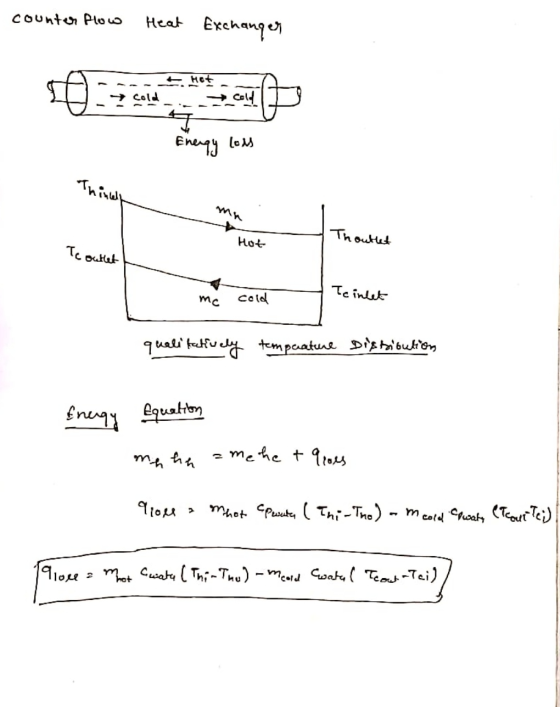
Add Answer to:
1. In a counterflow heat exchanger, the heat loss to the environment is to be included...
please help for thermal design subject 1. In a counterflow heat exchanger, the heat loss to...
 please help for thermal design subject
1. In a counterflow heat exchanger, the heat loss to the environment is to be included in the mathematical model. Considering the case of the hot fluid on the outside and the colder fluid on the inside, as shown in Figure below, sketch qualitatively the change that the inclusion of this consideration will have on the temperature distribution in the heat exchanger. Also, give the energy equation taking this loss into account. Hot Cold...
please help for thermal design subject
1. In a counterflow heat exchanger, the heat loss to the environment is to be included in the mathematical model. Considering the case of the hot fluid on the outside and the colder fluid on the inside, as shown in Figure below, sketch qualitatively the change that the inclusion of this consideration will have on the temperature distribution in the heat exchanger. Also, give the energy equation taking this loss into account. Hot Cold...
3.16. In a counterflow heat exchanger, the heat loss to the environment is to be included...
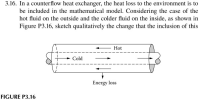 3.16. In a counterflow heat exchanger, the heat loss to the environment is to be included in the mathematical model. Considering the case of the hot fluid on the outside and the colder fluid on the inside, as shown in Figure P3.16, sketch qualitatively the change that the inclusion of this Hot Cold Energy loss FIGURE P3.16
1. In a counterflow heat exchanger, the heat loss to the environment is to be included...
 1. In a counterflow heat exchanger, the heat loss to the environment is to be included in the mathematical model. Considering the case of the hot fluid on the outside and the colder fluid on the inside, as shown in Figure below, sketch qualitatively the change that the inclusion of this consideration will have on the temperature distribution in the heat exchanger. Also, give the energy equation taking this loss into account. Hot Cold Energy loss 2. Experiments are carried...
1. In a counterflow heat exchanger, the heat loss to the environment is to be included...
 1. In a counterflow heat exchanger, the heat loss to the environment is to be included in the mathematical model. Considering the case of the hot fluid on the outside and the colder fluid on the inside, as shown in Figure below, sketch qualitatively the change that the inclusion of this consideration will have on the temperature distribution in the heat exchanger. Also, give the energy equation taking this loss into account. Hot Cold Energy loss 2. Experiments are carried...
Problem X3-5, Heat Transfer, Spring 2018 A single-pass, double-tube counterflow heat exchanger will be used to...
 Problem X3-5, Heat Transfer, Spring 2018 A single-pass, double-tube counterflow heat exchanger will be used to heat a 0.14 kg/s stream of water nowing in the 12-mm diameter inside tube. The water in the inside tube enters the heat exchanger at 25 C. The water will be heated with a 0.12 kg/s m of hot water flowing in the annulus between the inside and outside tube that enters the heat exchanger at 80°C. UP the hot and cold streams, and...
Determine the effectiveness of the concentric tube heat exchanger. The working fluid through the heat exchanger...
 Determine the effectiveness of the concentric tube heat exchanger. The working fluid through the heat exchanger is water and is flowing at 1 m/min for both cold and hot pipes. The hot water temperature at the tube inlet is 90°C and the temperature at the tube outlet is 60°C. The cold water temperature at the tube inlet is 50°C and the temperature at the tube outlet is 80°C. Assume the density and the specific heat of water are 988.1 kg/m3...
this problem in heat exchanger, please solve. . In a parallel flow heat exchanger, hot liquid...
 this problem in heat exchanger, please solve.
. In a parallel flow heat exchanger, hot liquid enters at 400°C and leaves at 250°C. Cold fluid enters at 50°C and leaves at 110°C. The inside and outside heat transfer coefficients are 120W/m2 K and 190 W/m2 K respectively. The inside and outside diameters of tube are 0.06 m and 0.08 m respectively. If the heat transferred per hour is 1.6x 10⁵ kJ. Determine the length of tube required. Ans:12.5 m
this problem in heat exchanger, please solve.
. In a parallel flow heat exchanger, hot liquid enters at 400°C and leaves at 250°C. Cold fluid enters at 50°C and leaves at 110°C. The inside and outside heat transfer coefficients are 120W/m2 K and 190 W/m2 K respectively. The inside and outside diameters of tube are 0.06 m and 0.08 m respectively. If the heat transferred per hour is 1.6x 10⁵ kJ. Determine the length of tube required. Ans:12.5 m
Steam enters a counterflow heat exchanger operating at steady state at 0.07 MPa with a quality...
Steam enters a counterflow heat exchanger operating at steady state at 0.07 MPa with a quality of 0.9 and exits at the same pressure as saturated liquid. The steam mass flow rate is 1.3 kg/min. A separate stream of air with a mass flow rate of 100 kg/min enters at 30oC and exits at 60oC. The ideal gas model with cp = 1.005 kJ/kg·K can be assumed for air. Kinetic and potential energy effects are negligible. Determine the temperature of...
Hot and cold water streams exchange heat in a double pipe heat exchanger in counter current...
 Hot and cold water streams exchange heat in a double pipe heat exchanger in counter current flow. The pipes are 3 ft long. The inside pipe is a 5/8 inch BWG 12 copper tube. The outside pipe is a 1 inch Sch 40 steel pipe. The outside pipe is insulated to minimize heat loss to the surroundings. The hot water enters the inside tube at 180F with a flow rate such that Re = 10000 The cold water flows through...
A heat exchanger is being investigated as a waste heat recovery device. A heat exchanger is commo...
A heat exchanger is being investigated as a waste heat recovery device. A heat exchanger is common device for using a hot fluid to heat a cold fluid without the fluids mixing. The cold fluid stream of liquid A enters at 294.2 K and leaves the device at a temperature of 330.91 K. Liquid A flows at a rate of 0.006 Kg/s and has a specific heat of 4180 J/(Kg K) and a specific volume of 0.00102 m3/Kg. Liquid B...
 please help for thermal design subject
1. In a counterflow heat exchanger, the heat loss to the environment is to be included in the mathematical model. Considering the case of the hot fluid on the outside and the colder fluid on the inside, as shown in Figure below, sketch qualitatively the change that the inclusion of this consideration will have on the temperature distribution in the heat exchanger. Also, give the energy equation taking this loss into account. Hot Cold...
please help for thermal design subject
1. In a counterflow heat exchanger, the heat loss to the environment is to be included in the mathematical model. Considering the case of the hot fluid on the outside and the colder fluid on the inside, as shown in Figure below, sketch qualitatively the change that the inclusion of this consideration will have on the temperature distribution in the heat exchanger. Also, give the energy equation taking this loss into account. Hot Cold...
 3.16. In a counterflow heat exchanger, the heat loss to the environment is to be included in the mathematical model. Considering the case of the hot fluid on the outside and the colder fluid on the inside, as shown in Figure P3.16, sketch qualitatively the change that the inclusion of this Hot Cold Energy loss FIGURE P3.16
 1. In a counterflow heat exchanger, the heat loss to the environment is to be included in the mathematical model. Considering the case of the hot fluid on the outside and the colder fluid on the inside, as shown in Figure below, sketch qualitatively the change that the inclusion of this consideration will have on the temperature distribution in the heat exchanger. Also, give the energy equation taking this loss into account. Hot Cold Energy loss 2. Experiments are carried...
 1. In a counterflow heat exchanger, the heat loss to the environment is to be included in the mathematical model. Considering the case of the hot fluid on the outside and the colder fluid on the inside, as shown in Figure below, sketch qualitatively the change that the inclusion of this consideration will have on the temperature distribution in the heat exchanger. Also, give the energy equation taking this loss into account. Hot Cold Energy loss 2. Experiments are carried...
 Problem X3-5, Heat Transfer, Spring 2018 A single-pass, double-tube counterflow heat exchanger will be used to heat a 0.14 kg/s stream of water nowing in the 12-mm diameter inside tube. The water in the inside tube enters the heat exchanger at 25 C. The water will be heated with a 0.12 kg/s m of hot water flowing in the annulus between the inside and outside tube that enters the heat exchanger at 80°C. UP the hot and cold streams, and...
 Determine the effectiveness of the concentric tube heat exchanger. The working fluid through the heat exchanger is water and is flowing at 1 m/min for both cold and hot pipes. The hot water temperature at the tube inlet is 90°C and the temperature at the tube outlet is 60°C. The cold water temperature at the tube inlet is 50°C and the temperature at the tube outlet is 80°C. Assume the density and the specific heat of water are 988.1 kg/m3...
 this problem in heat exchanger, please solve.
. In a parallel flow heat exchanger, hot liquid enters at 400°C and leaves at 250°C. Cold fluid enters at 50°C and leaves at 110°C. The inside and outside heat transfer coefficients are 120W/m2 K and 190 W/m2 K respectively. The inside and outside diameters of tube are 0.06 m and 0.08 m respectively. If the heat transferred per hour is 1.6x 10⁵ kJ. Determine the length of tube required. Ans:12.5 m
this problem in heat exchanger, please solve.
. In a parallel flow heat exchanger, hot liquid enters at 400°C and leaves at 250°C. Cold fluid enters at 50°C and leaves at 110°C. The inside and outside heat transfer coefficients are 120W/m2 K and 190 W/m2 K respectively. The inside and outside diameters of tube are 0.06 m and 0.08 m respectively. If the heat transferred per hour is 1.6x 10⁵ kJ. Determine the length of tube required. Ans:12.5 m
 Hot and cold water streams exchange heat in a double pipe heat exchanger in counter current flow. The pipes are 3 ft long. The inside pipe is a 5/8 inch BWG 12 copper tube. The outside pipe is a 1 inch Sch 40 steel pipe. The outside pipe is insulated to minimize heat loss to the surroundings. The hot water enters the inside tube at 180F with a flow rate such that Re = 10000 The cold water flows through...
Most questions answered within 3 hours.
-
Where is the error in this code sequence?
String s1 = "Hello";
String s2 = "ello";...
asked 11 months ago -
Financial data for Joel de Paris, Inc., for last year
follow:
Joel de Paris, Inc.
Balance...
asked 11 months ago -
Consider this reaction:
Al2(SO4)3 (aq)+ BaCl3
(aq) Al2Cl6 (aq)- +
3BaSO4(s) . What is the...
asked 11 months ago -
Suppose that Savneet is considering increasing her
recent random sample from 20 car rentals to 40...
asked 11 months ago -
Trucks arrive at an unloading terminal at an average rate of 120
per hour.
Trucks arrive...
asked 11 months ago -
Why are methanol and ethanol completely soluble in water while
octanol is not very little soluble....
asked 11 months ago -
A facilities manager at a university reads in a research report
that the mean amount of...
asked 11 months ago -
When the CuSO4 is rehydrated by adding water to the anhydrous
compound, is this an endothermic...
asked 11 months ago -
A ray of sunlight is passing from diamond into crown glass; the
angle of incidence is...
asked 11 months ago -
A block of mass 0.249 kg is placed on top of a light, vertical
spring of...
asked 11 months ago -
how do the kidneys compensate in the presences of acidosis
a) trigger hyperventilate
b) reserve acid...
asked 11 months ago -
Question 501 pts
The rental rate of capital to the firm increases. Which of the
following...
asked 11 months ago