please help for thermal design subject
Homework Answers
Add Answer to:
please help for thermal design subject
1. In a counterflow heat exchanger, the heat loss to...
1. In a counterflow heat exchanger, the heat loss to the environment is to be included...
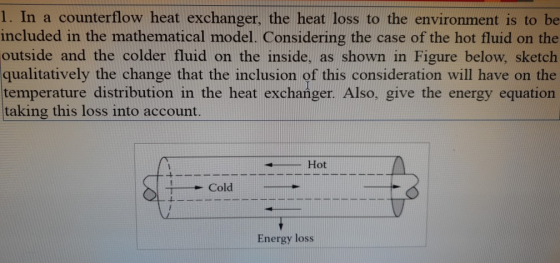
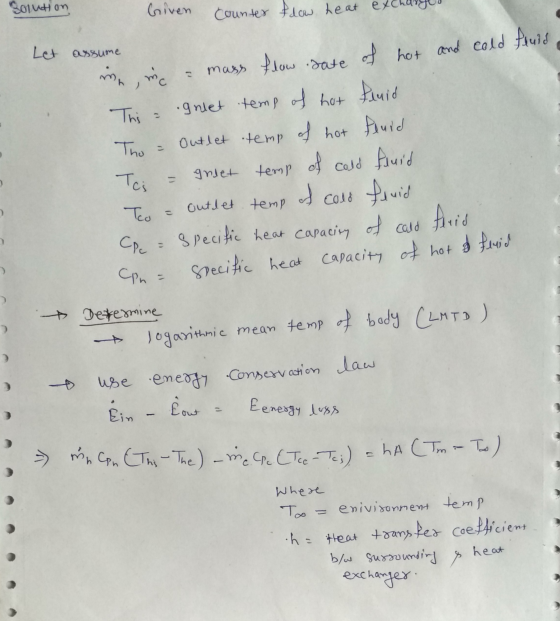
 1. In a counterflow heat exchanger, the heat loss to the environment is to be included in the mathematical model. Considering the case of the hot fluid on the outside and the colder fluid on the inside, as shown in Figure below, sketch qualitatively the change that the inclusion of this consideration will have on the temperature distribution in the heat exchanger. Also, give the energy equation taking this loss into account. Hot Cold Energy loss
3.16. In a counterflow heat exchanger, the heat loss to the environment is to be included...
 3.16. In a counterflow heat exchanger, the heat loss to the environment is to be included in the mathematical model. Considering the case of the hot fluid on the outside and the colder fluid on the inside, as shown in Figure P3.16, sketch qualitatively the change that the inclusion of this Hot Cold Energy loss FIGURE P3.16
1. In a counterflow heat exchanger, the heat loss to the environment is to be included...
 1. In a counterflow heat exchanger, the heat loss to the environment is to be included in the mathematical model. Considering the case of the hot fluid on the outside and the colder fluid on the inside, as shown in Figure below, sketch qualitatively the change that the inclusion of this consideration will have on the temperature distribution in the heat exchanger. Also, give the energy equation taking this loss into account. Hot Cold Energy loss 2. Experiments are carried...
1. In a counterflow heat exchanger, the heat loss to the environment is to be included...
 1. In a counterflow heat exchanger, the heat loss to the environment is to be included in the mathematical model. Considering the case of the hot fluid on the outside and the colder fluid on the inside, as shown in Figure below, sketch qualitatively the change that the inclusion of this consideration will have on the temperature distribution in the heat exchanger. Also, give the energy equation taking this loss into account. Hot Cold Energy loss 2. Experiments are carried...
Problem X3-5, Heat Transfer, Spring 2018 A single-pass, double-tube counterflow heat exchanger will be used to...
 Problem X3-5, Heat Transfer, Spring 2018 A single-pass, double-tube counterflow heat exchanger will be used to heat a 0.14 kg/s stream of water nowing in the 12-mm diameter inside tube. The water in the inside tube enters the heat exchanger at 25 C. The water will be heated with a 0.12 kg/s m of hot water flowing in the annulus between the inside and outside tube that enters the heat exchanger at 80°C. UP the hot and cold streams, and...
this problem in heat exchanger, please solve. . In a parallel flow heat exchanger, hot liquid...
 this problem in heat exchanger, please solve.
. In a parallel flow heat exchanger, hot liquid enters at 400°C and leaves at 250°C. Cold fluid enters at 50°C and leaves at 110°C. The inside and outside heat transfer coefficients are 120W/m2 K and 190 W/m2 K respectively. The inside and outside diameters of tube are 0.06 m and 0.08 m respectively. If the heat transferred per hour is 1.6x 10⁵ kJ. Determine the length of tube required. Ans:12.5 m
this problem in heat exchanger, please solve.
. In a parallel flow heat exchanger, hot liquid enters at 400°C and leaves at 250°C. Cold fluid enters at 50°C and leaves at 110°C. The inside and outside heat transfer coefficients are 120W/m2 K and 190 W/m2 K respectively. The inside and outside diameters of tube are 0.06 m and 0.08 m respectively. If the heat transferred per hour is 1.6x 10⁵ kJ. Determine the length of tube required. Ans:12.5 m
[10] Design Problem As shown in the figure below, a double-pipe parallel-flow heat exchanger is used...
 [10] Design Problem As shown in the figure below, a double-pipe parallel-flow heat exchanger is used to heat cold fluid which is water (Cp = 4180 J/(kg.K), p = 1000 kg/m) from 20°C to 80°C at a rate of 0.15 kg/s. The heating is to be accomplished by hot fluid, which is geothermal water (Cp = 4310 J/(kg.K), p = 1050 kg/m²) available at 130°C at a mass flow rate of 0.25 kg/s. The inner tube has an inner diameter...
Problem 4: Consider the heat exchanger design illustrated. Hot air flows at speed of r0.6 m/s thr...
 Problem 4: Consider the heat exchanger design illustrated. Hot air flows at speed of r0.6 m/s through the center pipe. The center pipe has an outer diameter of D=7 cm and length 4-2 m Cold water flows at 20-25 cm3/s through a smaller helical pipe having an outer diameter d = 1 cm and wall thickness of mm. The helical pipe is wrapped around the center pipe to form a heat exchanger. The center pipe has a thermal conductivity of...
at Your objective in this problem is to design a "simple" annular flow heat exchanger (see...
 at Your objective in this problem is to design a "simple" annular flow heat exchanger (see the "simple" description the beginning of this HW). A heat exchanger of this kind can easily be built in your garage with two different size pper pipes along with some solder. Assume both fluids are water with the cold fluid flowing in the outer tube. The pipe diameters are based in Type L copper tube dimensions: outside diameter 1/2 -inch nominal tube is 0.625...
1 CPD4701 Assignment 2/2019 Question 2 shell and-tube heat exchanger was designed for the following service: Cold strea...
 1 CPD4701 Assignment 2/2019 Question 2 shell and-tube heat exchanger was designed for the following service: Cold stream Hot stream Crude Oil Fluid Cooling water Tube side Stream allocation Shell side Mass flow rate (kg/s) 110 30 Inlet temperature (C) 90 Outlet temperature (C) Heat capacity (J/kg K) Density (kg/m2) Viscosity (Pa-s) Thermal conductivity (W/m-K) Fouling factor (m2 CW) 40 50 2177 4187 787 995 0.72-10 1.89-103 0.122 0.59 0.0002 0.0004 The shell and tube heat exchanger has the following...
 1. In a counterflow heat exchanger, the heat loss to the environment is to be included in the mathematical model. Considering the case of the hot fluid on the outside and the colder fluid on the inside, as shown in Figure below, sketch qualitatively the change that the inclusion of this consideration will have on the temperature distribution in the heat exchanger. Also, give the energy equation taking this loss into account. Hot Cold Energy loss
 3.16. In a counterflow heat exchanger, the heat loss to the environment is to be included in the mathematical model. Considering the case of the hot fluid on the outside and the colder fluid on the inside, as shown in Figure P3.16, sketch qualitatively the change that the inclusion of this Hot Cold Energy loss FIGURE P3.16
 1. In a counterflow heat exchanger, the heat loss to the environment is to be included in the mathematical model. Considering the case of the hot fluid on the outside and the colder fluid on the inside, as shown in Figure below, sketch qualitatively the change that the inclusion of this consideration will have on the temperature distribution in the heat exchanger. Also, give the energy equation taking this loss into account. Hot Cold Energy loss 2. Experiments are carried...
 1. In a counterflow heat exchanger, the heat loss to the environment is to be included in the mathematical model. Considering the case of the hot fluid on the outside and the colder fluid on the inside, as shown in Figure below, sketch qualitatively the change that the inclusion of this consideration will have on the temperature distribution in the heat exchanger. Also, give the energy equation taking this loss into account. Hot Cold Energy loss 2. Experiments are carried...
 Problem X3-5, Heat Transfer, Spring 2018 A single-pass, double-tube counterflow heat exchanger will be used to heat a 0.14 kg/s stream of water nowing in the 12-mm diameter inside tube. The water in the inside tube enters the heat exchanger at 25 C. The water will be heated with a 0.12 kg/s m of hot water flowing in the annulus between the inside and outside tube that enters the heat exchanger at 80°C. UP the hot and cold streams, and...
 this problem in heat exchanger, please solve.
. In a parallel flow heat exchanger, hot liquid enters at 400°C and leaves at 250°C. Cold fluid enters at 50°C and leaves at 110°C. The inside and outside heat transfer coefficients are 120W/m2 K and 190 W/m2 K respectively. The inside and outside diameters of tube are 0.06 m and 0.08 m respectively. If the heat transferred per hour is 1.6x 10⁵ kJ. Determine the length of tube required. Ans:12.5 m
this problem in heat exchanger, please solve.
. In a parallel flow heat exchanger, hot liquid enters at 400°C and leaves at 250°C. Cold fluid enters at 50°C and leaves at 110°C. The inside and outside heat transfer coefficients are 120W/m2 K and 190 W/m2 K respectively. The inside and outside diameters of tube are 0.06 m and 0.08 m respectively. If the heat transferred per hour is 1.6x 10⁵ kJ. Determine the length of tube required. Ans:12.5 m
 [10] Design Problem As shown in the figure below, a double-pipe parallel-flow heat exchanger is used to heat cold fluid which is water (Cp = 4180 J/(kg.K), p = 1000 kg/m) from 20°C to 80°C at a rate of 0.15 kg/s. The heating is to be accomplished by hot fluid, which is geothermal water (Cp = 4310 J/(kg.K), p = 1050 kg/m²) available at 130°C at a mass flow rate of 0.25 kg/s. The inner tube has an inner diameter...
 Problem 4: Consider the heat exchanger design illustrated. Hot air flows at speed of r0.6 m/s through the center pipe. The center pipe has an outer diameter of D=7 cm and length 4-2 m Cold water flows at 20-25 cm3/s through a smaller helical pipe having an outer diameter d = 1 cm and wall thickness of mm. The helical pipe is wrapped around the center pipe to form a heat exchanger. The center pipe has a thermal conductivity of...
 at Your objective in this problem is to design a "simple" annular flow heat exchanger (see the "simple" description the beginning of this HW). A heat exchanger of this kind can easily be built in your garage with two different size pper pipes along with some solder. Assume both fluids are water with the cold fluid flowing in the outer tube. The pipe diameters are based in Type L copper tube dimensions: outside diameter 1/2 -inch nominal tube is 0.625...
 1 CPD4701 Assignment 2/2019 Question 2 shell and-tube heat exchanger was designed for the following service: Cold stream Hot stream Crude Oil Fluid Cooling water Tube side Stream allocation Shell side Mass flow rate (kg/s) 110 30 Inlet temperature (C) 90 Outlet temperature (C) Heat capacity (J/kg K) Density (kg/m2) Viscosity (Pa-s) Thermal conductivity (W/m-K) Fouling factor (m2 CW) 40 50 2177 4187 787 995 0.72-10 1.89-103 0.122 0.59 0.0002 0.0004 The shell and tube heat exchanger has the following...
Most questions answered within 3 hours.
-
Where is the error in this code sequence?
String s1 = "Hello";
String s2 = "ello";...
asked 10 months ago -
Financial data for Joel de Paris, Inc., for last year
follow:
Joel de Paris, Inc.
Balance...
asked 10 months ago -
Consider this reaction:
Al2(SO4)3 (aq)+ BaCl3
(aq) Al2Cl6 (aq)- +
3BaSO4(s) . What is the...
asked 10 months ago -
Suppose that Savneet is considering increasing her
recent random sample from 20 car rentals to 40...
asked 10 months ago -
Trucks arrive at an unloading terminal at an average rate of 120
per hour.
Trucks arrive...
asked 10 months ago -
Why are methanol and ethanol completely soluble in water while
octanol is not very little soluble....
asked 10 months ago -
A facilities manager at a university reads in a research report
that the mean amount of...
asked 10 months ago -
When the CuSO4 is rehydrated by adding water to the anhydrous
compound, is this an endothermic...
asked 10 months ago -
A ray of sunlight is passing from diamond into crown glass; the
angle of incidence is...
asked 10 months ago -
A block of mass 0.249 kg is placed on top of a light, vertical
spring of...
asked 10 months ago -
how do the kidneys compensate in the presences of acidosis
a) trigger hyperventilate
b) reserve acid...
asked 10 months ago -
Question 501 pts
The rental rate of capital to the firm increases. Which of the
following...
asked 10 months ago