


Homework Answers

Add Answer to:
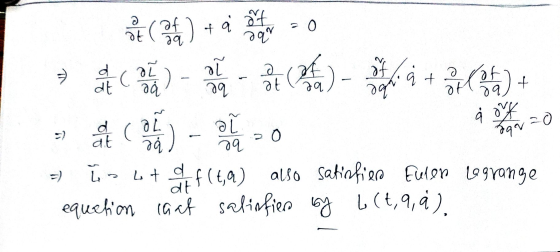
1. Show that the Lagrangians L(t,q, y) and Īct, 4, ) = L(1,4,0) + f/10, 9)...
2. Consider a mass m moving in R3 without friction. It is fasten tightly at one...
 2. Consider a mass m moving in R3 without friction. It is fasten tightly at one end of a string with length 1 and can swing in any direction. In fact, it moves on a sphere, a subspace of R3 1 0 φ g 2.1 Use the spherical coordinates (1,0,) to derive the Lagrangian L(0,0,0,0) = T-U, namely the difference of kinetic energy T and potential energy U. (Note r = 1 is fixed.) 2.2 Calculate the Euler-Lagrange equations, namely...
1. A particle of mass m moves in three dimensions, and has position r(t)-(x(t), y(t), z(t)) at ti...
 Mechanics. Need help with c) and d)
1. A particle of mass m moves in three dimensions, and has position r(t)-(x(t), y(t), z(t)) at time t. The particle has potential energy V(x, y, 2) so that its Lagrangian is given by where i d/dt, dy/dt, dz/dt (a) Writing q(q2.93)-(r, y, z) and denoting by p (p,P2, ps) their associated canonical momenta, show that the Hamiltonian is given by (show it from first principles rather than using the energy) H(q,p)H(g1, 92,9q3,...
Mechanics. Need help with c) and d)
1. A particle of mass m moves in three dimensions, and has position r(t)-(x(t), y(t), z(t)) at time t. The particle has potential energy V(x, y, 2) so that its Lagrangian is given by where i d/dt, dy/dt, dz/dt (a) Writing q(q2.93)-(r, y, z) and denoting by p (p,P2, ps) their associated canonical momenta, show that the Hamiltonian is given by (show it from first principles rather than using the energy) H(q,p)H(g1, 92,9q3,...
(3) Let f(t) := (sint)/t, with the understanding that f(0) = 1 (for reasons which should be obvio...
 (3) Let f(t) := (sint)/t, with the understanding that f(0) = 1 (for reasons which should be obvious from your study of limits in Calculus 1). (a) Show that ļf(t) 1 forall t. (Note that f is an even function, so you can assume t0. In fact, we will only be concerned with f (t) for t 20 in this problem.) The Laplace transform F(s) of f (t) is therefore defined for all s >0 (b) Show that -1/s <...
Problem 4: Evaluation of the convolution integral too y(t) = (f * h)(t) = f(t)h(t –...
 Problem 4: Evaluation of the convolution integral too y(t) = (f * h)(t) = f(t)h(t – 7)dt is greatly simplified when either the input f(t) or impulse response h(t) is the sum of weighted impulse functions. This fact will be used later in the semester when we study the operation of communication systems using Fourier analysis methods. a) Use the convolution integral to prove that f(t) *8(t – T) = f(t – T) and 8(t – T) *h(t) = h(t...
Elementary Laplace Transtorms Y(S) = {f} -L e-stf(t)dt fc = C-'{F(s)} F(s) = {f} f(t) =-'{F(s))...
 Elementary Laplace Transtorms Y(S) = {f} -L e-stf(t)dt fc = C-'{F(s)} F(s) = {f} f(t) =-'{F(s)) F(s) = {f} -CS 1. 1 1 12. uct) le S> 0 S> 0 . s S 2. eat 1 13. ucOf(t-c) e-csF(s) S> a S-a n! 3. t",n e Z 14. ectf(t) F( sc) S> 0 sh+1 4. tP, p>-1 (p+1) S> 0 SP+1 15. f(ct) F). c>0 16. SFt - 1)g(t)dt F(s)G(*) 5. sin at S> 0 16. cos at 17. 8(t...
Let f be a function of two variables x,y. Define r(t) Yobt y(t) Хо + at,...
 Let f be a function of two variables x,y. Define r(t) Yobt y(t) Хо + at, Let g(t) f(x(t), y(t)) (a) Explain what does (x(t), y(t)) represent in the plane (b) Explain how the graph of g can be viewed as a part of the graph of f. dg (c) Find dt \t=0 in terms of partial derivatives of f. What does this repre- sent? (d) What does your answer in part c become if a 0 or b=0? (e)...
Elementary Laplace Transtorms Y(S) = {f} -L e-stf(t)dt fc = C-'{F(s)} F(s) = {f} f(t) =-'{F(s))...
 Elementary Laplace Transtorms Y(S) = {f} -L e-stf(t)dt fc = C-'{F(s)} F(s) = {f} f(t) =-'{F(s)) F(s) = {f} -CS 1. 1 1 12. uct) le S> 0 S> 0 . s S 2. eat 1 13. ucOf(t-c) e-csF(s) S> a S-a n! 3. t",n e Z 14. ectf(t) F( sc) S> 0 sh+1 4. tP, p>-1 (p+1) S> 0 SP+1 15. f(ct) F). c>0 16. SFt - 1)g(t)dt F(s)G(*) 5. sin at S> 0 16. cos at 17. 8(t...
(e) /(z) = and γ is parametrized by r(t), 0 z + t 1, and satisfies Imr(t)> 0, r(0) -4 + i, and γ(...
 Problem 4.9
(e) /(z) = and γ is parametrized by r(t), 0 z + t 1, and satisfies Imr(t)> 0, r(0) -4 + i, and γ(1) 6 + 2i (f) f(s) sin(z) and γ is some piecewise smooth path from 1 to π. 4.2 and the fact that the length of γ does not change under 4.9. Prove Proposi reparametrization. (Hint: Assume γ, σ, and τ are smooth. Start with the definition off, f, apply the chain rule to σ...
Problem 4.9
(e) /(z) = and γ is parametrized by r(t), 0 z + t 1, and satisfies Imr(t)> 0, r(0) -4 + i, and γ(1) 6 + 2i (f) f(s) sin(z) and γ is some piecewise smooth path from 1 to π. 4.2 and the fact that the length of γ does not change under 4.9. Prove Proposi reparametrization. (Hint: Assume γ, σ, and τ are smooth. Start with the definition off, f, apply the chain rule to σ...
Problem 4 Given: St t(t) # -t e g(t) a) Compute fg () using convolution integral method. b) Compute g*f () with Laplace transform. o) What are the differences between the results of questions (a)...
 Problem 4 Given: St t(t) # -t e g(t) a) Compute fg () using convolution integral method. b) Compute g*f () with Laplace transform. o) What are the differences between the results of questions (a) and (0) above? d) Find the Laplace transform of the following function: (t 0 to +oo) e dt e) Find the equivalent solution of (d) using MATLAB method) (find 2 methods)
Problem 4 Given: St t(t) # -t e g(t) a) Compute fg () using...
Problem 4 Given: St t(t) # -t e g(t) a) Compute fg () using convolution integral method. b) Compute g*f () with Laplace transform. o) What are the differences between the results of questions (a) and (0) above? d) Find the Laplace transform of the following function: (t 0 to +oo) e dt e) Find the equivalent solution of (d) using MATLAB method) (find 2 methods)
Problem 4 Given: St t(t) # -t e g(t) a) Compute fg () using...
A continuous probability density fanction is a non-negati ve continuous function f with integral over its entire do...
 A continuous probability density fanction is a non-negati ve continuous function f with integral over its entire domain D Rn equal to unity. The domain D may have any number n of dimensions. Thus . . .lofdェ1 . . . drn-1, The mean, also called expectation, of a function q is denoted by尋or E(q) and defined by 1··· DG-f) d工1-.. drn. The same function fmay also represent a density of matter or a density of electrical charges Definition 1 The...
 2. Consider a mass m moving in R3 without friction. It is fasten tightly at one end of a string with length 1 and can swing in any direction. In fact, it moves on a sphere, a subspace of R3 1 0 φ g 2.1 Use the spherical coordinates (1,0,) to derive the Lagrangian L(0,0,0,0) = T-U, namely the difference of kinetic energy T and potential energy U. (Note r = 1 is fixed.) 2.2 Calculate the Euler-Lagrange equations, namely...
 Mechanics. Need help with c) and d)
1. A particle of mass m moves in three dimensions, and has position r(t)-(x(t), y(t), z(t)) at time t. The particle has potential energy V(x, y, 2) so that its Lagrangian is given by where i d/dt, dy/dt, dz/dt (a) Writing q(q2.93)-(r, y, z) and denoting by p (p,P2, ps) their associated canonical momenta, show that the Hamiltonian is given by (show it from first principles rather than using the energy) H(q,p)H(g1, 92,9q3,...
Mechanics. Need help with c) and d)
1. A particle of mass m moves in three dimensions, and has position r(t)-(x(t), y(t), z(t)) at time t. The particle has potential energy V(x, y, 2) so that its Lagrangian is given by where i d/dt, dy/dt, dz/dt (a) Writing q(q2.93)-(r, y, z) and denoting by p (p,P2, ps) their associated canonical momenta, show that the Hamiltonian is given by (show it from first principles rather than using the energy) H(q,p)H(g1, 92,9q3,...
 (3) Let f(t) := (sint)/t, with the understanding that f(0) = 1 (for reasons which should be obvious from your study of limits in Calculus 1). (a) Show that ļf(t) 1 forall t. (Note that f is an even function, so you can assume t0. In fact, we will only be concerned with f (t) for t 20 in this problem.) The Laplace transform F(s) of f (t) is therefore defined for all s >0 (b) Show that -1/s <...
 Problem 4: Evaluation of the convolution integral too y(t) = (f * h)(t) = f(t)h(t – 7)dt is greatly simplified when either the input f(t) or impulse response h(t) is the sum of weighted impulse functions. This fact will be used later in the semester when we study the operation of communication systems using Fourier analysis methods. a) Use the convolution integral to prove that f(t) *8(t – T) = f(t – T) and 8(t – T) *h(t) = h(t...
 Elementary Laplace Transtorms Y(S) = {f} -L e-stf(t)dt fc = C-'{F(s)} F(s) = {f} f(t) =-'{F(s)) F(s) = {f} -CS 1. 1 1 12. uct) le S> 0 S> 0 . s S 2. eat 1 13. ucOf(t-c) e-csF(s) S> a S-a n! 3. t",n e Z 14. ectf(t) F( sc) S> 0 sh+1 4. tP, p>-1 (p+1) S> 0 SP+1 15. f(ct) F). c>0 16. SFt - 1)g(t)dt F(s)G(*) 5. sin at S> 0 16. cos at 17. 8(t...
 Let f be a function of two variables x,y. Define r(t) Yobt y(t) Хо + at, Let g(t) f(x(t), y(t)) (a) Explain what does (x(t), y(t)) represent in the plane (b) Explain how the graph of g can be viewed as a part of the graph of f. dg (c) Find dt \t=0 in terms of partial derivatives of f. What does this repre- sent? (d) What does your answer in part c become if a 0 or b=0? (e)...
 Elementary Laplace Transtorms Y(S) = {f} -L e-stf(t)dt fc = C-'{F(s)} F(s) = {f} f(t) =-'{F(s)) F(s) = {f} -CS 1. 1 1 12. uct) le S> 0 S> 0 . s S 2. eat 1 13. ucOf(t-c) e-csF(s) S> a S-a n! 3. t",n e Z 14. ectf(t) F( sc) S> 0 sh+1 4. tP, p>-1 (p+1) S> 0 SP+1 15. f(ct) F). c>0 16. SFt - 1)g(t)dt F(s)G(*) 5. sin at S> 0 16. cos at 17. 8(t...
 Problem 4.9
(e) /(z) = and γ is parametrized by r(t), 0 z + t 1, and satisfies Imr(t)> 0, r(0) -4 + i, and γ(1) 6 + 2i (f) f(s) sin(z) and γ is some piecewise smooth path from 1 to π. 4.2 and the fact that the length of γ does not change under 4.9. Prove Proposi reparametrization. (Hint: Assume γ, σ, and τ are smooth. Start with the definition off, f, apply the chain rule to σ...
Problem 4.9
(e) /(z) = and γ is parametrized by r(t), 0 z + t 1, and satisfies Imr(t)> 0, r(0) -4 + i, and γ(1) 6 + 2i (f) f(s) sin(z) and γ is some piecewise smooth path from 1 to π. 4.2 and the fact that the length of γ does not change under 4.9. Prove Proposi reparametrization. (Hint: Assume γ, σ, and τ are smooth. Start with the definition off, f, apply the chain rule to σ...
 Problem 4 Given: St t(t) # -t e g(t) a) Compute fg () using convolution integral method. b) Compute g*f () with Laplace transform. o) What are the differences between the results of questions (a) and (0) above? d) Find the Laplace transform of the following function: (t 0 to +oo) e dt e) Find the equivalent solution of (d) using MATLAB method) (find 2 methods)
Problem 4 Given: St t(t) # -t e g(t) a) Compute fg () using...
Problem 4 Given: St t(t) # -t e g(t) a) Compute fg () using convolution integral method. b) Compute g*f () with Laplace transform. o) What are the differences between the results of questions (a) and (0) above? d) Find the Laplace transform of the following function: (t 0 to +oo) e dt e) Find the equivalent solution of (d) using MATLAB method) (find 2 methods)
Problem 4 Given: St t(t) # -t e g(t) a) Compute fg () using...
 A continuous probability density fanction is a non-negati ve continuous function f with integral over its entire domain D Rn equal to unity. The domain D may have any number n of dimensions. Thus . . .lofdェ1 . . . drn-1, The mean, also called expectation, of a function q is denoted by尋or E(q) and defined by 1··· DG-f) d工1-.. drn. The same function fmay also represent a density of matter or a density of electrical charges Definition 1 The...
Most questions answered within 3 hours.
-
Where is the error in this code sequence?
String s1 = "Hello";
String s2 = "ello";...
asked 11 months ago -
Financial data for Joel de Paris, Inc., for last year
follow:
Joel de Paris, Inc.
Balance...
asked 11 months ago -
Consider this reaction:
Al2(SO4)3 (aq)+ BaCl3
(aq) Al2Cl6 (aq)- +
3BaSO4(s) . What is the...
asked 11 months ago -
Suppose that Savneet is considering increasing her
recent random sample from 20 car rentals to 40...
asked 11 months ago -
Trucks arrive at an unloading terminal at an average rate of 120
per hour.
Trucks arrive...
asked 11 months ago -
Why are methanol and ethanol completely soluble in water while
octanol is not very little soluble....
asked 11 months ago -
A facilities manager at a university reads in a research report
that the mean amount of...
asked 11 months ago -
When the CuSO4 is rehydrated by adding water to the anhydrous
compound, is this an endothermic...
asked 11 months ago -
A ray of sunlight is passing from diamond into crown glass; the
angle of incidence is...
asked 11 months ago -
A block of mass 0.249 kg is placed on top of a light, vertical
spring of...
asked 11 months ago -
how do the kidneys compensate in the presences of acidosis
a) trigger hyperventilate
b) reserve acid...
asked 11 months ago -
Question 501 pts
The rental rate of capital to the firm increases. Which of the
following...
asked 11 months ago