

Homework Answers
![Sin Go (3- et sest) caret + salto) aun cons} 43 3 Sin (7+) - et sic (74) + sett sin (70)] L{ 3 sin (76)] 2 Lett sin(at)} + {](http://img.homeworklib.com/questions/4d1f3280-ebe9-11ea-959d-c590f6e76a02.png?x-oss-process=image/resize,w_560)
Add Answer to:
Page 3 Name (please print) III (10) When solving this problem show all the steps needed...
III. When solving this problem show all the steps needed to transform the expressions into ones...
 III. When solving this problem show all the steps needed to transform the expressions into ones that can be (10) found in the table and indicate the entry of the table used in each step. a) Find the Laplace transform F(s) of the function (5+234 +5e-2) cos(6t) b) Find the inverse Laplace transform f(t) of the function F(s) = 2 s2 + 2s + 5 f(t)=L-'{F(s) Table of Laplace Transforms F(s)=L{()} f(t)= L-'{F(s) F(s)=L{f(t)} 1. 2. et s-a 3. r",...
Page 2 II. (7) Use the Laplace transform to solve the IVP y" - 5y' +...
 Page 2 II. (7) Use the Laplace transform to solve the IVP y" - 5y' + 6y = 8(t-1), y(0) = 0,0) = 0, where the right hand side is the Dirac Delta Function (t - to) for to = 1. You may use the partial fraction decomposition 1 + 52-58 +6 2 S-3 but you need to show all the steps needed to arrive to the expression 1 52-58 +6 in order to receive credit. f(t)=L-'{F(s) Table of Laplace...
Page 4 IV. (10) Use the Laplace transform to solve the IVP y" - 2y +...
 Page 4 IV. (10) Use the Laplace transform to solve the IVP y" - 2y + y = f(t), y(0) = 1, y(0) = 1, where t<5 f(t) = t-5, t5 You may use the partial fraction decomposition 7(x2–2x+1) (6-1) + + - , but you need to show all the steps needed to arrive to the expression -16-28+1) in order to receive credit. f(t)=L-'{F(s) Table of Laplace Transforms F(s)=L{()} f(t)= L-'{F(s) F(s)=L{f(t)} 1. 2. et s-a 3. r", n=1,2,3,......
III. (10) When solving this problem show all the steps needed to transform the expressions into...
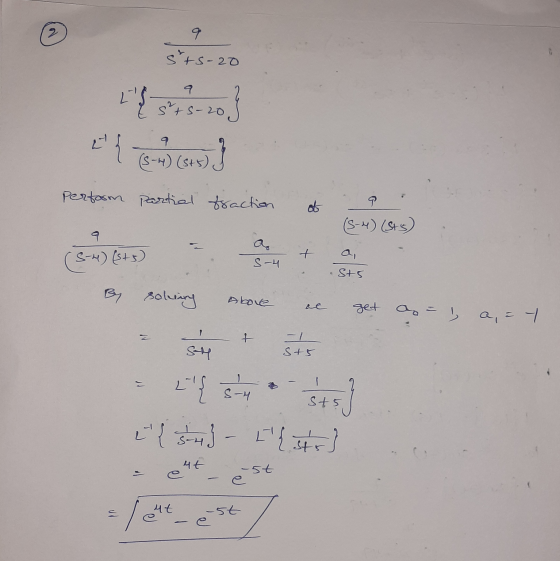
 III. (10) When solving this problem show all the steps needed to transform the expressions into ones that can be found in the table and indicate the entry of the table used in each step. a) Find the Laplace transform F(s) of the function (3 - e2+ 5e-6) sin(74) b) Find the inverse Laplace transform f(t) of the function F(S) = 9 $2 + 8 - 20
III (10) When solving this problem show all the steps needed to transform the expressions into...
 III (10) When solving this problem show all the steps needed to transform the expressions into ones that can be found in the table and indicate the entry of the table used in each step. a) Find the Laplace transform F(s) of the function (3 - 2 + 5e - 6t) sin(71) b) Find the inverse Laplace transform f(t) of the function 9 F($) = +8- 20
2) Upon starting a new position in a company, you have been assigned to work on...
 2) Upon starting a new position in a company, you have been assigned to work on a project that requires you to analyze an electrical network. The project kickoff meeting is in 2 weeks and you are not sure how to complete the network analysis. While looking through the department file, you found incomplete archives that show the results for a similar network but it does not show all the components of the network. a) What would you do to...
need help all those questions. 10. Solve the following systems of linear differential equations: 11. Determine the Laplace transform of each of the following functions: (a) fe)-2t+1, 0StcI , 21 (b...
 need help all those questions.
10. Solve the following systems of linear differential equations: 11. Determine the Laplace transform of each of the following functions: (a) fe)-2t+1, 0StcI , 21 (b) f(t) te (c) f(t) = cos t cos 2t (Hint: Examine cos(a ± b).) Determine the inverse Laplace transform of each function: 12. (a) F(s) = 52 +9 is Demin 13. Determine L{kt cos kt + sin kt). 0, t< a 14. Determine L(cos 2t)U(t-r), where U(t-a)={ 15. Use...
need help all those questions.
10. Solve the following systems of linear differential equations: 11. Determine the Laplace transform of each of the following functions: (a) fe)-2t+1, 0StcI , 21 (b) f(t) te (c) f(t) = cos t cos 2t (Hint: Examine cos(a ± b).) Determine the inverse Laplace transform of each function: 12. (a) F(s) = 52 +9 is Demin 13. Determine L{kt cos kt + sin kt). 0, t< a 14. Determine L(cos 2t)U(t-r), where U(t-a)={ 15. Use...
Verify the following using MATLAB 2) (a) Consider the following function f(t)=e"" sinwt u (t (1)...
 Verify the following using MATLAB
2) (a) Consider the following function f(t)=e"" sinwt u (t (1) .... Write the formula for Laplace transform. L[f)]=F(6) F(6))e"d Where f(t is the function in time domain. F(s) is the function in frequency domain Apply Laplace transform to equation 1. Le sin cot u()]F(s) Consider, f() sin wtu(t). From the frequency shifting theorem, L(e"f()F(s+a) (2) Apply Laplace transform to f(t). F,(s)sin ot u (t)e" "dt Define the step function, u(t u(t)= 1 fort >0...
Verify the following using MATLAB
2) (a) Consider the following function f(t)=e"" sinwt u (t (1) .... Write the formula for Laplace transform. L[f)]=F(6) F(6))e"d Where f(t is the function in time domain. F(s) is the function in frequency domain Apply Laplace transform to equation 1. Le sin cot u()]F(s) Consider, f() sin wtu(t). From the frequency shifting theorem, L(e"f()F(s+a) (2) Apply Laplace transform to f(t). F,(s)sin ot u (t)e" "dt Define the step function, u(t u(t)= 1 fort >0...
HI, PLEASE ANSWER ALL PARTS AND PLEASE SHOW ALL WORKINGS STEP BY STEP. THANK YOU. Question...
 HI, PLEASE ANSWER ALL PARTS AND PLEASE SHOW ALL WORKINGS STEP BY STEP. THANK YOU. Question 1: a) Show from first principles that the Laplace transform of the function f(n)=1, 120 is f(s) = Make a note of any conditions imposed on the transform variable "s" to ensure the transform exists. (8 Marks) b) Find, using the appropriate theorem, the Laplace transform of a function f(t); b) f(t) = t.sin(56) OR ii) f(t) = 5 sin 2(t - 3). H(t...
Check the existence of the Laplace transform for the given function and hence show that -...
 Check the existence of the Laplace transform for the given function and hence show that - cos 20 1s² + 4 L = In t s2 where L{f(t)} is represent the Laplace transform of f(t). [Hint: 2 cos A cos B = COSIA+B) + cos(A - B) sin(A + B) + sin(A - B) = sinA cosB, sin(A + B) – sin(A - ?) = os AsmB] [2+ Find the Fourier Sine series of [8 f(x) = e-*,0<x<. Using the...
 III. When solving this problem show all the steps needed to transform the expressions into ones that can be (10) found in the table and indicate the entry of the table used in each step. a) Find the Laplace transform F(s) of the function (5+234 +5e-2) cos(6t) b) Find the inverse Laplace transform f(t) of the function F(s) = 2 s2 + 2s + 5 f(t)=L-'{F(s) Table of Laplace Transforms F(s)=L{()} f(t)= L-'{F(s) F(s)=L{f(t)} 1. 2. et s-a 3. r",...
 Page 2 II. (7) Use the Laplace transform to solve the IVP y" - 5y' + 6y = 8(t-1), y(0) = 0,0) = 0, where the right hand side is the Dirac Delta Function (t - to) for to = 1. You may use the partial fraction decomposition 1 + 52-58 +6 2 S-3 but you need to show all the steps needed to arrive to the expression 1 52-58 +6 in order to receive credit. f(t)=L-'{F(s) Table of Laplace...
 Page 4 IV. (10) Use the Laplace transform to solve the IVP y" - 2y + y = f(t), y(0) = 1, y(0) = 1, where t<5 f(t) = t-5, t5 You may use the partial fraction decomposition 7(x2–2x+1) (6-1) + + - , but you need to show all the steps needed to arrive to the expression -16-28+1) in order to receive credit. f(t)=L-'{F(s) Table of Laplace Transforms F(s)=L{()} f(t)= L-'{F(s) F(s)=L{f(t)} 1. 2. et s-a 3. r", n=1,2,3,......
 III. (10) When solving this problem show all the steps needed to transform the expressions into ones that can be found in the table and indicate the entry of the table used in each step. a) Find the Laplace transform F(s) of the function (3 - e2+ 5e-6) sin(74) b) Find the inverse Laplace transform f(t) of the function F(S) = 9 $2 + 8 - 20
 III (10) When solving this problem show all the steps needed to transform the expressions into ones that can be found in the table and indicate the entry of the table used in each step. a) Find the Laplace transform F(s) of the function (3 - 2 + 5e - 6t) sin(71) b) Find the inverse Laplace transform f(t) of the function 9 F($) = +8- 20
 2) Upon starting a new position in a company, you have been assigned to work on a project that requires you to analyze an electrical network. The project kickoff meeting is in 2 weeks and you are not sure how to complete the network analysis. While looking through the department file, you found incomplete archives that show the results for a similar network but it does not show all the components of the network. a) What would you do to...
 need help all those questions.
10. Solve the following systems of linear differential equations: 11. Determine the Laplace transform of each of the following functions: (a) fe)-2t+1, 0StcI , 21 (b) f(t) te (c) f(t) = cos t cos 2t (Hint: Examine cos(a ± b).) Determine the inverse Laplace transform of each function: 12. (a) F(s) = 52 +9 is Demin 13. Determine L{kt cos kt + sin kt). 0, t< a 14. Determine L(cos 2t)U(t-r), where U(t-a)={ 15. Use...
need help all those questions.
10. Solve the following systems of linear differential equations: 11. Determine the Laplace transform of each of the following functions: (a) fe)-2t+1, 0StcI , 21 (b) f(t) te (c) f(t) = cos t cos 2t (Hint: Examine cos(a ± b).) Determine the inverse Laplace transform of each function: 12. (a) F(s) = 52 +9 is Demin 13. Determine L{kt cos kt + sin kt). 0, t< a 14. Determine L(cos 2t)U(t-r), where U(t-a)={ 15. Use...
 Verify the following using MATLAB
2) (a) Consider the following function f(t)=e"" sinwt u (t (1) .... Write the formula for Laplace transform. L[f)]=F(6) F(6))e"d Where f(t is the function in time domain. F(s) is the function in frequency domain Apply Laplace transform to equation 1. Le sin cot u()]F(s) Consider, f() sin wtu(t). From the frequency shifting theorem, L(e"f()F(s+a) (2) Apply Laplace transform to f(t). F,(s)sin ot u (t)e" "dt Define the step function, u(t u(t)= 1 fort >0...
Verify the following using MATLAB
2) (a) Consider the following function f(t)=e"" sinwt u (t (1) .... Write the formula for Laplace transform. L[f)]=F(6) F(6))e"d Where f(t is the function in time domain. F(s) is the function in frequency domain Apply Laplace transform to equation 1. Le sin cot u()]F(s) Consider, f() sin wtu(t). From the frequency shifting theorem, L(e"f()F(s+a) (2) Apply Laplace transform to f(t). F,(s)sin ot u (t)e" "dt Define the step function, u(t u(t)= 1 fort >0...
 HI, PLEASE ANSWER ALL PARTS AND PLEASE SHOW ALL WORKINGS STEP BY STEP. THANK YOU. Question 1: a) Show from first principles that the Laplace transform of the function f(n)=1, 120 is f(s) = Make a note of any conditions imposed on the transform variable "s" to ensure the transform exists. (8 Marks) b) Find, using the appropriate theorem, the Laplace transform of a function f(t); b) f(t) = t.sin(56) OR ii) f(t) = 5 sin 2(t - 3). H(t...
 Check the existence of the Laplace transform for the given function and hence show that - cos 20 1s² + 4 L = In t s2 where L{f(t)} is represent the Laplace transform of f(t). [Hint: 2 cos A cos B = COSIA+B) + cos(A - B) sin(A + B) + sin(A - B) = sinA cosB, sin(A + B) – sin(A - ?) = os AsmB] [2+ Find the Fourier Sine series of [8 f(x) = e-*,0<x<. Using the...
Most questions answered within 3 hours.
-
Where is the error in this code sequence?
String s1 = "Hello";
String s2 = "ello";...
asked 11 months ago -
Financial data for Joel de Paris, Inc., for last year
follow:
Joel de Paris, Inc.
Balance...
asked 11 months ago -
Consider this reaction:
Al2(SO4)3 (aq)+ BaCl3
(aq) Al2Cl6 (aq)- +
3BaSO4(s) . What is the...
asked 11 months ago -
Suppose that Savneet is considering increasing her
recent random sample from 20 car rentals to 40...
asked 11 months ago -
Trucks arrive at an unloading terminal at an average rate of 120
per hour.
Trucks arrive...
asked 11 months ago -
Why are methanol and ethanol completely soluble in water while
octanol is not very little soluble....
asked 11 months ago -
A facilities manager at a university reads in a research report
that the mean amount of...
asked 11 months ago -
When the CuSO4 is rehydrated by adding water to the anhydrous
compound, is this an endothermic...
asked 11 months ago -
A ray of sunlight is passing from diamond into crown glass; the
angle of incidence is...
asked 11 months ago -
A block of mass 0.249 kg is placed on top of a light, vertical
spring of...
asked 11 months ago -
how do the kidneys compensate in the presences of acidosis
a) trigger hyperventilate
b) reserve acid...
asked 11 months ago -
Question 501 pts
The rental rate of capital to the firm increases. Which of the
following...
asked 11 months ago