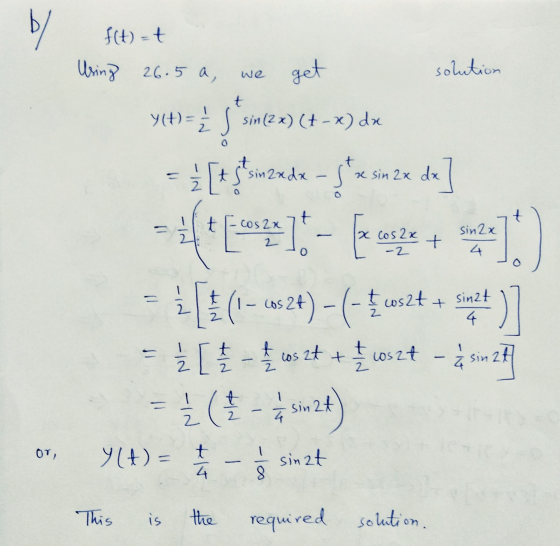
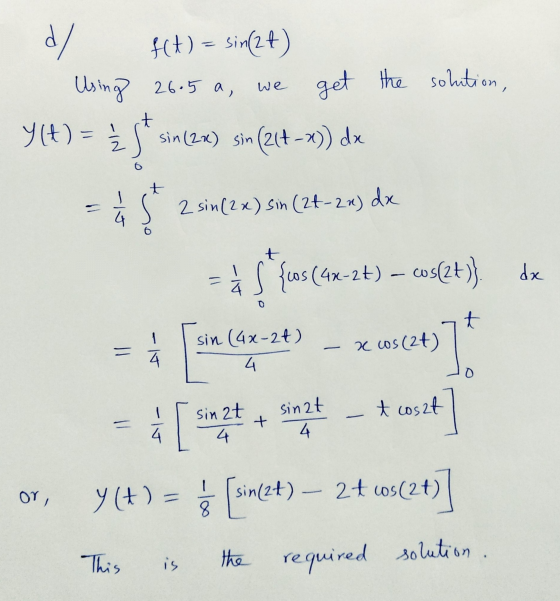
 Please do b and d. The result for 26.5 a is below
![26.5 a. C[SOL {[y + 4y]. [Y). + 4L[y]1, → = F(s) [s?Y(s) – s y(0) - y(o)] + 4Y(s) = F(s) 0 0 (52 + 4) Y() = f(s) Y(s) = F(](http://img.homeworklib.com/questions/f17021f0-eca9-11ea-b487-c96beb8d141b.png?x-oss-process=image/resize,w_560)
Homework Answers
Add Answer to:
Please do b and d. The result for 26.5 a is below
26.6. Using the results...
4. Convolution EX4. The input X(t) and impulse response h(t) for a system are given. Using...
 4. Convolution EX4. The input X(t) and impulse response h(t) for a system are given. Using convolution evaluating the system output y(t). X(t)=1 O<t1 h(t)=sin pi*t 0<<2 =0 else where =0 elsewhere Xit) ↑ hlt) E mer
0<t<T when Tt< 2 t 2T sin t when 2. Calculate the Laplace transform of the periodic function f(t) 0 f(t-...
 0<t<T when Tt< 2 t 2T sin t when 2. Calculate the Laplace transform of the periodic function f(t) 0 f(t-2) when -7s 3. Calculate the inverse Laplace transform of G(s) 3-4e-5 + $2+2s+17 4. Use the Laplace transform to solve each initial value problem: 4y"+ y u2m(t)sin(t/2) y(0)=0 &(0 =0 (a) 0 and /(0) 2 "+4y+13y = 4to(t-T) if y(0) (b) 5. Use the convolution to write a solution of each initial value problem. y"+6y'+10y g(t) 1 y(0) 0...
Compute Laplace transforms of the following functions: (a) f1 = (1 + t) (b) f2 =...
 Compute Laplace transforms of the following functions: (a) f1 = (1 + t) (b) f2 = eat sin(bt) 11, 0<t<1, (c) f3 = -1 1<t<2, | 2, t>2, Find the functions from their Laplace transforms: (a) Lyı] s(s + 1) (s +3) 2+s (b) L[42] = 52 + 2 s +5 (c) L[y3] = Solve the following initial value problems using the Laplace transform. Confirm each solution with a Matlab plot showing the function on the interval 0 <t<5. (a)...
For full credit, you must show all work and box answers 1. If functions f and g are piecewise con...
 For full credit, you must show all work and box answers 1. If functions f and g are piecewise continuous on the interval [0, oo), then the convolution of f and g is a function defined by the integral The Convolution Theorem (theorem 7.4.2 in your book and formula 6 in your table) states: If j(t) and g) are piecewise continuous on [0, oo) and of exponential order, then We are going to use convolution to solve y"-y,-t-e-,, y(0)-0, y'(0)-0....
7. Identify the impulse response function for the differential equation below. y" +24' + 5y =...
 7. Identify the impulse response function for the differential equation below. y" +24' + 5y = sin(t), y(0) = 1, y'(0) = 2. (a) Not enough information to tell (b) h(t) = 2e' sin(t) (c) h(t) = ecos(2t) (d) h(t) = {e- sin(21) 8. Which of the following equations is valid for functions f(t) and g(0)? (a) C{28 +7.9}(s) = 2C{S}(s) +tL{9}(3) (b) C{t.g}(8) = -(L{9}) (c) C{e-at.g}(s) = ({9}(s - a) (d) None of the above.
a) Two bandpass signals are added together. j2rfet j2Tfet y(t)-Re y(t)e v(t)-x(t) y(t) v(t) may be represented as, What...
 a) Two bandpass signals are added together. j2rfet j2Tfet y(t)-Re y(t)e v(t)-x(t) y(t) v(t) may be represented as, What is v(t) as a function of (t) and y(t)? b) Suppose that a bandpass filter with centre frequency f has an impulse response h(t). Since h(t) is a bandpass function, it has the complex envelope representation, h (t) = Re[h(t)e'2n4 ], where h(t ) is the complex envelope of h (t) Suppose that s(t) is filtered with the filter with impulse...
9. (a) Find the inverse Fourier transform of the following function 1 (2 iw)(5 iw) (b)...
 9. (a) Find the inverse Fourier transform of the following function 1 (2 iw)(5 iw) (b) The displacement of a particular mechanical system is governed by the following ordinary differential equation dy 10y f(t) 7 dt where y(t) is the displacement and f(t) is the applied load Page 2 of 4 MATH2124 SaMplE EXAM IV i Use the Fourier transform to obtain the impulse response h(t) of the mechanical system (ii) If the applied load is f(t) = H (t1)-...
helpful equations: 4. A solution-concentration mixer control system consists of three subsystems that are flow control...
 helpful equations:
4. A solution-concentration mixer control system consists of three subsystems that are flow control valve, cylinder, and mixing pipe components respectively. The block diagram below shows the input-output relationship of the system a) Indicate the system types for these subsystems; b) What is the transfer function H(s) of the entire system with input V(s) and output C(s)? (8 points) V(s)Q(s) C(s) Complex numbers: - R034 (reje)"-rkejke Trignometric Identities sin2x=2sinxcosx sinx+cosx-1 1-cos 2x x= 2 cos2x=1 + cos2x sin(xt...
helpful equations:
4. A solution-concentration mixer control system consists of three subsystems that are flow control valve, cylinder, and mixing pipe components respectively. The block diagram below shows the input-output relationship of the system a) Indicate the system types for these subsystems; b) What is the transfer function H(s) of the entire system with input V(s) and output C(s)? (8 points) V(s)Q(s) C(s) Complex numbers: - R034 (reje)"-rkejke Trignometric Identities sin2x=2sinxcosx sinx+cosx-1 1-cos 2x x= 2 cos2x=1 + cos2x sin(xt...
21.6 A,B,C,D result given in part c of this exercise. 21.6. Consider a damped mass/spring system...
 21.6 A,B,C,D
result given in part c of this exercise. 21.6. Consider a damped mass/spring system given by m dy gdy tr dt + ky = Fo cos(nt) where m. y. K and Fo are all positive constants. (This is the same as equation (214) a. Using the method of educated guess, derive the particular solution given by equation ser (21.10) on page 409. genelaidi b. Then show that the solution in the previous part can be rewritten as described...
21.6 A,B,C,D
result given in part c of this exercise. 21.6. Consider a damped mass/spring system given by m dy gdy tr dt + ky = Fo cos(nt) where m. y. K and Fo are all positive constants. (This is the same as equation (214) a. Using the method of educated guess, derive the particular solution given by equation ser (21.10) on page 409. genelaidi b. Then show that the solution in the previous part can be rewritten as described...
1. Auto- and Cross-Correlation. For each of the following, compute the cross correlation T/2 Rry(,) = E[drpd, + n-linx...
 1. Auto- and Cross-Correlation. For each of the following, compute the cross correlation T/2 Rry(,) = E[drpd, + n-linx t-Tax(ry(, + rdr . Hint: Use trigonometric identities (see HW 1), 27T such as sin a sin b-2 [cos(a-b)-cos(a + b)] . Also use the fact that j cos(ont-б unless co-0 x(t) = sin(2n/r), y(t)-sin(2nft) (here x and y are the same, so Rry-Rrr is the a. autocorrelation of x). x(t) = sin(2nft), y(t) = sin(2nf(t-to)) c. x(t)-n(), y()2x(t) +n2(t) where...
 4. Convolution EX4. The input X(t) and impulse response h(t) for a system are given. Using convolution evaluating the system output y(t). X(t)=1 O<t1 h(t)=sin pi*t 0<<2 =0 else where =0 elsewhere Xit) ↑ hlt) E mer
 0<t<T when Tt< 2 t 2T sin t when 2. Calculate the Laplace transform of the periodic function f(t) 0 f(t-2) when -7s 3. Calculate the inverse Laplace transform of G(s) 3-4e-5 + $2+2s+17 4. Use the Laplace transform to solve each initial value problem: 4y"+ y u2m(t)sin(t/2) y(0)=0 &(0 =0 (a) 0 and /(0) 2 "+4y+13y = 4to(t-T) if y(0) (b) 5. Use the convolution to write a solution of each initial value problem. y"+6y'+10y g(t) 1 y(0) 0...
 Compute Laplace transforms of the following functions: (a) f1 = (1 + t) (b) f2 = eat sin(bt) 11, 0<t<1, (c) f3 = -1 1<t<2, | 2, t>2, Find the functions from their Laplace transforms: (a) Lyı] s(s + 1) (s +3) 2+s (b) L[42] = 52 + 2 s +5 (c) L[y3] = Solve the following initial value problems using the Laplace transform. Confirm each solution with a Matlab plot showing the function on the interval 0 <t<5. (a)...
 For full credit, you must show all work and box answers 1. If functions f and g are piecewise continuous on the interval [0, oo), then the convolution of f and g is a function defined by the integral The Convolution Theorem (theorem 7.4.2 in your book and formula 6 in your table) states: If j(t) and g) are piecewise continuous on [0, oo) and of exponential order, then We are going to use convolution to solve y"-y,-t-e-,, y(0)-0, y'(0)-0....
 7. Identify the impulse response function for the differential equation below. y" +24' + 5y = sin(t), y(0) = 1, y'(0) = 2. (a) Not enough information to tell (b) h(t) = 2e' sin(t) (c) h(t) = ecos(2t) (d) h(t) = {e- sin(21) 8. Which of the following equations is valid for functions f(t) and g(0)? (a) C{28 +7.9}(s) = 2C{S}(s) +tL{9}(3) (b) C{t.g}(8) = -(L{9}) (c) C{e-at.g}(s) = ({9}(s - a) (d) None of the above.
 a) Two bandpass signals are added together. j2rfet j2Tfet y(t)-Re y(t)e v(t)-x(t) y(t) v(t) may be represented as, What is v(t) as a function of (t) and y(t)? b) Suppose that a bandpass filter with centre frequency f has an impulse response h(t). Since h(t) is a bandpass function, it has the complex envelope representation, h (t) = Re[h(t)e'2n4 ], where h(t ) is the complex envelope of h (t) Suppose that s(t) is filtered with the filter with impulse...
 9. (a) Find the inverse Fourier transform of the following function 1 (2 iw)(5 iw) (b) The displacement of a particular mechanical system is governed by the following ordinary differential equation dy 10y f(t) 7 dt where y(t) is the displacement and f(t) is the applied load Page 2 of 4 MATH2124 SaMplE EXAM IV i Use the Fourier transform to obtain the impulse response h(t) of the mechanical system (ii) If the applied load is f(t) = H (t1)-...
 helpful equations:
4. A solution-concentration mixer control system consists of three subsystems that are flow control valve, cylinder, and mixing pipe components respectively. The block diagram below shows the input-output relationship of the system a) Indicate the system types for these subsystems; b) What is the transfer function H(s) of the entire system with input V(s) and output C(s)? (8 points) V(s)Q(s) C(s) Complex numbers: - R034 (reje)"-rkejke Trignometric Identities sin2x=2sinxcosx sinx+cosx-1 1-cos 2x x= 2 cos2x=1 + cos2x sin(xt...
helpful equations:
4. A solution-concentration mixer control system consists of three subsystems that are flow control valve, cylinder, and mixing pipe components respectively. The block diagram below shows the input-output relationship of the system a) Indicate the system types for these subsystems; b) What is the transfer function H(s) of the entire system with input V(s) and output C(s)? (8 points) V(s)Q(s) C(s) Complex numbers: - R034 (reje)"-rkejke Trignometric Identities sin2x=2sinxcosx sinx+cosx-1 1-cos 2x x= 2 cos2x=1 + cos2x sin(xt...
 21.6 A,B,C,D
result given in part c of this exercise. 21.6. Consider a damped mass/spring system given by m dy gdy tr dt + ky = Fo cos(nt) where m. y. K and Fo are all positive constants. (This is the same as equation (214) a. Using the method of educated guess, derive the particular solution given by equation ser (21.10) on page 409. genelaidi b. Then show that the solution in the previous part can be rewritten as described...
21.6 A,B,C,D
result given in part c of this exercise. 21.6. Consider a damped mass/spring system given by m dy gdy tr dt + ky = Fo cos(nt) where m. y. K and Fo are all positive constants. (This is the same as equation (214) a. Using the method of educated guess, derive the particular solution given by equation ser (21.10) on page 409. genelaidi b. Then show that the solution in the previous part can be rewritten as described...
 1. Auto- and Cross-Correlation. For each of the following, compute the cross correlation T/2 Rry(,) = E[drpd, + n-linx t-Tax(ry(, + rdr . Hint: Use trigonometric identities (see HW 1), 27T such as sin a sin b-2 [cos(a-b)-cos(a + b)] . Also use the fact that j cos(ont-б unless co-0 x(t) = sin(2n/r), y(t)-sin(2nft) (here x and y are the same, so Rry-Rrr is the a. autocorrelation of x). x(t) = sin(2nft), y(t) = sin(2nf(t-to)) c. x(t)-n(), y()2x(t) +n2(t) where...
Most questions answered within 3 hours.
-
Where is the error in this code sequence?
String s1 = "Hello";
String s2 = "ello";...
asked 10 months ago -
Financial data for Joel de Paris, Inc., for last year
follow:
Joel de Paris, Inc.
Balance...
asked 10 months ago -
Consider this reaction:
Al2(SO4)3 (aq)+ BaCl3
(aq) Al2Cl6 (aq)- +
3BaSO4(s) . What is the...
asked 10 months ago -
Suppose that Savneet is considering increasing her
recent random sample from 20 car rentals to 40...
asked 10 months ago -
Trucks arrive at an unloading terminal at an average rate of 120
per hour.
Trucks arrive...
asked 10 months ago -
Why are methanol and ethanol completely soluble in water while
octanol is not very little soluble....
asked 10 months ago -
A facilities manager at a university reads in a research report
that the mean amount of...
asked 10 months ago -
When the CuSO4 is rehydrated by adding water to the anhydrous
compound, is this an endothermic...
asked 10 months ago -
A ray of sunlight is passing from diamond into crown glass; the
angle of incidence is...
asked 10 months ago -
A block of mass 0.249 kg is placed on top of a light, vertical
spring of...
asked 10 months ago -
how do the kidneys compensate in the presences of acidosis
a) trigger hyperventilate
b) reserve acid...
asked 10 months ago -
Question 501 pts
The rental rate of capital to the firm increases. Which of the
following...
asked 10 months ago