
Homework Answers
Request Answer!
We need at least 10 more requests to produce the answer.
0 / 10 have requested this problem solution
The more requests, the faster the answer.
Add Answer to:
ANSWER ONLY QUESTION 4, QUESTION 3 is for reference only
QUESTION 3 Determining the amount of...
reagent is BaCl2 Determining the amount of sulfate ion (SO2) dissolved in seawater in the unit...
 reagent is BaCl2
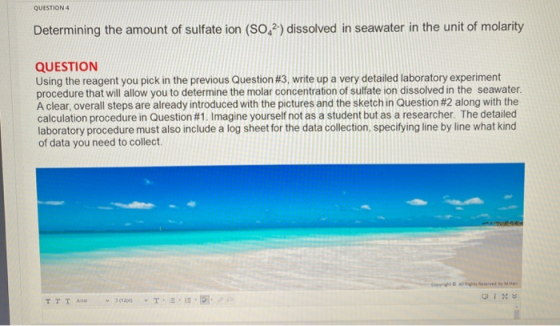
Determining the amount of sulfate ion (SO2) dissolved in seawater in the unit of molarity QUESTION Using the reagent you pick in the previous Question #3, write up a very detailed laboratory experiment procedure that will allow you to determine the molar concentration of sulfate ion dissolved in the seawater. A clear, overall steps are already introduced with the pictures and the sketch in Question #2 along with the calculation procedure in Question #1. Imagine yourself not...
reagent is BaCl2
Determining the amount of sulfate ion (SO2) dissolved in seawater in the unit of molarity QUESTION Using the reagent you pick in the previous Question #3, write up a very detailed laboratory experiment procedure that will allow you to determine the molar concentration of sulfate ion dissolved in the seawater. A clear, overall steps are already introduced with the pictures and the sketch in Question #2 along with the calculation procedure in Question #1. Imagine yourself not...
Determining the amount of sulfate ion (SO2) dissolved in seawater in the unit of molarity QUESTION...
 Determining the amount of sulfate ion (SO2) dissolved in seawater in the unit of molarity QUESTION Sulfate concentration in the seawater is about 28 mm (0.028 M). Take the reverse approach to the calculation procedure in the previous Question #1 (so called a backward calculation) and find a rough estimate for the volume of the seawater sample you may need to take from the beach like the one below. A 20.0 mL sample solution contains unknown amount of bromide ion...
The reagents that were in the choices were BaCl2 and CaCl2 and I chose BaCl2. The...
 The reagents that were in the choices were BaCl2 and CaCl2 and
I chose BaCl2.
The detailed picture it is talking about (Q#2) is also posted
below to help.
*Only the first question which is visible
second pic is only there as an additional info if needed
QUESTION 4 Determining the amount of sulfate ion (SO221) dissolved in seawater in the unit of molarity QUESTION Using the reagent you pick in the previous Question #3, write up a very detailed...
The reagents that were in the choices were BaCl2 and CaCl2 and
I chose BaCl2.
The detailed picture it is talking about (Q#2) is also posted
below to help.
*Only the first question which is visible
second pic is only there as an additional info if needed
QUESTION 4 Determining the amount of sulfate ion (SO221) dissolved in seawater in the unit of molarity QUESTION Using the reagent you pick in the previous Question #3, write up a very detailed...
Only answer the first picture. Second is just there as a reference Sulfate concentration in the...
 Only answer the first picture. Second is just there as a
reference
Sulfate concentration in the seawater is about 28 mM (0.028 M). Take the reverse approach to the calculation procedure in the previous Question #1 (so called a backward calculation) and find a rough estimate for the volume of the seawater sample you may need to take from the beach like the one below. A 20.0 mL sample solution contains unknown amount of bromide ion (Br). To this solution...
Only answer the first picture. Second is just there as a
reference
Sulfate concentration in the seawater is about 28 mM (0.028 M). Take the reverse approach to the calculation procedure in the previous Question #1 (so called a backward calculation) and find a rough estimate for the volume of the seawater sample you may need to take from the beach like the one below. A 20.0 mL sample solution contains unknown amount of bromide ion (Br). To this solution...
Question A 20.0 mL sample solution contains unknown amount of bromide ion (Br). To this solution...
 Question
A 20.0 mL sample solution contains unknown amount of bromide ion (Br). To this solution was added the solution that contains plenty of AgNO3. AgBr precipitates were formed. The precipitate were filtered and measured to be is 0.6964 g. What is the molarity of bromide ion in the original sample solution? The molar mass of Br = 80.0 g; the molar mass of AgBr = 188 g. (Solution) AgNO, is soluble and thus exists Ag+ ion and NO3-ion. Ag+...
Question
A 20.0 mL sample solution contains unknown amount of bromide ion (Br). To this solution was added the solution that contains plenty of AgNO3. AgBr precipitates were formed. The precipitate were filtered and measured to be is 0.6964 g. What is the molarity of bromide ion in the original sample solution? The molar mass of Br = 80.0 g; the molar mass of AgBr = 188 g. (Solution) AgNO, is soluble and thus exists Ag+ ion and NO3-ion. Ag+...
PRE-LABORATORY QUESTIONS, WATER: DETERMINING THE CONCENTRATION OF CALCIUM IONS IN WATER SAMPLES EXPT. SA HARD Prior...
 PRE-LABORATORY QUESTIONS, WATER: DETERMINING THE CONCENTRATION OF CALCIUM IONS IN WATER SAMPLES EXPT. SA HARD Prior to coming to lab, carefully read the entire experimental procedure that follows and write an outline of the procedure in your lab notebook IN YOUR OWN WORDS (do not simply copy). Then, add three tables for your titrations of the blank, tap water, and CaCl samples. Complete these problems and hand in gt the bexinning of the laboratory period. Show all work. EDTA is...
The first picture is used for question #2, and question #3 can be normally answered. I...
 The first picture is used for question #2, and question #3 can
be normally answered. I believe the answer to question 3 is ->
0.07144M. However I would like someone to check it. I am not sure
about 2.
BE SURE THAT YOU RECORD ALL OF YOUR DATA AND LABEL PROPERLY FOR PARTI OF THIS LABORATORY EXPERIMENT. YOU WILL NEED TO ACCESS THIS INFORMATION IN THREE WEEKS. Part I Synthesis of the Complex Salt containing Copper Procedure 16.004 1. In...
The first picture is used for question #2, and question #3 can
be normally answered. I believe the answer to question 3 is ->
0.07144M. However I would like someone to check it. I am not sure
about 2.
BE SURE THAT YOU RECORD ALL OF YOUR DATA AND LABEL PROPERLY FOR PARTI OF THIS LABORATORY EXPERIMENT. YOU WILL NEED TO ACCESS THIS INFORMATION IN THREE WEEKS. Part I Synthesis of the Complex Salt containing Copper Procedure 16.004 1. In...
Can you answer question 4 & 5? The experiment and porcedure is posted below Question 4...
 Can
you answer question 4 & 5? The experiment and porcedure is
posted below
Question 4 & 5
CHM3120C Analytical Chemistry Lab Lab 7. Spectrophotometric Determination of Iron in Mohr's Salt with o-Phenanthroline Required Reagents and Supplies: 50 mL of 0.0005M -0.0006 M of Mohr's solution (unknown), 10 g of Hydroxylamine hydrochloride (NH2OH, HCI), 500 mL of o-phenanthroline solution (contains 0.5 g of o-phenanthroline monohydrate), 83 g of sodium acetate (NaOAc. 3H20) in 500 mL of water (for 1.2 M...
Can
you answer question 4 & 5? The experiment and porcedure is
posted below
Question 4 & 5
CHM3120C Analytical Chemistry Lab Lab 7. Spectrophotometric Determination of Iron in Mohr's Salt with o-Phenanthroline Required Reagents and Supplies: 50 mL of 0.0005M -0.0006 M of Mohr's solution (unknown), 10 g of Hydroxylamine hydrochloride (NH2OH, HCI), 500 mL of o-phenanthroline solution (contains 0.5 g of o-phenanthroline monohydrate), 83 g of sodium acetate (NaOAc. 3H20) in 500 mL of water (for 1.2 M...
help please? this was the only other information given REPORT SHEET Determination of the Solubility-Product Constant...
 help please?
this was the only other information given
REPORT SHEET Determination of the Solubility-Product Constant for a Sparingly Soluble Salt EXPERIMENT 8 A. Preparation of a Calibration Curve Initial (Cro121 0.0024 M Absorbance 5 mL Volume of 0.0024 M K Cro Total volume 1. I mL 100 mL 2. 100ML 3. 10 mL 100ml 4. 15 mL 100 ML Molar extinction coefficient for [CrO2) [Cro,2) 2.4x100M 12x1044 2.4810M 3.6810M 0.04) 2037.37 0.85 1.13 2. 3. Average molar extinction coefficient...
help please?
this was the only other information given
REPORT SHEET Determination of the Solubility-Product Constant for a Sparingly Soluble Salt EXPERIMENT 8 A. Preparation of a Calibration Curve Initial (Cro121 0.0024 M Absorbance 5 mL Volume of 0.0024 M K Cro Total volume 1. I mL 100 mL 2. 100ML 3. 10 mL 100ml 4. 15 mL 100 ML Molar extinction coefficient for [CrO2) [Cro,2) 2.4x100M 12x1044 2.4810M 3.6810M 0.04) 2037.37 0.85 1.13 2. 3. Average molar extinction coefficient...
Help please??! Molarity of KMnO4 is 0.0100 M Determination of oxalate in Kufe.(0,0...0). Name AB A...
 Help please??!
Molarity of KMnO4 is 0.0100 M
Determination of oxalate in Kufe.(0,0...0). Name AB A LOCAL Partner's Name MA R ENDALL Total mass of product synthesized in previous experiment (6) 1720 g Molarity of KMnO. (Record from the label on the container) Trial 1 Trial 2 Trial 2 0.105 1. Mass of sample taken for titration (g) 0.11 2. Initial burette reading (ml) 0 Final burette reading (ml) 20 33.4 22.2 4. Volume of KMnO, used (ml) 2.2 5....
Help please??!
Molarity of KMnO4 is 0.0100 M
Determination of oxalate in Kufe.(0,0...0). Name AB A LOCAL Partner's Name MA R ENDALL Total mass of product synthesized in previous experiment (6) 1720 g Molarity of KMnO. (Record from the label on the container) Trial 1 Trial 2 Trial 2 0.105 1. Mass of sample taken for titration (g) 0.11 2. Initial burette reading (ml) 0 Final burette reading (ml) 20 33.4 22.2 4. Volume of KMnO, used (ml) 2.2 5....
 reagent is BaCl2
Determining the amount of sulfate ion (SO2) dissolved in seawater in the unit of molarity QUESTION Using the reagent you pick in the previous Question #3, write up a very detailed laboratory experiment procedure that will allow you to determine the molar concentration of sulfate ion dissolved in the seawater. A clear, overall steps are already introduced with the pictures and the sketch in Question #2 along with the calculation procedure in Question #1. Imagine yourself not...
reagent is BaCl2
Determining the amount of sulfate ion (SO2) dissolved in seawater in the unit of molarity QUESTION Using the reagent you pick in the previous Question #3, write up a very detailed laboratory experiment procedure that will allow you to determine the molar concentration of sulfate ion dissolved in the seawater. A clear, overall steps are already introduced with the pictures and the sketch in Question #2 along with the calculation procedure in Question #1. Imagine yourself not...
 Determining the amount of sulfate ion (SO2) dissolved in seawater in the unit of molarity QUESTION Sulfate concentration in the seawater is about 28 mm (0.028 M). Take the reverse approach to the calculation procedure in the previous Question #1 (so called a backward calculation) and find a rough estimate for the volume of the seawater sample you may need to take from the beach like the one below. A 20.0 mL sample solution contains unknown amount of bromide ion...
 The reagents that were in the choices were BaCl2 and CaCl2 and
I chose BaCl2.
The detailed picture it is talking about (Q#2) is also posted
below to help.
*Only the first question which is visible
second pic is only there as an additional info if needed
QUESTION 4 Determining the amount of sulfate ion (SO221) dissolved in seawater in the unit of molarity QUESTION Using the reagent you pick in the previous Question #3, write up a very detailed...
The reagents that were in the choices were BaCl2 and CaCl2 and
I chose BaCl2.
The detailed picture it is talking about (Q#2) is also posted
below to help.
*Only the first question which is visible
second pic is only there as an additional info if needed
QUESTION 4 Determining the amount of sulfate ion (SO221) dissolved in seawater in the unit of molarity QUESTION Using the reagent you pick in the previous Question #3, write up a very detailed...
 Only answer the first picture. Second is just there as a
reference
Sulfate concentration in the seawater is about 28 mM (0.028 M). Take the reverse approach to the calculation procedure in the previous Question #1 (so called a backward calculation) and find a rough estimate for the volume of the seawater sample you may need to take from the beach like the one below. A 20.0 mL sample solution contains unknown amount of bromide ion (Br). To this solution...
Only answer the first picture. Second is just there as a
reference
Sulfate concentration in the seawater is about 28 mM (0.028 M). Take the reverse approach to the calculation procedure in the previous Question #1 (so called a backward calculation) and find a rough estimate for the volume of the seawater sample you may need to take from the beach like the one below. A 20.0 mL sample solution contains unknown amount of bromide ion (Br). To this solution...
 Question
A 20.0 mL sample solution contains unknown amount of bromide ion (Br). To this solution was added the solution that contains plenty of AgNO3. AgBr precipitates were formed. The precipitate were filtered and measured to be is 0.6964 g. What is the molarity of bromide ion in the original sample solution? The molar mass of Br = 80.0 g; the molar mass of AgBr = 188 g. (Solution) AgNO, is soluble and thus exists Ag+ ion and NO3-ion. Ag+...
Question
A 20.0 mL sample solution contains unknown amount of bromide ion (Br). To this solution was added the solution that contains plenty of AgNO3. AgBr precipitates were formed. The precipitate were filtered and measured to be is 0.6964 g. What is the molarity of bromide ion in the original sample solution? The molar mass of Br = 80.0 g; the molar mass of AgBr = 188 g. (Solution) AgNO, is soluble and thus exists Ag+ ion and NO3-ion. Ag+...
 PRE-LABORATORY QUESTIONS, WATER: DETERMINING THE CONCENTRATION OF CALCIUM IONS IN WATER SAMPLES EXPT. SA HARD Prior to coming to lab, carefully read the entire experimental procedure that follows and write an outline of the procedure in your lab notebook IN YOUR OWN WORDS (do not simply copy). Then, add three tables for your titrations of the blank, tap water, and CaCl samples. Complete these problems and hand in gt the bexinning of the laboratory period. Show all work. EDTA is...
 The first picture is used for question #2, and question #3 can
be normally answered. I believe the answer to question 3 is ->
0.07144M. However I would like someone to check it. I am not sure
about 2.
BE SURE THAT YOU RECORD ALL OF YOUR DATA AND LABEL PROPERLY FOR PARTI OF THIS LABORATORY EXPERIMENT. YOU WILL NEED TO ACCESS THIS INFORMATION IN THREE WEEKS. Part I Synthesis of the Complex Salt containing Copper Procedure 16.004 1. In...
The first picture is used for question #2, and question #3 can
be normally answered. I believe the answer to question 3 is ->
0.07144M. However I would like someone to check it. I am not sure
about 2.
BE SURE THAT YOU RECORD ALL OF YOUR DATA AND LABEL PROPERLY FOR PARTI OF THIS LABORATORY EXPERIMENT. YOU WILL NEED TO ACCESS THIS INFORMATION IN THREE WEEKS. Part I Synthesis of the Complex Salt containing Copper Procedure 16.004 1. In...
 Can
you answer question 4 & 5? The experiment and porcedure is
posted below
Question 4 & 5
CHM3120C Analytical Chemistry Lab Lab 7. Spectrophotometric Determination of Iron in Mohr's Salt with o-Phenanthroline Required Reagents and Supplies: 50 mL of 0.0005M -0.0006 M of Mohr's solution (unknown), 10 g of Hydroxylamine hydrochloride (NH2OH, HCI), 500 mL of o-phenanthroline solution (contains 0.5 g of o-phenanthroline monohydrate), 83 g of sodium acetate (NaOAc. 3H20) in 500 mL of water (for 1.2 M...
Can
you answer question 4 & 5? The experiment and porcedure is
posted below
Question 4 & 5
CHM3120C Analytical Chemistry Lab Lab 7. Spectrophotometric Determination of Iron in Mohr's Salt with o-Phenanthroline Required Reagents and Supplies: 50 mL of 0.0005M -0.0006 M of Mohr's solution (unknown), 10 g of Hydroxylamine hydrochloride (NH2OH, HCI), 500 mL of o-phenanthroline solution (contains 0.5 g of o-phenanthroline monohydrate), 83 g of sodium acetate (NaOAc. 3H20) in 500 mL of water (for 1.2 M...
 help please?
this was the only other information given
REPORT SHEET Determination of the Solubility-Product Constant for a Sparingly Soluble Salt EXPERIMENT 8 A. Preparation of a Calibration Curve Initial (Cro121 0.0024 M Absorbance 5 mL Volume of 0.0024 M K Cro Total volume 1. I mL 100 mL 2. 100ML 3. 10 mL 100ml 4. 15 mL 100 ML Molar extinction coefficient for [CrO2) [Cro,2) 2.4x100M 12x1044 2.4810M 3.6810M 0.04) 2037.37 0.85 1.13 2. 3. Average molar extinction coefficient...
help please?
this was the only other information given
REPORT SHEET Determination of the Solubility-Product Constant for a Sparingly Soluble Salt EXPERIMENT 8 A. Preparation of a Calibration Curve Initial (Cro121 0.0024 M Absorbance 5 mL Volume of 0.0024 M K Cro Total volume 1. I mL 100 mL 2. 100ML 3. 10 mL 100ml 4. 15 mL 100 ML Molar extinction coefficient for [CrO2) [Cro,2) 2.4x100M 12x1044 2.4810M 3.6810M 0.04) 2037.37 0.85 1.13 2. 3. Average molar extinction coefficient...
 Help please??!
Molarity of KMnO4 is 0.0100 M
Determination of oxalate in Kufe.(0,0...0). Name AB A LOCAL Partner's Name MA R ENDALL Total mass of product synthesized in previous experiment (6) 1720 g Molarity of KMnO. (Record from the label on the container) Trial 1 Trial 2 Trial 2 0.105 1. Mass of sample taken for titration (g) 0.11 2. Initial burette reading (ml) 0 Final burette reading (ml) 20 33.4 22.2 4. Volume of KMnO, used (ml) 2.2 5....
Help please??!
Molarity of KMnO4 is 0.0100 M
Determination of oxalate in Kufe.(0,0...0). Name AB A LOCAL Partner's Name MA R ENDALL Total mass of product synthesized in previous experiment (6) 1720 g Molarity of KMnO. (Record from the label on the container) Trial 1 Trial 2 Trial 2 0.105 1. Mass of sample taken for titration (g) 0.11 2. Initial burette reading (ml) 0 Final burette reading (ml) 20 33.4 22.2 4. Volume of KMnO, used (ml) 2.2 5....
Most questions answered within 3 hours.
-
Where is the error in this code sequence?
String s1 = "Hello";
String s2 = "ello";...
asked 10 months ago -
Financial data for Joel de Paris, Inc., for last year
follow:
Joel de Paris, Inc.
Balance...
asked 10 months ago -
Consider this reaction:
Al2(SO4)3 (aq)+ BaCl3
(aq) Al2Cl6 (aq)- +
3BaSO4(s) . What is the...
asked 10 months ago -
Suppose that Savneet is considering increasing her
recent random sample from 20 car rentals to 40...
asked 10 months ago -
Trucks arrive at an unloading terminal at an average rate of 120
per hour.
Trucks arrive...
asked 10 months ago -
Why are methanol and ethanol completely soluble in water while
octanol is not very little soluble....
asked 10 months ago -
A facilities manager at a university reads in a research report
that the mean amount of...
asked 10 months ago -
When the CuSO4 is rehydrated by adding water to the anhydrous
compound, is this an endothermic...
asked 10 months ago -
A ray of sunlight is passing from diamond into crown glass; the
angle of incidence is...
asked 10 months ago -
A block of mass 0.249 kg is placed on top of a light, vertical
spring of...
asked 10 months ago -
how do the kidneys compensate in the presences of acidosis
a) trigger hyperventilate
b) reserve acid...
asked 10 months ago -
Question 501 pts
The rental rate of capital to the firm increases. Which of the
following...
asked 10 months ago