 class : numerical analysis
I wish if it was written in block letter
Sorry I can't read cursive
Homework Answers
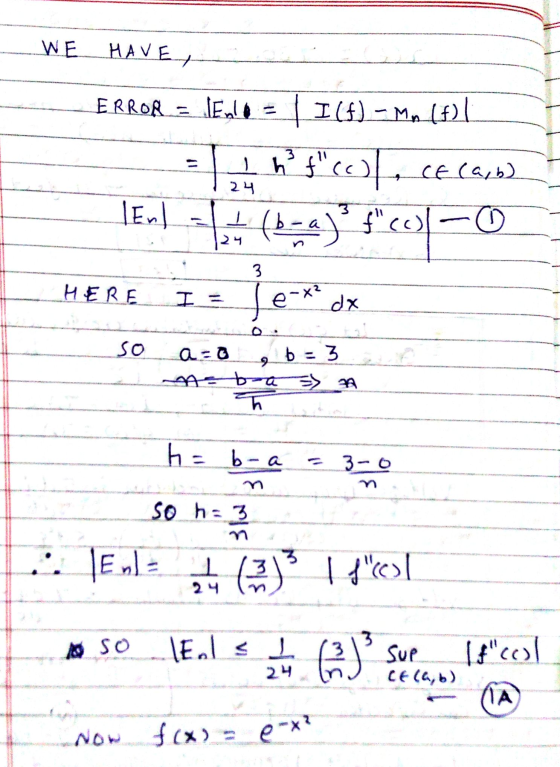
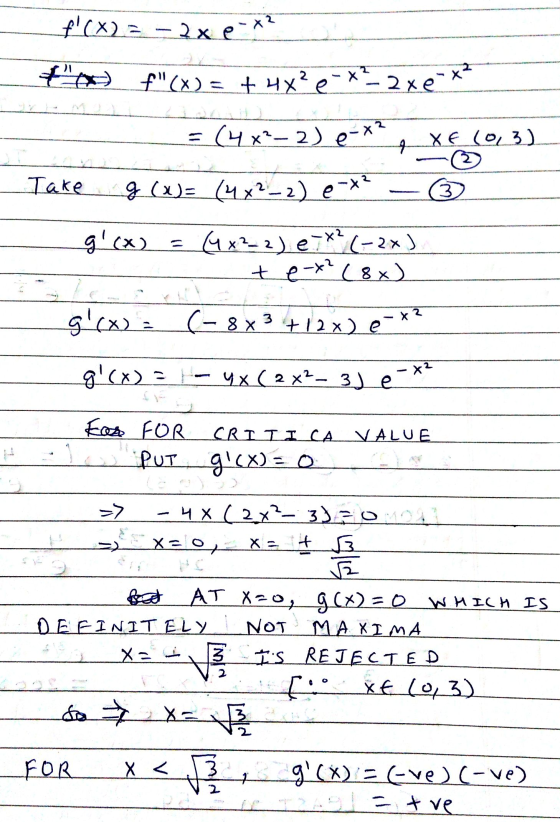
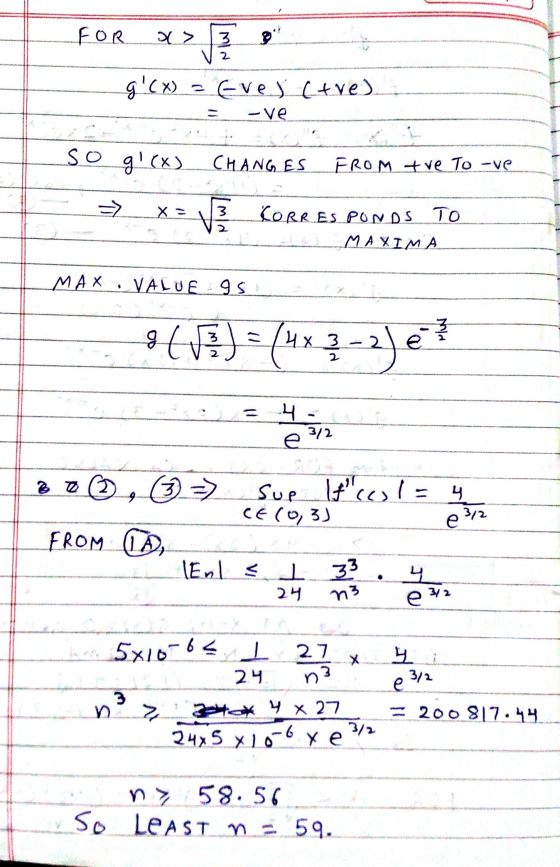
Add Answer to:
class : numerical analysis
I wish if it was written in block letter
Sorry I can't...
class: numerical analysis I wish if it was written in block letter Sorry I can't read...
 class: numerical analysis
I wish if it was written in block letter
Sorry I can't read cursive
= COS Problem 1: Recall that the Chebyshev nodes x4, x1,...,xy are determined on the interval (-1,1] as the zeros of Tn+1(x) = cos((n + 1) arccos(x)) and are given by 2j +10 Xj j = 0,1, ... 1 n+1 2 Consider now interpolating the function f(x) = 1/(1 + x2) on the interval (-5,5). We have seen in lecture that if equispaced...
class: numerical analysis
I wish if it was written in block letter
Sorry I can't read cursive
= COS Problem 1: Recall that the Chebyshev nodes x4, x1,...,xy are determined on the interval (-1,1] as the zeros of Tn+1(x) = cos((n + 1) arccos(x)) and are given by 2j +10 Xj j = 0,1, ... 1 n+1 2 Consider now interpolating the function f(x) = 1/(1 + x2) on the interval (-5,5). We have seen in lecture that if equispaced...
this is numerical analysis please do a and b 3. Consider the trapezoidal rule (T) and...
 this is numerical analysis please do a and b
3. Consider the trapezoidal rule (T) and Simpson's rule (S) for approximating the integral of a relatively smooth function f on an interval (a, b), for which the following error local estimates are known to hold: (6 - a)"}" (n), for some 7 € (a, b), 12 [ f(z)de –T(S) = [ f(a)der – 5(8) = f(), for some 5 € (a, b), where 8 = (b -a)/2. (a) Given a...
this is numerical analysis please do a and b
3. Consider the trapezoidal rule (T) and Simpson's rule (S) for approximating the integral of a relatively smooth function f on an interval (a, b), for which the following error local estimates are known to hold: (6 - a)"}" (n), for some 7 € (a, b), 12 [ f(z)de –T(S) = [ f(a)der – 5(8) = f(), for some 5 € (a, b), where 8 = (b -a)/2. (a) Given a...
121, C. Consider the integral - dr. Use the theorems from Section 4.4 to get upper...
 121, C. Consider the integral - dr. Use the theorems from Section 4.4 to get upper and lower bounds for the signed error (estimate - actual value) of these three methods, as a function of n. Note that this is a pencil-and paper calculation, and h should be eliminated in favor of n. Theorem 4.4 Let f e C4[a,b], n be even, h = (b - a)/n, and x; = a + jh, for each j = 0, 1,...,n. There...
I need proof of this numerical analysis theorem. This theorem is from Burden's Numerical analysis book....
 I need proof of this numerical analysis theorem. This theorem is
from Burden's Numerical analysis book. Please give me the detailed
solution of this theorem.
Theorem If {00, ... , ºn} is an orthogonal set of functions on an interval [a, b] with respect to the weight function w, then the least squares approximation to f on [a, b] with respect to w is 11 P(x) = a;°;(x), j=0 where, for each j = 0, 1, ... ,n, cb aj...
I need proof of this numerical analysis theorem. This theorem is
from Burden's Numerical analysis book. Please give me the detailed
solution of this theorem.
Theorem If {00, ... , ºn} is an orthogonal set of functions on an interval [a, b] with respect to the weight function w, then the least squares approximation to f on [a, b] with respect to w is 11 P(x) = a;°;(x), j=0 where, for each j = 0, 1, ... ,n, cb aj...
Please all thank you Exercise 25: Let f 0,R be defined by f(x)-1/n, m, with m,nENand n is the minimal n such that m/n a) Show that L(f, P)0 for all partitions P of [0, 1] b) Let mE N. Show that t...
 Please all thank you
Exercise 25: Let f 0,R be defined by f(x)-1/n, m, with m,nENand n is the minimal n such that m/n a) Show that L(f, P)0 for all partitions P of [0, 1] b) Let mE N. Show that the cardinality of the set A bounded by m(m1)/2. e [0, 1]: f(x) > 1/m) is c) Given m E N construct a partition P such that U(f, Pm)2/m. d) Show that f is integrable and compute Jo...
Please all thank you
Exercise 25: Let f 0,R be defined by f(x)-1/n, m, with m,nENand n is the minimal n such that m/n a) Show that L(f, P)0 for all partitions P of [0, 1] b) Let mE N. Show that the cardinality of the set A bounded by m(m1)/2. e [0, 1]: f(x) > 1/m) is c) Given m E N construct a partition P such that U(f, Pm)2/m. d) Show that f is integrable and compute Jo...
numerical methods 2+17), j = 0,1...... Problem 1: Recall that the Chebyshev nodes x0, 71,..., are...
 numerical methods
2+17), j = 0,1...... Problem 1: Recall that the Chebyshev nodes x0, 71,..., are determined on the interval (-1,1) as the zeros of Tn+1(x) = cos((n +1) arccos(x)) and are given by 2j +17 X; = cos in +12 Consider now interpolating the function f(x) = 1/(1+22) on the interval (-5,5). We have seen in lecture that if equispaced nodes are used, the error grows unbound- edly as more points are used. The purpose of this problem is...
numerical methods
2+17), j = 0,1...... Problem 1: Recall that the Chebyshev nodes x0, 71,..., are determined on the interval (-1,1) as the zeros of Tn+1(x) = cos((n +1) arccos(x)) and are given by 2j +17 X; = cos in +12 Consider now interpolating the function f(x) = 1/(1+22) on the interval (-5,5). We have seen in lecture that if equispaced nodes are used, the error grows unbound- edly as more points are used. The purpose of this problem is...
Problem 11.11 I have included a picture of the question (and the referenced problem 11.5), followed...
 Problem 11.11
I have included a picture of the question (and the referenced
problem 11.5), followed by definitions and theorems so you're able
to use this books particular language. The information I include
ranges from basic definitions to the fundamental theorems of
calculus.
Problem 11.11. Show, if f : [0,1] → R is bounded and the lower integral of f is positive, then there is an open interval on which f > 0. (Compare with problems 11.5 above and Problem...
Problem 11.11
I have included a picture of the question (and the referenced
problem 11.5), followed by definitions and theorems so you're able
to use this books particular language. The information I include
ranges from basic definitions to the fundamental theorems of
calculus.
Problem 11.11. Show, if f : [0,1] → R is bounded and the lower integral of f is positive, then there is an open interval on which f > 0. (Compare with problems 11.5 above and Problem...
Part I: Show that (y − y ∗ 0 )(y − y ∗ 1 ). ....
 Part I: Show that (y − y ∗ 0 )(y − y ∗ 1 ). . .(y − y ∗ n ) = 5
n+1 2 n Tn+1(x), where x = y/5
Part II: It can be shown that there exists R > 0 such that |f
(n) (y)| ≤ Rn for all y ∈ [−5, 5]. Assuming this, show that limn→∞
max{|f(y) − Pn(y)|, y ∈ [−5, 5]} = 0
Ij = COS Problem 1: Recall that the Chebyshev...
Part I: Show that (y − y ∗ 0 )(y − y ∗ 1 ). . .(y − y ∗ n ) = 5
n+1 2 n Tn+1(x), where x = y/5
Part II: It can be shown that there exists R > 0 such that |f
(n) (y)| ≤ Rn for all y ∈ [−5, 5]. Assuming this, show that limn→∞
max{|f(y) − Pn(y)|, y ∈ [−5, 5]} = 0
Ij = COS Problem 1: Recall that the Chebyshev...
the two codes have an error and I can’t figure out where. First one public class...
the two codes have an error and I can’t figure out where. First one public class Program { public static void main(String[] args) { int i, j = 1, k = 0; String alphabet = "abcdefghijklmnopqrstuvwxyz"; i = alphabet.length(); while (i>0){ j=(i-(i-j)); System.ou.println(alphabet.charAt(k)+" is the number "+j"letter in the alphabet"); k++; j++; i--; } } } Second one char [] alphabet = {a,b,c,d,e,f,g,h,I,j,k,l,m,n,o,p,a,r,s,t,u,v,w,x,y,z}; for (int i = 0; i < alphabet.length; i++) { System.out.println(alphabet[i] +...
QUESTION: Show= (y − y0* )(y − y1*) . .(y − yn* ) = 5 it...
 QUESTION: Show= (y − y0* )(y −
y1*) . .(y − yn* ) = 5
it is Part 1 at the bottom
We were unable to transcribe this image(7+17) Problem 1: Recall that the Chebyshev nodes x7, x1,...,x* are determined on the interval (-1,1] [-1, 1) as the zeros of Tn+1(x) = cos((n + 1) arccos(x)) and are given by 2j +12 X; - cos j = 0,1, ... n. n+1 2 Consider now interpolating the function f(x) = 1/(1+x2)...
QUESTION: Show= (y − y0* )(y −
y1*) . .(y − yn* ) = 5
it is Part 1 at the bottom
We were unable to transcribe this image(7+17) Problem 1: Recall that the Chebyshev nodes x7, x1,...,x* are determined on the interval (-1,1] [-1, 1) as the zeros of Tn+1(x) = cos((n + 1) arccos(x)) and are given by 2j +12 X; - cos j = 0,1, ... n. n+1 2 Consider now interpolating the function f(x) = 1/(1+x2)...
 class: numerical analysis
I wish if it was written in block letter
Sorry I can't read cursive
= COS Problem 1: Recall that the Chebyshev nodes x4, x1,...,xy are determined on the interval (-1,1] as the zeros of Tn+1(x) = cos((n + 1) arccos(x)) and are given by 2j +10 Xj j = 0,1, ... 1 n+1 2 Consider now interpolating the function f(x) = 1/(1 + x2) on the interval (-5,5). We have seen in lecture that if equispaced...
class: numerical analysis
I wish if it was written in block letter
Sorry I can't read cursive
= COS Problem 1: Recall that the Chebyshev nodes x4, x1,...,xy are determined on the interval (-1,1] as the zeros of Tn+1(x) = cos((n + 1) arccos(x)) and are given by 2j +10 Xj j = 0,1, ... 1 n+1 2 Consider now interpolating the function f(x) = 1/(1 + x2) on the interval (-5,5). We have seen in lecture that if equispaced...
 this is numerical analysis please do a and b
3. Consider the trapezoidal rule (T) and Simpson's rule (S) for approximating the integral of a relatively smooth function f on an interval (a, b), for which the following error local estimates are known to hold: (6 - a)"}" (n), for some 7 € (a, b), 12 [ f(z)de –T(S) = [ f(a)der – 5(8) = f(), for some 5 € (a, b), where 8 = (b -a)/2. (a) Given a...
this is numerical analysis please do a and b
3. Consider the trapezoidal rule (T) and Simpson's rule (S) for approximating the integral of a relatively smooth function f on an interval (a, b), for which the following error local estimates are known to hold: (6 - a)"}" (n), for some 7 € (a, b), 12 [ f(z)de –T(S) = [ f(a)der – 5(8) = f(), for some 5 € (a, b), where 8 = (b -a)/2. (a) Given a...
 121, C. Consider the integral - dr. Use the theorems from Section 4.4 to get upper and lower bounds for the signed error (estimate - actual value) of these three methods, as a function of n. Note that this is a pencil-and paper calculation, and h should be eliminated in favor of n. Theorem 4.4 Let f e C4[a,b], n be even, h = (b - a)/n, and x; = a + jh, for each j = 0, 1,...,n. There...
 I need proof of this numerical analysis theorem. This theorem is
from Burden's Numerical analysis book. Please give me the detailed
solution of this theorem.
Theorem If {00, ... , ºn} is an orthogonal set of functions on an interval [a, b] with respect to the weight function w, then the least squares approximation to f on [a, b] with respect to w is 11 P(x) = a;°;(x), j=0 where, for each j = 0, 1, ... ,n, cb aj...
I need proof of this numerical analysis theorem. This theorem is
from Burden's Numerical analysis book. Please give me the detailed
solution of this theorem.
Theorem If {00, ... , ºn} is an orthogonal set of functions on an interval [a, b] with respect to the weight function w, then the least squares approximation to f on [a, b] with respect to w is 11 P(x) = a;°;(x), j=0 where, for each j = 0, 1, ... ,n, cb aj...
 Please all thank you
Exercise 25: Let f 0,R be defined by f(x)-1/n, m, with m,nENand n is the minimal n such that m/n a) Show that L(f, P)0 for all partitions P of [0, 1] b) Let mE N. Show that the cardinality of the set A bounded by m(m1)/2. e [0, 1]: f(x) > 1/m) is c) Given m E N construct a partition P such that U(f, Pm)2/m. d) Show that f is integrable and compute Jo...
Please all thank you
Exercise 25: Let f 0,R be defined by f(x)-1/n, m, with m,nENand n is the minimal n such that m/n a) Show that L(f, P)0 for all partitions P of [0, 1] b) Let mE N. Show that the cardinality of the set A bounded by m(m1)/2. e [0, 1]: f(x) > 1/m) is c) Given m E N construct a partition P such that U(f, Pm)2/m. d) Show that f is integrable and compute Jo...
 numerical methods
2+17), j = 0,1...... Problem 1: Recall that the Chebyshev nodes x0, 71,..., are determined on the interval (-1,1) as the zeros of Tn+1(x) = cos((n +1) arccos(x)) and are given by 2j +17 X; = cos in +12 Consider now interpolating the function f(x) = 1/(1+22) on the interval (-5,5). We have seen in lecture that if equispaced nodes are used, the error grows unbound- edly as more points are used. The purpose of this problem is...
numerical methods
2+17), j = 0,1...... Problem 1: Recall that the Chebyshev nodes x0, 71,..., are determined on the interval (-1,1) as the zeros of Tn+1(x) = cos((n +1) arccos(x)) and are given by 2j +17 X; = cos in +12 Consider now interpolating the function f(x) = 1/(1+22) on the interval (-5,5). We have seen in lecture that if equispaced nodes are used, the error grows unbound- edly as more points are used. The purpose of this problem is...
 Problem 11.11
I have included a picture of the question (and the referenced
problem 11.5), followed by definitions and theorems so you're able
to use this books particular language. The information I include
ranges from basic definitions to the fundamental theorems of
calculus.
Problem 11.11. Show, if f : [0,1] → R is bounded and the lower integral of f is positive, then there is an open interval on which f > 0. (Compare with problems 11.5 above and Problem...
Problem 11.11
I have included a picture of the question (and the referenced
problem 11.5), followed by definitions and theorems so you're able
to use this books particular language. The information I include
ranges from basic definitions to the fundamental theorems of
calculus.
Problem 11.11. Show, if f : [0,1] → R is bounded and the lower integral of f is positive, then there is an open interval on which f > 0. (Compare with problems 11.5 above and Problem...
 Part I: Show that (y − y ∗ 0 )(y − y ∗ 1 ). . .(y − y ∗ n ) = 5
n+1 2 n Tn+1(x), where x = y/5
Part II: It can be shown that there exists R > 0 such that |f
(n) (y)| ≤ Rn for all y ∈ [−5, 5]. Assuming this, show that limn→∞
max{|f(y) − Pn(y)|, y ∈ [−5, 5]} = 0
Ij = COS Problem 1: Recall that the Chebyshev...
Part I: Show that (y − y ∗ 0 )(y − y ∗ 1 ). . .(y − y ∗ n ) = 5
n+1 2 n Tn+1(x), where x = y/5
Part II: It can be shown that there exists R > 0 such that |f
(n) (y)| ≤ Rn for all y ∈ [−5, 5]. Assuming this, show that limn→∞
max{|f(y) − Pn(y)|, y ∈ [−5, 5]} = 0
Ij = COS Problem 1: Recall that the Chebyshev...
 QUESTION: Show= (y − y0* )(y −
y1*) . .(y − yn* ) = 5
it is Part 1 at the bottom
We were unable to transcribe this image(7+17) Problem 1: Recall that the Chebyshev nodes x7, x1,...,x* are determined on the interval (-1,1] [-1, 1) as the zeros of Tn+1(x) = cos((n + 1) arccos(x)) and are given by 2j +12 X; - cos j = 0,1, ... n. n+1 2 Consider now interpolating the function f(x) = 1/(1+x2)...
QUESTION: Show= (y − y0* )(y −
y1*) . .(y − yn* ) = 5
it is Part 1 at the bottom
We were unable to transcribe this image(7+17) Problem 1: Recall that the Chebyshev nodes x7, x1,...,x* are determined on the interval (-1,1] [-1, 1) as the zeros of Tn+1(x) = cos((n + 1) arccos(x)) and are given by 2j +12 X; - cos j = 0,1, ... n. n+1 2 Consider now interpolating the function f(x) = 1/(1+x2)...
Most questions answered within 3 hours.
-
Where is the error in this code sequence?
String s1 = "Hello";
String s2 = "ello";...
asked 10 months ago -
Financial data for Joel de Paris, Inc., for last year
follow:
Joel de Paris, Inc.
Balance...
asked 10 months ago -
Consider this reaction:
Al2(SO4)3 (aq)+ BaCl3
(aq) Al2Cl6 (aq)- +
3BaSO4(s) . What is the...
asked 10 months ago -
Suppose that Savneet is considering increasing her
recent random sample from 20 car rentals to 40...
asked 10 months ago -
Trucks arrive at an unloading terminal at an average rate of 120
per hour.
Trucks arrive...
asked 10 months ago -
Why are methanol and ethanol completely soluble in water while
octanol is not very little soluble....
asked 10 months ago -
A facilities manager at a university reads in a research report
that the mean amount of...
asked 10 months ago -
When the CuSO4 is rehydrated by adding water to the anhydrous
compound, is this an endothermic...
asked 10 months ago -
A ray of sunlight is passing from diamond into crown glass; the
angle of incidence is...
asked 10 months ago -
A block of mass 0.249 kg is placed on top of a light, vertical
spring of...
asked 10 months ago -
how do the kidneys compensate in the presences of acidosis
a) trigger hyperventilate
b) reserve acid...
asked 10 months ago -
Question 501 pts
The rental rate of capital to the firm increases. Which of the
following...
asked 10 months ago