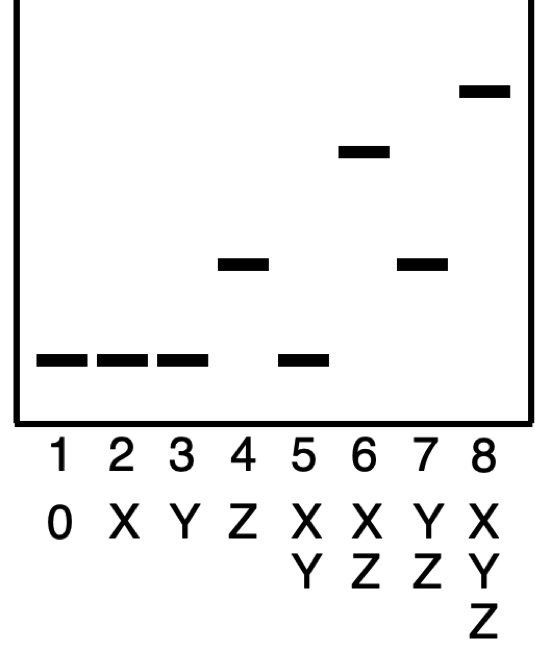
12. You have cloned an origin of replication and are interested in identifying the proteins that bring about initiation of replication. You find that proteins in a cell extract bind to your origin. You fractionate the extract and identify three fractions, X, Y and Z, that you believe contain proteins that directly or indirectly bind to your origin. You carry out an EMSA experiment and obtain the data shown in the figure below.
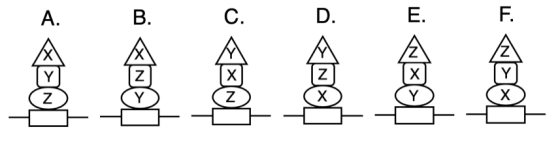
Which of the following (A-F) is order of binding of your fractions to the origin?
Homework Answers
Ans: EMSA(Electrophoretic Mobile Shift Assay) technique is based on the observation that protein–DNA complexes migrate more slowly than free linear DNA fragments when subjected to non-denaturing polyacrylamide or agarose gel electrophoresis.
Now as given in the gel run that in the presence of none of the protein or in the presence of X protein or Y protein or x and y protein together the band is forming at the same position (at the farthest position) which means that neither X nor Y protein is directly binding with fraction of origin. So this means that Z is directly binding with the fraction of origin and we can see thta in the gel run that in 4th column the fraction has travelled less as compared to the 0th, 1st, 2nd, 3rd and 5th column.
Now among 6th and 7th column the band in 6th column with X and Z protein has travelled less as compared to the 7th column with X and Z protein which means that Z has more affinity for X protein than for Y protein.
So this means that the order of binding of the proteins to the fraction of origin is : Z directly binds to the fraction and X binds with Z protein and lastly Y binds to the X protein.
Hence option C is correct.
Add Answer to:
12. You have cloned an origin of replication and are interested
in identifying the proteins that...
You have identified a gene that produces a small RNA. You find that it is transcribed...
 You have identified a gene that produces a small RNA. You find
that it is transcribed by RNA polymerase III. Because it enodes an
RNA that is not related to tRNAs or the 5S ribosomal RNA you wonder
if the same factors are required for transcription of your gene.
You find that TFIIIB, TFIIIC and RNAPIII are not sufficient to
transcribe your gene in vitro. You decide to try to purify
the factors that are needed for transcription of your...
You have identified a gene that produces a small RNA. You find
that it is transcribed by RNA polymerase III. Because it enodes an
RNA that is not related to tRNAs or the 5S ribosomal RNA you wonder
if the same factors are required for transcription of your gene.
You find that TFIIIB, TFIIIC and RNAPIII are not sufficient to
transcribe your gene in vitro. You decide to try to purify
the factors that are needed for transcription of your...
16. You have cloned a centromere from yeast. You have also identified three genes, X, Y...
 16. You have cloned a centromere from yeast. You have also
identified three genes, X, Y and Z that code for proteins that are
a subset of the kinetochore proteins that are bound to the
centromere. None of your three genes is essential but each does
contribute to the overall efficiency of chromosomal segregation.
You raise antibodies to each of your three proteins. You also
contstruct four strains, a wild-type strain, a strain in which gene
X is deleted (XD),...
16. You have cloned a centromere from yeast. You have also
identified three genes, X, Y and Z that code for proteins that are
a subset of the kinetochore proteins that are bound to the
centromere. None of your three genes is essential but each does
contribute to the overall efficiency of chromosomal segregation.
You raise antibodies to each of your three proteins. You also
contstruct four strains, a wild-type strain, a strain in which gene
X is deleted (XD),...
You are interested in finding out what genes are expressed in your heart cells vs your...
 You are interested in finding out what genes are expressed in your heart cells vs your skin cells. You can't compare the · You could use an enzyme called since it is identical in all of your cells. to create from both sets of cells, and compare the sequences you get Hint: if you are looking for a word bank for parts X and Y, refer to learning objectives. QUESTION 5 Your friend wants to know what recombinant therapeutic protein...
 You have identified a gene that produces a small RNA. You find
that it is transcribed by RNA polymerase III. Because it enodes an
RNA that is not related to tRNAs or the 5S ribosomal RNA you wonder
if the same factors are required for transcription of your gene.
You find that TFIIIB, TFIIIC and RNAPIII are not sufficient to
transcribe your gene in vitro. You decide to try to purify
the factors that are needed for transcription of your...
You have identified a gene that produces a small RNA. You find
that it is transcribed by RNA polymerase III. Because it enodes an
RNA that is not related to tRNAs or the 5S ribosomal RNA you wonder
if the same factors are required for transcription of your gene.
You find that TFIIIB, TFIIIC and RNAPIII are not sufficient to
transcribe your gene in vitro. You decide to try to purify
the factors that are needed for transcription of your...
 16. You have cloned a centromere from yeast. You have also
identified three genes, X, Y and Z that code for proteins that are
a subset of the kinetochore proteins that are bound to the
centromere. None of your three genes is essential but each does
contribute to the overall efficiency of chromosomal segregation.
You raise antibodies to each of your three proteins. You also
contstruct four strains, a wild-type strain, a strain in which gene
X is deleted (XD),...
16. You have cloned a centromere from yeast. You have also
identified three genes, X, Y and Z that code for proteins that are
a subset of the kinetochore proteins that are bound to the
centromere. None of your three genes is essential but each does
contribute to the overall efficiency of chromosomal segregation.
You raise antibodies to each of your three proteins. You also
contstruct four strains, a wild-type strain, a strain in which gene
X is deleted (XD),...
 You are interested in finding out what genes are expressed in your heart cells vs your skin cells. You can't compare the · You could use an enzyme called since it is identical in all of your cells. to create from both sets of cells, and compare the sequences you get Hint: if you are looking for a word bank for parts X and Y, refer to learning objectives. QUESTION 5 Your friend wants to know what recombinant therapeutic protein...
Most questions answered within 3 hours.
-
Where is the error in this code sequence?
String s1 = "Hello";
String s2 = "ello";...
asked 11 months ago -
Financial data for Joel de Paris, Inc., for last year
follow:
Joel de Paris, Inc.
Balance...
asked 11 months ago -
Consider this reaction:
Al2(SO4)3 (aq)+ BaCl3
(aq) Al2Cl6 (aq)- +
3BaSO4(s) . What is the...
asked 11 months ago -
Suppose that Savneet is considering increasing her
recent random sample from 20 car rentals to 40...
asked 11 months ago -
Trucks arrive at an unloading terminal at an average rate of 120
per hour.
Trucks arrive...
asked 11 months ago -
Why are methanol and ethanol completely soluble in water while
octanol is not very little soluble....
asked 11 months ago -
A facilities manager at a university reads in a research report
that the mean amount of...
asked 11 months ago -
When the CuSO4 is rehydrated by adding water to the anhydrous
compound, is this an endothermic...
asked 11 months ago -
A ray of sunlight is passing from diamond into crown glass; the
angle of incidence is...
asked 11 months ago -
A block of mass 0.249 kg is placed on top of a light, vertical
spring of...
asked 11 months ago -
how do the kidneys compensate in the presences of acidosis
a) trigger hyperventilate
b) reserve acid...
asked 11 months ago -
Question 501 pts
The rental rate of capital to the firm increases. Which of the
following...
asked 11 months ago