
Homework Answers
![time period, T- 2 oto . for on oscillation m given to 16.998 Tz t 70 16.99 10 1.6998 2) T= 20 ens] 1.0 1.699 = 21 ܩܘ 4112 N 3](http://img.homeworklib.com/questions/99755500-eef8-11ea-b04b-595714ac6a08.png?x-oss-process=image/resize,w_560)
Any queries please comment
Rate it up
Thanks
Add Answer to:
Step 13: Let's find out the gravity on an unknown planet. Go back to the simulation,...
LUITIUS UGUNLU LIL VALIUTIU IUIL WIIUI IL SLLL LUU, LEICEL IS VII USCITILIUIT. HUN LIV LP...
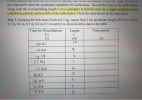 LUITIUS UGUNLU LIL VALIUTIU IUIL WIIUI IL SLLL LUU, LEICEL IS VII USCITILIUIT. HUN LIV LP VULLULL VI the stopwatch when the pendulum completes 10 oscillations. Record this time in the table below along with the corresponding length. Use a calculator to find the time for a single oscillation (also called time period), and record it in the table below. Click the reset button on the stopwatch. Step 3: Keeping the bob mass fixed at 0.1 kg, repeat Step 2...
A.The earth's acceleration due to gravity varies from 9.780 m/s2 at the equator to 9.832 m/s2...
A.The earth's acceleration due to gravity varies from 9.780 m/s2 at the equator to 9.832 m/s2 at the poles. A pendulum whose length is precisely 1.000 m can be used to measure g. Such a device is called a gravimeter. a. How long do 100 oscillations take at the equator? b.How long do 100 oscillations take at the north pole? B) An infant's toy has a 120 g wooden animal hanging from a spring. If pulled down gently, the animal...
yBLEMS FOR TOPIC 3 ASSIGNMENT QUESTIONS AND PROBLEMS FOR TOPIC 3.1 A student was supplied with a stop watch, two metre rules and a simole pendulum suspended from a ceiling and was asked to measure...
 yBLEMS FOR TOPIC 3 ASSIGNMENT QUESTIONS AND PROBLEMS FOR TOPIC 3.1 A student was supplied with a stop watch, two metre rules and a simole pendulum suspended from a ceiling and was asked to measure the heihple the ceiling indirectly. He set the pendulum swinging through a small angle and measured the period of oscillation for different lengths of the Since he was unable to measure the length of the pendulum direer measured the height of the centre of the...
once I find out per day 90/60*24*60, how do you get period. fully explain each step...
 once I find out per day 90/60*24*60, how do you get
period. fully explain each step and why please. know answer need to
know why
PHY 162 NOT Problems 453 r 7. A clock is constructed so that it keeps perfect time when its simple pendulum has a period of 1.000 s at locations where g = 9.800 m/s. The pendulum bob has length L 0.2482 m, and instead of keeping perfect time, the clock runs slow by 1.500 minutes...
once I find out per day 90/60*24*60, how do you get
period. fully explain each step and why please. know answer need to
know why
PHY 162 NOT Problems 453 r 7. A clock is constructed so that it keeps perfect time when its simple pendulum has a period of 1.000 s at locations where g = 9.800 m/s. The pendulum bob has length L 0.2482 m, and instead of keeping perfect time, the clock runs slow by 1.500 minutes...
ASSIGNMENT QUESTIONS AND PRORLEMS FOR TOPIC 3 ASSIGNMENT QUESTIONS AND PROBLEMS FOR TOPIC 3 3.1A student...
 ASSIGNMENT QUESTIONS AND PRORLEMS FOR TOPIC 3 ASSIGNMENT QUESTIONS AND PROBLEMS FOR TOPIC 3 3.1A student was supplied with a stop watch, two metre rules and a simple pendulum suspended from a ceiling and was asked to measure the height of the ceiling indirectly, He set the pendulum swinging through a small angle and measured the period of oscillation for different lengths of the pendulum. Since he was unabie to measure the length of the pendulum directly, he measured the...
i would like help to write a program to run the following application in visual studio C++, CLR empty project Borough of Manhatan Community College The City University of New York SCIENCE DEPA...
 i would like help to write a program to run the following
application in visual studio C++, CLR empty project
Borough of Manhatan Community College The City University of New York SCIENCE DEPARTMENT Laboratory Experiment ACCELERATION DUE TO GRAVITY USING A SIMPLE PENDULUM To calculate the value of the acceleration due to gravity by measuring the period of a pendulum with four different lengths. Apparatus Drilled steel ball, string, clamp, support to hold pendulum apparatus, meter stick, and timer Theory:...
i would like help to write a program to run the following
application in visual studio C++, CLR empty project
Borough of Manhatan Community College The City University of New York SCIENCE DEPARTMENT Laboratory Experiment ACCELERATION DUE TO GRAVITY USING A SIMPLE PENDULUM To calculate the value of the acceleration due to gravity by measuring the period of a pendulum with four different lengths. Apparatus Drilled steel ball, string, clamp, support to hold pendulum apparatus, meter stick, and timer Theory:...
Start the Sound (uses Java) simulation (opens in a new window). Select the Measure" tab at...
 Start the Sound (uses Java) simulation (opens in a new window). Select the Measure" tab at the top left corner of your simulation window. Set the frequency to 200 Hz (once you click on the frequency button you can use the left and right arrow keys on your keyboard to decrease/increase the frequency to the desired value). Also set the amplitude to maximum. The waves are very now well defined. Pause the simulation. There are two blue lines that you...
Write a simulation of zombies/walkers that move randomly in one dimension. Each walker begins at the...
 Write a simulation of zombies/walkers that move randomly in one dimension. Each walker begins at the origin and at each time-step it takes a step to the right or left with equal probability, so that Pright= 0.5, Pleft= 0.5. Use a lattice of spacing x =1 and discrete time-steps, t= 1. Number of steps in each walk: 20 Number of walkers: 10.000 Please make your own algorithm for this simulation. Note: You will need to use a random number generator....
6. An astronaut ona distant planet wants to determine its acceleration due to gravity. The astronaut...
 6. An astronaut ona distant planet wants to determine its acceleration due to gravity. The astronaut throws a rock straight up with a velocity of +15 m/s and measures a time of 20.0 s before the rock returns to his hand. What is the acceleration (magnitude and direction) due to gravity on this planet? See Diagram below: 20.0s v,15 m/s Show your work below: 7. Problem using vectors: A sailboat sails for 1 hr at 4 km/hr (relative to the...
 LUITIUS UGUNLU LIL VALIUTIU IUIL WIIUI IL SLLL LUU, LEICEL IS VII USCITILIUIT. HUN LIV LP VULLULL VI the stopwatch when the pendulum completes 10 oscillations. Record this time in the table below along with the corresponding length. Use a calculator to find the time for a single oscillation (also called time period), and record it in the table below. Click the reset button on the stopwatch. Step 3: Keeping the bob mass fixed at 0.1 kg, repeat Step 2...
 yBLEMS FOR TOPIC 3 ASSIGNMENT QUESTIONS AND PROBLEMS FOR TOPIC 3.1 A student was supplied with a stop watch, two metre rules and a simole pendulum suspended from a ceiling and was asked to measure the heihple the ceiling indirectly. He set the pendulum swinging through a small angle and measured the period of oscillation for different lengths of the Since he was unable to measure the length of the pendulum direer measured the height of the centre of the...
 once I find out per day 90/60*24*60, how do you get
period. fully explain each step and why please. know answer need to
know why
PHY 162 NOT Problems 453 r 7. A clock is constructed so that it keeps perfect time when its simple pendulum has a period of 1.000 s at locations where g = 9.800 m/s. The pendulum bob has length L 0.2482 m, and instead of keeping perfect time, the clock runs slow by 1.500 minutes...
once I find out per day 90/60*24*60, how do you get
period. fully explain each step and why please. know answer need to
know why
PHY 162 NOT Problems 453 r 7. A clock is constructed so that it keeps perfect time when its simple pendulum has a period of 1.000 s at locations where g = 9.800 m/s. The pendulum bob has length L 0.2482 m, and instead of keeping perfect time, the clock runs slow by 1.500 minutes...
 ASSIGNMENT QUESTIONS AND PRORLEMS FOR TOPIC 3 ASSIGNMENT QUESTIONS AND PROBLEMS FOR TOPIC 3 3.1A student was supplied with a stop watch, two metre rules and a simple pendulum suspended from a ceiling and was asked to measure the height of the ceiling indirectly, He set the pendulum swinging through a small angle and measured the period of oscillation for different lengths of the pendulum. Since he was unabie to measure the length of the pendulum directly, he measured the...
 i would like help to write a program to run the following
application in visual studio C++, CLR empty project
Borough of Manhatan Community College The City University of New York SCIENCE DEPARTMENT Laboratory Experiment ACCELERATION DUE TO GRAVITY USING A SIMPLE PENDULUM To calculate the value of the acceleration due to gravity by measuring the period of a pendulum with four different lengths. Apparatus Drilled steel ball, string, clamp, support to hold pendulum apparatus, meter stick, and timer Theory:...
i would like help to write a program to run the following
application in visual studio C++, CLR empty project
Borough of Manhatan Community College The City University of New York SCIENCE DEPARTMENT Laboratory Experiment ACCELERATION DUE TO GRAVITY USING A SIMPLE PENDULUM To calculate the value of the acceleration due to gravity by measuring the period of a pendulum with four different lengths. Apparatus Drilled steel ball, string, clamp, support to hold pendulum apparatus, meter stick, and timer Theory:...
 Start the Sound (uses Java) simulation (opens in a new window). Select the Measure" tab at the top left corner of your simulation window. Set the frequency to 200 Hz (once you click on the frequency button you can use the left and right arrow keys on your keyboard to decrease/increase the frequency to the desired value). Also set the amplitude to maximum. The waves are very now well defined. Pause the simulation. There are two blue lines that you...
 Write a simulation of zombies/walkers that move randomly in one dimension. Each walker begins at the origin and at each time-step it takes a step to the right or left with equal probability, so that Pright= 0.5, Pleft= 0.5. Use a lattice of spacing x =1 and discrete time-steps, t= 1. Number of steps in each walk: 20 Number of walkers: 10.000 Please make your own algorithm for this simulation. Note: You will need to use a random number generator....
 6. An astronaut ona distant planet wants to determine its acceleration due to gravity. The astronaut throws a rock straight up with a velocity of +15 m/s and measures a time of 20.0 s before the rock returns to his hand. What is the acceleration (magnitude and direction) due to gravity on this planet? See Diagram below: 20.0s v,15 m/s Show your work below: 7. Problem using vectors: A sailboat sails for 1 hr at 4 km/hr (relative to the...
Most questions answered within 3 hours.
-
Where is the error in this code sequence?
String s1 = "Hello";
String s2 = "ello";...
asked 10 months ago -
Financial data for Joel de Paris, Inc., for last year
follow:
Joel de Paris, Inc.
Balance...
asked 10 months ago -
Consider this reaction:
Al2(SO4)3 (aq)+ BaCl3
(aq) Al2Cl6 (aq)- +
3BaSO4(s) . What is the...
asked 10 months ago -
Suppose that Savneet is considering increasing her
recent random sample from 20 car rentals to 40...
asked 10 months ago -
Trucks arrive at an unloading terminal at an average rate of 120
per hour.
Trucks arrive...
asked 10 months ago -
Why are methanol and ethanol completely soluble in water while
octanol is not very little soluble....
asked 10 months ago -
A facilities manager at a university reads in a research report
that the mean amount of...
asked 10 months ago -
When the CuSO4 is rehydrated by adding water to the anhydrous
compound, is this an endothermic...
asked 10 months ago -
A ray of sunlight is passing from diamond into crown glass; the
angle of incidence is...
asked 10 months ago -
A block of mass 0.249 kg is placed on top of a light, vertical
spring of...
asked 10 months ago -
how do the kidneys compensate in the presences of acidosis
a) trigger hyperventilate
b) reserve acid...
asked 10 months ago -
Question 501 pts
The rental rate of capital to the firm increases. Which of the
following...
asked 10 months ago