
Homework Answers
Add Answer to:
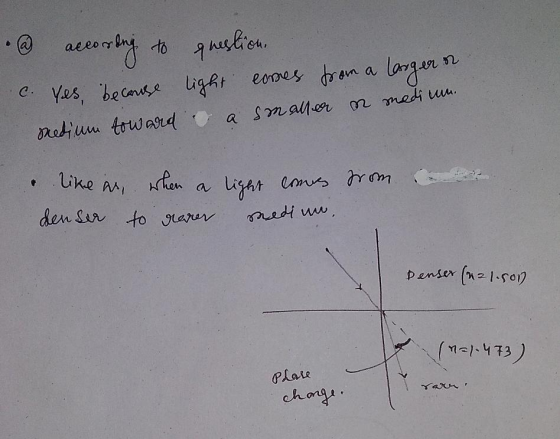
Air n = 1.00 Benzene n = 1.501 Glycerin n=1.473 A thin layer of Benzene (n...
part d and e i want a further explanation (33 Question 19 1 A very thin...
 part d and e i want a further explanation
(33 Question 19 1 A very thin film of transparent oil of refractive index_1.40 floats on a smooth hody of water of refractive index 1.33. Above the oil is air, Green light of wavelength 520 nm (in air) is incident normally on to the oil from above." green light, A=520 nm air oil, = 1.40 water, n 1.33 Do light waves reflected at the top of the oil suffer a phase...
part d and e i want a further explanation
(33 Question 19 1 A very thin film of transparent oil of refractive index_1.40 floats on a smooth hody of water of refractive index 1.33. Above the oil is air, Green light of wavelength 520 nm (in air) is incident normally on to the oil from above." green light, A=520 nm air oil, = 1.40 water, n 1.33 Do light waves reflected at the top of the oil suffer a phase...
3) (6 pts) White light in air (n = 1) is incident normally on a thin...
 3) (6 pts) White light in air (n = 1) is incident normally on a thin layer of an unknown liquid (n = 1.65) on glass (n = 1.5). Light of wavelength 1 = 450nm (in air) is missing from the reflected light. Yes / No Is there a phase change due to reflection at the air/liquid interface? Yes / No Is there a n phase change due to reflection at the liquid/glass interface? mdfilm ' (m+3) arum What would...
3) (6 pts) White light in air (n = 1) is incident normally on a thin...
 3) (6 pts) White light in air (n = 1) is incident normally on a thin layer of an unknown liquid (n = 1.65) on glass (n = 1.5). Light of wavelength 1 = 450nm (in air) is missing from the reflected light. Yes / No Is there a phase change due to reflection at the air/liquid interface? Yes / No Is there a n phase change due to reflection at the liquid/glass interface? +) Afilm What would the path...
2. Use Snell's law (n, sin = n, sine,) to explain why , is greater than...
 2. Use Snell's law (n, sin = n, sine,) to explain why , is greater than 0 in Fig. 2. Total Internal Reflection When light passes from a medium of large refractive index into one of small refractive index --- for example, from water to air --- the refracted ray bends away from the surface normal, as shown in Fig. 2. As the angle of incidence increases, the angle of refraction also increases. When the angle of incidence reaches a...
Question 6: What percentage error would result from miscounting the bars by one? EXPERIMENT 10 THIN...
 Question 6:
What percentage error would result from miscounting
the bars by one?
EXPERIMENT 10 THIN FILM INTERFERENCE Light from a monochromatic source is shined downward on two glass plates that are separated at one end by a hair. Light that is reflected from the top and bottom surfaces of the wedge-shaped thin film of air undergoes interference, and a series of dark and light lines are seen. By counting the number of dark or light lines over a known...
Question 6:
What percentage error would result from miscounting
the bars by one?
EXPERIMENT 10 THIN FILM INTERFERENCE Light from a monochromatic source is shined downward on two glass plates that are separated at one end by a hair. Light that is reflected from the top and bottom surfaces of the wedge-shaped thin film of air undergoes interference, and a series of dark and light lines are seen. By counting the number of dark or light lines over a known...
QUESTION If the water is replaced by a transparent fluid with a higher index of refraction,...
 QUESTION If the water is replaced by a transparent fluid with a higher index of refraction, the critical angle of the fluid- air boundary is: O smaller. o the same as for water. o larger PRACTICE IT Use the worked example above to help you solve this problem. (a) Find the critical angle for a water-air boundary if the index of refraction of water is 1.33. (b) Use the result of part (a) to predict what a fish will see...
3. In Fig. 2, if we increase the index n, but keepn, <n,, should the value...
 3. In Fig. 2, if we increase the index n, but keepn, <n,, should the value of increase or decrease? Give your reasoning. Total Internal Reflection When light passes from a medium of large refractive index into one of small refractive index --- for example, from water to air --- the refracted ray bends away from the surface normal, as shown in Fig. 2. As the angle of incidence increases, the angle of refraction also increases. When the angle of...
A light ray in air (n= 1) is incident on a thin film of oil (noil...
 A light ray in air (n= 1) is incident on a thin film of oil (noil = 1.60) floating on top of water (nwater = 1.33), as shown below. The wavelength of the incident light in air is Aair = 640 nm. The oil layer has a thickness t = 0.5 um. The ray is assumed to be incident practically along the normal. That is, we won't be worried about angles of reflection or refraction when doing this problem. However,...
Question 5: How would dust and oil on the glass plates affect the results? EXPERIMENT 10 THIN FILM I...
 Question 5:
How would dust and oil on the glass plates affect the
results?
EXPERIMENT 10 THIN FILM INTERFERENCE Light from a monochromatic source is shined downward on two glass plates that are separated at one end by a hair. Light that is reflected from the top and bottom surfaces of the wedge-shaped thin film of air undergoes interference, and a series of dark and light lines are seen. By counting the number of dark or light lines over a...
Question 5:
How would dust and oil on the glass plates affect the
results?
EXPERIMENT 10 THIN FILM INTERFERENCE Light from a monochromatic source is shined downward on two glass plates that are separated at one end by a hair. Light that is reflected from the top and bottom surfaces of the wedge-shaped thin film of air undergoes interference, and a series of dark and light lines are seen. By counting the number of dark or light lines over a...
(a) Briefly explain what is meant by the following terms: refraction, refractive index, angle of incidence,...
 (a) Briefly explain what is meant by the following terms: refraction, refractive index, angle of incidence, angle of refraction. [4 marks] (b) The drawing shows four different situations in which a light ray is traveling from one medium into another. In some of the cases, the refraction is not shown correctly. For cases (i), (ii), and (iii), the angle of incidence is 55°; for case (iv), the angle of incidence is 0°. Identify which cases are incorrectly drawn and determine...
 part d and e i want a further explanation
(33 Question 19 1 A very thin film of transparent oil of refractive index_1.40 floats on a smooth hody of water of refractive index 1.33. Above the oil is air, Green light of wavelength 520 nm (in air) is incident normally on to the oil from above." green light, A=520 nm air oil, = 1.40 water, n 1.33 Do light waves reflected at the top of the oil suffer a phase...
part d and e i want a further explanation
(33 Question 19 1 A very thin film of transparent oil of refractive index_1.40 floats on a smooth hody of water of refractive index 1.33. Above the oil is air, Green light of wavelength 520 nm (in air) is incident normally on to the oil from above." green light, A=520 nm air oil, = 1.40 water, n 1.33 Do light waves reflected at the top of the oil suffer a phase...
 3) (6 pts) White light in air (n = 1) is incident normally on a thin layer of an unknown liquid (n = 1.65) on glass (n = 1.5). Light of wavelength 1 = 450nm (in air) is missing from the reflected light. Yes / No Is there a phase change due to reflection at the air/liquid interface? Yes / No Is there a n phase change due to reflection at the liquid/glass interface? mdfilm ' (m+3) arum What would...
 3) (6 pts) White light in air (n = 1) is incident normally on a thin layer of an unknown liquid (n = 1.65) on glass (n = 1.5). Light of wavelength 1 = 450nm (in air) is missing from the reflected light. Yes / No Is there a phase change due to reflection at the air/liquid interface? Yes / No Is there a n phase change due to reflection at the liquid/glass interface? +) Afilm What would the path...
 2. Use Snell's law (n, sin = n, sine,) to explain why , is greater than 0 in Fig. 2. Total Internal Reflection When light passes from a medium of large refractive index into one of small refractive index --- for example, from water to air --- the refracted ray bends away from the surface normal, as shown in Fig. 2. As the angle of incidence increases, the angle of refraction also increases. When the angle of incidence reaches a...
 Question 6:
What percentage error would result from miscounting
the bars by one?
EXPERIMENT 10 THIN FILM INTERFERENCE Light from a monochromatic source is shined downward on two glass plates that are separated at one end by a hair. Light that is reflected from the top and bottom surfaces of the wedge-shaped thin film of air undergoes interference, and a series of dark and light lines are seen. By counting the number of dark or light lines over a known...
Question 6:
What percentage error would result from miscounting
the bars by one?
EXPERIMENT 10 THIN FILM INTERFERENCE Light from a monochromatic source is shined downward on two glass plates that are separated at one end by a hair. Light that is reflected from the top and bottom surfaces of the wedge-shaped thin film of air undergoes interference, and a series of dark and light lines are seen. By counting the number of dark or light lines over a known...
 QUESTION If the water is replaced by a transparent fluid with a higher index of refraction, the critical angle of the fluid- air boundary is: O smaller. o the same as for water. o larger PRACTICE IT Use the worked example above to help you solve this problem. (a) Find the critical angle for a water-air boundary if the index of refraction of water is 1.33. (b) Use the result of part (a) to predict what a fish will see...
 3. In Fig. 2, if we increase the index n, but keepn, <n,, should the value of increase or decrease? Give your reasoning. Total Internal Reflection When light passes from a medium of large refractive index into one of small refractive index --- for example, from water to air --- the refracted ray bends away from the surface normal, as shown in Fig. 2. As the angle of incidence increases, the angle of refraction also increases. When the angle of...
 A light ray in air (n= 1) is incident on a thin film of oil (noil = 1.60) floating on top of water (nwater = 1.33), as shown below. The wavelength of the incident light in air is Aair = 640 nm. The oil layer has a thickness t = 0.5 um. The ray is assumed to be incident practically along the normal. That is, we won't be worried about angles of reflection or refraction when doing this problem. However,...
 Question 5:
How would dust and oil on the glass plates affect the
results?
EXPERIMENT 10 THIN FILM INTERFERENCE Light from a monochromatic source is shined downward on two glass plates that are separated at one end by a hair. Light that is reflected from the top and bottom surfaces of the wedge-shaped thin film of air undergoes interference, and a series of dark and light lines are seen. By counting the number of dark or light lines over a...
Question 5:
How would dust and oil on the glass plates affect the
results?
EXPERIMENT 10 THIN FILM INTERFERENCE Light from a monochromatic source is shined downward on two glass plates that are separated at one end by a hair. Light that is reflected from the top and bottom surfaces of the wedge-shaped thin film of air undergoes interference, and a series of dark and light lines are seen. By counting the number of dark or light lines over a...
 (a) Briefly explain what is meant by the following terms: refraction, refractive index, angle of incidence, angle of refraction. [4 marks] (b) The drawing shows four different situations in which a light ray is traveling from one medium into another. In some of the cases, the refraction is not shown correctly. For cases (i), (ii), and (iii), the angle of incidence is 55°; for case (iv), the angle of incidence is 0°. Identify which cases are incorrectly drawn and determine...
Most questions answered within 3 hours.
-
Where is the error in this code sequence?
String s1 = "Hello";
String s2 = "ello";...
asked 11 months ago -
Financial data for Joel de Paris, Inc., for last year
follow:
Joel de Paris, Inc.
Balance...
asked 11 months ago -
Consider this reaction:
Al2(SO4)3 (aq)+ BaCl3
(aq) Al2Cl6 (aq)- +
3BaSO4(s) . What is the...
asked 11 months ago -
Suppose that Savneet is considering increasing her
recent random sample from 20 car rentals to 40...
asked 11 months ago -
Trucks arrive at an unloading terminal at an average rate of 120
per hour.
Trucks arrive...
asked 11 months ago -
Why are methanol and ethanol completely soluble in water while
octanol is not very little soluble....
asked 11 months ago -
A facilities manager at a university reads in a research report
that the mean amount of...
asked 11 months ago -
When the CuSO4 is rehydrated by adding water to the anhydrous
compound, is this an endothermic...
asked 11 months ago -
A ray of sunlight is passing from diamond into crown glass; the
angle of incidence is...
asked 11 months ago -
A block of mass 0.249 kg is placed on top of a light, vertical
spring of...
asked 11 months ago -
how do the kidneys compensate in the presences of acidosis
a) trigger hyperventilate
b) reserve acid...
asked 11 months ago -
Question 501 pts
The rental rate of capital to the firm increases. Which of the
following...
asked 11 months ago