
Homework Answers


1. A proton has a speed of 1.5 x 10 m/s at a point where the...
 1. A proton has a speed of 1.5 x 10 m/s at a point where the electrical potential is 1000 V. It moves through a point where the electric potential is 900 V. What is its speed at this second point? (e = 1.60 x 10⁻¹⁹, mproton = 1.67 * 10-27 kg) 3.55 x 10 m/s 0.53 * 10 m/s 2.04 * 1010 m/s 2.04 x 10 m/s 04.16 1010 m/s
1. A proton has a speed of 1.5 x 10 m/s at a point where the...
 1. A proton has a speed of 1.5 x 10 m/s at a point where the electrical potential is 1000 V. It moves through a point where the electric potential is 900 V. What is its speed at this second point? (e = 1.60 x 10⁻¹⁹ C, Mproton = 1.67 * 10-27 kg)
A proton is moving at 105 m/s at a point where the potential is 10 V....
A proton is moving at 105 m/s at a point where the potential is 10 V. Later, it is at a place where the potential is 5 V. What is its speed there, assuming energy is conserved? 105 m/s Its speed will depend on how it got to the new place. Less than 105 m/s More than 105 m/s
PROBLEM (a) Find the speed of the proton at x 0.0500 m if s released from...
 PROBLEM (a) Find the speed of the proton at x 0.0500 m if s released from rest at x -2.00 cm in a constant electric field with magnitude 1.50 x 10³ N/C, pointing in the positive direction. (b) Find the initial speed of an electron fired from x 2.00 cm given that its speed has fallen by half when it reaches x 0.120 m STRATEGY Apply conservation of energy, solving for the unknown speeds. Part (b) involves two equations: the...
A proton is moving at a speed of 1.5 x 10^5 m/s when it travels through...
A proton is moving at a speed of 1.5 x 10^5 m/s when it travels through a potential difference and accelerates uniformly to a speed of 4.5 x 10^6 m/s. What was the value of the potential difference through which the proton traveled. If the distance the proton traveled was 50 cm, what was the magnitude of the electric field?
A proton of mass m = 1.67 x 10⁻²⁷ kg and charge q = 1.60 x 10⁻¹⁹ C is accelerated from rest through a potential difference of 4000 V. What final velocity does it achieve? A proton of mass...
 A proton of mass m = 1.67 x 10⁻²⁷ kg and charge q = 1.60 x 10⁻¹⁹ C is accelerated from rest through a potential difference of 4000 V. What final velocity does it achieve?
A proton of mass m = 1.67 x 10⁻²⁷ kg and charge q = 1.60 x 10⁻¹⁹ C is accelerated from rest through a potential difference of 4000 V. What final velocity does it achieve?
A proton of mass m = 1.67 x 10⁻²⁷ kg and charge q = 1.60 x 10⁻¹⁹ C is accelerated from rest through a potential difference of 4000 V. What final velocity does it achieve?
An alpha particle is a nucleus of helium. It has twice the charge and four times...
An alpha particle is a nucleus of helium. It has twice the charge and four times the mass of the proton. When they were very far away from each other, but headed toward directly each other, a proton and an alpha particle each had an initial speed of 0.002c, where c is the speed of light. What is their distance of closest approach? Hint: There are two conserved quantities. Make use of both of them. (c = 3.00 × 10⁸...
55. A proton moving at 3.0 x 10t m/s is projected at an angle of 30°...
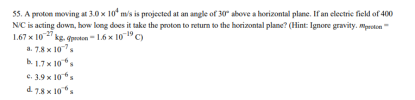 55. A proton moving at 3.0 x 10t m/s is projected at an angle of 30° above a horizontal plane. If an electric field of 400 NiC is acting down, how long does it take the proton to return to the horizontal plane? (Hint: Ignore gravity. mproton 1.67 x 1027 kg, gproton 1.6x 10¹⁹ c) a. 7.8 x 10⁻⁷ s b. 1.7x 10 6s c.3.9x10 6s d. 7.8 x 10° s
A proton moves with a speed of 8.0 × 10⁶ m/s at an angle of 30°...
A proton moves with a speed of 8.0 × 10⁶ m/s at an angle of 30° to a magnetic field of 2T, shown in the figure in question 1, (the charge of a proton = 1.60 × 10⁻¹⁹ C). Calculate the magnitude of the magnetic force on the proton.
m. What is its speed (in m/s)? (a) A moving proton has a wavelength of 5.26...
 m. What is its speed (in m/s)? (a) A moving proton has a wavelength of 5.26 x 10 m/s (b) A proton moves with a speed of 2.50 x 10 m/s. What is its wavelength (in m)? m Need Help? Read it
 1. A proton has a speed of 1.5 x 10 m/s at a point where the electrical potential is 1000 V. It moves through a point where the electric potential is 900 V. What is its speed at this second point? (e = 1.60 x 10⁻¹⁹, mproton = 1.67 * 10-27 kg) 3.55 x 10 m/s 0.53 * 10 m/s 2.04 * 1010 m/s 2.04 x 10 m/s 04.16 1010 m/s
 1. A proton has a speed of 1.5 x 10 m/s at a point where the electrical potential is 1000 V. It moves through a point where the electric potential is 900 V. What is its speed at this second point? (e = 1.60 x 10⁻¹⁹ C, Mproton = 1.67 * 10-27 kg)
 PROBLEM (a) Find the speed of the proton at x 0.0500 m if s released from rest at x -2.00 cm in a constant electric field with magnitude 1.50 x 10³ N/C, pointing in the positive direction. (b) Find the initial speed of an electron fired from x 2.00 cm given that its speed has fallen by half when it reaches x 0.120 m STRATEGY Apply conservation of energy, solving for the unknown speeds. Part (b) involves two equations: the...
 A proton of mass m = 1.67 x 10⁻²⁷ kg and charge q = 1.60 x 10⁻¹⁹ C is accelerated from rest through a potential difference of 4000 V. What final velocity does it achieve?
A proton of mass m = 1.67 x 10⁻²⁷ kg and charge q = 1.60 x 10⁻¹⁹ C is accelerated from rest through a potential difference of 4000 V. What final velocity does it achieve?
A proton of mass m = 1.67 x 10⁻²⁷ kg and charge q = 1.60 x 10⁻¹⁹ C is accelerated from rest through a potential difference of 4000 V. What final velocity does it achieve?
 55. A proton moving at 3.0 x 10t m/s is projected at an angle of 30° above a horizontal plane. If an electric field of 400 NiC is acting down, how long does it take the proton to return to the horizontal plane? (Hint: Ignore gravity. mproton 1.67 x 1027 kg, gproton 1.6x 10¹⁹ c) a. 7.8 x 10⁻⁷ s b. 1.7x 10 6s c.3.9x10 6s d. 7.8 x 10° s
 m. What is its speed (in m/s)? (a) A moving proton has a wavelength of 5.26 x 10 m/s (b) A proton moves with a speed of 2.50 x 10 m/s. What is its wavelength (in m)? m Need Help? Read it
Most questions answered within 3 hours.
-
Where is the error in this code sequence?
String s1 = "Hello";
String s2 = "ello";...
asked 11 months ago -
Financial data for Joel de Paris, Inc., for last year
follow:
Joel de Paris, Inc.
Balance...
asked 11 months ago -
Consider this reaction:
Al2(SO4)3 (aq)+ BaCl3
(aq) Al2Cl6 (aq)- +
3BaSO4(s) . What is the...
asked 11 months ago -
Suppose that Savneet is considering increasing her
recent random sample from 20 car rentals to 40...
asked 11 months ago -
Trucks arrive at an unloading terminal at an average rate of 120
per hour.
Trucks arrive...
asked 11 months ago -
Why are methanol and ethanol completely soluble in water while
octanol is not very little soluble....
asked 11 months ago -
A facilities manager at a university reads in a research report
that the mean amount of...
asked 11 months ago -
When the CuSO4 is rehydrated by adding water to the anhydrous
compound, is this an endothermic...
asked 11 months ago -
A ray of sunlight is passing from diamond into crown glass; the
angle of incidence is...
asked 11 months ago -
A block of mass 0.249 kg is placed on top of a light, vertical
spring of...
asked 11 months ago -
how do the kidneys compensate in the presences of acidosis
a) trigger hyperventilate
b) reserve acid...
asked 11 months ago -
Question 501 pts
The rental rate of capital to the firm increases. Which of the
following...
asked 11 months ago