
Homework Answers
![ابن As Bar starts to move towards right there a change in flud which Cames Current to flow. FR = è lB. iz olde]/R Boda Body B](http://img.homeworklib.com/questions/460d5930-f2f3-11ea-853d-476975e5f44e.png?x-oss-process=image/resize,w_560)
Add Answer to:
w 2. The conducting bar illustrated in the figure moves on two frictionless, parallel rails in...
5. The conducting bar illustrated in the figure moves on two frictionless, parallel rails in the...
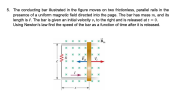 5. The conducting bar illustrated in the figure moves on two frictionless, parallel rails in the presence of a uniform magnetic field directed into the page. The bar has mass m, and its length is t. The bar is given an initial velocity vi to the right and is released at t = 0. Using Newton's law find the speed of the bar as a function of time after it is released. X X X * Bin x x X...
Using Newton’s law find the speed of the bar as a function of time after it...
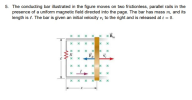 Using Newton’s law find the speed of the bar as a function of
time after it is released
5. The conducting bar illustrated in the figure moves on two frictionless, parallel rails in the presence of a uniform magnetic field directed into the page. The bar has mass m, and its length is 4. The bar is given an initial velocity vi to the right and is released at t = 0. x x x x X X X X...
Using Newton’s law find the speed of the bar as a function of
time after it is released
5. The conducting bar illustrated in the figure moves on two frictionless, parallel rails in the presence of a uniform magnetic field directed into the page. The bar has mass m, and its length is 4. The bar is given an initial velocity vi to the right and is released at t = 0. x x x x X X X X...
A conducting rod of length script i moves on two horizontal frictionless rails, as in the...
A conducting rod of length script i moves on two horizontal frictionless rails, as in the figure below. A constant force of magnitude 3.00 N moves the bar at a uniform speed of 9.00 m/s through a magnetic field vector B that is directed into the page.
A conducting bar of length ! moves to the right on two frictionless rails as shown...
 A conducting bar of length ! moves to the right on two frictionless rails as shown in the figure below. A uniform magnetic field directed into the page has a magnitude of 0.290 T. Assume R = 9.10 and l = 0.330 m. X X X X X X X X * * *A* X * * * * * * * X X * * x * * * * * * * X X * * x *...
A conducting bar moves along frictionless conducting rails connected to a 4.00 omega resistor. The length...
 A conducting bar moves along frictionless conducting rails
connected to a 4.00 omega resistor. The length of the bar is 1.60m
and a uniform magnetic field of 2.20T is applied perpendicular to
the paper pointing outward as shown
a) What is the applied force required to move the bar to the
right with a constant speed of 6.00 m/s?
b) At what rate is energy dissipated in the 4.00 ohm
resistor?
A conducting bar moves along frictionless conducting rails connected...
A conducting bar moves along frictionless conducting rails
connected to a 4.00 omega resistor. The length of the bar is 1.60m
and a uniform magnetic field of 2.20T is applied perpendicular to
the paper pointing outward as shown
a) What is the applied force required to move the bar to the
right with a constant speed of 6.00 m/s?
b) At what rate is energy dissipated in the 4.00 ohm
resistor?
A conducting bar moves along frictionless conducting rails connected...
A conducting bar of length f moves to the right on two frictionless rails as shown...
 A conducting bar of length f moves to the right on two frictionless rails as shown in the figure below. A uniform magnetic field directed into the page has a magnitude of 0.290 T. Assume R-9.10 Ω and 1 0.320 m. (a) At what constant speed should the bar move to produce an 8.60-mA current in the resistor? 83m/s (b) What is the direction of the induced current? clockwise counterclockwise O into the page O out of the page (c)...
A pair of conducting, parallel, frictionless rails is mounted on an insulating platform. The distance between...
 A pair of conducting, parallel, frictionless rails is mounted on an insulating platform. The distance between the rails is L = 0.20 m. The rails are connected on one end by a R = 10.12 resistor. A conducting bar of mass 1.2 kg can slide on the rails without friction. When the conducting bar is at x = 0, the enclosed area of the loop is 0.03 m2. There is zero resistance in the conducting bar or rails. A uniform...
In the figure below, a metal bar sitting on two parallel conducting rails, connected to each other by a resistor, is pulled to the right at a constant speed.
 A vertical bar and two parallel horizontal rails lie in the
plane of the page. The parallel rails run from left to right, with
one a distance ℓ above the other. The left ends of the rails are
connected by a vertical wire containing a resistor R. The
vertical bar lies across the rails to the right of the wire. Force
vector Fapp points from the bar toward
the right.In the figure below, a metal bar sitting on two parallel...
A vertical bar and two parallel horizontal rails lie in the
plane of the page. The parallel rails run from left to right, with
one a distance ℓ above the other. The left ends of the rails are
connected by a vertical wire containing a resistor R. The
vertical bar lies across the rails to the right of the wire. Force
vector Fapp points from the bar toward
the right.In the figure below, a metal bar sitting on two parallel...
13. A conducting bar moves along frictionless conducting rails connected to a 4.00-0 resistor as shown...
 13. A conducting bar moves along frictionless conducting rails connected to a 4.00-0 resistor as shown in the figure. The length of the bar is 1.60 m and a uniform magnetic field of 2.20 T is applied perpendicular to the paper pointing outward, as shown. (8 points) (a) If the bar is moving to the right at a constant speed of 6.0 m/s, what is the direction of the current and the power dissipated by the resistor? (b) What is...
The figure below shows a top view of a bar that can slide on two frictionless...
The figure below shows a top view of a bar that can slide on two frictionless rails. The resistor is R = 5.00 Ω, and a 2.50-T magnetic field is directed perpendicularly downward, into the page. Let ℓ = 1.20 m. A vertical bar and two parallel horizontal rails lie in the plane of the page, in a region of uniform magnetic field, vector Bin, pointing into the page. The parallel rails run from left to right, with one a...
 5. The conducting bar illustrated in the figure moves on two frictionless, parallel rails in the presence of a uniform magnetic field directed into the page. The bar has mass m, and its length is t. The bar is given an initial velocity vi to the right and is released at t = 0. Using Newton's law find the speed of the bar as a function of time after it is released. X X X * Bin x x X...
 Using Newton’s law find the speed of the bar as a function of
time after it is released
5. The conducting bar illustrated in the figure moves on two frictionless, parallel rails in the presence of a uniform magnetic field directed into the page. The bar has mass m, and its length is 4. The bar is given an initial velocity vi to the right and is released at t = 0. x x x x X X X X...
Using Newton’s law find the speed of the bar as a function of
time after it is released
5. The conducting bar illustrated in the figure moves on two frictionless, parallel rails in the presence of a uniform magnetic field directed into the page. The bar has mass m, and its length is 4. The bar is given an initial velocity vi to the right and is released at t = 0. x x x x X X X X...
 A conducting bar of length ! moves to the right on two frictionless rails as shown in the figure below. A uniform magnetic field directed into the page has a magnitude of 0.290 T. Assume R = 9.10 and l = 0.330 m. X X X X X X X X * * *A* X * * * * * * * X X * * x * * * * * * * X X * * x *...
 A conducting bar moves along frictionless conducting rails
connected to a 4.00 omega resistor. The length of the bar is 1.60m
and a uniform magnetic field of 2.20T is applied perpendicular to
the paper pointing outward as shown
a) What is the applied force required to move the bar to the
right with a constant speed of 6.00 m/s?
b) At what rate is energy dissipated in the 4.00 ohm
resistor?
A conducting bar moves along frictionless conducting rails connected...
A conducting bar moves along frictionless conducting rails
connected to a 4.00 omega resistor. The length of the bar is 1.60m
and a uniform magnetic field of 2.20T is applied perpendicular to
the paper pointing outward as shown
a) What is the applied force required to move the bar to the
right with a constant speed of 6.00 m/s?
b) At what rate is energy dissipated in the 4.00 ohm
resistor?
A conducting bar moves along frictionless conducting rails connected...
 A conducting bar of length f moves to the right on two frictionless rails as shown in the figure below. A uniform magnetic field directed into the page has a magnitude of 0.290 T. Assume R-9.10 Ω and 1 0.320 m. (a) At what constant speed should the bar move to produce an 8.60-mA current in the resistor? 83m/s (b) What is the direction of the induced current? clockwise counterclockwise O into the page O out of the page (c)...
 A pair of conducting, parallel, frictionless rails is mounted on an insulating platform. The distance between the rails is L = 0.20 m. The rails are connected on one end by a R = 10.12 resistor. A conducting bar of mass 1.2 kg can slide on the rails without friction. When the conducting bar is at x = 0, the enclosed area of the loop is 0.03 m2. There is zero resistance in the conducting bar or rails. A uniform...
 A vertical bar and two parallel horizontal rails lie in the
plane of the page. The parallel rails run from left to right, with
one a distance ℓ above the other. The left ends of the rails are
connected by a vertical wire containing a resistor R. The
vertical bar lies across the rails to the right of the wire. Force
vector Fapp points from the bar toward
the right.In the figure below, a metal bar sitting on two parallel...
A vertical bar and two parallel horizontal rails lie in the
plane of the page. The parallel rails run from left to right, with
one a distance ℓ above the other. The left ends of the rails are
connected by a vertical wire containing a resistor R. The
vertical bar lies across the rails to the right of the wire. Force
vector Fapp points from the bar toward
the right.In the figure below, a metal bar sitting on two parallel...
 13. A conducting bar moves along frictionless conducting rails connected to a 4.00-0 resistor as shown in the figure. The length of the bar is 1.60 m and a uniform magnetic field of 2.20 T is applied perpendicular to the paper pointing outward, as shown. (8 points) (a) If the bar is moving to the right at a constant speed of 6.0 m/s, what is the direction of the current and the power dissipated by the resistor? (b) What is...
Most questions answered within 3 hours.
-
Where is the error in this code sequence?
String s1 = "Hello";
String s2 = "ello";...
asked 11 months ago -
Financial data for Joel de Paris, Inc., for last year
follow:
Joel de Paris, Inc.
Balance...
asked 11 months ago -
Consider this reaction:
Al2(SO4)3 (aq)+ BaCl3
(aq) Al2Cl6 (aq)- +
3BaSO4(s) . What is the...
asked 11 months ago -
Suppose that Savneet is considering increasing her
recent random sample from 20 car rentals to 40...
asked 11 months ago -
Trucks arrive at an unloading terminal at an average rate of 120
per hour.
Trucks arrive...
asked 11 months ago -
Why are methanol and ethanol completely soluble in water while
octanol is not very little soluble....
asked 11 months ago -
A facilities manager at a university reads in a research report
that the mean amount of...
asked 11 months ago -
When the CuSO4 is rehydrated by adding water to the anhydrous
compound, is this an endothermic...
asked 11 months ago -
A ray of sunlight is passing from diamond into crown glass; the
angle of incidence is...
asked 11 months ago -
A block of mass 0.249 kg is placed on top of a light, vertical
spring of...
asked 11 months ago -
how do the kidneys compensate in the presences of acidosis
a) trigger hyperventilate
b) reserve acid...
asked 11 months ago -
Question 501 pts
The rental rate of capital to the firm increases. Which of the
following...
asked 11 months ago