
Homework Answers
Add Answer to:
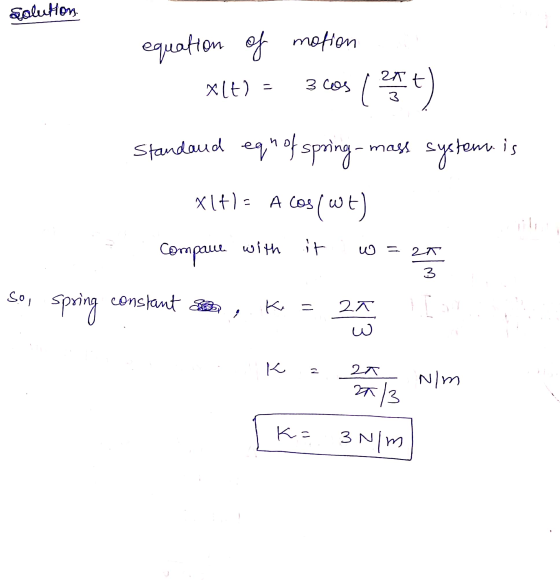
2. The equation of motion for a mass of 100g in a mass-spring system is 27t....
1. Give two examples whose motion is described by simple harmonic motion. (Besides mass-spring system) 2....
 1. Give two examples whose motion is described by simple harmonic motion. (Besides mass-spring system) 2. The equation of motion for a mass of 100g in a mass-spring system is 2nt x(t) = 3Cos(f 3 Find the value of spring constant k.
A system of mass(m=100g) and spring(k=100N/m)on a horizontal surface . The mass displaced 5 cm from...
A system of mass(m=100g) and spring(k=100N/m)on a horizontal surface . The mass displaced 5 cm from its equilibrium position and released. Find: (1) Angular frequency and frequency of motion? (2) Maximum velocity and maximum acceleration of vibrations ? (3) The total energy of the system? (4) Wright down the equation of motion?
Part 2: (Theory) Simple Harmonie Motion in a Mass-Spring System Sketch a simple horizontal, mass-spring system...
 Part 2: (Theory) Simple Harmonie Motion in a Mass-Spring System Sketch a simple horizontal, mass-spring system with the mass displaced slightly from its equilibrium position (x=0). Draw the forces acting on the mass (you should have three; neglect friction). Now imagine that the system is released from rest. According to Newton's Second Law, F=ma, the equation of motion for the mass can be written as: (1) m dr 1. By direct substitution, show explicitly that x(t) - Acos(wt + )...
Suppose that the mass in a mass-spring-dashpot system with mass m = 81, damping constant C=...
 Suppose that the mass in a mass-spring-dashpot system with mass m = 81, damping constant C= 108, and spring constant k = 232 is set in motion with c(0) = 23 and z'(0) = 38. (a) Find the position function X(t) in the form x(t) = cos (b) Find the psuedoperiod of the oscillations and the equations of the "envelope curves" shown in the figure below, which graphs the motion of the mass in the system described above. Psuedoperiod of...
1 point) Math 216 Homework webHW6, Problem 3 Suppose that the mass in a mass-spring-dashpot system...
 1 point) Math 216 Homework webHW6, Problem 3 Suppose that the mass in a mass-spring-dashpot system with mass m = 49, damping constant c = 1 12, and spring constant k 185 is set in motion with x(0) 18 and x' (0) 43. (a) Find the position function x(t) in the form x(t) (b) Find the psuedoperiod of the oscillations and the equations of the "envelope curves" shown in the figure below, which graphs the cos( motion of the mass...
The motion of a mass-spring system with damping is governed by y''(t) + 8y' (t) +...
 The motion of a mass-spring system with damping is governed by y''(t) + 8y' (t) + ky(t) = 0; y(0) = 4, and y'(0) = 0. Find the equation of motion and sketch its graph for k= 13, 16, and 19. What is the equation of motion for k= 13? y(t) = 1 (Type an exact answer, using radicals as needed.)
1. A 1 kg mass is attached to a spring of spring constant k = 4kg/82, The spring-mass system is a...
 Differntial Equations Forced Spring Motion
1. A 1 kg mass is attached to a spring of spring constant k = 4kg/82, The spring-mass system is attached to a machine that supplies an external driving force of f(t) = 4 cos(wt). The systern is started from equilibrium i.e. 2(0) = 0 and z'(0) = 0. There is no damping. (a) Find the position x(t) of the mass as a function of time (b) write your answer in the form r(t)-1 sin(6t)...
Differntial Equations Forced Spring Motion
1. A 1 kg mass is attached to a spring of spring constant k = 4kg/82, The spring-mass system is attached to a machine that supplies an external driving force of f(t) = 4 cos(wt). The systern is started from equilibrium i.e. 2(0) = 0 and z'(0) = 0. There is no damping. (a) Find the position x(t) of the mass as a function of time (b) write your answer in the form r(t)-1 sin(6t)...
During simple harmonic motion, the position, x, in meters, of the mass in a spring-mass system,...
 During simple harmonic motion, the position, x, in meters, of the mass in a spring-mass system, changes according to the equation: x = (0.25) cos (0.523 t). a) Find the period. T_s of this motion. b) Calculate the time when the position of the mass is +0.2 m from equilibrium.
A 3.50 kg mass is attached to a spring and set into motion horizontally along a...
A 3.50 kg mass is attached to a spring and set into motion horizontally along a frictionless track. At time t = 0.00 s, the mass passes through the equilibrium position (x = 0.00 m) moving to the left. At time t = 0.85 s, the mass reaches the left endpoint (x = - 0.16 m). a) Write an equation to describe the motion of the mass throughout time. [4] b) Find the spring constant, k. [2] c) Find the...
1. Find the equation of motion of a mass-spring system with damping governed by y"(t) +...
 1. Find the equation of motion of a mass-spring system with damping governed by y"(t) + y(t) = 5 cost; y(0) = 0; y'(0) = 1.
 1. Give two examples whose motion is described by simple harmonic motion. (Besides mass-spring system) 2. The equation of motion for a mass of 100g in a mass-spring system is 2nt x(t) = 3Cos(f 3 Find the value of spring constant k.
 Part 2: (Theory) Simple Harmonie Motion in a Mass-Spring System Sketch a simple horizontal, mass-spring system with the mass displaced slightly from its equilibrium position (x=0). Draw the forces acting on the mass (you should have three; neglect friction). Now imagine that the system is released from rest. According to Newton's Second Law, F=ma, the equation of motion for the mass can be written as: (1) m dr 1. By direct substitution, show explicitly that x(t) - Acos(wt + )...
 Suppose that the mass in a mass-spring-dashpot system with mass m = 81, damping constant C= 108, and spring constant k = 232 is set in motion with c(0) = 23 and z'(0) = 38. (a) Find the position function X(t) in the form x(t) = cos (b) Find the psuedoperiod of the oscillations and the equations of the "envelope curves" shown in the figure below, which graphs the motion of the mass in the system described above. Psuedoperiod of...
 1 point) Math 216 Homework webHW6, Problem 3 Suppose that the mass in a mass-spring-dashpot system with mass m = 49, damping constant c = 1 12, and spring constant k 185 is set in motion with x(0) 18 and x' (0) 43. (a) Find the position function x(t) in the form x(t) (b) Find the psuedoperiod of the oscillations and the equations of the "envelope curves" shown in the figure below, which graphs the cos( motion of the mass...
 The motion of a mass-spring system with damping is governed by y''(t) + 8y' (t) + ky(t) = 0; y(0) = 4, and y'(0) = 0. Find the equation of motion and sketch its graph for k= 13, 16, and 19. What is the equation of motion for k= 13? y(t) = 1 (Type an exact answer, using radicals as needed.)
 Differntial Equations Forced Spring Motion
1. A 1 kg mass is attached to a spring of spring constant k = 4kg/82, The spring-mass system is attached to a machine that supplies an external driving force of f(t) = 4 cos(wt). The systern is started from equilibrium i.e. 2(0) = 0 and z'(0) = 0. There is no damping. (a) Find the position x(t) of the mass as a function of time (b) write your answer in the form r(t)-1 sin(6t)...
Differntial Equations Forced Spring Motion
1. A 1 kg mass is attached to a spring of spring constant k = 4kg/82, The spring-mass system is attached to a machine that supplies an external driving force of f(t) = 4 cos(wt). The systern is started from equilibrium i.e. 2(0) = 0 and z'(0) = 0. There is no damping. (a) Find the position x(t) of the mass as a function of time (b) write your answer in the form r(t)-1 sin(6t)...
 During simple harmonic motion, the position, x, in meters, of the mass in a spring-mass system, changes according to the equation: x = (0.25) cos (0.523 t). a) Find the period. T_s of this motion. b) Calculate the time when the position of the mass is +0.2 m from equilibrium.
 1. Find the equation of motion of a mass-spring system with damping governed by y"(t) + y(t) = 5 cost; y(0) = 0; y'(0) = 1.
Most questions answered within 3 hours.
-
Where is the error in this code sequence?
String s1 = "Hello";
String s2 = "ello";...
asked 11 months ago -
Financial data for Joel de Paris, Inc., for last year
follow:
Joel de Paris, Inc.
Balance...
asked 11 months ago -
Consider this reaction:
Al2(SO4)3 (aq)+ BaCl3
(aq) Al2Cl6 (aq)- +
3BaSO4(s) . What is the...
asked 11 months ago -
Suppose that Savneet is considering increasing her
recent random sample from 20 car rentals to 40...
asked 11 months ago -
Trucks arrive at an unloading terminal at an average rate of 120
per hour.
Trucks arrive...
asked 11 months ago -
Why are methanol and ethanol completely soluble in water while
octanol is not very little soluble....
asked 11 months ago -
A facilities manager at a university reads in a research report
that the mean amount of...
asked 11 months ago -
When the CuSO4 is rehydrated by adding water to the anhydrous
compound, is this an endothermic...
asked 11 months ago -
A ray of sunlight is passing from diamond into crown glass; the
angle of incidence is...
asked 11 months ago -
A block of mass 0.249 kg is placed on top of a light, vertical
spring of...
asked 11 months ago -
how do the kidneys compensate in the presences of acidosis
a) trigger hyperventilate
b) reserve acid...
asked 11 months ago -
Question 501 pts
The rental rate of capital to the firm increases. Which of the
following...
asked 11 months ago